
Digital Marketing for Freelancers: A Practical Playbook
Digital marketing for freelancers made practical. Learn positioning, channels, pricing, GEO tactics for AI search, and a 30-day plan to win qualified clients.
Stop treating daily posting as the entry fee for freelancing. You don't need to become a content creator, maintain every social account, or buy ads before you've worked out what makes your service worth choosing. You need a clear offer, somewhere credible to send buyers, and a way to distinguish attention from actual business.
My recommendation for digital marketing for freelancers is simple: prioritise positioning, build assets you control, concentrate your distribution, and make your expertise easy to discover through both conventional search and AI-generated answers. Marketing should support your client work, not become another full-time job.
Why Most Freelance Marketing Advice Falls Short
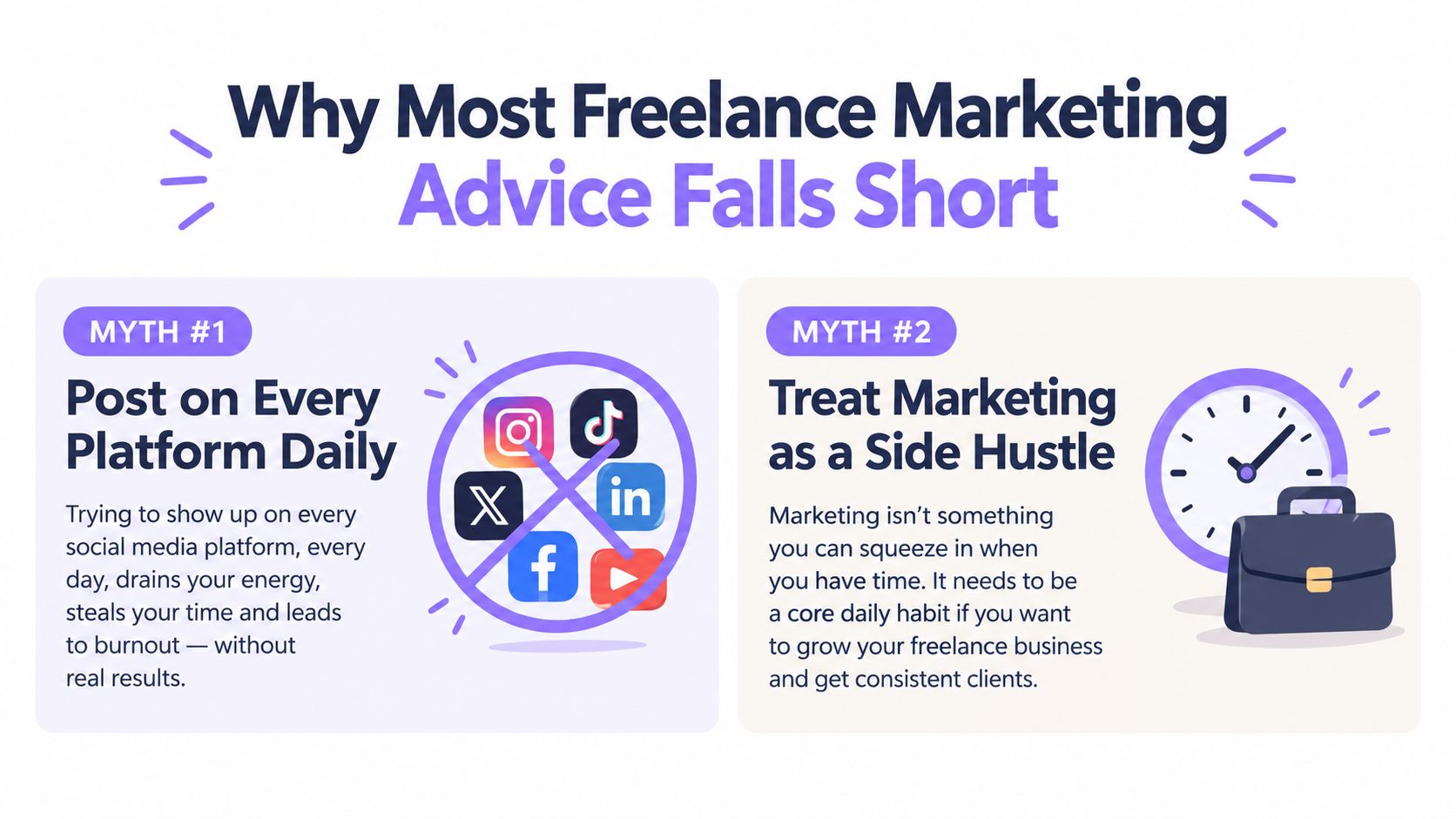
The weakest advice confuses activity with acquisition. Posting every day might suit someone selling sponsorships or audience access. It isn't automatically the right approach for a consultant, designer, therapist, or tradesperson selling a specific service.
The other mistake is treating marketing as an occasional creative exercise. A fresh logo, an energetic announcement, and a collection of disconnected posts don't constitute a customer acquisition system. Buyers need a coherent route from discovering your expertise to checking your suitability and making an enquiry.
What the French evidence actually supports
France Num's benchmark provides useful context: 85% of French businesses used an online-visibility solution, 65% had a website, and 65% had a social-media account; 56% reported that at least 5% of customers came from the internet, rising to 61% among businesses without employees, according to the France Num 2024 digital adoption benchmark.
Those findings support taking online acquisition seriously. They don't establish that posting constantly causes sales, or that every freelancer needs the same channel mix.
The distinction between useful marketing and unnecessary activity is worth keeping visible.
Build a funnel rather than a posting streak
Start with a website you control and a professional profile carrying the same offer. Your profile is rented distribution, not owned infrastructure, so keep your portfolio, contact records, and essential service information elsewhere too.
Give each asset a clear role:
- Discovery: Help the right buyer recognise that your service addresses their problem.
- Evaluation: Show relevant work, scope, location, and evidence.
- Action: Offer an obvious next step, such as requesting a project assessment.
- Measurement: Record the enquiry source and eventual commercial outcome.
Practical rule: If a marketing task has no plausible route to a qualified conversation, question why you're doing it.
You can maintain a regular marketing habit without publishing daily. Replying to a referral, improving a service page, and recording an enquiry are marketing work too. Don't let the public visibility of posting obscure the quieter tasks that help buyers make decisions.
Position Yourself So the Right People Find You
“I build websites” describes a capability. “I build booking-ready websites for independent therapists in Paris” describes a buyer, a problem, and a relevant deliverable. The second is the stronger headline because a suitable prospect can recognise themselves without interpreting what you mean.
That doesn't mean you must reject every project outside your niche. Positioning is a decision about what you lead with, not a lifetime restriction on whom you're allowed to serve.
Choose a problem you can credibly own
Start with the work you understand, not the niche someone else says is fashionable. Look for buyers whose requirements you can describe accurately and whose projects you can deliver reliably.
Use this worksheet:
- Buyer: Which type of client understands the value of your work?
- Problem: What specific difficulty brings them looking for help?
- Deliverable: What will you produce or change?
- Context: Does location, language, sector, or business stage affect the service?
- Boundary: What result can you support without promising something outside your control?
Complete the sentence: I help [buyer] address [problem] through [deliverable], with [relevant distinction].
A freelance copywriter might replace “Words that work” with “Service-page copy for French consultancies selling complex expertise”. A photographer might replace “Capturing your story” with “Property photography for estate agents in Lyon”. These are illustrative headlines, not claims about proven campaign results.
Avoid adding a delivery deadline merely to sound decisive. Promise speed only when your process, capacity, and client dependencies justify it.
Make your proof match your promise
Collect a relevant work sample, an explanation of your decisions, and genuine client feedback where you have permission to publish it. A beautiful portfolio isn't enough if it leaves the buyer guessing about your contribution.
Describe the initial problem, what you delivered, and what the client can verify. If you don't have measured results, show the work and explain the reasoning instead of inventing a performance story.
For help translating that positioning into useful editorial material, consult Humantext.pro's content marketing best practices 2026. Use it as a planning resource, while keeping your own buyers' questions at the centre of the brief.
Before launching a campaign, check whether your headline, sample, and contact invitation describe the same service. If they don't, fix that mismatch before increasing distribution.
Pick Two Acquisition Channels and Go Deep
Choose a primary acquisition route and a complementary one. My default recommendation is referrals plus searchable service content for relationship-led specialists, or LinkedIn plus searchable service content for freelancers selling to business decision-makers.
This isn't a universal ranking. The right choice depends on where your buyer looks when they need help, not where you enjoy publishing.
Acquisition Channels Scored for Freelancers
The assessments below are planning judgements, not measured market averages. Costs depend on your existing assets, subscription choices, and whether you outsource implementation.
| Channel | Monthly Cost | Time per Week | Lead Intent |
|---|---|---|---|
| Referral partnerships | Low cash outlay | Relationship maintenance and follow-up | Potentially strong when the introduction is relevant |
| Searchable service website | Hosting and maintenance costs vary | Upfront work, then periodic improvements | Strong when visitors search for the exact service |
| Optional subscription costs | Sustained participation and selective outreach | Mixed, stronger around explicit business needs | |
| Local or industry directory | Free or paid listing, depending on provider | Light upkeep after setup | Potentially strong in a relevant category |
| AI-search discovery through GEO | Tool and implementation costs vary | Content maintenance and monitoring | Depends on the query and accuracy of the recommendation |
A website is both an asset and a destination. Search, referrals, directories, and social platforms are routes that can bring people to it. Don't count building a homepage as distribution and then wonder why nobody arrives.
Match the channel to the buying situation
For a local service provider, I'd prioritise searchable service information and a relevant local directory. State your service area precisely, explain the work you accept, and make contacting you straightforward.
For a B2B consultant, I'd favour referrals and LinkedIn when you already know the professional community you serve. Participate where buyers discuss actual operational problems, rather than filling your feed with broad motivational advice.
For a creative specialist, portfolio-led discovery and partnerships with complementary providers are sensible starting points. A developer can introduce a copywriter; a photographer can introduce a designer. Make the relationship useful rather than transactional.
Recent evidence also challenges the assumption that constant social publishing is standard practice: 46% of French businesses using social networks used them at least weekly, representing 30% of all businesses, and the weekly-use share had fallen by 6 percentage points over three years, according to the France Num 2025 report.
Don't use that finding to justify disappearing. Use it to reject an unnecessarily demanding publishing schedule. Choose a distribution rhythm you can sustain, then evaluate the quality of the conversations it produces.
Package and Price So Clients Self-Select
An hourly rate tells buyers what your time costs. A package tells them what they're buying, what they must provide, and where the engagement ends.
Keep hourly billing where uncertainty makes it appropriate. For repeatable work, however, I'd present a defined package rather than ask prospects to estimate how many hours their problem might take.
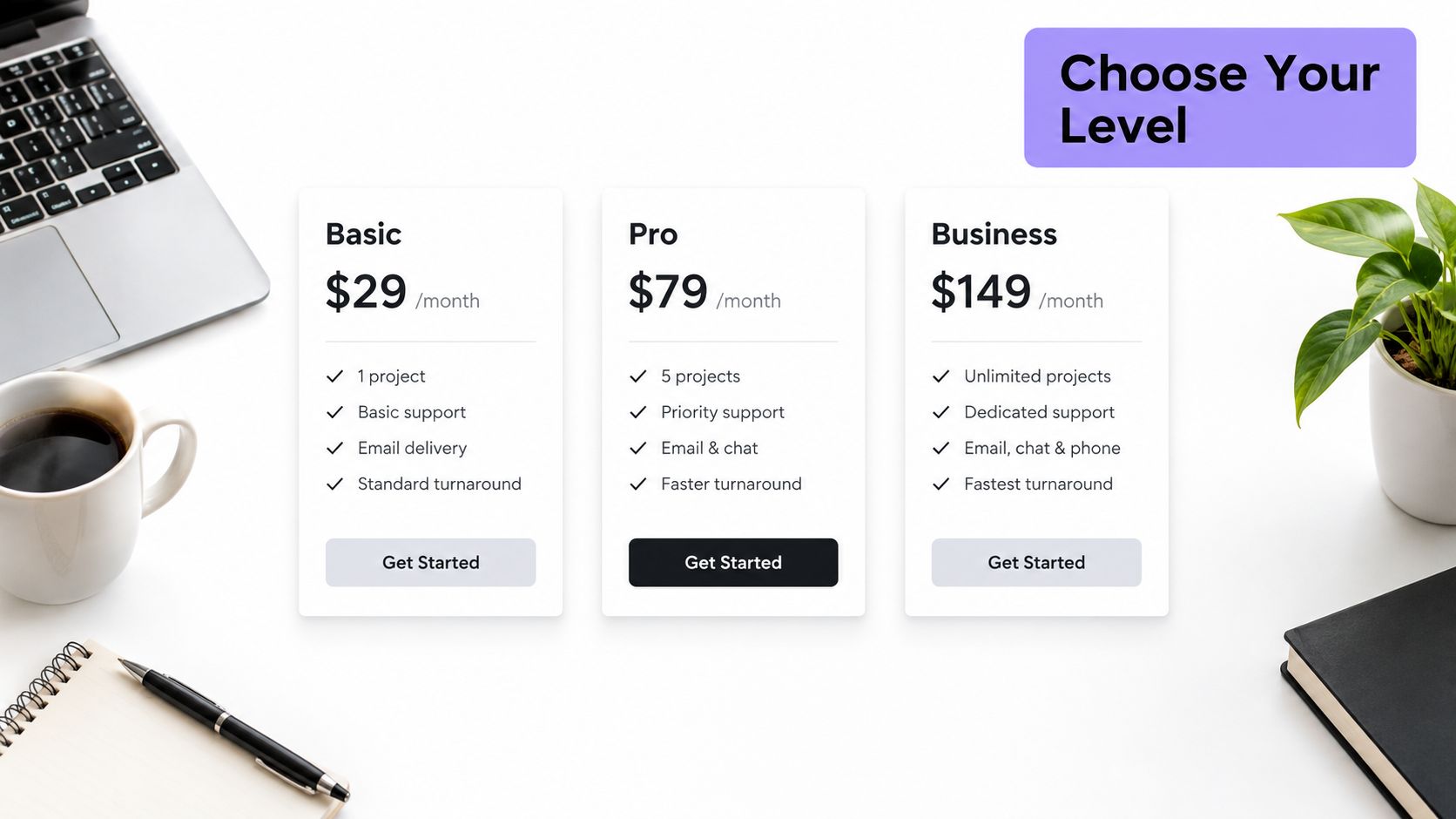
A pricing layout can make those scope differences easier to compare.
Differentiate scope, not decorative extras
Use Essential, Growth, and Flagship as working labels if they suit your offer. The important distinction is the work included, not the names.
| Package | Appropriate buyer | Scope distinction | Boundary to state |
|---|---|---|---|
| Essential | Needs a focused problem solved | Defined deliverable using existing inputs | Excludes broader strategy and ongoing support |
| Growth | Needs diagnosis and implementation | Research, recommendations, and delivery | Specifies revision and approval arrangements |
| Flagship | Needs coordinated specialist support | Wider implementation and agreed follow-through | Defines availability and additional-work terms |
Don't assume the middle option will sell most. Present a genuine recommendation based on the buyer's requirements, and don't create an inflated top tier purely to make another price look attractive.
Your package page should specify deliverables, client inputs, exclusions, revision arrangements, scheduling conditions, payment terms, and the process for handling scope changes. Calculate your fee against delivery effort, overheads, risk, and the capacity you're reserving.
Give prospects enough information to decide
Publish a fixed price when the scope is stable. If projects vary substantially, explain your pricing basis and what information you need to prepare a quote. Transparency helps a prospect assess fit, but it doesn't guarantee more enquiries.
A useful package makes it easier for the right client to proceed and easier for an unsuitable client to decline.
For an adjacent perspective on presenting offers digitally, AmaJova's guide to how UK freelancers sell services online is a relevant resource. Adapt the presentation to your French business context rather than copying another market's contractual or tax assumptions.
Use a short proposal organised around the buyer's problem, recommended scope, fee, dependencies, and next action. The four Ps of marketing explained offers another useful lens for checking whether your service, price, distribution, and promotion fit together.
Get Found by AI Search Engines With GEO
Generative Engine Optimisation, or GEO, means preparing your business information and content for discovery and potential citation in AI-generated answers. The objective isn't just a visit to your website. It's also an accurate mention when someone asks an AI search service for help finding a suitable professional.
Treat GEO as an extension of clear, credible publishing, not a shortcut around it. No freelancer can guarantee inclusion in an answer, and no directory listing or schema implementation can promise a recommendation.
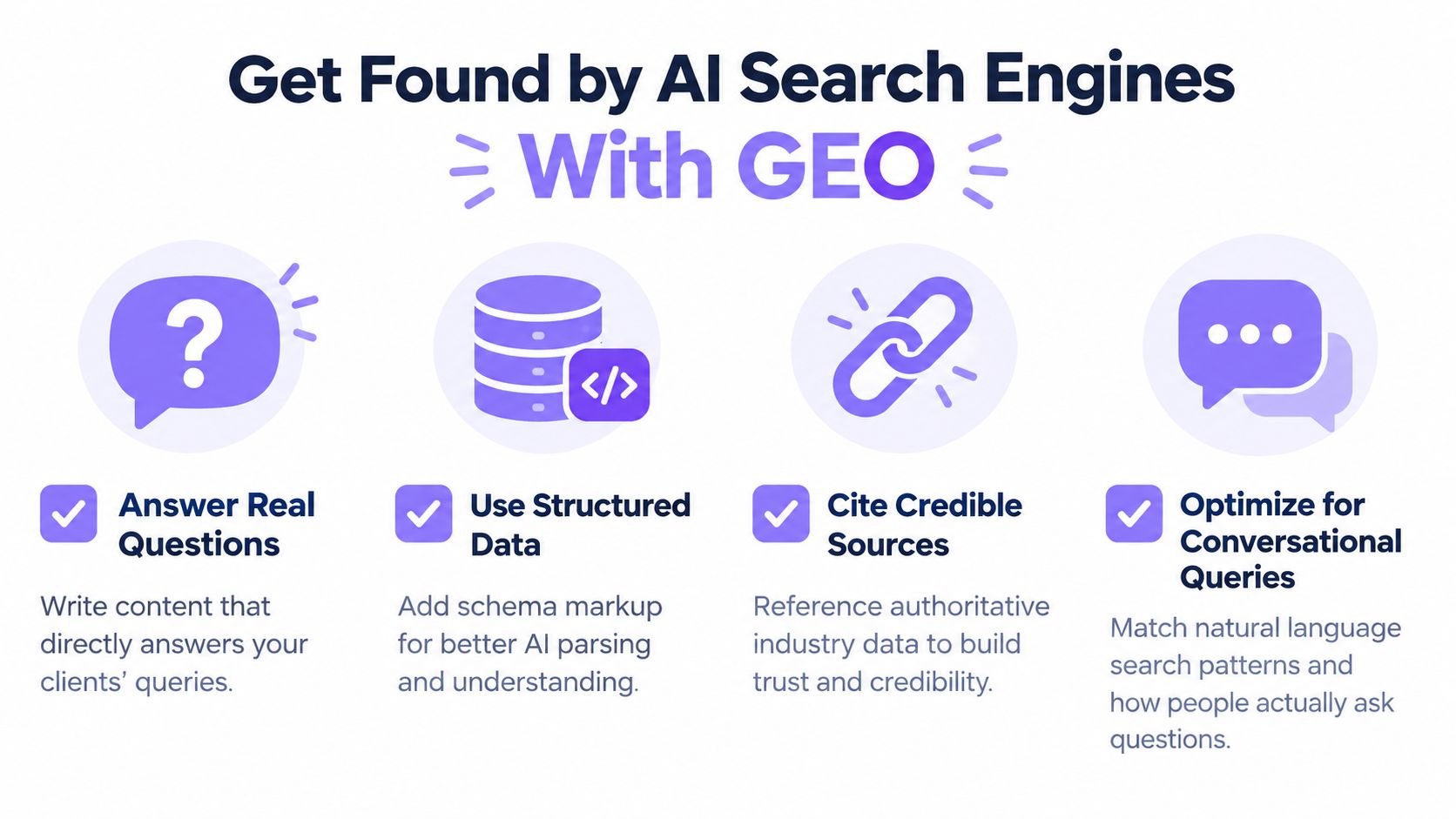
Use this checklist to organise the work.
Publish material a buyer can actually use
Start with questions you hear during enquiries. A prospective client might ask whether you work remotely, what inputs you need, whether you serve their location, or what your package excludes.
Answer directly before adding detail. Keep the wording specific enough that a reader can distinguish your service from a generic description of the profession.
- Service information: State what you do, whom you serve, and where you operate.
- Buyer FAQs: Address real suitability, process, and scope questions.
- Proof of work: Publish approved examples with your role and limitations clearly explained.
- Credible references: Link to original evidence when you make a factual claim.
- Structured data: Use accurate markup that corresponds to visible page content.
Schema isn't a certification of expertise. Have a competent implementer check it, and don't add unsupported ratings, qualifications, or service areas merely to make your business appear more established.
Monitor accuracy rather than chase a badge
Check relevant conversational queries and record whether your business appears, whether the description is correct, and which page is cited when a citation is shown. Treat each observation as a snapshot, not a permanent ranking.
A practical introduction to the terminology is available in GEO explained simply for SMEs. Keep the commercial test separate: a mention matters more when it leads a suitable buyer towards an enquiry.
For a video companion to the topic, use the explainer below.
My recommendation is to make your offer intelligible to AI search services without making them your only discovery route. Maintain conventional search visibility, referral relationships, and direct contact access alongside this work.
The Lean Tool Stack a Freelancer Actually Needs
Buy software to remove a known bottleneck, not to compensate for an unclear offer. A tool should help you capture a lead, deliver useful material, arrange a conversation, or evaluate an outcome.
Start with functions you can operate reliably. A modest system you maintain is preferable to an elaborate one with incomplete records.
Give each tool a defined job
- Lead tracking: Use a spreadsheet or simple CRM for contact details, source, qualification, next action, and outcome. Require exportability before committing.
- Scheduling: A booking tool should reflect your actual availability, provide reminders, and ask only for information needed for the meeting.
- Content production: Keep a reusable brief and review process. If LinkedIn is a chosen channel, ViralBrain's AI carousel creator for LinkedIn is an optional production aid, not a reason to create more posts.
- Analytics: Track enquiries and commercial outcomes alongside visits. Record unknown sources.
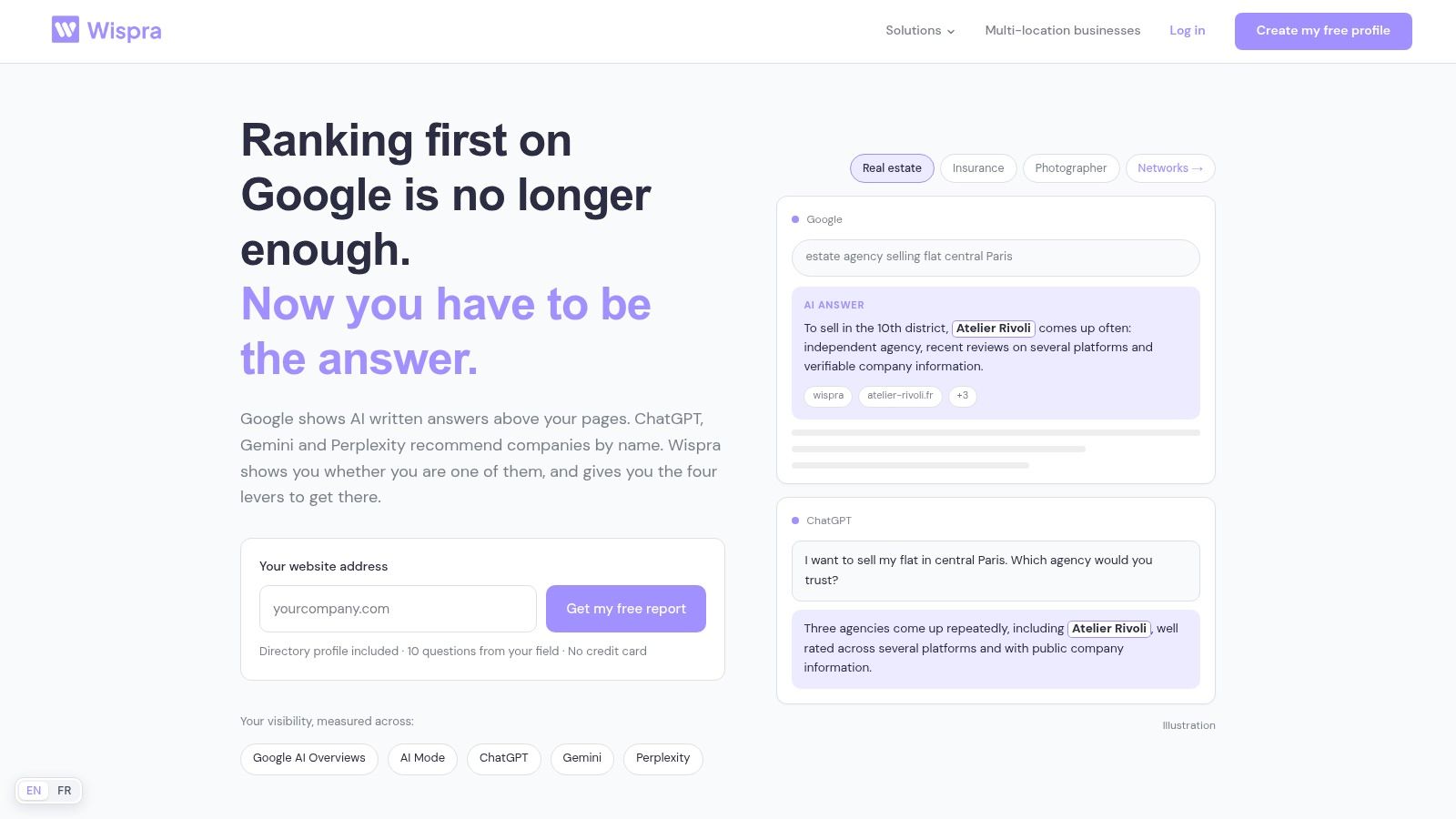
- AI visibility: Wispra is one option alongside manual monitoring and other tools, offering an AI-optimised directory, content generation, and visibility reporting.
The platform interface provides a visual reference for this category of tool.
Protect client records and measurement quality
Platform dependence deserves attention. The OECD's research on self-employed online freelancers in the platform economy identifies recurring concerns around platform opacity, unequal negotiating power, and restrictions on moving client relationships off platforms.
Keep an appropriate first-party record of enquiries rather than treating a marketplace inbox as your entire customer database. Respect platform terms, limit collected personal information, explain its purpose, and obtain consent where required.
Buying test: Don't pay for a feature until you can describe the decision or task it will improve.
Connect forms to your lead record and bookings to enquiry outcomes before adding complex automation. Check privacy and consent requirements before deploying tracking pixels; installing analytics doesn't establish compliance.
Use the guide to free SEO tools for freelancers to compare needs before purchasing subscriptions. Skip sprawling ad suites and multi-channel scheduling systems until your workload provides a clear reason to use them.
Your 30-Day Freelance Marketing Sprint
Treat the sprint as a setup and learning exercise, not a promise of immediate revenue. The aim is to publish a coherent offer, establish deliberate distribution, and collect enough evidence to improve your decisions.
Follow a practical weekly calendar
- Foundation week: Finalise your positioning, select your acquisition routes, and define what makes an enquiry qualified. Review your public business information for inconsistencies.
- Asset week: Publish the service page, package details, and approved proof. Complete relevant directory information and apply the GEO checklist where appropriate.
- Distribution week: Share a useful proof-of-work piece, contact suitable referral partners, and direct prospects to the relevant offer rather than a generic homepage.
- Review week: Examine enquiry quality, bookings, costs, and sales. Identify missing information before deciding a channel has failed.
Keep the schedule small enough to survive a busy delivery period. If production takes too much time, repurpose an existing explanation instead of inventing another topic.
Record commercial outcomes
Maintain these indicators in your lead record:
| Indicator | How to calculate or record it |
|---|---|
| Qualified enquiries | Count prospects matching your stated fit criteria |
| Conversion rate to call | Booked calls divided by qualified enquiries |
| Cost per qualified lead | Attributable channel spend divided by qualified enquiries |
| Revenue by channel | Record agreed revenue attribution consistently |
Record time spent separately so an apparently inexpensive channel doesn't conceal substantial unpaid work. When a channel produces no qualified enquiries, mark cost per lead as unavailable rather than forcing a misleading calculation.
Don't confuse an initial review with a final verdict. Searchable assets and relationship-building need continued observation, and a short test cannot prove reliable future performance.
Market less indiscriminately, ship more useful evidence, and measure. Start by fixing the offer buyers will see, then distribute it with purpose.
Wispra offers an AI-optimised business directory, automated content tools, and AI visibility reporting for businesses, including freelancers. Visit it to assess whether those capabilities fit your lean acquisition system, and use your existing enquiry and revenue records to evaluate their commercial value.