
Digital Marketing for Real Estate: A Practical Playbook
Digital marketing for real estate agents and brokerages made practical. Covers local SEO, GEO, paid ads, portals, email, and measurement in one playbook.
You have two viewings before lunch, a valuation that has gone quiet, six portal logins, and a phone full of enquiries you meant to return yesterday. None of that means you're bad at marketing. It usually means your marketing is a collection of disconnected tasks, not a system that turns visibility into signed mandates. Digital marketing for real estate works when portals, search, ads, email and SMS share one budget, one CRM and one definition of success.
Why Most Real Estate Marketing Stops Working Before the First Click
A self-employed agent in a mid-sized French town can do everything that looks right and still lose money. She boosts a listing on a portal, posts a reel, updates a half-finished website, then discovers the enquiries landed in three inboxes and nobody called them back. The effort isn't the problem. The missing piece is a funnel that tracks every enquiry from first click to qualification, appointment and mandate.
Most agencies still judge each channel separately. The portal report shows clicks, Meta shows cheap leads, Google shows impressions, and the CRM, if there is one, shows a different total again. That fragmentation hides the only question that matters, which euro produced a signed mandate.
Treat every channel as competing for the same budget, because your bank account already does.
The Four Jobs Your Marketing Has to Do
Your system needs to be findable in your catchment area, convert visibility into qualified enquiries, respect French consent rules, and close the loop with mandate revenue. If one job fails, the others get more expensive. Strong ads sent to a slow follow-up process waste spend, and fast follow-up can't rescue enquiries you were never allowed to recontact.
- Be findable locally: Buyers and sellers should find accurate listings, branch details and useful answers before they phone you.
- Convert with intent: Each listing, valuation page and neighbourhood guide needs one clear next step and a dedicated form.
- Qualify immediately: Route submissions to a CRM, trigger an alert and separate buyer, seller and renter intent at capture.
- Attribute to mandates: Tag the source on every contact so renewal decisions use revenue, not impressions.
The scale of online discovery makes this essential. France recorded more than 13 million monthly unique visitors to real-estate advertising sites by 2015, compared with fewer than 7 million in Germany and 5 million in the United Kingdom, according to Médiamétrie figures cited by France's government digital-information service. Your buyers were online a decade ago. Your operating system needs to catch up.
The Digital-First Buyer Is Not New, So Stop Designing for 2010
Agents still talk about digital as if it's an emerging channel. The French data punctures that excuse. By 2015, seven out of ten French people consulted property advertisements online and 90% of completed real-estate projects began on the internet, as noted in the government figures cited above.
The baseline from that period shows why a brochure website no longer works.
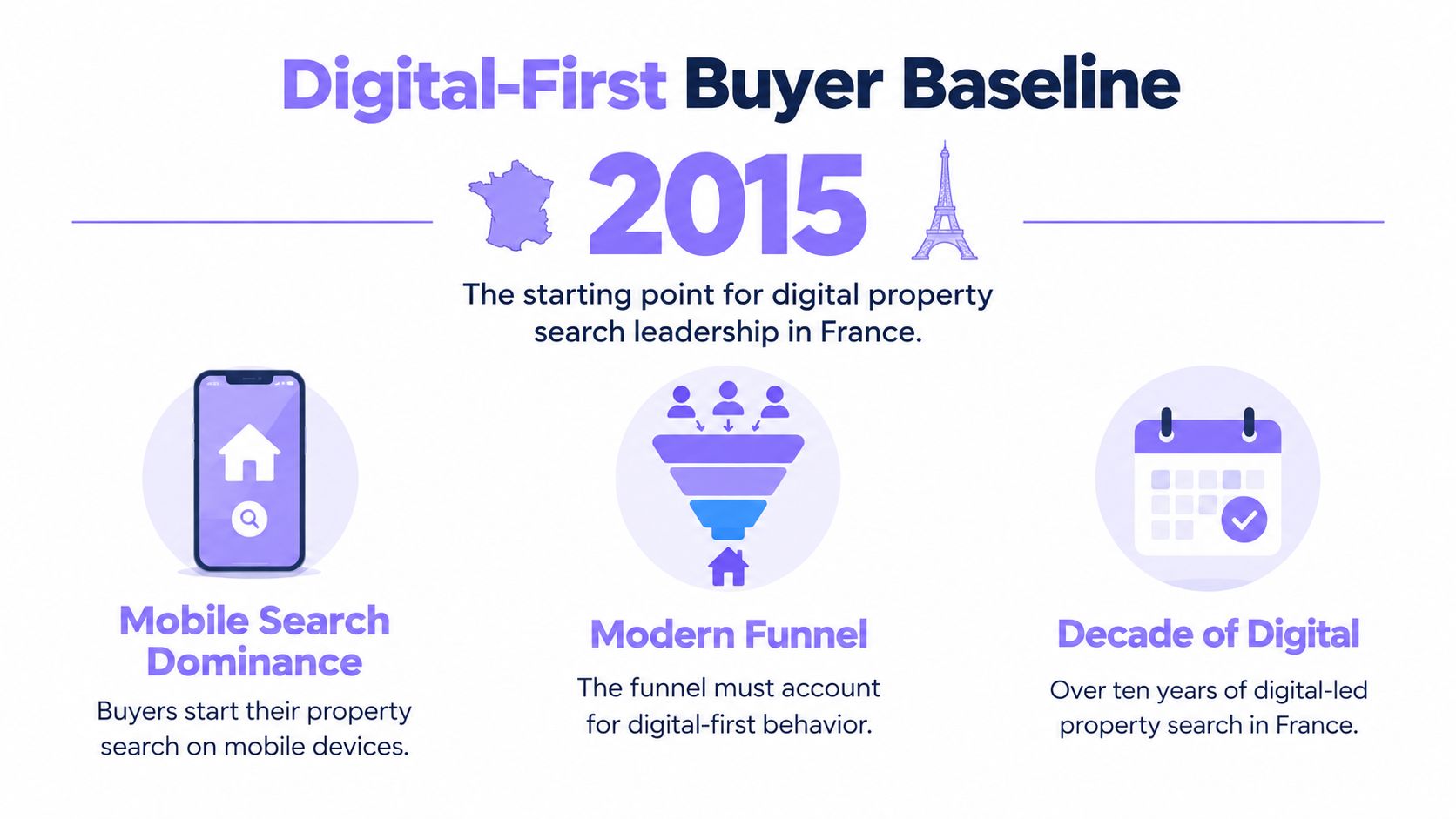
Médiamétrie recorded 14.3 million internet users visiting a real-estate listings website in 2015, with 11 million using a computer, 2.9 million a mobile device and 2.2 million a tablet, with overlap because some people used several devices. Even then, search wasn't a single desktop session. It was fragmented, comparative and increasingly mobile.
Websites Became the First Adviser
In a 2014 OpinionWay survey, real-estate websites were the preferred information source for 55% of respondents, ahead of estate agents at 52%, personal recommendations at 39%, notaries at 32% and print media at 12%. That ordering matters. By the time a prospect phones you, they've usually compared prices, photos, fees and neighbourhood claims elsewhere.
So your website isn't there to introduce your agency in vague terms. It's the first conversation. It should answer the questions a buyer or seller has already asked a portal, a search engine or an AI assistant, including price context, DPE implications, notaire fees, viewing process and how quickly you'll respond.
What Changes in Practice
Design for a prospect who arrives informed and impatient. Make listings searchable, keep local information accurate, load pages quickly on mobile, and put the enquiry path where thumbs can reach it. Publish educational content that helps someone decide, not generic posts about your team lunch. Visibility is the constraint, then speed, then trust. Persuasion comes after all three.
Get Found Locally With SEO and GEO Combined
Local SEO helps you appear in Google Maps and the local pack. GEO, or Generative Engine Optimisation, helps AI assistants such as ChatGPT, Perplexity, Gemini and Google AI Overviews cite or recommend you. Don't run them as separate projects, because they feed on the same inputs, namely clear facts, local relevance and consistent information.
This checklist separates the mechanics while keeping the work unified.
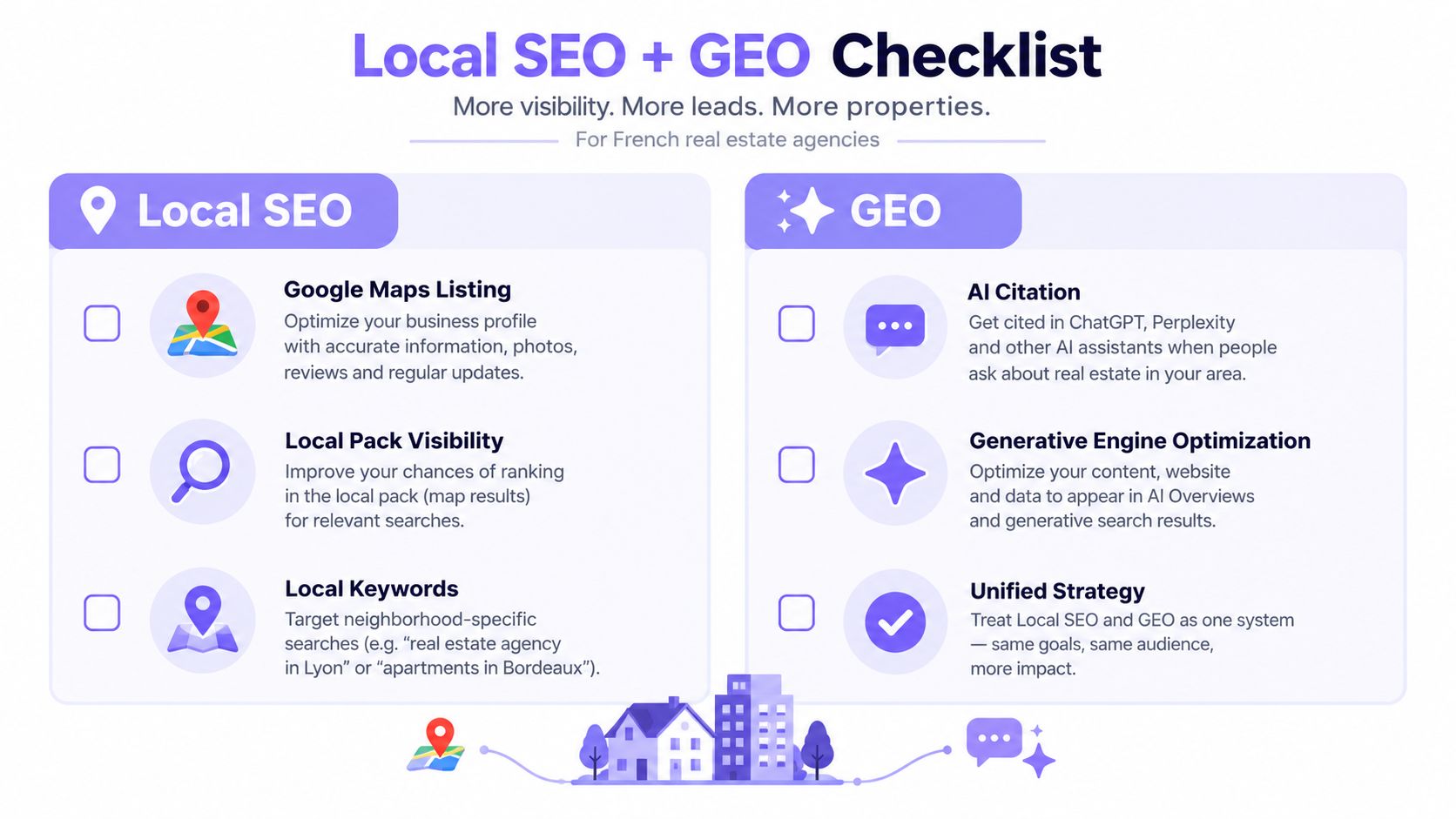
Start with a verified Google Business Profile for each branch, not one profile stretched across several towns. Keep name, address and phone details identical across your site, portals and directories, and state opening hours, service area and languages spoken. Those basics sound dull, but inconsistent details give search engines and AI systems a reason to choose a competitor whose facts line up.
Pages That Earn Local Visibility
Build neighbourhood landing pages that answer real decisions, not pages stuffed with a town name. A useful set includes a neighbourhood guide for your core commune, a first-time buyer guide for France, a notaire fees explainer, and a DPE and energy-performance FAQ. Add structured data to listings where your platform allows it, and write FAQs in the plain language buyers use.
For a deeper walkthrough of branch profiles, reviews and local pages, work through our complete guide to local SEO for estate agencies alongside this playbook. If you want the AI side explained in property-specific terms, Geo for Realtors AI search guide is a useful companion on how assistants select businesses to mention.
The video below is worth watching before you brief a web developer, because it reinforces why structure matters as much as copy.
The Minimum Fact Set for AI Recommendation
Give assistants a clean, repeatable fact set on your site and profiles:
- Service area: Name communes and neighbourhoods precisely, not just a département.
- Specialisms: State whether you focus on sales, rentals, new-build, prestige or investment.
- Practical details: Publish languages, fee approach, response-time commitment and remote viewing options.
- Proof: Keep reviews, sold examples and team credentials current and consistent.
Tools can help organise that information. Wispra, for example, turns agency and listing information into structured, AI-readable content and directory listings. Whether you use a tool or do it manually, the principle is the same.
The prize for getting found is growing. Existing-home transactions in France were estimated at about 921,000 over the 12 months ending September 2025, roughly 11% above the prior year, which raises the value of every qualified enquiry generated through search and AI assistants, according to Coraly's France property portal market analysis.
Allocate Your Portal Spend by Qualified Intent, Not Reach
Portals are usually the largest marketing line item for a French agency, yet many agents can't say which portal produced their last signed mandate. France has at least ten active property portals, with leboncoin Immobilier, SeLoger, Bien'ici, PAP and Logic-Immo among the leading destinations. Publishing everywhere feels safe, but it isn't a strategy.
The practical split is reach versus intent. A broad classified platform can generate large visit volumes, while a specialist property portal may attract people closer to a transaction. Neither is automatically better. The right answer depends on your stock, price band, commune and capacity to respond.
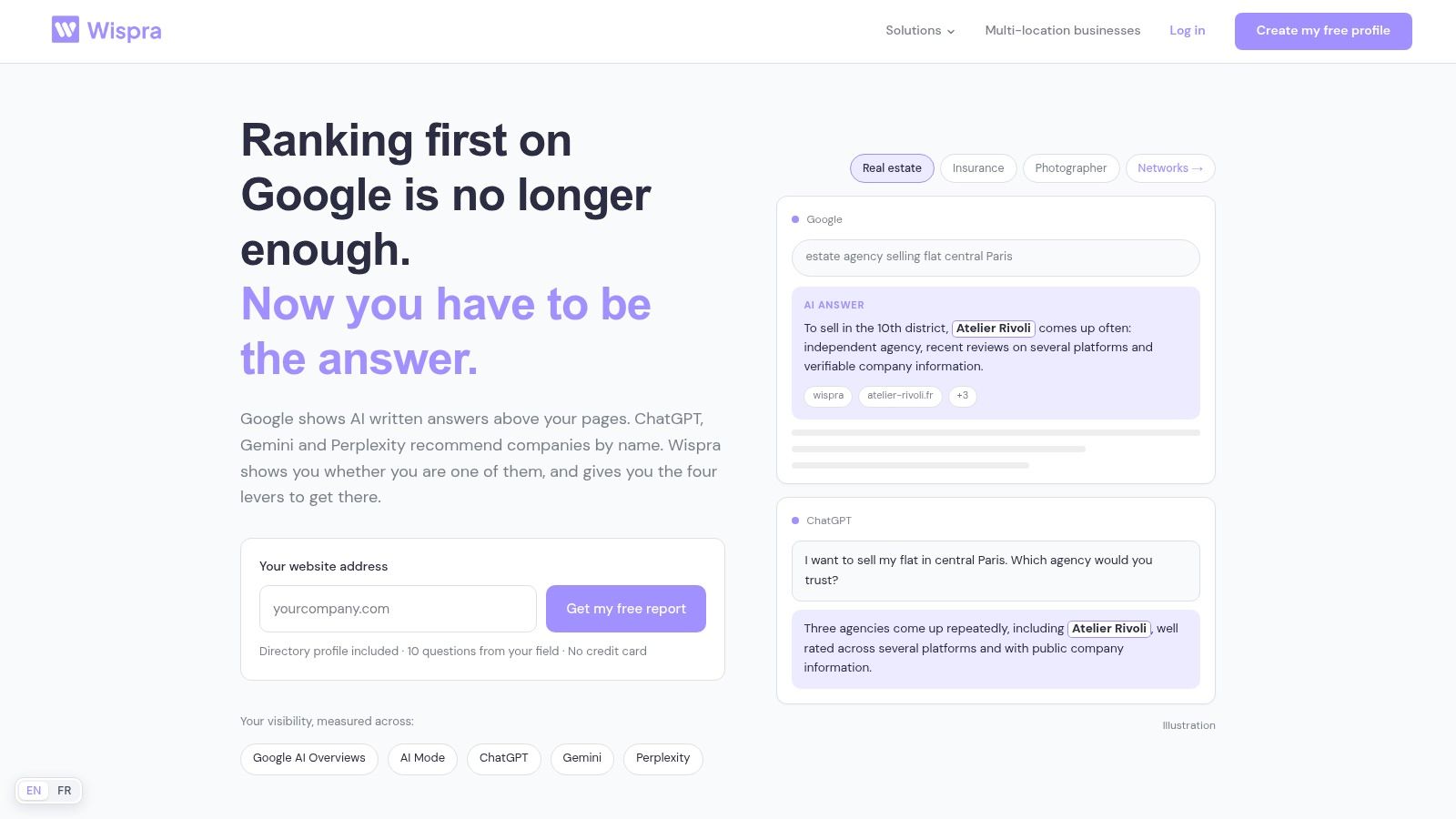
This screenshot shows the kind of AI visibility view you should compare against portal reports, rather than judging channels in isolation.
Score Portals on Outcomes
Score each portal monthly using the same fields in your CRM:
| Measure | What to record |
|---|---|
| Qualified enquiry rate | Enquiries with budget, timing and contactable details |
| Viewing or valuation rate | Appointments booked, not just messages sent |
| Signed-mandate revenue | Fees linked back to the original portal source |
| Handling cost | Time spent filtering duplicates and low-context requests |
My contrarian view, after watching agencies spread themselves thin, is that identical listings on five portals often reduce efficiency. Duplicated, low-context enquiries crowd out serious ones, slow your response time and make attribution messy. A smaller, well-attended presence on two portals usually beats a thin presence on five, provided those two match your local demand.
A Simple Allocation Rule
Fund portals in order of signed-mandate revenue per euro spent, reviewed by neighbourhood and property type. Test exclusivity or premium placement on one segment at a time, for example family houses in one commune, and keep the creative portal-specific. Rewrite headlines for the audience, lead with different photos where it helps, and include the context that platform's users tend to ask for.
During a recovering market, more demand doesn't automatically justify more spend. It increases the value of knowing which channel produces serious buyers and sellers, and which one only produces work.
Paid Ads, Social and the Five-Minute Follow-Up
Paid acquisition is where agencies bleed budget fastest, usually because the ad account is better organised than the follow-up. Build the layer in order of intent. Use Google Search for high-intent queries such as valuation and property type plus commune, Meta lead forms for sellers and first-time buyers who need a guide or estimate, and portal boosts only for listings with strong expected fees and good creative.
For campaign structure, budgets and negative keywords, pair this section with our PPC guide for small businesses before you increase spend. On the organic and paid social side, this overview of social media marketing for real estate agents gives useful context on content formats that support, rather than replace, lead generation.
The operational work behind the ads matters more than another audience tweak.

Set Campaigns Up by Neighbourhood
Don't run one campaign for your whole territory. Split budgets by neighbourhood or commune, property type and seller or buyer intent, so you can pause weak segments without killing strong ones. Mention the exact street, quartier or postcode in creative where it's accurate, and send each ad to a dedicated landing page with one consented form. Suppress recent enquirers from prospecting campaigns so you don't pay again to reach people already in nurture.
Keep buyer and seller cohorts separate from day one. They have different timelines, questions and revenue value, and mixing them makes cost per lead meaningless.
Wire the Five-Minute Rule Into the CRM
A French-sector lead-generation benchmark reports conversion of 26% when a lead is contacted within five minutes, versus 12% after one hour and 3% after 24 hours, with shared-lead conversion of 3 to 8% compared to 12 to 18% for exclusive leads, according to RBP Group's French real-estate lead channel comparison. Treat those figures as directional because the source is a commercial lead provider, but they're strong enough to justify a service-level objective.
Operational rule: Every form submission creates a CRM record, fires an alert to the responsible agent, and gets a human call within five minutes during working hours.
Score the morning call list by recency, exclusivity, property type and stated timing. A cheap shared lead that nobody calls quickly isn't cheap. It's a subsidised enquiry for a faster competitor.
Track cost per lead, contact rate, qualified-lead rate, appointment rate, signed-mandate rate and revenue per campaign. If a campaign can't produce appointments after you've fixed follow-up speed, it doesn't earn a second month just because the click price looked attractive.
Email, SMS and Seller Nurture Without Breaking CNIL Rules
Email and SMS can revive valuation enquiries, viewing no-shows and sellers who weren't ready three months ago. They're also where French agencies most often create compliance risk, usually by importing old portal enquiries into promotional nurture without checking the original permission.
CNIL states that electronic commercial prospecting to individuals generally requires prior consent that is free, specific, informed and unambiguous, with a pre-checked box not counting as valid consent, as set out in CNIL guidance on electronic communication rules. That rule should shape your forms before you write a single sequence.
Build Consent Into Capture
Use a dedicated, unticked checkbox that names the category of communication, for example valuation updates or a neighbourhood newsletter. Store the timestamp, exact wording or version, source and channel for every contact. Identify your agency in every message, provide a simple unsubscribe mechanism, and suppress opt-outs immediately across all campaigns.
- Transactional messages: Viewing confirmations and appointment reminders tied to a specific request.
- Marketing messages: Newsletters, new-listing alerts and seller-conversion sequences that need the right permission.
- Existing-customer exception: Only for an actual customer receiving similar services from the same organisation, not someone who merely created an account.
For broader nurture ideas beyond property sales, see Wojo Media's lead gen playbook, then adapt the sequencing to French consent requirements rather than copying lists across. If your priority is the seller journey specifically, our guide to generating real-estate seller leads goes deeper on valuation-led capture.
Sequence Around Real Moments
Send valuation reminders when market context changes, viewing follow-ups while the property is still fresh, and neighbourhood newsletters that contain local information. A seller sequence should move from estimate, to comparable evidence, to preparation advice, to a clear invitation for a mandate discussion. Audit consent before every send and measure opt-out and complaint rates alongside opens and clicks. A sequence that converts but burns permission is borrowing revenue from next quarter.
Measurement, Attribution and the 30-Day Marketing Review
Most agencies don't have a traffic problem they can prove. They have an attribution problem they can feel every time a portal invoice arrives. If you can't trace a mandate back to its source, you can't budget with confidence, and every renewal becomes a negotiation based on habit.
You don't need enterprise software to fix this. You need consistent tagging and a monthly habit.
A Measurement Framework That Fits a Small Agency
Use a unique phone number per major portal where practical, dedicated landing pages per campaign, and a mandatory source field in the CRM. Then track the chain in order, cost per lead, contact rate within five minutes, qualified-lead rate, appointment rate, signed-mandate rate and revenue per campaign. Clicks sit at the top for diagnosis, but they don't decide spend.
Keep the model deliberately simple:
- Capture: Record source, campaign, commune, property type and buyer or seller intent on every enquiry.
- Qualify: Mark whether the person was contactable, had a realistic budget or property to sell, and gave a timeframe.
- Close the loop: When a mandate signs, link the fee back to the original contact, even if months passed in nurture.
- Calculate payback: Judge channels on signed mandates and fees, not raw enquiries or low cost per lead.
The Sunday Afternoon Review
Once a month, set aside a short review and make decisions while the data is in front of you. Which portals produced qualified appointments and mandates relative to cost, and which produced duplicate work. Which campaigns should pause, which search terms need negating, which neighbourhoods deserve more budget, and which email sequences generated appointments without raising opt-outs.
If a channel can't show a path to a mandate, it's not a brand investment by default. It's an expense you haven't challenged yet.
Also check operational leaks before blaming media. Slow first calls, missing source tags, unsegmented seller leads and consent gaps can make a good channel look weak. Fix the leak, rerun the test for one cycle, then decide.
That monthly discipline changes digital marketing for real estate from a list of activities into a defended investment. You'll spend less time arguing about impressions and more time funding the few channels that reliably put qualified buyers and sellers in front of your agents.
If your agency is visible on portals but invisible when buyers ask ChatGPT, Perplexity or Gemini for a local recommendation, Wispra can help you turn your agency profile, listings and FAQs into structured content that AI search engines can read and cite. Set up your AI-optimised presence, track where you're being recommended, and connect that visibility to the enquiries and mandates that matter.