
Generative AI SEO: The Complete Guide for SMBs
Discover generative AI SEO for your business. Learn ranking signals, content tactics, and how Wispra helps SMBs get recommended by AI engines in 2026.
In France, 48% of the population now uses generative AI, and information retrieval is the dominant use case for 73% of users. That means people are already asking AI tools for recommendations, not just typing queries into search engines.
A customer can be standing on a city street, asking for the nearest accountant, florist, or repair service, and never open a traditional results page at all. If your business facts are hard to extract, inconsistent across the web, or buried in vague copy, you're easier to overlook in that new discovery flow. The practical answer is to treat generative AI SEO as a visibility layer built on top of conventional SEO, not as a replacement for it.

Introduction
A bakery owner checks her phone and sees a customer asking an AI assistant where to find gluten-free pastries nearby. The assistant does not begin with a tidy list of ten blue links. It gives one answer, then names a few sources it trusts. If her business profile, menu page, FAQs, and reviews all tell the same clear story, she has a chance to be mentioned. If those details conflict, she can disappear from the answer altogether.
That is why generative AI SEO matters now. In France, 48% of the population used generative AI in 2025, up 15 percentage points in one year and 28 points since 2023, while 73% of AI users used it for information search (Arcep's 2025 Digital Market Barometer). The shift is already changing how people research services, compare options, and choose who to contact.
Small business owners often hear that AI search is the future and assume they must abandon everything they have built for Google. The better approach is to treat generative AI SEO as a layer on top of conventional SEO, with a conversion-rate focus added in. Search still brings people in. Clear facts, consistent wording, and strong page structure help turn that visibility into contact, quote requests, or bookings.
Practical rule: if a human customer would struggle to summarise your offer after reading your site, an AI system may struggle too.
This guide uses plain language and concrete examples because most readers do not need more theory, they need a better working model. You will see how AI answers differ from ranked search results, which business facts matter most, and how to organise content so both search engines and conversational systems can understand it.
What is Generative AI SEO
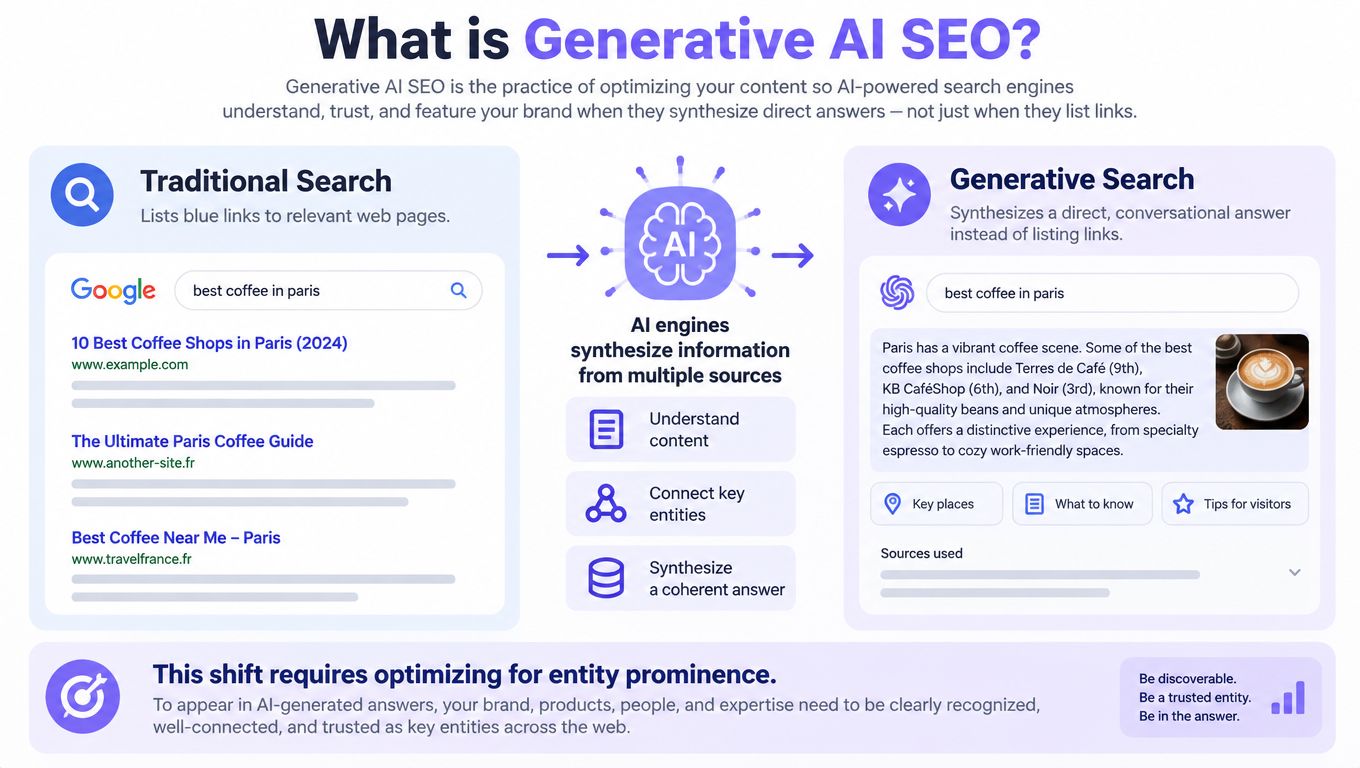
Generative AI SEO is the practice of making your business easier for AI systems to understand, trust, and mention inside generated answers. Traditional search tries to rank pages. Generative search tries to assemble an answer, then cite or reference sources that look reliable enough to support it.
Consider the difference. Traditional SEO is a librarian handing you a stack of books sorted by relevance. Generative AI SEO is a researcher who reads the books, pulls out the useful lines, and writes a summary for you. If your facts are clear, consistent, and easy to verify, your business has a better chance of becoming part of that summary.
The important detail is that AI engines don't all work the same way, but they share a common habit, they look for extractable facts and credible sources. That includes systems behind chat-based assistants, search summaries, and answer engines. A useful overview of that shift appears in growing visibility in AI search, which frames the topic around being included in generated responses rather than only ranking on results pages. For a French perspective, Wispra's article on ChatGPT SEO and how to optimise for AI gives a useful local context.
Where directories fit in
Directories matter because AI systems often prefer sources that present business data in compact, structured form. A directory entry can function like a clean reference card. It can surface your category, location, service area, opening hours, and core offer in a format that's easier to parse than a long homepage.
That doesn't mean directories replace your website. It means they can reinforce it. When the same business facts appear in multiple trustworthy places, AI systems have a stronger basis for citing you. In practice, generative AI SEO is about making your business easier to identify as an entity, then easier to quote accurately.
How Generative AI SEO Differs from Traditional SEO
Traditional SEO and generative AI SEO both care about trust, but they reward different signals. A page can rank well in search and still be weak inside an AI answer if the page is vague, poorly structured, or missing clean factual statements. The main difference is that one system wants the best page, while the other wants the best evidence to build a response.
Traditional SEO vs Generative AI SEO
| Traditional SEO | Generative AI SEO |
|---|---|
| Focuses on rankings in search results | Focuses on inclusion and citation in generated answers |
| Relies heavily on keywords, backlinks, and crawlability | Relies heavily on clear entities, explicit facts, and source credibility |
| Optimises pages as destinations | Optimises information so it can be extracted and summarised |
| Measures clicks, impressions, and positions | Measures citations, mentions, referral quality, and answer inclusion |
| Can reward broad content coverage | Can reward compact, verifiable business information |
The practical takeaway is that generative systems are less impressed by generic keyword stuffing and more interested in what a business actually is. If your site says “best local service” five times but never clearly states your service areas, contact details, or offer terms, you're making life harder for the system. That's why structured business profiles, FAQs, service pages, and product details matter so much.
A useful way to think about it is this: traditional SEO asks, “Can this page compete in a results page?” Generative AI SEO asks, “Can this business be described accurately in one answer?” That second question is tougher if your information lives in scattered fragments across your site and listings.
For a deeper conceptual comparison, Wispra's definition and 2026 guide to generative engine optimisation is worth reading alongside your current SEO playbook. It helps clarify why this isn't a separate discipline so much as a new layer on top of the old one.
A business can be visible to search engines and still be invisible to AI if the facts are messy.
Key Ranking Signals for AI Engines
AI engines tend to reward businesses that look consistent everywhere they appear. The strongest signals are usually not dramatic marketing claims, but boring operational facts stated clearly. That includes your name, address, phone number, service area, product details, and the wording you use to describe what you do.
What AI systems seem to trust most
Entity prominence matters because the system needs to know that your business is a distinct thing, not a vague mention buried in a paragraph. If your brand appears on your site, in directories, and in relevant profiles with the same identity, that helps the model connect the dots. This is especially important for local businesses, where one missing detail can make a profile feel unreliable.
Attribute consistency matters just as much. If one page says you serve Marseille, another says only Provence, and a third omits the location entirely, the system has to choose between conflicting versions. That's risky. The same goes for prices, opening hours, and contact information, especially when customers expect fast confirmation before they buy.
Source credibility is the third layer. AI systems are more likely to lean on sources that look established, specific, and well maintained. That's where clean directory listings, detailed service pages, and up-to-date documentation help. For people building more advanced workflows, the 2026 guide to AI agent SEO is a helpful companion because it looks at how automated systems evaluate and use web information.
A simple audit approach
Start with the basics.
- Check business identity: Make sure your name is written the same way everywhere.
- Match location details: Keep your address, service area, and contact number consistent.
- Clarify core offerings: Describe services and products with the same wording across site pages and listings.
- Review supporting pages: FAQs, about pages, and service pages should reinforce the same facts, not introduce new ones.
The goal isn't perfection for its own sake. It's reducing ambiguity. When AI systems can reconcile your business data quickly, they're less likely to ignore you and more likely to cite you.
Tactical Guidance for Visibility
French SMEs still have room to improve their digital foundations. The European Commission's 2025 Digital Decade country report says only 21.59% of French SMEs reached a high level of digital maturity, which suggests many businesses have a basic web presence but not the machine-readable structure AI systems prefer (European Commission report294_9/090166e51e13f2ac)). That gap is exactly where generative AI SEO can create value.
A useful way to approach visibility is to treat it like a mix of SEO and conversion-rate optimization. SEO helps people and systems find you. CRO helps them understand you fast enough to act. Generative AI search rewards both, because the model has to identify the right source and then extract the clearest version of your offer.
Build for clarity first
The strongest pages usually answer a real customer question in plain language. A service page should say what you do, where you do it, who it is for, and what the customer should expect next. FAQs should answer the questions people actually ask before they buy, not only the phrases you hope to rank for.
Structured data helps because it gives search systems a cleaner reading of your content. Schema markup, consistent headings, and clearly labelled sections make a page easier to parse, much like technical documentation that is organized by purpose instead of buried in a wall of text. For a practical reference, Trupeer Inc.’s technical documentation guidance shows that style in action.
Connect your site and your listings
Directory work and on-site content should support each other. A business profile should not say one thing while the website says another. If you change a service, update the profile, the FAQ, the service page, and any product or location page together.
This is the problem Wispra is built for. It pairs an AI-optimised business directory with automated content for blogs, FAQs, and product catalogues, so the same facts stay consistent everywhere AI systems look. That matters less for producing more content and more for making the content easier to recognise as a clean source of facts.
Practical rule: write each important business fact once, then repeat it consistently across the places that matter.
A simple pattern works well here. Start with a direct service page, add a short FAQ that handles common objections, and support both with directory listings and reviews that use the same terminology. That gives AI systems more than one path to verify you.

Measuring Success and KPIs
Traditional SEO often starts with rankings and clicks. Generative AI SEO starts earlier in the funnel, because the first win may be being mentioned at all. A useful measurement model therefore needs to track visibility inside AI answers, not just traffic after the click.
What to watch
The most important signals are citation volume, inclusion in generated answers, referral traffic from AI interfaces, and brand mentions in user conversations or support logs. Those indicators tell you whether your content is being used as source material, rather than merely indexed. For a practical framework, Wispra's guide to measuring AI visibility is a good reference.
If you're trying to decide whether to invest in this now, think in terms of risk management as much as growth. A business that isn't measurable inside AI search can't tell whether its facts are being surfaced correctly. It also can't easily spot when a competitor is taking the answer slot.
A realistic scoring model
A simple internal dashboard can help you make sense of the new signals.
- Answer presence: Are you mentioned when customers ask relevant questions?
- Source quality: Are the citations pointing to your site, a directory profile, or a third-party reference?
- Message accuracy: Does the AI describe your service correctly?
- Traffic quality: Do visits from AI interfaces lead to real enquiries, calls, or purchases?
The point isn't to chase vanity metrics. It's to see whether AI systems can find, trust, and reuse your business facts. If they can, your traditional SEO work becomes more powerful, not less. If they can't, you may be doing plenty of marketing work that never makes it into the answer layer.
Conclusion
Generative AI SEO works best as a hybrid of SEO and conversion-rate optimisation. Traditional SEO still brings people to your site, while AI systems decide whether your facts are clean enough to reuse in an answer. The practical job is simple: make pages easy to index, then make business details easy to copy accurately across search and AI systems.
The shift is already visible in the French market. As noted earlier, the Arcep barometer and the European Commission's Digital Decade reporting point to strong adoption alongside weaker digital foundations, which means many businesses will be judged in answer engines before they are fully judged in the browser. For small companies, that raises the value of clear service descriptions, consistent FAQs, and profiles that all say the same thing.
Winning here is less about replacing old SEO work than sharpening it. If your facts are consistent everywhere, measurable in AI citations, and easy for both Google and a chat assistant to reuse, you improve your chance of being named, summarised, and trusted.