
GEO vs SEO: A Practical Guide for French SMBs
GEO vs SEO explained for French businesses: how generative engine optimisation complements search, what to measure, and when to invest in each channel.
You can already feel the split in your marketing. Your site still brings in Google enquiries, your branded pages still rank, and yet when a prospect asks an AI assistant for a local recommendation, your business vanishes. That is the core question behind geo vs SEO for a French SMB, not which acronym is fashionable, but which visibility layer pays its way first.
For most owners, the answer is blunt. SEO still protects demand, because Google dominates conventional search in France, with 88.16% of the market between September 2025 and August 2026, while Bing sits at 5.47%, Yahoo at 2.75%, and Ecosia at 1.34% (StatCounter France search share). GEO adds a second layer, where AI systems decide whether your business gets cited, recommended, or ignored. If you only fund one layer, you're accepting blind spots.
| Criterion | SEO | GEO |
|---|---|---|
| Primary goal | Ranked link in search results | Cited answer inside AI output |
| Content format | Pages built for crawl and click | Facts, FAQs, evidence, and structured answers |
| Technical foundation | Crawlability, indexation, internal links | Machine-readable business facts and clear entity signals |
| Success metric | Rankings, traffic, conversions | Citations, mentions, recommendation share |
| Best use case | Sustaining search demand | Winning answer-level visibility |
Why a Lyon Café Stalls at the Blue Links but Disappears Inside ChatGPT
A café owner in Lyon checks Google and sees the brand sitting nicely for its name, maybe even for a few local terms. Then the owner types a very human prompt into ChatGPT, something like, “Where should my team have lunch near Place Bellecour?” and the café never appears. That's not a ranking problem in the old sense. It's a retrieval and recommendation problem.
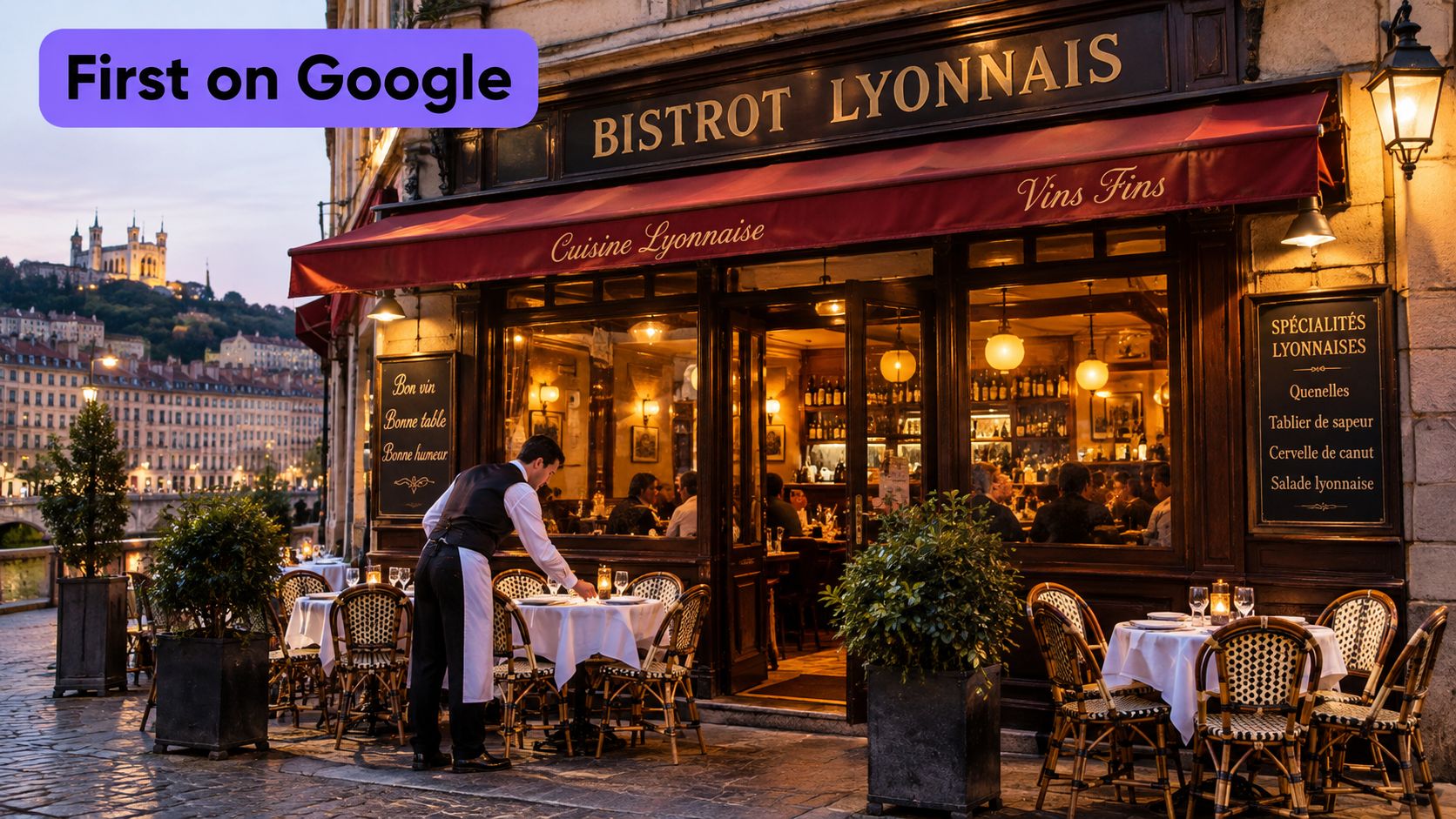
The business may have done the hard SEO work already, clean title tags, decent local pages, reviews, and a Google Business Profile that converts. But AI answers don't work like the classic blue links page. They synthesise, they compare, and they choose what they can interpret quickly.
Practical rule: If an AI system can't extract your business facts cleanly, it won't confidently recommend you.
That's why a strong Google presence doesn't guarantee visibility inside assistants. Search still rewards the page that matches intent best. Generative systems care more about whether your identity, offer, proof, and locality can be assembled into a trustworthy answer.
For a French SMB, this matters because the budget is never infinite. A lot of agencies sell GEO like a replacement for SEO, which is nonsense. The smarter move is to treat them as two layers with different jobs, then decide which customer questions belong in each layer.
If you want the tactical version of that logic, this practical GEO playbook is a useful next read, because it focuses on getting cited rather than just getting indexed.
What SEO and GEO Actually Mean in 2026
SEO, in plain English, is the discipline of making a website easier for search engines to crawl, understand, and rank. That means pages, links, technical hygiene, structured content, and local relevance all working together so Google or Bing can place the right URL in front of the right searcher.
GEO, or generative engine optimisation, is different. It's the discipline of making your business information easy for AI systems to retrieve, interpret, and cite inside a generated answer. The target isn't the blue link. It's the recommendation, the mention, or the attributed answer.
The distinction sounds subtle until you manage it day to day. SEO asks, “How do we rank this page?” GEO asks, “How do we make sure a model can trust and reuse this fact?” Those are not the same question, and they don't use the same proof.
A solid overview of the mechanics is Data Hunters Agency's GEO guide, because it separates answer visibility from classic ranking in a way many marketers still don't. The useful part isn't the jargon, it's the reminder that the evidence has changed. AI systems want clean business facts, well-structured service pages, FAQs, reviews, and consistency across the web.
Wispra's definition of generative engine optimisation lines up with that same idea. GEO isn't a prettier label for SEO. It's a different optimisation target with a different success condition.
Short version: SEO helps people find your page. GEO helps AI systems find reasons to mention your business.
That difference affects how you brief an agency. If they talk only about keywords and rankings, they're selling SEO. If they talk about citation-ready facts, entity consistency, and prompt visibility, they're talking GEO. You need both conversations, but you shouldn't confuse them.
A Head-to-Head Comparison Across the Criteria That Matter
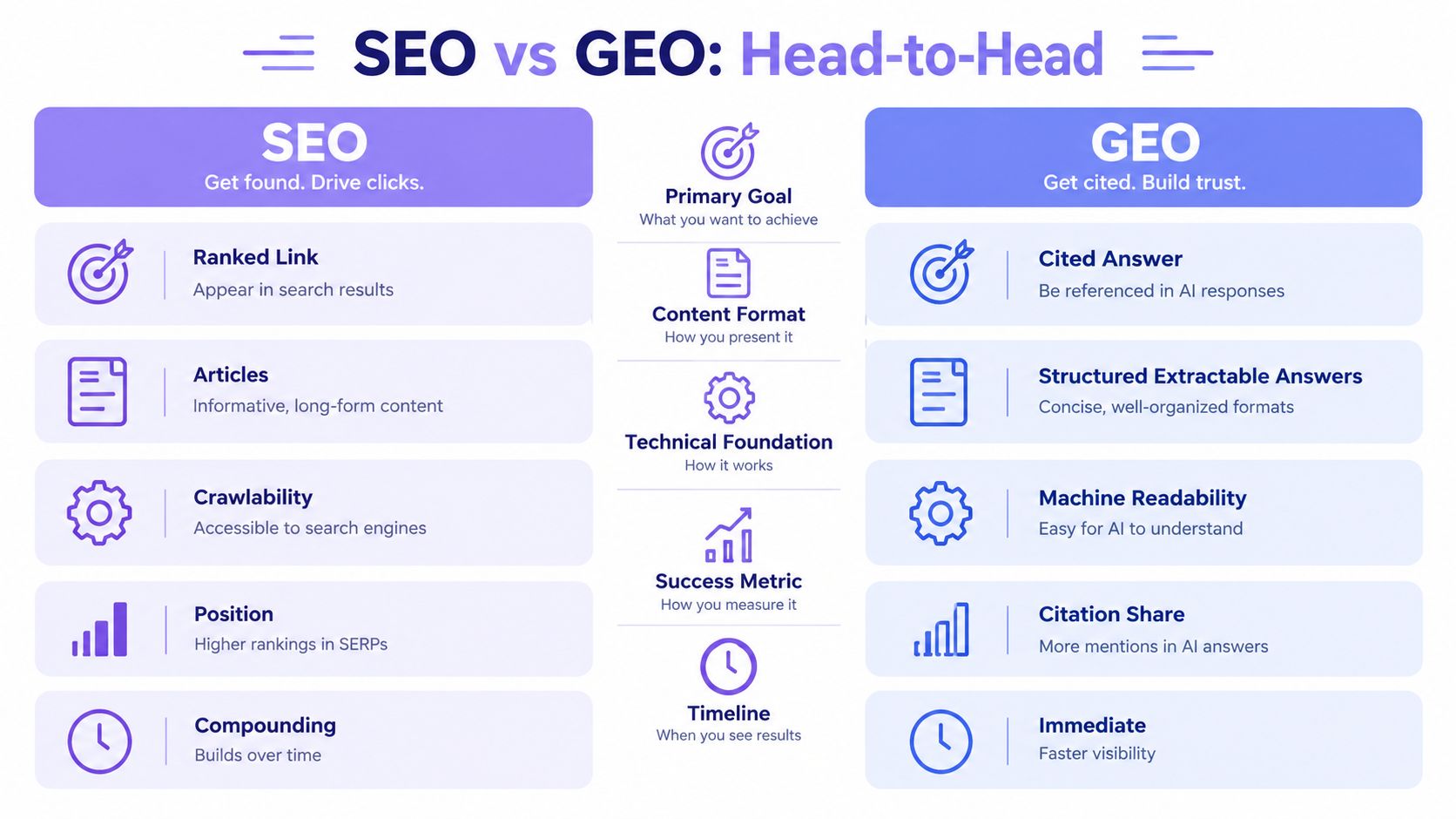
| Criterion | SEO | GEO |
|---|---|---|
| Primary goal | Rank a page in search results | Get cited or recommended in an AI answer |
| Content format | Full pages built for human and crawler consumption | Concise, factual, extractable passages |
| Technical foundation | Crawlability, internal links, speed, indexation | Machine-readable facts, entity clarity, consistency |
| Timeline | Tends to compound over time | Can surface faster when evidence is already clear |
| Success metric | Position, traffic, and conversions | Citation rate and recommendation share |
The first trade-off is goal setting. SEO wants the click. GEO wants the answer. If your business depends on a user comparing several options before buying, SEO still matters enormously. If your business depends on being the one option the assistant names, GEO has to be in the mix.
The content format changes the work
SEO content can be broader, more exploratory, and built to satisfy a search journey. GEO content has to be easy to lift into an answer without the model doing much extra work. That means tighter facts, cleaner wording, and less fluff.
For an owner, this changes briefs. You don't ask for “more content” and hope it works everywhere. You ask for pages that rank, and you ask for answer-ready blocks that a model can quote or summarise cleanly.
The technical foundation also shifts
SEO still cares about crawlability, site structure, and internal linking. GEO still benefits from those basics, but it adds a layer of machine readability. If your company name appears one way on your site, another way on directories, and a third way on review pages, you're making life harder for AI systems.
Rule of thumb: clean structure helps both channels, but GEO punishes inconsistency faster.
If you're evaluating tools, 10 AI SEO tools for SEO and GEO in 2026 is a good example of how the market is starting to split. Some tools still optimise for classic visibility, others are trying to measure answer-level presence. The important bit is to know which problem you're buying for.
The French Market Reality That Shapes Your Investment
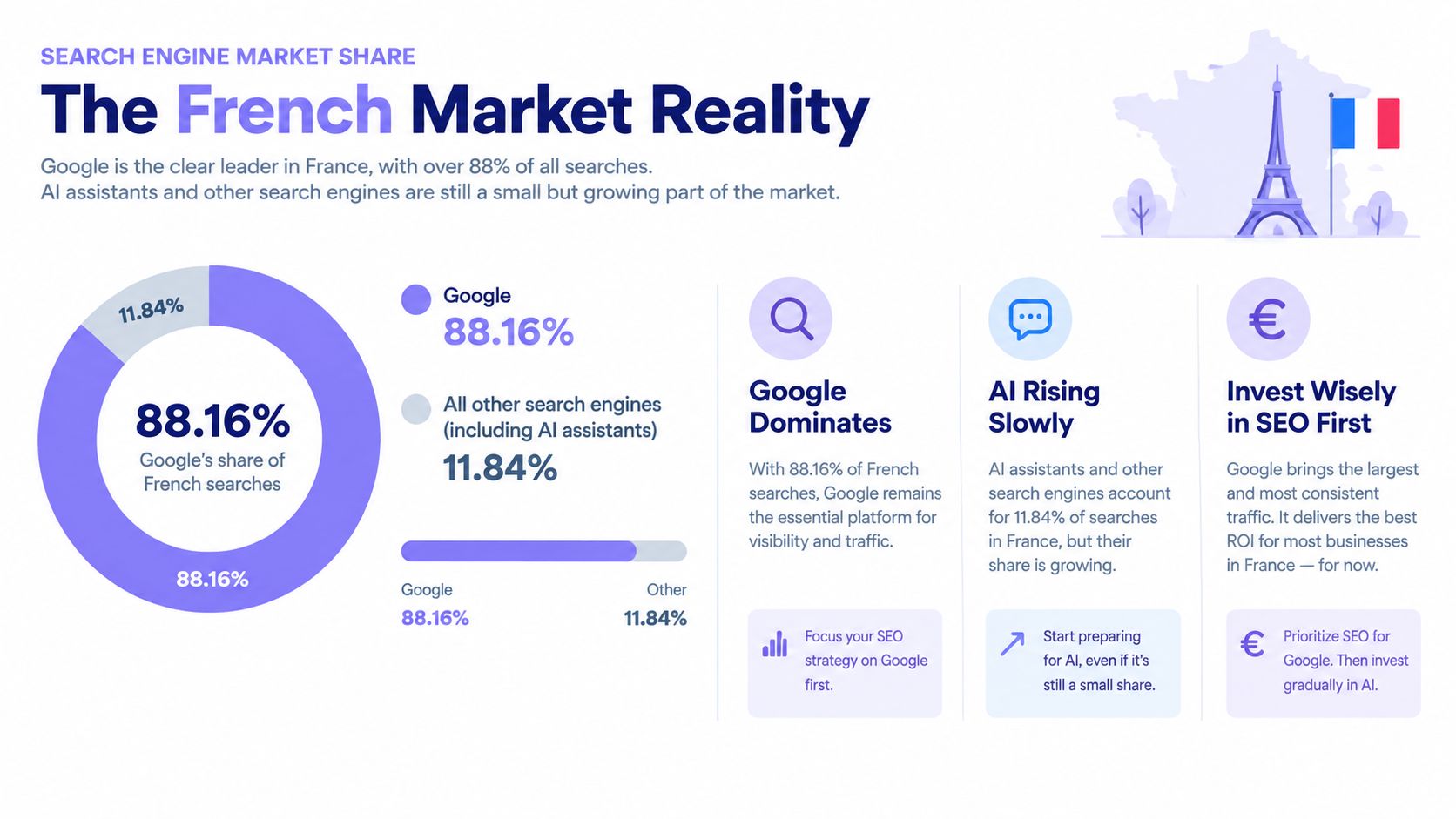
French SMBs should treat SEO as the default visibility spend. Google still dominates search in France, so the biggest share of commercial discovery continues to pass through classic search results. Ignore that base and you starve the channel that already proves demand.
GEO deserves budget too, but for a different reason. The goal is not to replace SEO, it is to add a second visibility layer where AI answers shape what buyers hear first. That layer is still early, yet French adoption of AI inside businesses is moving fast enough to change expectations, especially in firms that already work with digital tools and structured content (Insee via France's AI adoption publication.)
What that means for budget
Do not split spend evenly just because GEO sounds new. That is a weak allocation. Start by protecting SEO, because it still carries the broadest demand capture, then fund GEO on top of it where assistant-driven discovery can affect purchase decisions.
For a local business, the order is simple. Keep Google fundamentals strong, then add the facts AI systems can reuse with confidence. For an e-commerce store, product and category pages still need SEO discipline, while product attributes, FAQs, and comparison copy should also be written in a way an assistant can lift without guessing.
Outrank's guide to AI SEO for small business is useful here because it reflects the practical trade-off smaller teams face. The right question is not whether to chase GEO or SEO. It is how much budget goes to defending proven search demand, and how much goes to making sure AI systems can quote you accurately when they start influencing the sale.
Where SEO and GEO Diverge Inside a Weekly Routine
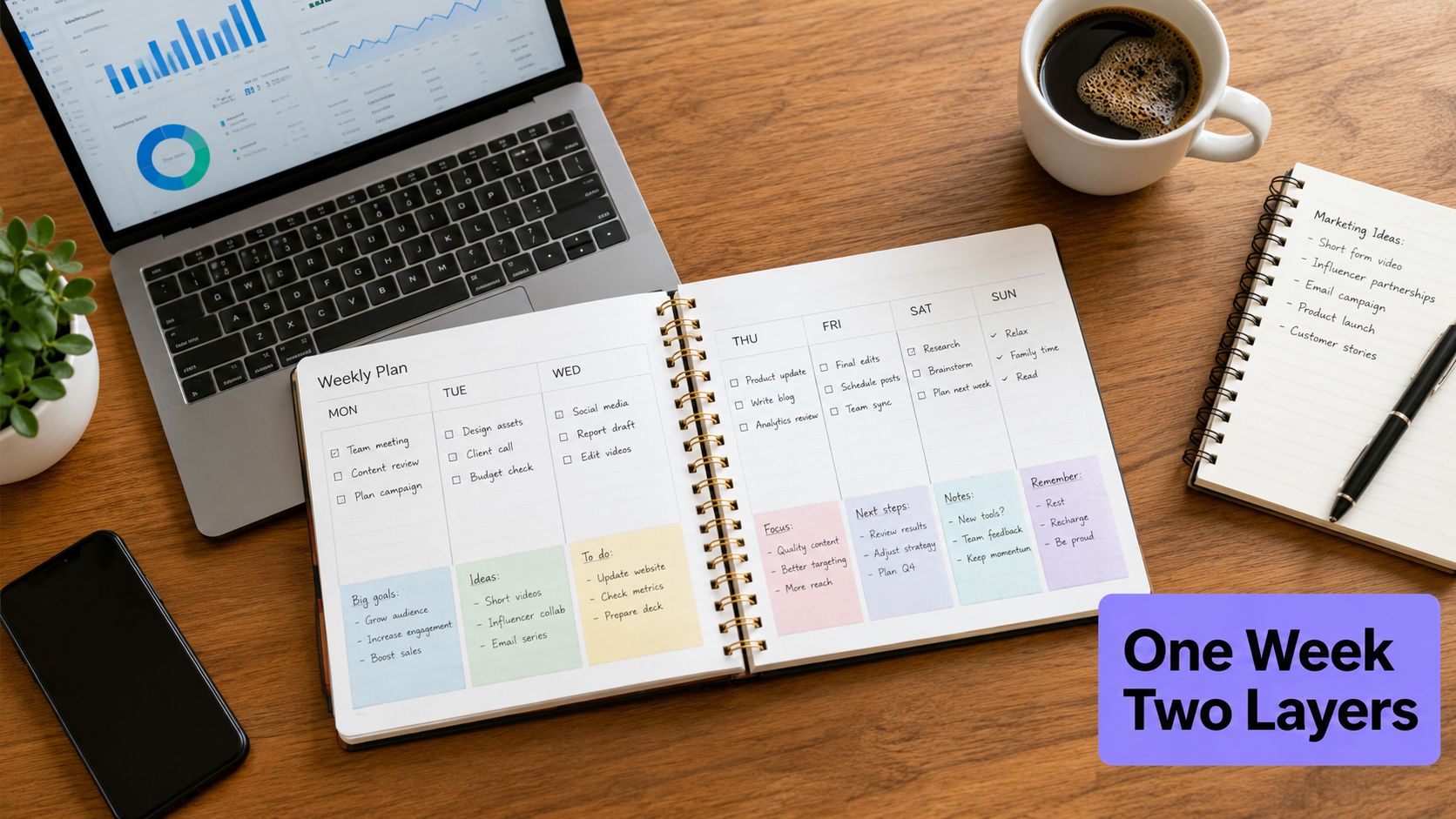
A sane weekly routine doesn't treat SEO and GEO as separate universes. It treats them as overlapping workstreams with different outputs. The overlap is real, but the evidence each channel needs is not identical.
For SEO, the weekly jobs are familiar. Check technical health, refresh pages that have gone stale, keep internal links tight, and review local listings so your business details don't drift. For GEO, the weekly jobs are more about proof, not polish. Make sure your business facts are current, your services are described in plain language, your FAQs answer actual buyer questions, and your review evidence is easy to reuse.
What to keep in the SEO lane
SEO tasks are still the hygiene work that keeps the site discoverable. Page titles, crawl errors, location pages, image alt text, and link structure still matter because they help search engines interpret your site. Ignore those and GEO won't save you, because the foundation will be weak.
What belongs in the GEO lane
GEO needs source material that AI systems can lift safely. That means product specs, opening hours, service areas, credentials, comparison points, and short explanatory blocks that answer common prompts without drift. It also means reviewing the prompts you want to win on, not just hoping your homepage gets surfaced.
A simple prompt set works better than a vague brainstorm. Test your brand against queries by city, by service, and by intent. Then note whether the assistant cites you, recommends you, or skips you entirely.
The best overlap asset is often an FAQ. A well-written FAQ page can help both SEO and GEO, because it clarifies intent for crawlers and gives AI systems a cleaner answer block. That's the sort of content worth creating once and using twice.
If you want one sentence to give your team, use this: SEO keeps the site eligible, GEO makes the business recommendable.
Measuring Visibility Without Mistaking Traffic for Performance
A weekly GEO report should not look like a standard SEO report with a different label. If you judge both channels only by traffic, you'll misread the work. SEO still cares about rankings, clicks, and conversions. GEO cares about whether the assistant names you at all.
The clearest baseline I've seen for France comes from the Reuters Institute's 2025 YouGov survey, which found 29% of French respondents had seen an AI-generated search answer in the previous week, compared with 54% across the six-country sample, before Google AI Overviews expanded in France (Reuters Institute survey). That makes one thing obvious. AI answers are already part of the discovery journey, even if they're not yet the only journey.
Use separate scorecards
For SEO, track the metrics you already know. For GEO, build a prompt-based audit. Use a fixed set of prompts, log whether your brand is cited, whether it's recommended, and whether the mention is positive, neutral, or negative.
Good measurement question: did the assistant name us when the user asked for a provider like us?
That question matters more than vanity traffic in this layer. A page can lose clicks because the answer was resolved in the assistant, while the business itself gains qualified awareness. Don't panic if that happens. Check whether downstream actions are holding up.
The mistake to avoid is merging everything into one dashboard and pretending it tells a single story. It doesn't. SEO traffic and GEO citation are related, but they're not interchangeable measures of success.
Channel Allocation Playbook by Business Profile
French SMBs already have enough AI usage to justify channel choices by business profile, not by buzz. France Num reported that 26% of TPE-PME used AI in 2025, with adoption ranging from 23% among 1 to 4 employee firms to 42% among 50 to 249 employee firms (France Num barometer). Smaller firms are still early. Larger small businesses are already using AI in day-to-day operations.
Local service business
If you run a restaurant, clinic, agency, salon, or trades business, put most of your energy into SEO first and use GEO to tighten the facts assistants repeat. Your first KPI is not citation rate alone. It is whether your business details stay consistent wherever a model might pull from. Spend the first 30 days tightening location pages, updating business descriptions, refreshing FAQs, and checking how assistants describe you.
E-commerce store
If you sell products, split the work more evenly. SEO still drives category and product discovery, while GEO helps when product pages are structured, specific, and easy to compare. Watch whether assistants mention your brand for product-type prompts. In the first month, clean up product attributes, write comparison copy, and make sure specs and benefits are stated plainly.
Agency or freelancer
If you sell expertise, GEO deserves real attention because buyers increasingly ask AI systems who to trust. Start with proof assets, case summaries, service pages, and short explainers that show competence without fluff. The first KPI is citation quality, not just frequency.
For smaller teams mapping this work, AI SEO for small business gives a practical way to sequence visibility work without overcomplicating it.
The question in 2026 isn't SEO or GEO. It's which customer questions should lead to a click, and which should end in a recommendation.
My recommendation is simple. Keep SEO funded, because it still carries most conventional demand. Add GEO where your facts, reputation, and service clarity can change what an assistant says.
If you want a team to help you make that split without wasting budget, Wispra helps businesses track AI visibility, organise the facts assistants use, and turn GEO into something measurable. If this topic is on your desk now, visit Wispra and use it to build a visibility plan that fits your market, not a generic one.