
Professional Liability Insurance for Auto-Entrepreneurs: The Complete 2026 Guide
Master professional liability insurance coverage, costs, and legal obligations in this practical 2026 guide for French freelancers.
Professional liability insurance isn't automatically mandatory for every auto-entrepreneur in France, but any vehicle used for professional activity must be insured for that use, whether owned or leased. The obligation for professional liability depends on the activity and the regulations governing it.
You may be a consultant driving to a client, a delivery driver using a leased van, or a tradesperson carrying equipment between building sites. Your personal motor policy may appear perfectly valid until an insurer asks why the journey wasn't private. At that point, the difference between professional vehicle liability and professional service liability becomes financially important.
Professional liability insurance, or responsabilité civile professionnelle, protects against claims arising from the service itself, such as an error, omission, or professional mistake. Motor insurance covers damage caused through use of the vehicle. They solve different problems, and buying one doesn't automatically replace the other.
The Hidden Risk Most Auto-Entrepreneurs Miss
A consultant visits a client in Lyon, parks outside the office, and reverses into another vehicle. The accident looks ordinary until the insurer checks the journey. If the policy covers only private driving or home-to-work travel, the declared use may not match the actual business trip.
A delivery driver can face the same problem for another reason. The van may be insured, while the contract excludes deliveries or transporting goods. A mobile technician carrying tools to customer premises and a sales representative travelling between appointments also use their vehicles as part of the business, not solely for commuting.

French public guidance requires insurance for vehicles used for professional activity, including owned and leased vehicles, and covers professional journeys involving goods or passengers (official guidance on vehicle insurance for business use). A personal motor policy may therefore leave a gap unless professional use is declared and the contract matches the work performed.
Two claims, two insurance policies
The boundary becomes clearer when the same appointment creates two separate losses. If the consultant gives incorrect technical advice and the client suffers a financial loss, the motor policy will not normally respond. The allegation concerns the professional service, so it falls under professional liability insurance.
Motor insurance covers bodily injury or property damage caused through use of the vehicle. Professional liability insurance covers damage attributed to the work, advice, design, installation, data handling, or another service. One appointment can involve both risks, but each is assessed under a different contract.
The activity description matters as much as the policy name. A cheap professional liability insurance contract can be ineffective if it lists consulting while the business also installs equipment, transports goods, or performs technical work. Ask the insurer to confirm the declared activities and professional vehicle use in writing, then check that the wording covers the journeys and services that generate revenue.
France Assureurs reported 13.2 million new insurance claims handled in 2024, with automobile claims representing 64% of that total (France Assureurs data reported through French public administration guidance). For an auto-entrepreneur, insurance protects two distinct parts of the business: the vehicle used to reach or serve clients, and the professional work performed once the service begins.
Understanding Legal Obligations and Coverage Requirements
Start by identifying which part of your activity creates the legal obligation, rather than shopping for a professional liability insurance package first.
French rules separate the vehicle from the profession. A car, van, or other vehicle used for professional journeys must be insured for that use, whether you own, lease, or otherwise use it. The requirement also covers transporting passengers or goods. The applicable rule was outlined earlier.
Professional liability insurance follows a different logic. French government guidance makes compulsory cover depend on the activity, not solely on auto-entrepreneur status (French government guidance on compulsory business insurance). Some regulated professions have specific obligations, while consulting or digital work may leave professional liability insurance optional. Client contracts and the financial consequences of an error can still make it a sensible choice.
Use this activity test
Describe the work you perform, rather than relying on the broad label used for registration.
- Regulated services: Legal and healthcare professions can face professional indemnity requirements.
- Building work: Tradespeople may need additional cover, including ten-year liability where applicable.
- Transport activity: The motor policy must state commercial transport, not only private driving.
- Consulting and digital work: Check client requirements and exposure to financial loss, even where professional liability insurance is not automatically required.
- Mixed activities: Adding implementation, data handling, installation, or site visits can change the insurance requirements.
The wording on the certificate matters more than the product name. A policy describing “consulting” may exclude implementation, subcontracting, technical configuration, or physical work at a client's premises. Confirm every revenue-generating activity with the insurer and request the response in writing.
For a wider explanation of liability cover across contractor activities, consult these contractor liability coverage basics. French readers can also review this guide to professional civil liability, which explains the distinction between motor liability and professional civil liability.
The minimum motor requirement is third-party liability for damage caused through vehicle use. Theft, fire, broken glass, vehicle damage, legal assistance, and equipment protection may be added, but these guarantees do not replace professional liability insurance. Verify both contracts against the exact journeys and services you sell.
Coverage Scope and Typical Policy Exclusions
A policy responds to the risks it defines. That sounds obvious, yet many disputes begin with a business owner assuming that “professional liability” covers every bad outcome connected with the business.
Consider three activities:
| Situation | Main risk | Cover to investigate |
|---|---|---|
| Consultant gives commercially harmful advice | Financial loss caused by advice | Professional liability insurance wording for errors and omissions |
| Web professional loses or mishandles client data | Data-related loss and service disruption | Professional liability insurance extensions, cyber cover, or exclusions |
| Tradesperson damages a client's property while working | Physical damage during the service | Professional liability insurance and activity-specific wording |
The table isn't a substitute for the policy wording. It's a prompt to ask precise questions. Some policies restrict consequential financial loss, exclude particular technical services, limit work performed abroad, or treat subcontractor activity separately. A low-cost certificate may exist while the relevant scenario remains outside the insured activity.
The activity-matching trap
A web professional who only designs pages may later add implementation. A consultant may begin processing sensitive client data. An online seller may add installation or customer-site delivery. If the insurer still sees the original, narrower activity, the contract may not reflect the work that caused the claim.
The issue isn't solved by selecting a higher indemnity limit. A larger limit for the wrong activity remains the wrong protection. Check the definitions, exclusions, territorial scope, deductible, and whether the policy covers financial loss without physical damage.
The contractor insurance requirements explained resource can help frame the wider questions, but French auto-entrepreneurs still need to apply them to their own policy and regulated activity.
A deductible is another trade-off. It's the amount you bear before the insurer contributes, so understand what an insurance deductible means before comparing premiums. A cheaper policy with a deductible you can't comfortably fund may be less useful than a moderately more expensive policy with clearer claim terms.
Cost Ranges and Price Comparison Strategies
French sources commonly present indicative professional liability insurance pricing of roughly €100 to €200 annually for low-risk activities, with materially higher costs for higher-risk businesses (indicative professional liability insurance pricing and coverage factors). Treat that range as orientation, not a quotation.
The insurer prices the risk described in the application. Activity, turnover, claims history, territory, indemnity limits, deductibles, and optional guarantees all influence the result. For vehicle cover, the number of vehicles, vehicle type, usage, driver profile, location, and selected protections also matter.
Compare like with like
Request quotations using the same written information. If one insurer receives “consulting” and another receives “consulting, client data handling, implementation, and training”, the prices and exclusions may not be comparable.
Ask each provider to quote against identical:
- Activity description: Include every service you sell.
- Limits: Compare the same indemnity ceilings.
- Deductibles: Record the amount and the situations where it applies.
- Territory: Confirm where you work and where clients are based.
- Guarantees: Separate core professional liability insurance from cyber, legal protection, equipment, or business interruption options.
- Vehicle use: State visits, deliveries, equipment transport, passengers, and expected mileage.
A monthly premium is easy to compare because it's visible. The difficult comparison concerns what happens after a claim. Read the exclusions and ask the insurer to answer scenario questions in writing.
A certificate proves that a contract exists. It doesn't prove that every service, journey, loss, or jurisdiction is covered.
For many freelancers, the right decision isn't the broadest package. It's the policy whose description accurately matches the work and whose exclusions are understandable. Paying for guarantees unrelated to the business wastes money, but removing a relevant extension merely to obtain the lowest premium creates a different problem.
Step-by-Step Process to Purchase and Declare Coverage
Start with a complete activity inventory. Include the work you perform occasionally, not only the service that appears on your website. Note customer visits, deliveries, transported tools, passengers, subcontractors, foreign work, data access, and the annual mileage relevant to business journeys.
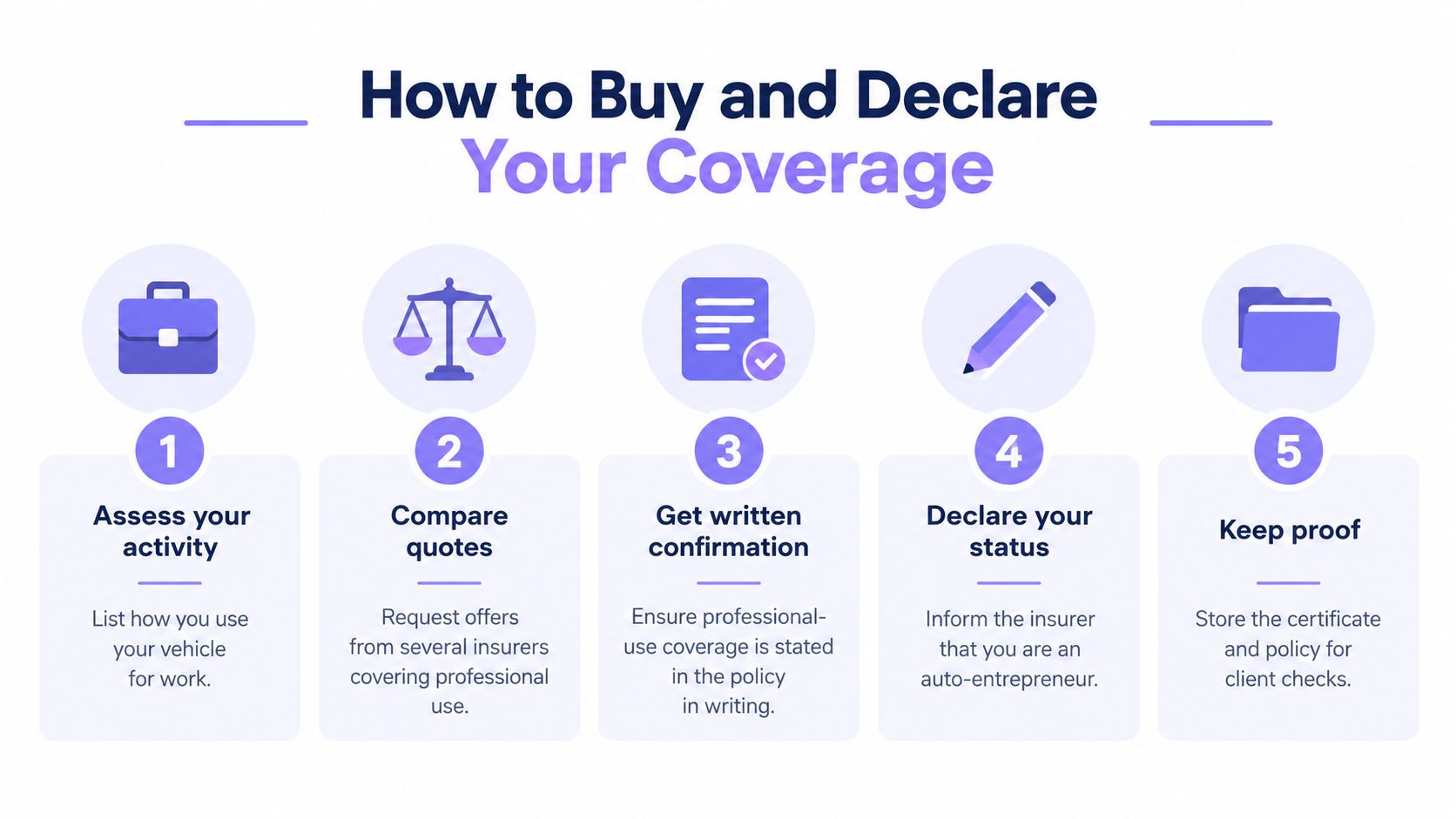
A practical purchase sequence
- Describe the activity precisely. Use plain language and identify every service that appears on invoices or contracts.
- Separate vehicle and service risks. Obtain motor quotations that explicitly include professional use, then assess professional liability insurance for mistakes, omissions, property damage, and financial loss.
- Request written confirmation. Ask the insurer to confirm customer visits, deliveries, equipment transport, passengers where relevant, and business mileage.
- Check the policy schedule. Verify the activity, geographical scope, effective date, exclusions, deductibles, and indemnity limits.
- Record changes. Notify the insurer when you add a service, change your vehicle, begin subcontracting, expand territory, or alter how the vehicle is used.
Bpifrance identifies the activity description, geographical scope, effective date, exclusions, deductibles, and indemnity limits as important items to verify on professional insurance documentation. Keep the proposal, policy wording, schedule, certificate, and written answers together.
The declaration should be consistent across the insurer, your contracts, and your own records. If your certificate says one thing while your invoices show another, the certificate won't repair the mismatch.
If an incident occurs, notify the insurer promptly and preserve relevant contracts, messages, estimates, photographs, and delivery records. This practical guide to reporting an insurance claim can help organise the first steps, but follow the deadlines and procedure in your own policy.
Real-World Examples and Claim Scenarios
A delivery driver transports goods to a customer and has a collision en route. The third party's bodily injury or property damage belongs to the motor liability policy, provided the policy declares professional delivery use. Damage to the van, stolen goods, or tools may require separate guarantees, depending on the wording.
If passengers are transported for payment, the insurer must also understand that use. A personal-use policy can't be assumed to cover a commercial passenger journey merely because the vehicle itself is insured.

The service claim looks different
A consultant recommends a supplier and the client later alleges that the recommendation caused a financial loss. No vehicle may be involved in the event at all. The relevant questions concern the insured activity, professional error wording, financial loss definitions, defence costs, exclusions, and deductible.
A web professional has a data-loss incident after implementing a client system. A basic professional liability insurance policy may not automatically cover every cyber-related cost, recovery expense, notification obligation, or interruption loss. The professional must check whether cyber protection is included, excluded, or available as an extension.
Higher limits don't cure narrow wording
A tradesperson buys a substantial indemnity limit but the policy describes only repair work. Later, the tradesperson provides design advice and performs installation through a subcontractor. If the claim concerns the unlisted design service or the subcontractor's work, the limit may be irrelevant because the activity itself is disputed.
That's why claim analysis should follow this order:
- Identify the event: Was it road use, professional advice, physical work, data handling, or a combination?
- Match the contract: Which policy describes that activity?
- Read the exclusion: Does the wording remove financial loss, subcontracting, foreign work, or a particular product?
- Check the evidence: Do invoices, contracts, emails, and the certificate support the declared activity?
An insurer's certificate can satisfy a client's procurement process, but it isn't a guarantee that every alleged loss will be indemnified. The wording decides the boundary.
Common Misconceptions and Critical Pitfalls
The most expensive misconception is that minimum legal cover equals adequate business protection. Motor third-party liability may satisfy the legal baseline for vehicle use, but it doesn't address a client's claim that your advice, installation, design, or service caused a loss.
Another mistake is treating professional liability insurance as automatically mandatory because you're self-employed. The obligation depends on the activity and applicable regulation. However, an activity that isn't legally required to carry professional liability insurance can still expose you to contractual demands, financial claims, or a client refusal to sign.
Check your policy before the next job
Use this short verification list:
- Vehicle use: Is business use declared for every vehicle, including leased vehicles?
- Journey type: Are customer visits, deliveries, passenger transport, equipment, and mileage described accurately?
- Professional activity: Does the professional liability insurance schedule list every service you sell?
- Financial loss: Are losses without physical damage covered, restricted, or excluded?
- Additional parties: Are subcontractors, employees, or partners addressed?
- Territory: Can you work where your contracts require, including outside France if relevant?
- Changes: Have you informed the insurer about new services or a different vehicle use?
- Evidence: Do you hold the current policy wording, schedule, and certificate?
Failure to disclose regular business use can create a coverage dispute because the declared risk doesn't match the actual use, particularly for delivery drivers, mobile technicians, sales representatives, and service providers travelling to customers (French guidance on declaring professional vehicle use).
Don't choose a policy from the certificate alone. Describe activity, obtain written confirmation, and test the contract against realistic scenarios. For auto-entrepreneurs who also need to build visibility around their services, Wispra offers an AI-optimised business directory, content tools, and AI visibility tracking for platforms such as ChatGPT, Perplexity, Gemini, and Google AI.
Review your motor policy and professional liability insurance wording against your actual journeys, services, and client contracts, then ask your insurer to confirm any uncertain point in writing. Visit Wispra to explore tools that can help make your professional offering easier to discover in AI search results.