
Saint Maurice Nice Neighborhood: Living, Transport and Prices
Saint Maurice Nice explained: transport, schools, rents, lifestyle and who the district suits best, with 2026 facts for buyers and renters.
97% of Saint-Maurice's homes are apartments, according to the Orpi neighborhood profile. That's the useful starting point for understanding this district: your quality of life will depend as much on the building entrance, lift and street outside as on the flat itself.
If you're searching for “Saint Maurice Nice Neighborhood”, don't stop at descriptions of a convenient residential neighborhood. Saint-Maurice deserves a place on your shortlist, but walking distance and genuine accessibility aren't interchangeable. The Place Alexandre-Médecin redesign will be a practical test of whether residents can move around more comfortably.
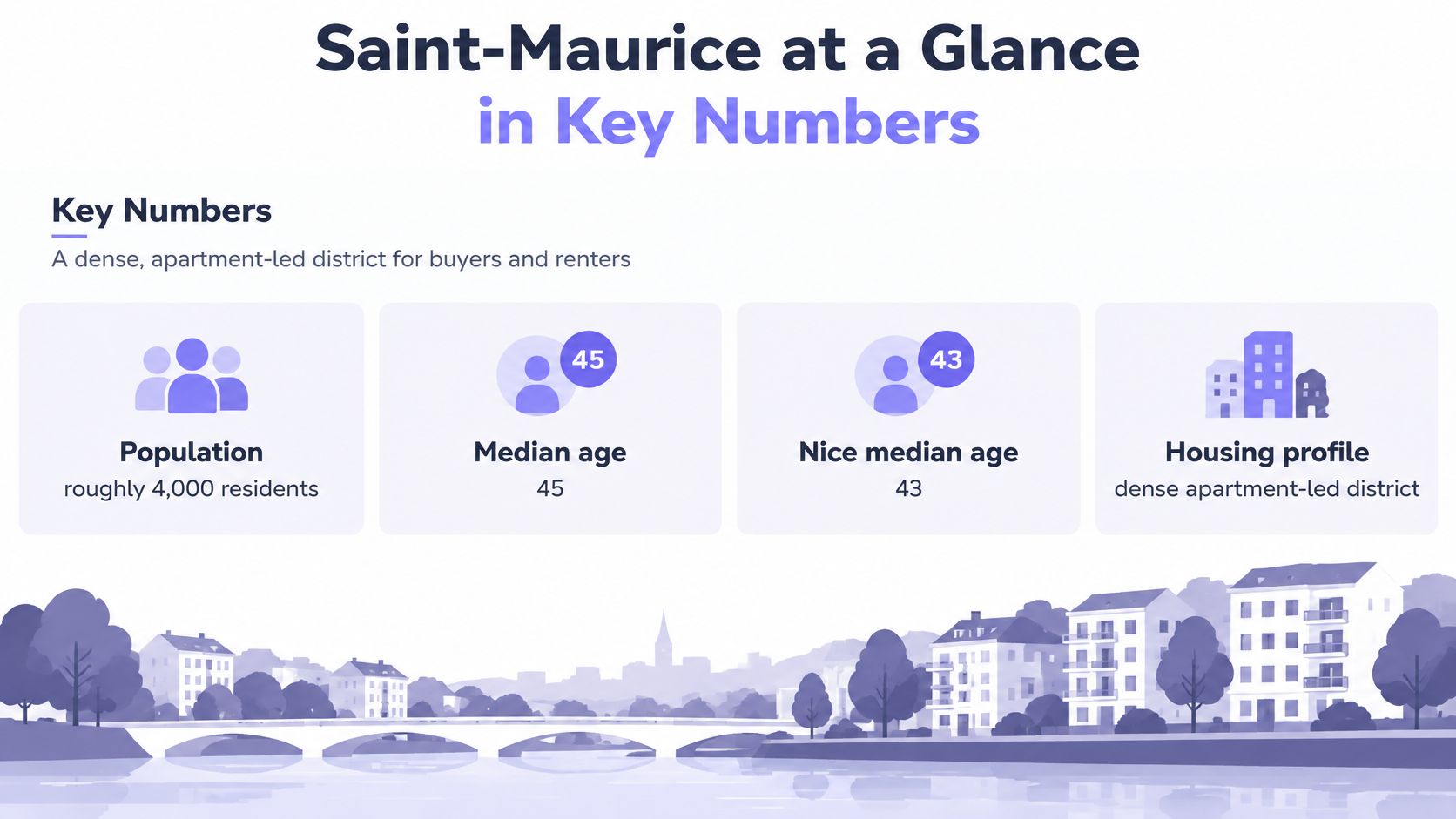
Saint-Maurice at a Glance in Key Numbers
Saint-Maurice is an apartment-led residential district, not a villa neighborhood disguised by estate-agent language. The profile below combines contemporary neighborhood estimates with older population counts, which need different interpretations.
Saint-Maurice key indicators
| Indicator | Value | Context |
|---|---|---|
| Population, 1975 | 14,936 | Earlier municipal boundary |
| Population, 1999 | 13,181 | Earlier municipal boundary |
| Population, current estimate | 3,940 to 4,016 | Current neighborhood profile, potentially different boundary |
| Median age | 45 years | Nice overall: 43 years |
| Homes that are apartments | 97% | Houses make up 3% |
| Residents under 20, aged 20 to 60, over 60 | 22%, 54%, 25% | Current neighborhood profile; rounded categories |
| Unemployment rate | 17% | Neighborhood estimate |
| Poverty rate | 20% | Neighborhood estimate |
| Nice citywide population | 357,737 (2023) | Up from 340,017 in 2017, according to INSEE |
The historical counts, neighborhood estimates and INSEE citywide context summarized here appear in the profile linked above. They aren't interchangeable measures of the same geographical area.
Don't mistake a boundary change for population collapse
The apparent gulf between the historical population and the current estimate doesn't establish that residents abandoned Saint-Maurice. The sources may draw the neighborhood differently, so treating the figures as a continuous population series would be misleading.
Nor should you assume that the boundary explanation has been fully reconciled. For an investment appraisal, ask for the precise statistical perimeter, ideally matched to the relevant INSEE Iris areas, before making claims about population growth or decline.
The age profile is useful for framing questions about local services. It doesn't tell you whether a particular entrance accommodates a wheelchair, whether a nearby crossing is comfortable, or whether an older resident can return uphill carrying groceries.
Read the figures according to your household
- Families: Put usable bedrooms, school access and outdoor space ahead of the headline population. A family-friendly district can still contain an unsuitable building.
- Retirees: Prioritize the entrance, lift, seating opportunities and route to everyday services. Neighborhood age alone isn't evidence of accessible design.
- Investors: Treat the economic indicators as reasons to examine affordability and tenant budgets, not as predictions about individual applicants.
- Business owners: Define your actual walking catchment. A district-wide headcount won't tell you how many customers pass your door.
Buying rule: Compare addresses within the same statistical boundary before comparing neighborhood averages.
Use these indicators to decide what to investigate, not to approve a purchase remotely. The exact building, street and household budget remain the deciding factors.
Getting Around by Tram, Bus, Foot and Car
Walkability means destinations are reachable on foot. Accessibility means the route works for the person using it. Saint-Maurice can suit a household that walks and uses public transport, yet still disappoint someone whose daily journey involves a pushchair, walking frame or wheelchair.
The RCF account of Nice Nord modernization places Saint-Maurice alongside Libération, Borriglione and Le Ray within a program intended to improve neighborhood life and pedestrian connections. That ambition isn't proof that every route already works well.
Choose transport from the address, not the district name
Transport and access options in Saint-Maurice
| Mode | What it covers | Best for | Watch-outs |
|---|---|---|---|
| Tram | Address-specific stop and line lookup on the live Lignes d'Azur network map | Commuters into central Nice | Confirm the complete walking route to the stop |
| Bus | Local routes and frequency checked through the live network map and timetable | Shorter trips and school runs | Peak-hour service, return journeys and hill climbs |
| Walking | Daily shops, the square and nearby parks | Families with pushchairs and car-free households | Slopes, kerbs and missing dropped crossings |
| Car and parking | Street access, parking and suitable drop-off points | Tradespeople, carers and shoppers carrying heavy loads | Temporary restrictions around the square |
| Cycling | Address-to-destination route checked against the city cycle map | Confident riders with a short commute | Gradients, junctions and shared streets |
Don't accept an unverified tram-stop name or a reassuring bus symbol on a property listing. Open the live Lignes d'Azur map, enter the proposed address and test the journey at your actual departure time.
For households comparing vehicle options, Punk Ride LLC's guide to electric bikes or cars for city travel offers a useful starting point. Apply that comparison to secure cycle storage, hill starts, carrying children and transporting shopping, rather than treating an electric bike as an automatic car replacement.
Run the journey under realistic conditions
Test the return trip, not just the downhill outward walk. A route that feels easy with empty hands can become exhausting after shopping or collecting a child.
Look for shade, places to rest and crossings that align with the pavement. Check whether a carer can stop without blocking traffic, and whether a delivery driver can reach the entrance without mounting the kerb.
Before committing:
- Time the food-shop journey using the pushchair, mobility aid or shopping trolley you'll normally need.
- Count usable crossings, noting dropped kerbs, awkward cambers and obstructions.
- Check peak-hour departures and the service available when you return home.
A successful car-free move starts with a repeatable daily journey, not a favorable distance on a map.
Schools, Shops and Local Businesses Day to Day
School allocation should come first in a family's search. The nearest school is not necessarily the one assigned to your address, so confirm the catchment and admission arrangements with Nice's education service before choosing a home.
Everyday errands depend on where you live within Saint-Maurice. A convenient grocery shop does not guarantee an easy trip to childcare, a pharmacy or an after-school activity.
Build a household service map
| Daily need | Where to look | What to check before moving |
|---|---|---|
| Nursery and primary schools | Nice education service and its address-based school information | Allocation, registration, canteen and after-school arrangements |
| Collège and lycée | Departmental and education-authority sector information | Sector, options and the pupil's actual journey |
| Groceries | Main streets and adjoining commercial areas | Range, opening hours and how you will carry shopping home |
| Markets | Municipal market information | Operating days and the return journey with bags |
| Health | Pharmacy and practitioner directories | Appointment availability and entrance accessibility |
| Community services | Nice municipal and association directories | Eligibility, timetable and location |
| Green space | Nearby public squares, including Square Jean-Baptiste-Carpeaux | Entrance, seating and suitability for your household |
| Independent businesses | Main-street cafés, shops and services | Current offer, opening hours and step-free entry |
Use the Nice education service to confirm school allocation, and check municipal information for market days and community services. For groceries and independent businesses, verify the options around the specific address: opening hours, what is available and whether the entrance works for your household. Directories can help you identify places to check, but they cannot tell you whether a daily trip will feel practical.
Be careful with similarly named neighborhoods. Centre social Albert Jacquard in Saint-Maurice Pellevoisin is in Lille, not Nice, so it does not belong on a Nice amenities shortlist.
Wispra is a French SaaS platform for businesses seeking recommendations from AI search engines. It is not a neighborhood walk-in service, so use its online platform rather than planning an in-person visit.
Visit when the neighborhood is being used
Visit during a school run and on a Saturday morning. The school run shows how families use local routes; Saturday helps you judge whether nearby shops suit your routine.
Check independent cafés and services directly. A directory listing may not reflect current opening hours, and an attractive frontage does not confirm that you can enter with a buggy.
A useful neighborhood shop is one you can reach, enter and use when you need it.
For a prospective shopkeeper, observe where pedestrians pause and which side of the street they favor. Ask neighboring traders about deliveries and customer access during the Place Alexandre-Médecin works rather than assuming approaches will stay unchanged.
How the Place Alexandre-Médecin Works Will Change Daily Life
The planned expansion of Place Alexandre-Médecin from roughly 900 m² to 1,800 m² would give the square more room for neighborhood use. In January 2026, Nice Premium reported that work had begun on a €500,000 initial phase. The announced program included seven trees, 1,400 shrubs and perennial plants, a children's play area, misters, new paving and improved public lighting.
That report describes the program and its reported start, not the exact construction status today or a guaranteed completion date. Check current municipal works information before committing to a move or opening premises.

More greenery isn't the whole test
The proposal changes the balance between cars, pedestrian space and neighborhood activity. A more attractive square is welcome, but appearance alone cannot show whether daily journeys will become easier.
For older residents, check whether seating is comfortable and reachable without a difficult route. Families need room to move with a buggy and clear sightlines around the play area. People with reduced mobility need continuous, unobstructed access, including during construction.
Walkability and accessibility are different tests. Planting totals do not tell you whether someone can reach, cross and use the square independently.
What residents should monitor
- Temporary access: Check which pedestrian approaches remain open and whether diversions are usable.
- Parking and drop-offs: Find out where carers, taxis and tradespeople can stop without blocking the route.
- Noise and dust: Visit a prospective home with the windows open, especially if bedrooms face the site.
- Business deliveries: Ask how unloading will work and whether suppliers need different instructions.
- Completion milestones: Check whether paving is finished and whether the whole public space has reopened.
- Summer comfort: Look for usable shade and seating, not just planting or misters.
Check nearby public spaces against your own access needs before choosing a home. Judge the finished square by whether older residents, families and people with reduced mobility can use it comfortably and independently, not by how green it looks in a rendering.
If a home overlooks the works, assess it on present conditions. Treat any eventual improvement as a possible benefit, not a substitute for a home that works for you today.
Rents and Property Prices You Can Expect
Compare Saint-Maurice homes by layout, condition, access and ongoing costs. Without dated local rental evidence and comparable completed sales, quoting a reliable rent or purchase-price band would mislead you.
A broad Nice average is a poor substitute. So are asking prices for homes that have not sold. A hillside flat with difficult access, a renovated apartment with a lift and a home facing construction are not like-for-like comparisons.
Match the property before comparing its price
What moves rents and prices, by property type
| Property type | What moves the price |
|---|---|
| Studio | Floor, lift access, orientation and construction noise |
| Two-room (T2) | Terrace or balcony, building condition and energy rating |
| Three-room (T3) | Family layout, parking and a quiet street side |
| Four-room or larger | Availability of comparable homes, condition and outdoor space |
| House or villa | Plot usability, slope access and rarity within the apartment-led stock |
For purchases, compare recent DVF completed-sale records, checking transaction dates and whether each property resembles the one you are considering. For rentals, consult relevant Nice rental-observatory evidence and compare furnished homes with furnished homes, and unfurnished with unfurnished.
A T2 has a living room and a bedroom, but that does not guarantee a practical layout. Check whether furniture fits, whether the bedroom faces traffic and whether the advertised floor area works for everyday living.
Price the costs you'll actually pay
Tenants should separate base rent from recoverable charges. Ask what the charges include, how heating and hot water are supplied, and how adjustments are calculated.
Buyers should request the co-ownership accounts, meeting minutes and details of voted or anticipated works. A low asking price can quickly lose its appeal if major repairs are coming.
- Families: Prioritize a workable T3 layout, storage and realistic parking arrangements over floor area alone.
- Investors: Calculate net income after charges, maintenance and vacancy. Do not assume every ownership expense can be passed on to a tenant.
- Buyers who depend on accessible routes: Rule out homes with stairs you cannot use before negotiating. A discount will not fix an unsuitable entrance.
- Renovation buyers: Get quotations for the property's actual defects, including energy improvements, instead of relying on a vague renovation allowance.
For furnished rentals, use this guide to furnished rentals in Nice to organize your questions, then check the property documents and current requirements.
Rare houses and villas need separate comparisons. Plot usability, vehicle access and retaining structures may matter more than an apartment-style price-per-square-meter comparison.
Pay for a home that works today. Treat unresolved access, building repairs and promised public-space improvements as risks, not reasons to accept a finished-home price.
Who Saint-Maurice Suits and Who Should Look Elsewhere
Saint-Maurice suits households that want an established residential district focused on daily life. It suits car-free households and residents with reduced mobility only when the particular building and route pass inspection.
Household fit for Saint-Maurice
| Household | Fit | Why | Main trade-off |
|---|---|---|---|
| Families with primary-school children | Good if the catchment fits | Potential to combine schooling and nearby green space | Construction disruption and changing parking arrangements |
| Car-free households | Conditional | Public-transport options can support central journeys | Slopes and uncomfortable pedestrian routes |
| Retirees and residents with reduced mobility | Conditional | Residential setting and everyday services | Building access must match individual needs |
| Students and young professionals | Good for a suitable small or shared flat | Potential transport convenience | Residential life rather than central nightlife |
| Investors buying to rent | Conditional on unit economics | Apartment stock offers different letting formats | Building condition, charges and unproven income assumptions |
| Tradespeople and carers | Mixed | Access to residential clients | Stopping and unloading can be difficult |
| Small business owners | Promising for a well-tested offer | Opportunities to serve repeat local customers | Delivery continuity and premises suitability |
Make the decision on non-negotiables
If you need a lift, dependable access to the square and a well-managed building, prioritize the visit and documents over the listing photographs. Don't compromise on an essential feature because the interior has been renovated attractively.
If you want residential surroundings and a practical journey into central Nice, Saint-Maurice merits a serious look. Test that commute before deciding that a particular street fits.
Buyers who need a settled streetscape immediately should be cautious around active works. There's a difference between accepting temporary inconvenience and having no workable daily routine until a project finishes.
For business owners, the right question isn't whether Saint-Maurice is generally improving. It's whether enough reachable customers need your offer, at a price that covers operating from that address.
Check Flood and Access Before You Commit
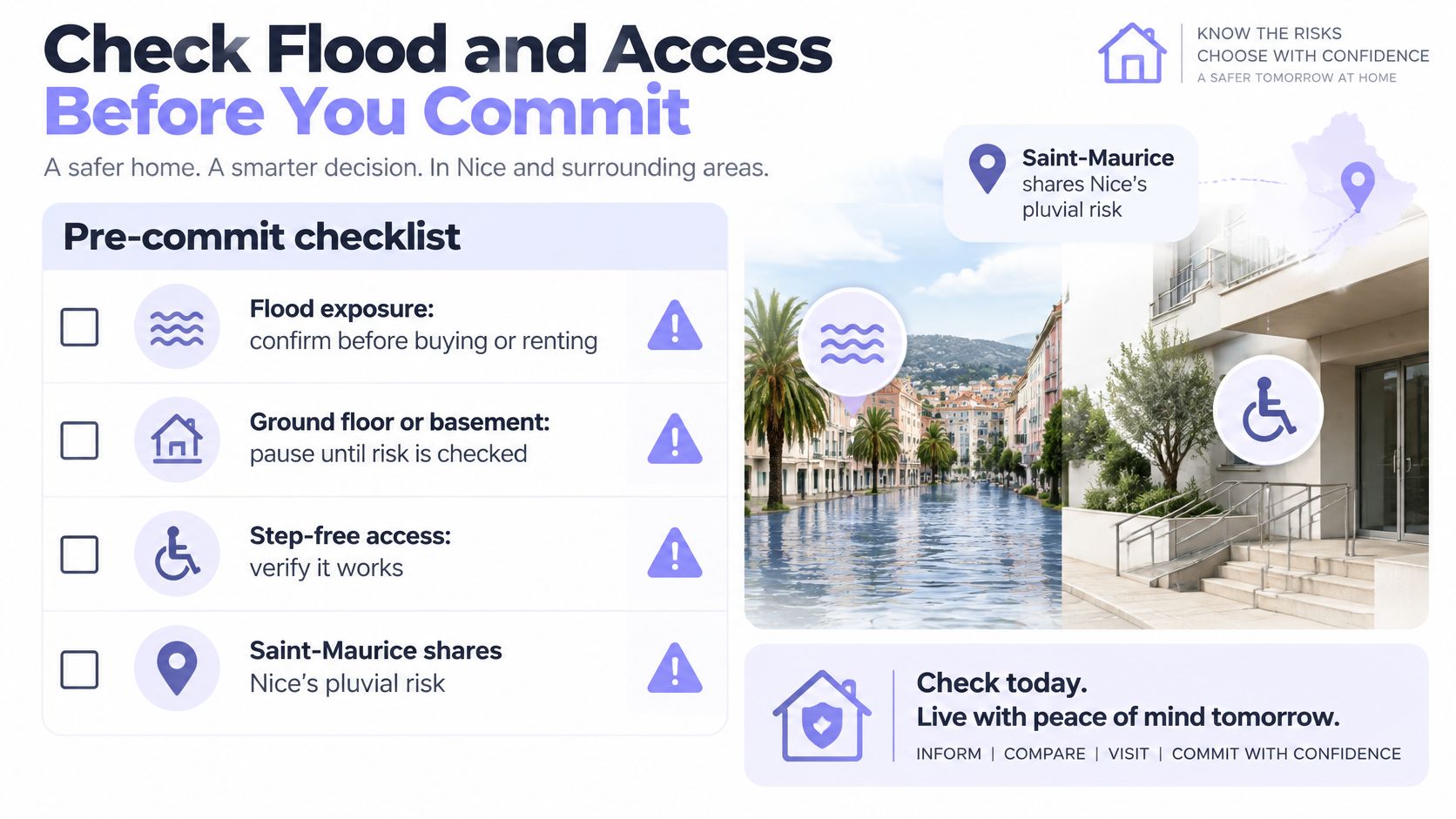
Pause on any ground-floor or basement property until you understand both water exposure and access. The City of Nice's municipal major-risk document identifies street runoff as a potential flooding mechanism in central and valley areas and confirms that local rivers can also generate flood events.
That doesn't establish that every Saint-Maurice property has the same exposure. It means that distance from a river is an inadequate screening method.
Inspect the premises and its approaches
- Locate the exact address on municipal risk mapping. Distinguish river-related exposure from surface-water runoff and read the accompanying information, not just the map color.
- Walk the vulnerable spaces. Inspect ground-floor entrances, basement storage, ventilation openings, electrical equipment and the delivery door. Note whether the street slopes towards the entrance.
- Question wet-weather access. Ask how residents, customers and suppliers would reach the property during intense rain, including when the building itself remains dry.
- Review insurance and operating arrangements. Obtain appropriate cover information before signing. For a business, plan stock storage, supplier instructions and customer communications.
- Resolve essential accessibility failures. Check thresholds, door operation and the route from the street under the conditions the intended occupant will face.
Look for staining, damaged finishes and improvised barriers, but don't treat their absence as proof of safety. Ask the owner or managing agent about previous water ingress and request supporting documents where available.
Set a clear refusal point
Use the apartment-buying guide to keep the wider purchase process organized, while obtaining address-specific answers from the relevant documents and professionals.
For a shop, raise vulnerable stock and avoid placing essential electrical equipment in an exposed low-level space without an appropriate assessment. For a home, make sure the access solution doesn't depend on someone always being available to help.
Unresolved flood exposure or an unusable essential route is a no-go. A greener square, attractive rent or convenient school allocation doesn't cancel those problems.
Wispra helps local businesses make their services easier to discover through AI search, with business listings, content tools and visibility analytics. If you serve Saint-Maurice, make your offer and location clear to prospective customers, then visit Wispra to explore how the platform can support that work.