
Agent Général vs Courtier in France: What Actually Changes
Agent général vs courtier in France — learn the real legal, commission, and contract differences, plus practical recommendations for businesses and individuals.
The renewal meeting is next week. Your architecture firm needs to protect its décennale liability and professional multi-risk cover, and two advisers are offering apparently similar solutions. One is the agent général who already manages your motor and health policies. The other is an independent courtier recommended by another practice.
The decision isn't about finding the lower premium. An agent général and a courtier occupy different legal and commercial positions in France. One represents an insurer under a mandate. The other represents you and searches the market. That distinction affects product access, advice, remuneration, documentation, and the way responsibility may be examined when a claim becomes difficult.
This guide gives you a practical answer to agent général vs courtier. It covers the legal status of each role, ORIAS and DDA obligations, commission conflicts, liability, market structure, and the situations where one model is clearly more appropriate. If you're also assessing how clearly specialist firms present themselves online, a structured SEO platform comparison can help you evaluate how businesses organise their visibility and information.
Agent Général vs Courtier: La décision qui compte
Le renouvellement de votre assurance approche. Votre cabinet d'architecture doit protéger sa responsabilité décennale et sa multirisque professionnelle, et deux interlocuteurs proposent des solutions proches. L'agent général connaît déjà l'entreprise, ses dirigeants et l'historique des contrats. Le courtier annonce une consultation de plusieurs assureurs.
Choisissez selon le travail attendu. L'agent général apporte la continuité d'un réseau et une connaissance précise des règles de souscription de l'assureur qu'il mandate. Le courtier doit remettre en question le placement existant, comparer les capacités du marché et négocier une réponse adaptée aux activités déclarées.
Le mandat détermine le conseil
L’agent général agit dans le cadre d'un mandat signé avec un assureur. Le courtier intervient comme intermédiaire indépendant au service du client lorsqu'il recherche une solution d'assurance. L'explication de France Assureurs sur les obligations applicables aux agents, courtiers et mandataires d'assurance précise cette distinction.
Demandez à chacun sa catégorie d'immatriculation ORIAS, l'identité de son mandant et l'étendue de son accès aux produits. Vérifiez aussi son inscription au RCS lorsqu'il exerce en société, son assurance de responsabilité civile professionnelle et la manière dont il remplit son devoir de conseil. Ces éléments comptent davantage que l'enseigne ou le titre commercial.
Un agent sérieux peut comprendre finement votre activité et obtenir rapidement une réponse de son assureur, notamment pour la souscription ou un sinistre. Son mandat limite toutefois les solutions qu'il peut proposer. Pour un risque standard, cette spécialisation et la continuité de gestion peuvent justifier votre choix.
Prenez un courtier si votre activité dépasse l'appétit d'un seul assureur, notamment en responsabilité professionnelle complexe, cyber, construction, activité internationale ou contrats liés. Il doit alors tester plusieurs marchés, comparer les exclusions et vérifier que les garanties suivent vos sous-traitants, vos projets, votre zone d'intervention et votre chiffre d'affaires.
Règle pratique : choisissez l'intermédiaire correspondant à votre besoin. Privilégiez l'agent général pour le service d'un réseau précis. Choisissez le courtier si vous voulez mettre en concurrence le placement et négocier une solution hors standard. Pour évaluer la présentation en ligne de cabinets spécialisés, consultez aussi our SEO platform comparison.
Definitions That Actually Hold Up Under French Law
The usual explanation, “one represents the insurer and the other represents you,” is directionally correct but too imprecise for an SME owner. The useful questions are who has granted the mandate, whose interests the intermediary serves, and which products the intermediary can place.
Agent général
An agent général is an insurance intermediary appointed by one insurer, or by a limited group of insurers, under a signed agency mandate. In practice, the agent represents that insurer locally and distributes its products. The mandate can include exclusivity or restrictions on placing business with competing insurers.
The agent may operate through a company or as an individual business, but the legal category matters more than the trading name on the door. The intermediary must be registered in the relevant ORIAS category, and the insurer relationship defines the scope of authority. A client should therefore ask which insurer or insurers the agent represents and whether any exceptions apply.
The agent generally presents and arranges policies within that network. It may have strong knowledge of the insurer's underwriting rules, claims process, risk-prevention services, and local decision-makers. That can be valuable when the cover is conventional and the client prioritises continuity.
Courtier
A courtier en assurance is an independent intermediary acting for the insured. The courtier isn't tied to one insurer's distribution mandate and can seek terms from several carriers, subject to the risk, market availability, and the client's instructions.
The courtier's engagement should be defined in a lettre de mission or equivalent written agreement. That document should identify the assignment, the risks concerned, the duration, the services provided, and remuneration. Without that clarity, disagreements can arise over whether the courtier was expected merely to obtain quotations or to advise on programme design, placement, renewal, and claims support.
| Criterion | Agent Général | Courtier |
|---|---|---|
| Principal relationship | Acts under an insurer mandate | Acts independently for the client |
| Market access | Primarily the mandating insurer's products | Can seek offers from several insurers |
| Commercial position | Part of an insurer's distribution network | Independent intermediary |
| Client document | Mandate and required information documents | Written lettre de mission |
| Best initial fit | Stable needs within one insurer ecosystem | Complex, changing, or multi-carrier needs |
The distinction became more important as French insurance distribution developed its own regulated vocabulary. The Senate's historical material on French insurance agents provides long-run context for the professional category, while modern supervision treats agents généraux and brokers as distinct intermediary types within the formal insurance framework.
Legal and Regulatory Framework in France
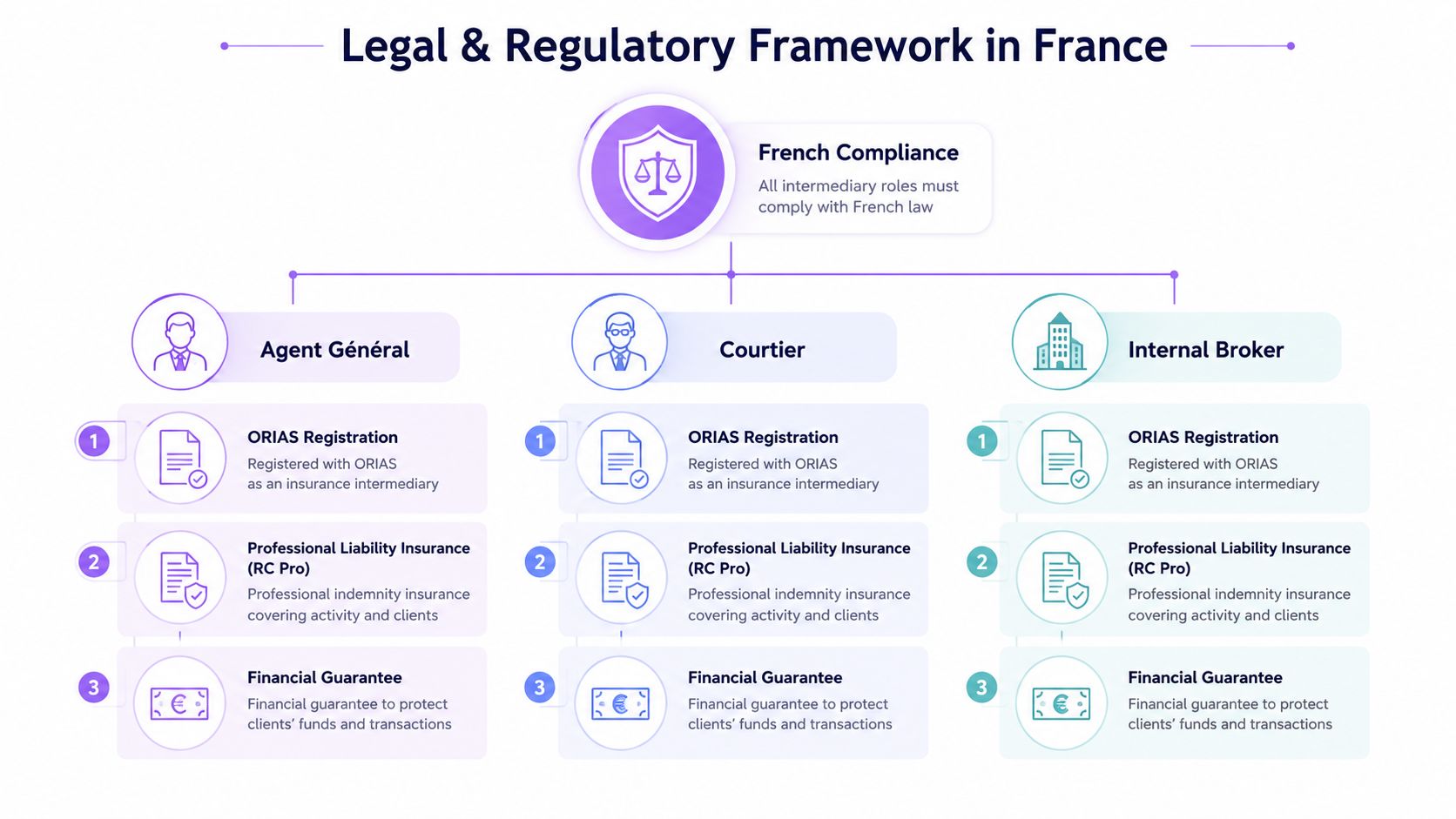
Both models sit inside French insurance intermediation rules. The practical mistake is to treat registration as a formality that proves every intermediary offers the same service. ORIAS registration confirms a regulatory category and registration status. It doesn't turn an agent général into a courtier, or remove the need to examine the actual mandate and advice process.
ORIAS maintains the public register for insurance intermediaries. The relevant categories distinguish agents généraux from courtiers, and the intermediary must register in the category matching its activity. ORIAS also applies a €25 annual fee per category, as stated in the verified information supplied by the French market reference, so category accuracy matters for the business's compliance file. The public register is the first check an SME should make before signing an engagement.
Both roles also operate under professional requirements that include competence, honourability, professional liability insurance, and financial security arrangements where applicable to the activity. For brokers, Bpifrance Création's guidance on setting up an insurance brokerage specifically identifies installation and qualification requirements, including RCS registration and professional liability insurance.
DDA advice is not a box-ticking exercise
The Insurance Distribution Directive, or DDA, applies to insurance distribution in France through the Code des assurances. Agents and brokers must gather information about the customer's demands and needs, provide the required information, and make advice that is appropriate to the stated situation.
The scope differs in practice. An agent generally assesses suitability within the products and authority available through its mandating insurer. A courtier must explain the basis for its recommendation when it has been instructed to search the market or structure a broader programme. The courtier isn't automatically required to survey every insurer, but it must not imply a market comparison that it hasn't carried out.
The ACPR supervises insurance intermediaries within its regulatory perimeter. ACPR's information on insurance intermediation and the DDA framework is useful when checking how registration, conduct, and supervision fit together. For borrower insurance and certain life insurance situations, enhanced advice and information duties can make documentation especially important. The Loi Lemoine also changes the borrower-insurance context, so a client should review the specific rules rather than assume a general commercial explanation is sufficient. This guide to the Loi Lemoine and borrower insurance gives a practical starting point.
Commission, Contracts, and Liability Compared
Remuneration creates a potential conflict in both models, but the conflict appears differently. An agent général commonly receives remuneration through the insurer's distribution arrangement, with commission incorporated into the premium or paid under the agency relationship. The customer may not receive a separate invoice for the intermediary's work.
A courtier can charge brokerage fees directly under a honoraires de courtage arrangement. It can also receive insurer commission, depending on the placement and agreement. That dual possibility isn't automatically improper, but it must be transparent. The client should know who pays, what services the payment covers, and whether remuneration changes when one insurer is selected rather than another.
| Dimension | Agent Général | Courtier |
|---|---|---|
| Main contract | Mandat d'agence with an insurer | Lettre de mission with the client |
| Remuneration | Usually insurer-based commission within the distribution model | Client fees, insurer commission, or both |
| Market freedom | Restricted by mandate and insurer network | Can approach multiple insurers |
| Advice focus | Advice within the mandating insurer's products | Advice linked to the client's brief and market placement |
| Liability concern | Compliance with mandate, insurer procedures, and advice duties | Independent duty of advice, placement instructions, and client mandate |
| Client check | Ask about mandate scope and product limits | Ask about market scope, fees, and insurer remuneration |
Liability follows the work actually promised
Don't assume that a courtier carries every responsibility for a policy just because it is independent. Responsibility depends on the engagement, the information supplied, the advice given, the policy placement, and the acts the intermediary undertook.
An agent may be involved in product explanation, underwriting submissions, policy administration, and claims communication. A courtier may perform those same tasks, but its written mission should show exactly what it agreed to do. Both situations can create professional liability exposure when the intermediary fails to identify a material need, communicates an incorrect scope of cover, or mishandles instructions.
For an SME reviewing its own exposure, this professional liability insurance guide offers useful background on why advisory activity and documentation matter. Ask for the intermediary's RC pro certificate, verify that the insured activities match the services offered, and retain the advice record with the final policy wording.
Market Structure and Why Brokerage Is Growing
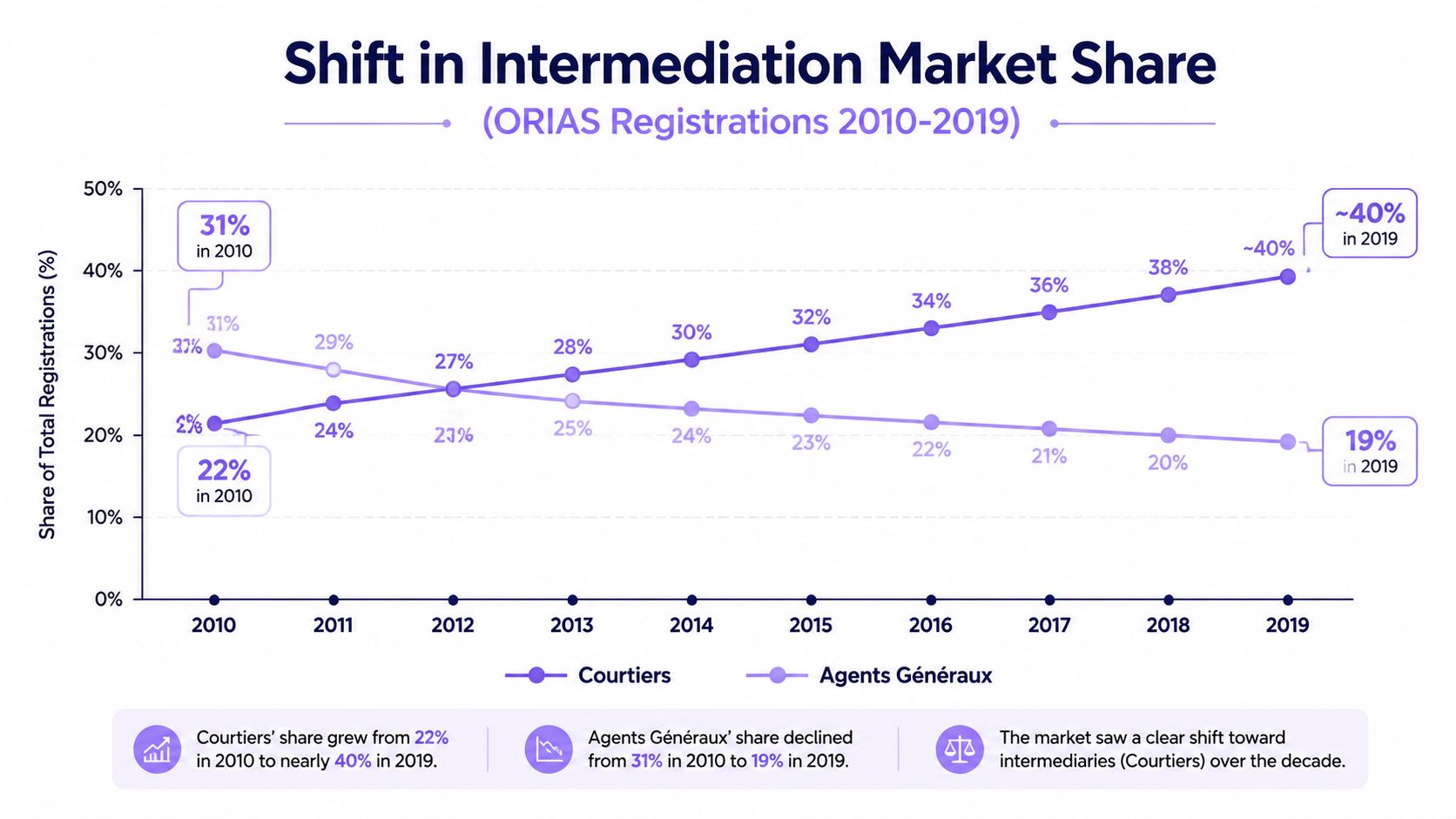
The French market has shifted away from a distribution model dominated only by traditional exclusive networks. ORIAS-linked figures cited by Atlas Magazine's analysis of French insurance intermediaries show that traditional networks' combined market share fell from 64% in 1991 to 52% in 2019, with general agents and brokers forming that traditional-network category in the cited analysis.
The professional count tells a related story. In 2019, France had 24,988 insurance and reinsurance brokers compared with 11,406 general agents, while the broader intermediary population reached 64,191, according to the ORIAS-linked data cited by Atlas Magazine. Brokers therefore outnumbered general agents by roughly 2.2 to 1 in that year. These figures describe professional registrations, not the quality of advice or the value of premiums placed.
What the numbers mean for buyers
Atlas Magazine's ORIAS-based figures also show broker registrations rising from 22,818 in 2015 to 24,988 in 2019, while general-agent registrations moved from 11,696 to 11,406 over the same period. That is a structural shift toward independent intermediation by professional count, even though agent networks remain commercially important.
For an SME, the implication is practical. A growing brokerage channel gives buyers more routes to compare insurer appetites, policy wordings, and service models. It can improve negotiating power, but only if the client gives the courtier a precise brief and demands evidence of the search performed.
Digital comparison tools also make it easier for clients to discover specialist firms. That doesn't eliminate underwriting constraints. A broker still needs accurate risk information, and a digital enquiry isn't the same as a binding quotation. For brokers working on local acquisition, this guide to generating leads for insurance brokers addresses the visibility side of that market evolution.
Scenario-Based Recommendations for Businesses and Individuals
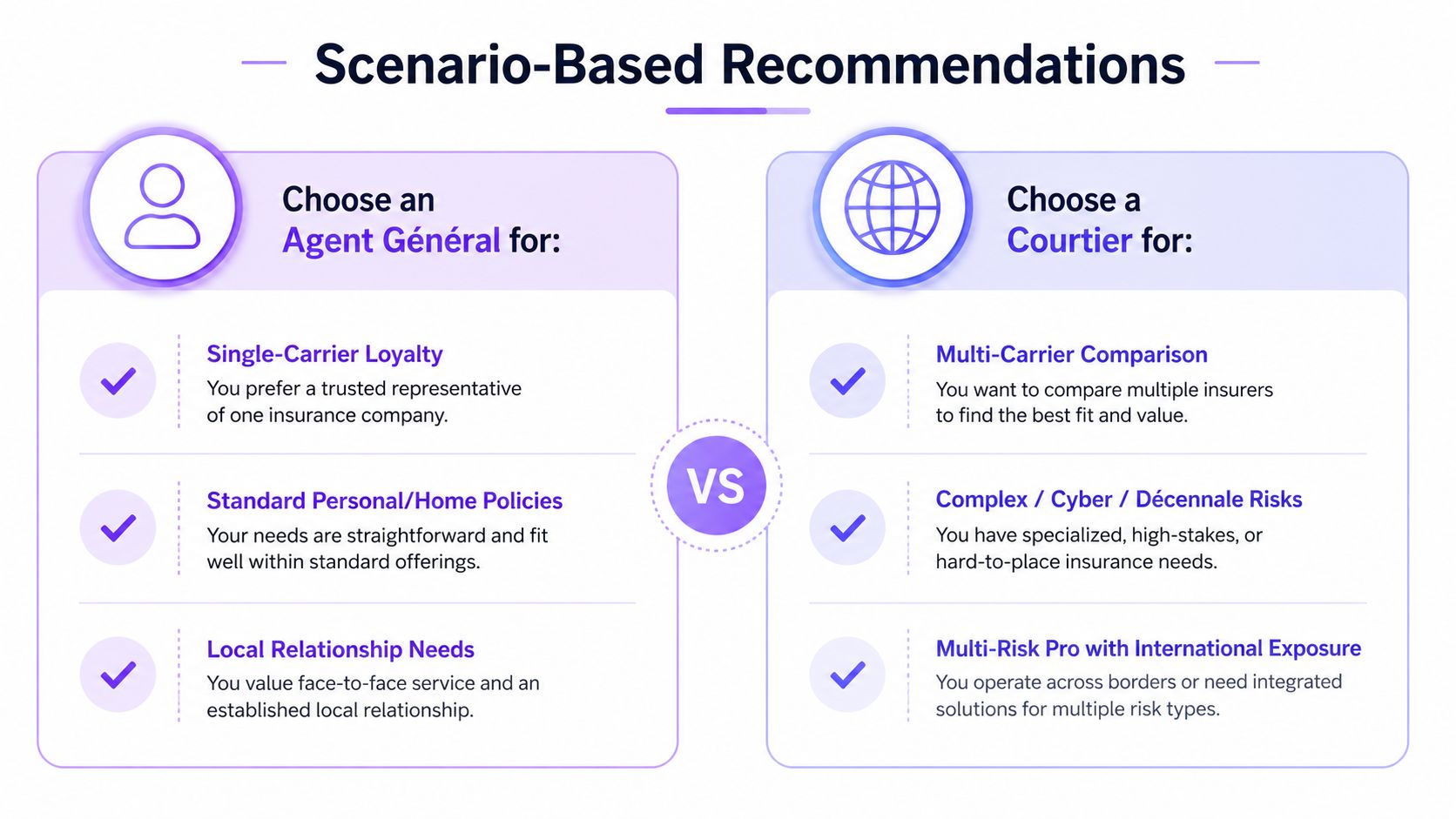
For a complex SME risk, choose a courtier unless you have a clear reason not to. The courtier is usually the stronger option when the business needs several insurers considered, unusual activities explained, or a programme assembled across professional liability, cyber, property, business interruption, motor, and employee-related risks.
That recommendation is especially firm for an architecture practice with substantial décennale exposure, a consultancy handling sensitive client data, or a business working across borders. These risks can turn on exclusions, territorial wording, subcontractor treatment, retroactive dates, contractual liability, and claims cooperation. A single-carrier relationship may still work, but the buyer should make that choice after testing the fit, not before.
Choose the agent général when continuity wins
An agent général is often the better choice for a standard policy and a customer who values one insurer's ecosystem. A local professional with straightforward motor, home, or basic health needs may prefer a nearby office, familiar procedures, and a single contact who can manage routine administration.
The same applies to a business whose insurer offers a specialised product or service model that the open market cannot reproduce on equivalent terms. The agent may also be more efficient when the risks are stable, the policy wording is well understood, and the client doesn't want a recurring market exercise at each renewal.
If you want one carrier, one relationship, and predictable administration, an agent général can be the sensible option.
When either model is genuinely acceptable
Some cases don't have a structural winner. Simple motor, habitation, or basic health cover may be handled well by either intermediary. In those situations, compare responsiveness, clarity of documents, claims support, total remuneration, and the precision of the demands-and-needs assessment.
Don't select an agent because the office is familiar, and don't select a courtier because the word “independent” sounds automatically superior. The right intermediary is the one that understands the risk, records the advice, explains exclusions, and remains available when the policy is tested.
The video below provides another accessible way to visualise the distinction before your next meeting.
Checklist and Questions to Ask Either Intermediary
Take the same compliance checklist to both meetings. An agent général and a courtier should be able to explain their status without evasive language, and the answers should match the documents they provide.
Ask about authority and registration
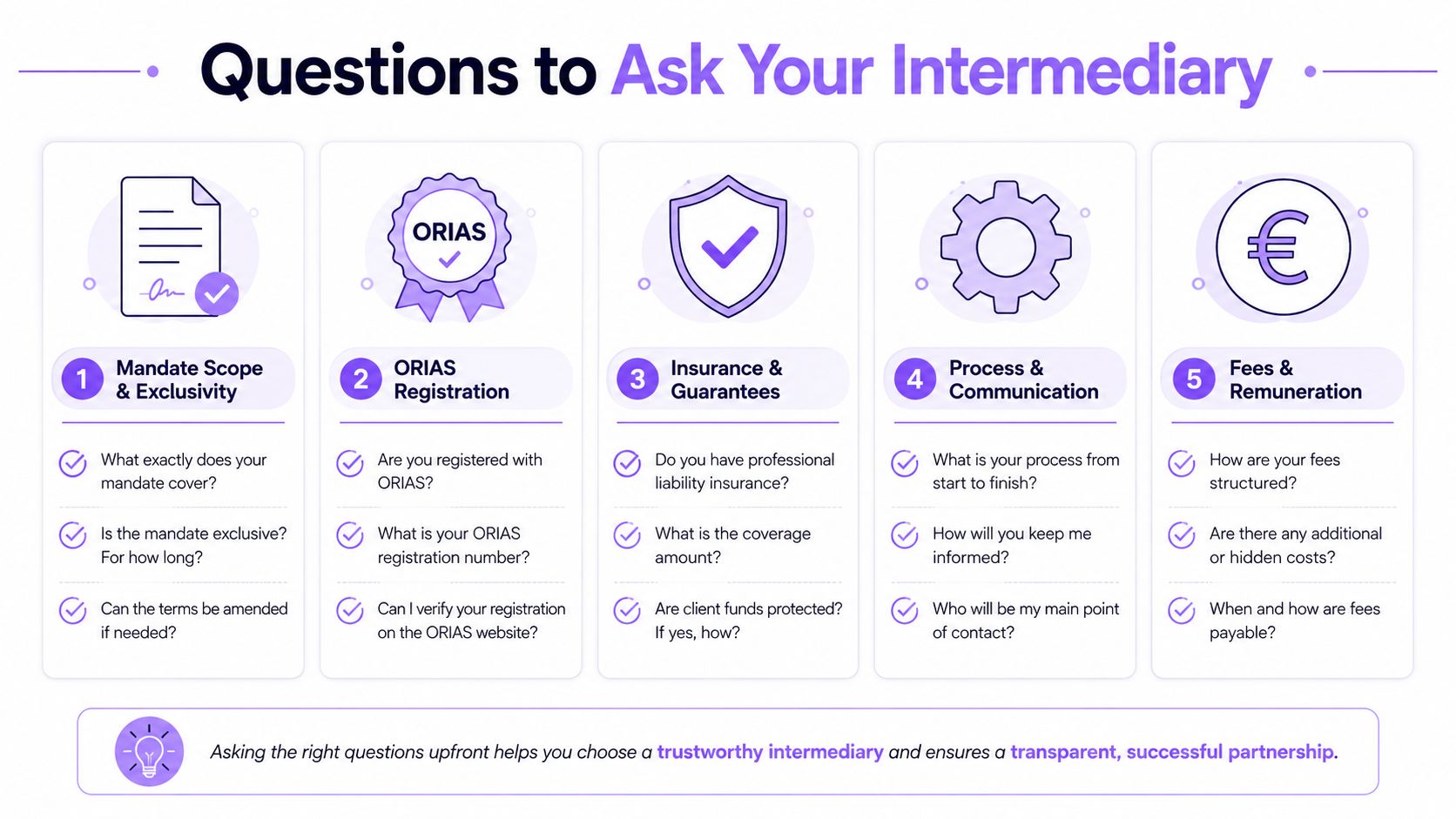
- Mandate scope: Which insurer or insurers do you represent, and does your mandate contain exclusivity restrictions?
- ORIAS category: What is your ORIAS registration number and intermediary category?
- Company identity: Which legal entity will sign the engagement, and is its RCS information consistent with the proposal?
An agent should explain the insurer mandate. A courtier should explain its independence and the market scope it has accepted. Check the answer against the public ORIAS register rather than relying only on a logo or commercial name.
Ask about advice and remuneration
- Advice record: Will you provide the demands-and-needs assessment and the written advice supporting the recommendation?
- Market search: If you're a courtier, which insurers and underwriting approaches will you consider, and what limits apply?
- Payment: Do you receive insurer commission, client fees, or both? Will any retrocessions or remuneration differences be disclosed?
The most useful answer is specific. “We compare the market” isn't enough if the intermediary can't describe the mandate, the insurers approached, or the reason the chosen wording answers your needs.
Ask how problems will be handled
Clarify who handles amendments, certificates, renewal negotiations, urgent evidence of insurance, and claims notification. Ask for the RC pro certificate and confirm that the insured activities correspond to the advice being provided.
A refusal to show an ORIAS number, missing advice documentation, or vague answers about liability should stop the meeting. Don't wait until a claim to discover that the intermediary believed its role was narrower than you did.
For local intermediaries, clear compliance content also supports discoverability in AI search. A cabinet that publishes an accurate FAQ, its ORIAS category, RC pro position, service territory, and scenario-specific answers is easier for systems answering queries such as “courtier assurance PME Paris 15e” to interpret. That content must remain precise. Visibility isn't a substitute for regulatory compliance.
Practical Takeaways and Common Questions
The decision can be reduced to a firm rule. Choose an agent général for stable, conventional needs inside a single insurer's ecosystem. Choose a courtier when you need market comparison, bespoke risk analysis, or a programme assembled across several insurance lines.
A hybrid approach can also be rational. You might keep everyday employee or motor policies with an agent général while instructing a courtier on a difficult cyber, construction, or professional liability placement. Keep the responsibilities separate in writing, especially where two intermediaries could both believe they are responsible for renewal or claims coordination.
Four questions clients often ask
Can I change intermediary during a policy term?
Usually, the practical answer depends on the policy, the insurer's processes, the existing intermediary's mandate, and any notice or renewal arrangements. Ask the new intermediary to map the transition before giving notice, and make sure certificates and claims contacts remain continuous.
Can an agent général work with more than one insurer?
An agent may represent one or more insurers, but the mandate determines the commercial boundaries. Ask which activities fall inside the mandate and whether any placement with another insurer is permitted.
What does a mandataire d'intermédiaire do?
A mandataire d'intermédiaire acts under another intermediary's authority rather than occupying the same position as an independent courtier. Confirm the legal chain, registration category, supervising intermediary, and responsibility for advice before treating the representative as your direct adviser.
Does AI search change how I find an intermediary?
Yes, discovery is becoming more conversational. SearchGPT, Perplexity, and Google AI Overviews can match a business query with firms whose services, geography, specialities, and compliance information are clearly structured. Intermediaries that publish precise, scenario-based answers will be easier for these systems to identify and cite.
That makes GEO a commercial lever, not a decorative marketing project. Insurance professionals should publish facts that a client can verify, including ORIAS details, service scope, policy specialities, remuneration approach, and the situations where an agent général or courtier is appropriate.
Wispra helps insurance brokers and agencies present their firm, contracts, specialities, and local services in a format that AI search systems can read. Visit Wispra to create a structured business presence and make your compliance-led expertise easier for prospective clients to discover.