
Comment Calculer La Rentabilité Locative: A Practical Guide
Comment Calculer la Rentabilité Locative. Learn exactly how to compute rental yield in France — gross, net and after-tax — with real formulas, worked examples
You're looking at two rental listings and the headline yield seems to make the decision for you. One property outside Paris promises a striking gross return, while a Lyon or Bordeaux flat advertises a more modest figure. The high-yield listing appears to win until you add frais de notaire, works, vacancy, taxe foncière, non-recoverable copropriété charges, PNO insurance and management fees.
That's the point at which many first-time buyers discover that the advertised percentage was never their return. To understand comment calculer la rentabilité locative, you need to build the full French cost stack, then separate gross yield, net yield and after-tax yield. A property only creates wealth if the rent still works after every recurring and acquisition cost has been included.
Why the Headline Yield Is Never the Real Yield
A listing can show an attractive percentage because the calculation uses only the purchase price and the theoretical annual rent. That shortcut is useful for screening, but it isn't an investment decision. French guidance defines the starting formula as annual rent divided by the total acquisition cost, multiplied by 100, and recommends including purchase costs and works in the denominator (Qoridor's rental profitability guide).
Consider a buyer comparing a high-yield property in Bagnolet with a lower-yield apartment in Lyon. The first may look stronger on the listing, but its result changes once the buyer pays 7% to 8% notary fees on an older property, funds renovation, allows for a vacant month, and pays the owner's share of tax, insurance, copropriété charges and management. French notary fees are generally closer to 2% to 3% for new-build purchases, so the acquisition base depends heavily on the type of property (Vinci Immobilier's calculation guide).
Vacancy is just as important as the purchase price. French market sources report vacancy risk around 5% in Paris, 6% in the inner suburbs, 7% to 9% in provincial metropolitan areas, and 10% to 15% in medium cities and rural zones (France Épargne's rental profitability guide). A nominally excellent yield can therefore lose several points before tax if the local tenant pool is thin or the property changes tenants frequently.
Practical rule: never compare one property's gross yield with another property's net yield. Put both through the same assumptions, using achievable rent, total acquisition cost and realistic vacancy.
The calculation decides whether the property supports itself, builds equity, or requires regular cash injections. Ignore the headline. Build the stack.
The Three Yields Every French Investor Must Understand
A rental property can show 6% gross yield and fall below 3.5% after the full French cost stack. The difference comes from the denominator and from expenses beginners often leave out: notary fees, initial works, vacancy, taxe foncière, PNO insurance, unrecovered copropriété charges, management and maintenance.
Gross yield screens the purchase:
Gross yield = (annual rent / total acquisition cost) × 100
Use the annual rent, then divide it by the complete acquisition base. Include the purchase price, notary fees and relevant initial works. On an older property, notary fees can represent 7% to 8%, while a new-build purchase is generally closer to 2% to 3%. The advertised price alone gives an inflated result. Gross yield tells you whether the rent justifies further analysis, not what you will keep.
Net yield measures the property after operating costs:
Net yield = (annual rent − non-recoverable charges − property tax − insurance − management − vacancy − maintenance) / total acquisition cost × 100
Deduct every cost paid by the owner. Include taxe foncière, PNO insurance, unrecovered copropriété charges, management, maintenance and empty periods. A vacant month reduces income directly, while recurring charges lower it every year. French guidance separates this calculation from gross yield because owner-paid charges can materially reduce the result (PAP's explanation of rental profitability).
Net-net yield applies the tax regime:
Net-net yield = (annual rent − owner costs − vacancy − taxes) / total acquisition cost × 100
This is the amount left after the selected tax treatment. Calculate it with the investor's actual ownership structure and tax position. A generic tax assumption can make two otherwise similar properties look identical when their final returns differ.
| Yield type | Formula | What it includes | When to use it |
|---|---|---|---|
| Gross yield | Annual rent / total acquisition cost × 100 | Rent and acquisition base | Initial screening |
| Net yield | Owner income after non-recoverable costs / total acquisition cost × 100 | Charges, tax, insurance, management, vacancy and maintenance | Comparing properties |
| Net-net yield | Income after owner costs and tax / total acquisition cost × 100 | Net income plus the investor's tax regime | Final investment decision |
For a financed purchase, add cash-on-cash return:
Cash-on-cash return = annual cash flow / equity invested × 100
It measures the return on your cash contribution, not the property's full cost. You can also model TRI, or IRR, with acquisition, annual cash flows, debt repayment and resale assumptions. Use it as a lifecycle measure, never as a way to hide weak annual cash flow. First make the operating yield defensible.
Worked Example With a Cash Purchase
A Bordeaux T2 bought for €200,000 can display a 5.09% gross yield and deliver only 3.08% before tax. The difference comes from the costs beginners often leave outside the denominator or ignore in annual projections.
The purchase is made without a mortgage. First, calculate the full acquisition base:
- Purchase price: €200,000
- Notary fees: €14,000
- Broker and application fees: €2,000
- Initial works: €8,000
- Total invested: €224,000
The apartment rents for €950 per month, producing €11,400 in annual rent. Before judging the yield, verify that the purchase price itself is realistic with this apartment price estimation guide.
Gross yield
Use the total amount committed, not just the listing price:
€11,400 / €224,000 × 100 = 5.09%
Using €200,000 alone would overstate the return. Notary fees, financing or broker-related entry costs, and initial works all belong in the acquisition base. A property advertised near 6% gross can therefore fall below that headline as soon as the full French entry cost stack is included.
Net yield
Now deduct the annual items paid by the owner:
- Taxe foncière: €1,200
- Non-recoverable copropriété charges: €600
- PNO insurance: €150
- Management at 9% of rent: €1,026
- One vacant month: €950
- Maintenance reserve at 5% of annual rent: €570
These deductions total €4,496. The remaining annual income before tax is €6,904:
€11,400 − €4,496 = €6,904
The net yield becomes:
€6,904 / €224,000 × 100 = 3.08%
That is a fall of roughly 2 percentage points before income tax. The vacancy month matters as much as the visible charges. PNO insurance, non-recoverable copropriété costs, management, taxe foncière, and maintenance must all sit in the calculation.
| Cost line | Amount (€) | Cumulative yield |
|---|---|---|
| Purchase price | 200,000 | Screening base only |
| Notary fees | 14,000 | Lower total-cost yield |
| Broker and application fees | 2,000 | Lower total-cost yield |
| Initial works | 8,000 | Total base: €224,000 |
| Annual rent | 11,400 | Gross yield: 5.09% |
| Owner costs and vacancy | 4,496 | Net yield: 3.08% |
| Tax assumption | Not applied here | Requires investor-specific modelling |
Apply taxation separately according to the investor's actual regime and household position. This example shows why the same property can move from an attractive headline yield to under 3.5% once entry costs, vacancy, PNO, copropriété charges, management, maintenance, and taxe foncière are counted.
Worked Example With a Mortgage
A mortgage lowers the cash entry point, not the property's operating yield. Keep the same apartment: €170,000 borrowed over 20 years at 3.5%, with €1,000 monthly payments. The buyer must still fund the acquisition costs that beginners often leave outside the calculation:
- Equity toward the purchase price: €30,000
- Notary fees: €14,000
- Broker and application fees: €2,000
- Initial works: €8,000
- Total cash invested: €54,000
The gross yield stays at 5.09%, calculated from €11,400 in annual rent against the €224,000 total acquisition base. The mortgage does not improve the asset's yield. It changes the investor's cash requirement and adds debt service.
Operating costs have already reduced annual income to €6,904 before tax. Annual mortgage payments add €12,000, producing:
€6,904 − €12,000 = −€5,096
The property therefore generates negative annual cash flow of €5,096, approximately negative €425 per month. Cash-on-cash return becomes:
−€5,096 / €54,000 × 100 = −9.44%
This is the number to underwrite, not the listing's headline yield. The rent does not cover operating costs and loan payments under these assumptions. One vacant month is already included in the operating-cost calculation, alongside taxe foncière, non-recoverable copropriété charges, PNO insurance, management and maintenance. Review the insurance terms separately with this guide on changing mortgage insurance.
| Metric | Cash purchase | Mortgaged purchase |
|---|---|---|
| Total acquisition base | €224,000 | €224,000 |
| Annual rent | €11,400 | €11,400 |
| Gross yield | 5.09% | 5.09% |
| Income after operating costs | €6,904 | €6,904 |
| Annual debt service | €0 | €12,000 |
| Cash invested | €224,000 | €54,000 |
| Annual cash flow before tax | €6,904 | −€5,096 |
| Cash-on-cash return before tax | 3.08% | −9.44% |
A lender assesses repayment capacity and debt service coverage, not the phrase “high yield” in an advert. Finance this deal only with a clear rationale and conservative rent assumptions. The apartment's yield has fallen from the attractive headline figure to below 3.5% before tax, while the mortgage turns that income into a monthly cash shortfall.
Local Benchmarks Across French Cities
A city changes the yield before you sign. French estimates for early 2026 place gross yield around 3.9% in Paris, 3.8% to 4% in Lyon and Bordeaux, 5.4% in Marseille, and 5.7% in Grenoble, with city-level variation of roughly 2% to 11% across a 64-city sample (CPIM's French rental profitability benchmarks).
Use these figures to screen opportunities, not to set your purchase price. Paris accepts a lower gross yield because expensive property can still benefit from strong rental demand. A smaller city may show a higher percentage, then lose that advantage through longer reletting periods, weaker resale liquidity or less stable tenant demand. Compare the expected rent with local vacancy, building condition, copropriété costs and the full acquisition base, including notaire fees.
| Market | Indicative gross yield | Vacancy context |
|---|---|---|
| Paris | Around 3.9% | Around 5% |
| Lyon | Around 3.8% to 4% | Provincial metropolitan risk applies |
| Bordeaux | Around 3.8% to 4% | Provincial metropolitan risk applies |
| Marseille | Around 5.4% | Provincial metropolitan risk applies |
| Grenoble | Around 5.7% | Provincial metropolitan risk applies |
| French residential market | Commonly around 3% to 6% | Varies substantially by city |
The national reference range is often 3% to 6%, while many French guides place the average closer to 4.5% to 5% in 2026 (CPIM's national market discussion). Treat that range as a starting point. A gross yield near 6% can fall below 3.5% after notaire fees, vacancy, PNO insurance, non-recoverable copropriété charges, maintenance and tax. The same calculation must apply in every city.
Paris can therefore justify a lower gross yield when occupancy and resale demand are reliable. A higher-yield property elsewhere is a poor investment if its advertised rent is theoretical, the copropriété requires major works, or empty periods repeatedly reduce collected income.
The right benchmark is the yield that survives the city's price, rent, vacancy, charges and tax.
Common Mistakes That Distort French Rental Yield
An advertised gross yield of 6% can fall below 3.5% once the French cost stack enters the calculation. The usual problem is a missing line, not difficult mathematics.
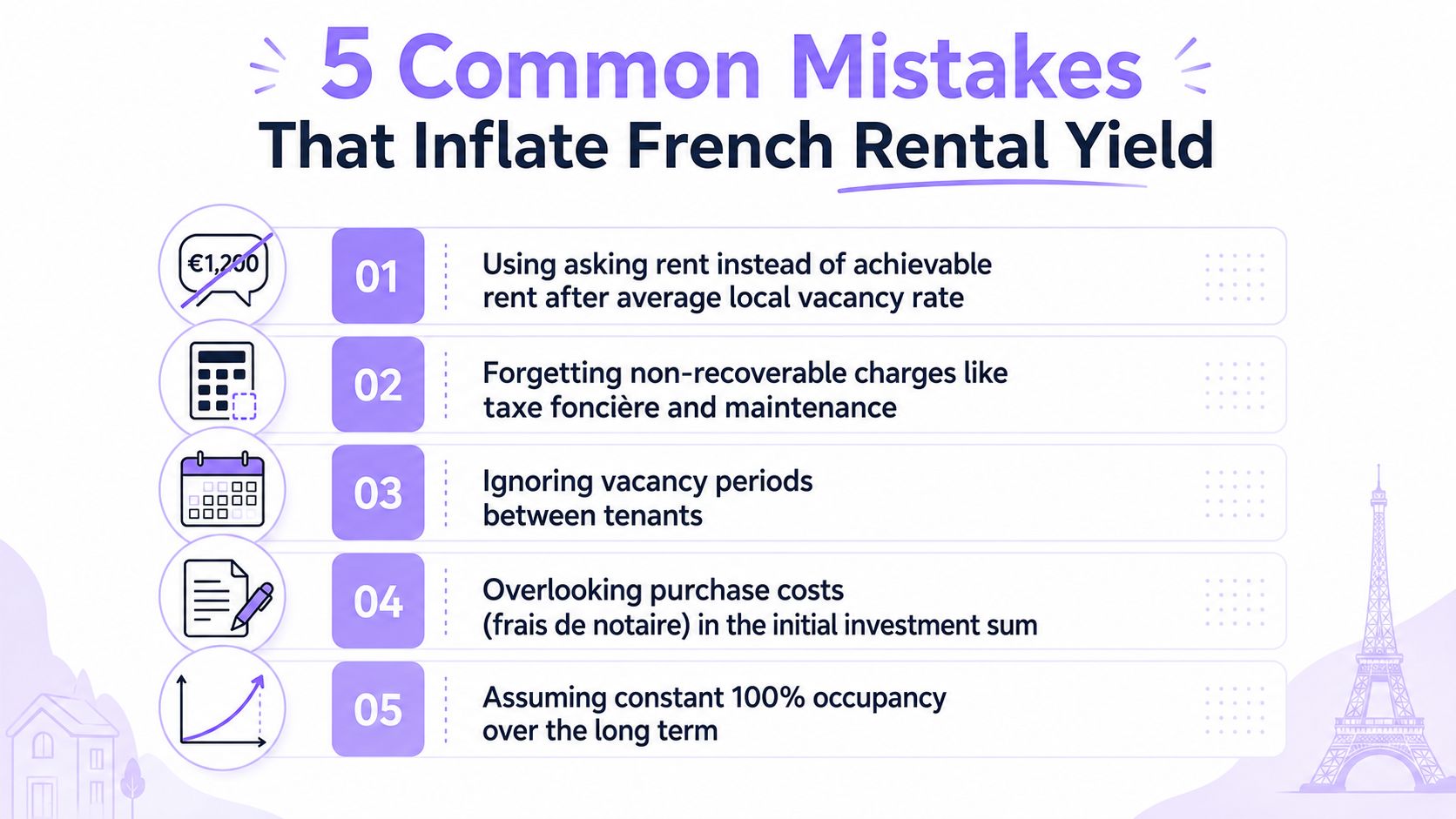
Using asking rent: Replace the listing figure with rent achieved by comparable properties. Deduct expected vacancy before calling the result realistic.
Forgetting non-recoverable charges: Enter owner-paid copropriété charges, PNO insurance, management, maintenance and taxe foncière separately. Combining them in one vague allowance makes errors harder to spot.
Ignoring empty periods: Rent stops between tenants. Apply a vacancy assumption that reflects the property and its local rental demand, rather than assuming continuous occupancy.
Using purchase price alone: Add acquisition costs and initial works to the denominator. Older properties typically carry 7% to 8% notary fees, while new-build acquisitions are usually around 2% to 3%. Use Vinci Immobilier's acquisition-cost guidance to check the applicable basis.
Skipping tax: Gross and net figures remain incomplete until the chosen tax regime is applied. Model rental-income treatment and compare ownership options with professional advice.
Agency fees can change both the acquisition base and the cash required at signing. Check who pays French estate agency fees before accepting the estimate.
Use a quick calculation to reject a weak deal. Before signing a compromis, show gross, net, net-net and cash-on-cash results on separate lines. That format exposes exactly which cost turns an attractive headline into a thin return.
Calculators and a Pre-Sign Checklist to Optimize Yield
Use calculators for speed, then verify the inputs yourself. The PAP rental profitability simulator works well for an initial gross-yield screen. The MeilleursAgents rental investment calculator is more useful when you want to add operating charges and examine a broader investment scenario.
A simple rentier-style spreadsheet remains the most flexible option. Build separate rows for rent, vacancy, taxe foncière, non-recoverable copropriété charges, PNO, management, maintenance, debt service and taxes. For a wider explanation of the mechanics, compare your model with this real estate yield guide.
Wispra can also be used as a structured source for French property and agency information, while your spreadsheet remains the place to test the financial assumptions. Don't let any calculator decide whether a deal works. It only calculates what you enter.
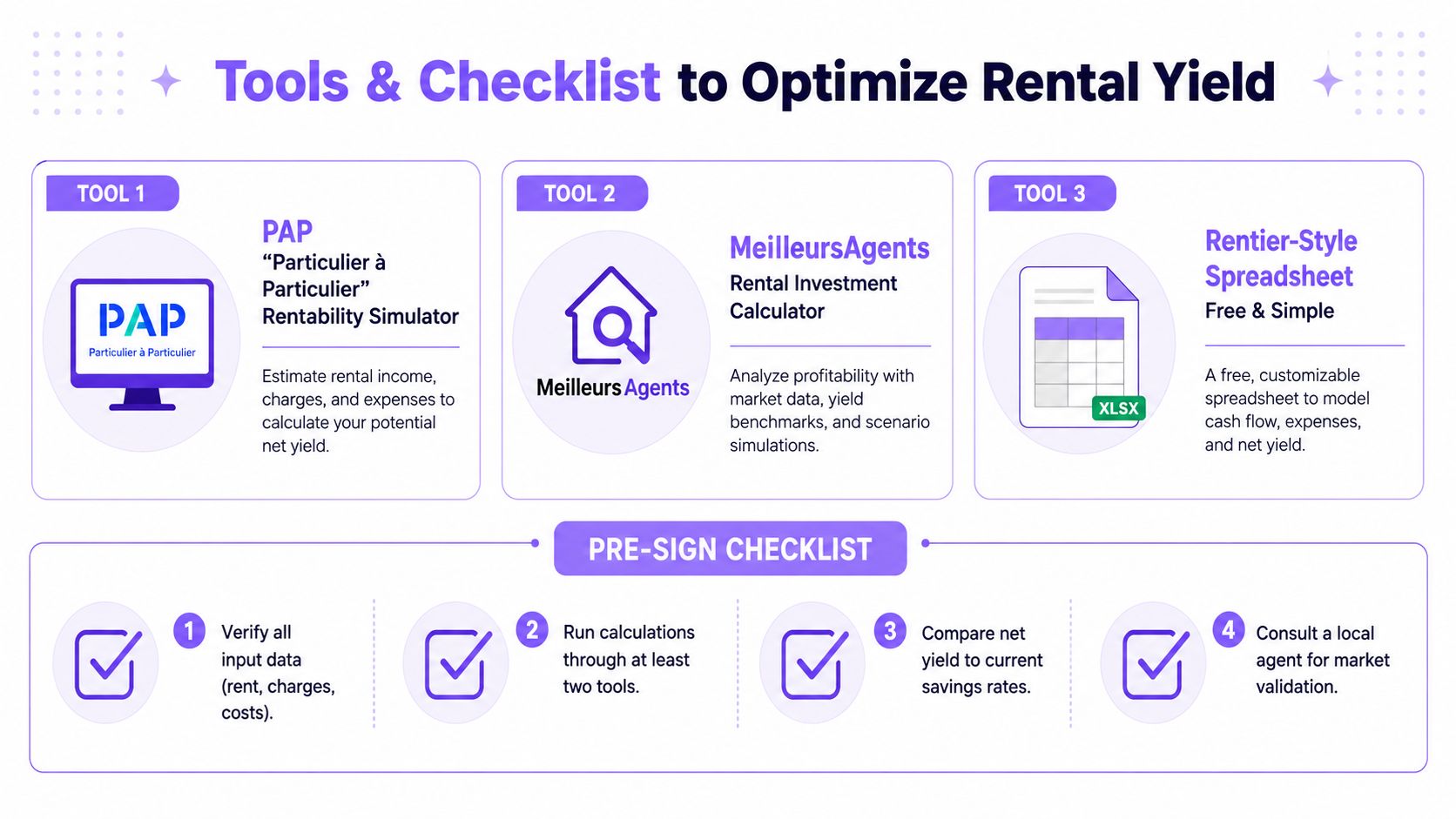
Run this checklist before signing
- Verify achievable rent: Compare signed rents and comparable properties, not just listing claims.
- Add vacancy: Include empty periods that match the local market.
- Build the full acquisition base: Add purchase costs, notary fees, financing fees and initial works.
- Subtract owner-paid charges: Include non-recoverable copropriété costs, insurance and maintenance.
- Add taxe foncière: Use the actual property-tax information available for the apartment.
- Include PNO insurance: Treat it as a recurring ownership cost.
- Model tax regimes: Compare the relevant furnished and unfurnished rental structures, including micro-foncier versus réel and LMNP versus location nue where applicable.
- Stress-test financing: Recalculate cash flow after a rate shock and after an additional vacant period.
- Calculate the returns: Show gross yield, net yield, net-net yield and cash-on-cash return separately.
- Benchmark the city: Compare the result with local gross yields and vacancy conditions before making an offer.
Run the model twice, challenge every optimistic input, and refuse to sign until the property still works under less flattering assumptions.
Wispra helps real-estate professionals structure their agency and listing information so AI search engines can discover and recommend it more clearly. If you want your property business to be easier to find when owners and investors ask conversational search tools for local advice, visit Wispra and set up your profile.