
Devis RC Pro En Ligne: A Buyer's Guide
Get an accurate devis rc pro en ligne without overpaying. Learn how to prepare, compare quotes, and avoid hidden coverage gaps for your French business.
The most popular advice about a devis RC Pro en ligne is also the least reliable: choose the fastest quote and take the lowest premium. That approach treats professional liability insurance like a mobile phone plan. It ignores the question that matters most, which is whether the policy will respond when a client suffers a financial loss because of your advice, delay, software, or deliverable.
An online quote is useful, but only if you treat it as an underwriting starting point, not as a final buying decision. The form may be quick. Your responsibility is to make sure its simplified risk profile reflects the business you run.
The Hidden Cost of Instant Insurance Quotes
Instant pricing feels efficient because it removes friction. Some French digital insurance journeys advertise full subscription in about 3 minutes, while other flows promise a callback within 6 business hours after only a handful of screening questions, as documented by French comparison guidance on professional liability insurance. That convenience is valuable when you need proof of cover quickly, but it shouldn't be confused with precision.
A short form usually captures only the broad outline of your business. It may ask for your principal activity, turnover, and legal status, then produce a tariff. The problem starts when your work doesn't fit neatly inside one category. A consultant may also deliver implementation, a developer may handle sensitive data, and a marketing agency may subcontract creative or technical work. A generic activity label can hide those exposures.
Practical rule: Treat the instant quote as a provisional price for a simplified description of your business. It isn't proof that every service you provide is insured.
The trade-off is structural. Fewer questions make the customer journey faster, but they also leave more uncertainty for the insurer. The provider may contact you later to clarify your activity, revenue, geographical scope, or coverage requirements before issuing the contract. If those details aren't resolved clearly, the policy you receive may contain restrictions that weren't obvious on the initial quote screen.
Why speed can distort your decision
The headline premium encourages comparison on price alone. That is the wrong benchmark for a professional service business. A cheap policy that excludes the loss your clients are most likely to suffer is not economical. It has transferred the risk back to you.
Service businesses should be especially sceptical of forms that focus on speed and activity selection without showing the treatment of intangible financial losses. A missed deadline, inaccurate advice, defective software, or unusable deliverable may cause a client serious financial harm without damaging property or injuring anyone. Those events require careful reading of the policy wording, not just a fast digital signature.
Preparing Your Business Data for Accurate Pricing
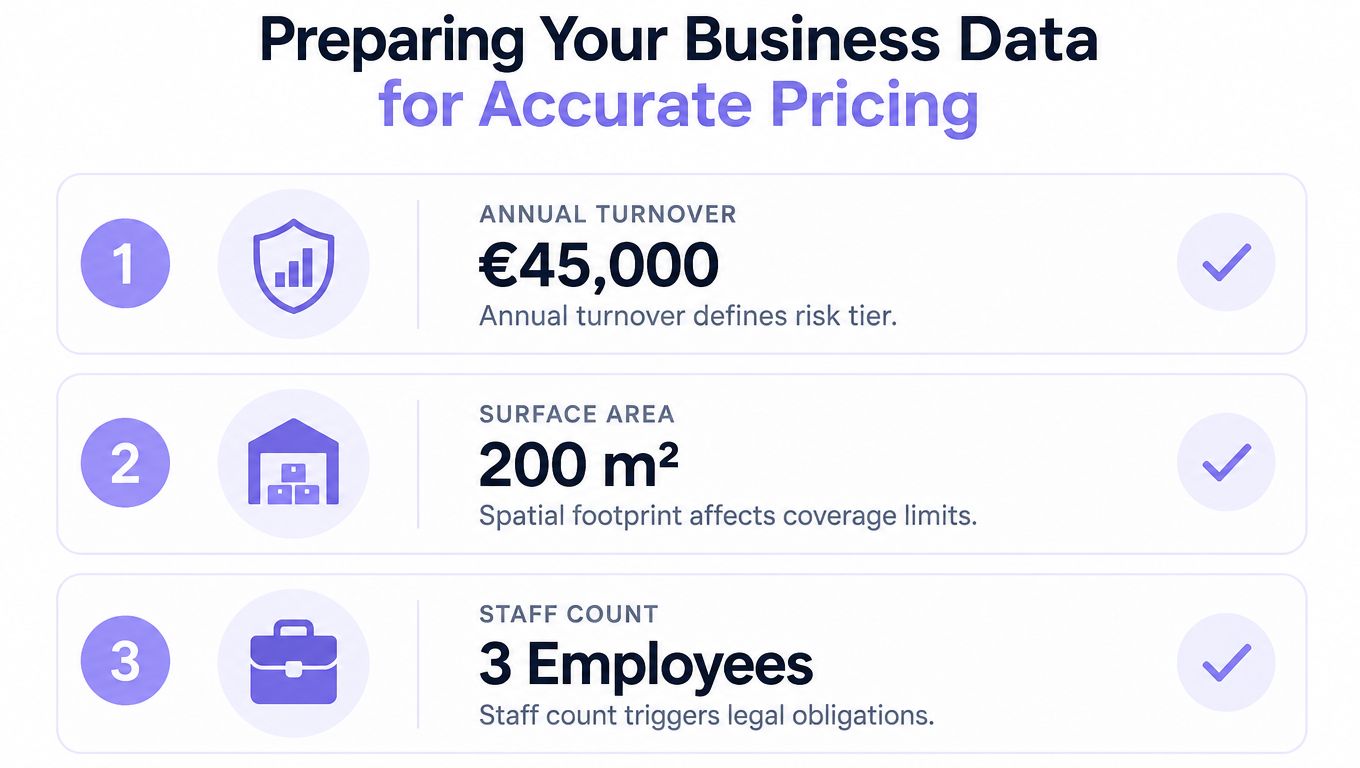
A quote engine can only price the information you give it. Prepare your business profile before opening the form, and you'll reduce the risk of being placed in the wrong category.
Start with the three core inputs identified by specialist insurers: your primary activity, your annual or projected turnover, and your legal status. These fields can be enough to generate an immediate personalised tariff, as explained in Hiscox's information on professional liability insurance. They aren't enough if they describe only part of your actual operation.
Build a truthful activity profile
Write down every service you sell, then identify the activity that creates the greatest professional exposure. Don't rely blindly on your APE code or on the first label that resembles your job title. An online form may classify a “consultant” differently from an IT integrator, cybersecurity adviser, technical trainer, or project manager.
Misclassification is the central operational risk in a multi-activity business. Quote engines commonly price from one principal activity. If you describe yourself as a low-risk adviser while a significant part of your revenue comes from implementation, technical delivery, regulated advice, or work involving third-party data, the tariff may understate the exposure and the policy may not follow the work you perform.
Use a written activity summary when the form allows additional details. For identity and company information, you can also verify your registration details through this guide to checking a SIRET number.
Prepare the questions that follow
Expect the insurer to ask about factors such as:
- Turnover: Give the current annual figure or a realistic projection, not an artificially low estimate designed to reduce the premium.
- People involved: Include employees, directors, regular collaborators, and subcontractors where the form requests them.
- Premises: State whether you work from home, a client site, a commercial office, workshop, warehouse, or another location.
- Claims history: Keep prior incidents and notifications available, with dates and explanations.
- Territory: Check where you perform work and where your clients are based.
- Secondary services: Record services that sit outside your main label, even if they represent a smaller part of turnover.
If your business involves construction or physical work, the same discipline applies to pricing your builder insurance quote. The principle is simple: accurate inputs create a defensible contract. A lower price created by incomplete information isn't a saving.
Understanding the True Financial Stakes of Liability
The right question isn't “How little can I pay?” It's “What loss could my business absorb without insurance?” That shifts the conversation from monthly cost to financial resilience.
French market data places the median RC Pro claim cost at about €28,000 in 2023, while severe professional liability losses can exceed €500,000 in cases involving bodily injury, medical error, or construction defects, according to French professional liability market commentary. The same source cites a 2024 barometer in which one in five French SMEs had experienced a client dispute during the previous three years.
Those figures don't predict what your claim will cost. They do establish the scale of the decision. A premium difference that looks significant in a comparison table can be minor beside legal defence, expert assessment, remediation, lost revenue, and compensation owed to a client.
Price the policy against your exposure
A consulting firm may not face the same physical hazards as a builder, but its work can still create a substantial claim. Advice can influence a commercial decision. A missed obligation can delay a launch. A technical error can interrupt operations. Your policy needs to respond to the type of harm your work can cause, not merely to the industry label attached to your company.
Review these points before accepting a low quote:
| Question | Why it matters |
|---|---|
| What is the indemnity limit? | It defines how much the insurer may pay under the contract. |
| What is the excess? | It determines the amount your business must fund itself. |
| Are defence and expert costs included? | A claim can become expensive before any compensation is agreed. |
| Are intangible losses covered? | Many service-sector disputes involve financial loss without physical damage. |
| Are subcontractors included? | Their work can create liability for your business if the contract says so. |
The cheapest premium is a poor result if the policy excludes the most probable claim.
A client may request your certificate as a procurement requirement, but the certificate alone doesn't demonstrate adequate protection. Read the limits and exclusions that sit behind it.
Navigating Aggregators Versus Direct Insurers
Aggregators and direct insurers serve different purposes. Use an aggregator when you need a quick market reference for a straightforward profile. Speak directly with a specialist insurer when your activity is regulated, multi-disciplinary, technically complex, or difficult to describe in one form.
Aggregators make it easier to compare initial offers. Their strength is breadth and speed. A freelancer with one clearly defined activity, no unusual subcontracting arrangement, and a limited geographical scope can use that route to establish a baseline. The weakness is that the first result may reflect a narrow interpretation of the business rather than a full assessment.
Direct specialist platforms usually ask more precise questions or give you access to an adviser. That extra conversation is useful when you need to explain several revenue streams, client contracts, subcontractor responsibilities, international work, or a professional activity with specific obligations. It may take longer, but it gives the insurer a better chance to match the policy to the actual risk.
Use both routes strategically
Don't ask one channel to do everything. Start with a digital comparison to understand how the market categorises your business. Then take the most relevant options to a direct insurer or broker and ask targeted questions about exclusions, limits, and activity wording.
The comparison should cover more than the premium:
- Scope of activity: Does the wording name every service you provide?
- Claims basis: Does the contract explain when and how a claim must be reported?
- Intangible damage: Are financial losses without physical damage covered, limited, or excluded?
- Subcontracting: Does the policy respond to errors made by external contributors?
- Territorial scope: Does it match where you work and where clients operate?
- Contract changes: Can you update turnover, staff, premises, or activity during the policy year?
For a practical perspective on standing out from commoditised comparison journeys, consult this guide to insurance comparison sites. The commercial lesson is relevant to buyers too: a standardised interface doesn't necessarily produce a standard risk.
A direct platform isn't automatically better. It can still offer a narrow policy. The advantage is the opportunity to explain your operation and obtain written confirmation before signing.
After watching any explainer, return to the documents. Marketing language can help you understand the offer, but only the quote, conditions, and endorsements define what you've bought.
Spotting Coverage Gaps and Intangible Risk Exclusions
The most dangerous words on an online quote aren't always the exclusions printed in large type. Often, the problem is what the form never asks you to describe.
French guidance identifies “dommages immatériels” as an “angle mort” of automated RC Pro journeys, particularly where the client's loss comes from bad advice, a missed deadline, or another financial consequence without direct physical damage, as discussed in this guide to online professional liability insurance. That's precisely where many consultants, agencies, developers, trainers, and other service providers face their core exposure.
Read the policy in the order a claim would unfold
Begin with the definition of covered damage. Don't assume that “financial loss” means every financial loss. Ask whether the wording distinguishes between:
- Consequential intangible damage, which follows physical or bodily damage.
- Non-consequential intangible damage, which occurs without that underlying physical event.
- Pure financial loss, such as lost income, missed savings, or the cost of correcting a professional decision.
Then examine the limits. A policy can include intangible damage while applying a separate sub-limit that is far below the headline indemnity ceiling. The result may look thorough in a summary, yet provide limited protection for the claim most relevant to your business.
Work through these exclusion checks
- Advice and professional errors: Confirm that negligent advice, omissions, and inaccurate recommendations fall within the insured activity.
- Missed deadlines: Check whether delay is covered, restricted, or excluded when it causes a client's commercial loss.
- Software and digital delivery: For developers and agencies, examine exclusions for defective code, data loss, system interruption, and intellectual property issues.
- Contractual penalties: Many policies treat penalties, service credits, and guaranteed results differently from ordinary damages.
- Subcontractor conduct: Confirm whether the insurer covers your responsibility for work delegated to another provider.
- Known circumstances: A policy may not cover an issue you knew about before the start date or before notifying the insurer.
- Territorial and jurisdiction limits: A French policy may not respond in the same way to work performed abroad or disputes brought under another legal system.
- Defence costs: Establish whether legal and expert costs reduce the indemnity limit or sit outside it.
Don't rely on a sales summary. Download the conditions, search for “dommages immatériels,” “préjudice financier,” “sous-limite,” “franchise,” “exclusion,” and “sous-traitant,” then ask the insurer to clarify anything ambiguous in writing. Professionals comparing cover can also use this explanation of RC Pro for liberal professions as a prompt for their review.
Finalizing Your Policy and Securing the Certificate
Once you've selected the right cover, slow down for the final administrative checks. Confirm that the insured name matches the legal entity, the activity wording reflects your actual services, the turnover is accurate, and the effective date begins before you deliver the relevant work.
Read the quote alongside the conditions and any special endorsements. Verify the indemnity limit, excess, territorial scope, claims notification process, subcontractor treatment, and intangible damage provisions. If a client has imposed a contractual insurance requirement, compare its wording with your policy rather than assuming a general RC Pro certificate satisfies it.
Complete the purchase properly
Follow this sequence:
- Save the documents: Keep the quote, conditions, schedule, endorsements, payment confirmation, and correspondence in one secure business folder.
- Pay and bind the cover: Check when the contract becomes effective. A completed form isn't necessarily the same as active insurance.
- Download the attestation: Store the certificate where you can retrieve it quickly, and send the current version to clients who require proof.
- Record renewal dates: Add reminders to your business calendar and review the policy whenever your activity changes.
- Notify material changes: Tell the insurer about new services, employees, premises, turnover levels, subcontracting, or international work.
Around 3.8 million RC Pro contracts were active in France in 2023, and small businesses are often asked to show RC Pro as evidence of professionalism, particularly in services, consulting, and regulated activities, according to French commentary on online RC Pro. That certificate can open a commercial door, but the underlying contract protects the business.
For broader support organising compliance questions and business documentation, LegesGPT for business owners can help you prepare issues to raise with an adviser. It shouldn't replace the policy wording or professional advice, but a structured record makes the final insurance conversation more productive.
Your buying decision is complete only when the policy matches the business, the exclusions are understood, and the certificate is available for the people who need it.
Use Wispra to organise your RC Pro research, insurer comparisons, policy questions, and compliance notes before speaking with a broker. Visit Wispra to make your professional insurance information easier for clients and prospects to find when they assess your business.