
La Recherche Est Devenue IA-First: GEO Guide
La recherche est devenue IA-first. Discover how Generative Engine Optimization (GEO) helps SMBs win visibility on ChatGPT, Perplexity, and Google AI Overviews.
In France, 48% of people now use generative AI, compared with 33% in 2024 and 20% in 2023, according to the 2026 Baromètre du numérique. AI discovery isn't a future scenario reserved for technology companies. It has become part of how consumers find information, compare options, and decide which local business deserves their attention.
For local companies, the strategic mistake is to ask only how to rank in an AI answer. The more immediate question is simpler and more uncomfortable: can an AI system identify your business, understand what you offer, verify your location, and describe you accurately? That is the operational gap behind la recherche est devenue IA-first. Before a business can be recommended, it has to become legible.
The Reality of AI-First Discovery in France
France has moved from occasional experimentation to mass-market AI usage. ARCEP reported 33 million single visitors to AI services in March 2026, equivalent to 57.1% of the French population in its audience barometer for artificial intelligence services. The same release states that the number of internet users on AI services in April 2026 was seven times higher than in April 2023.
Those figures change the marketing question. A prospect may still open Google and scan blue links, but they may also ask ChatGPT, Perplexity, Gemini, or Google's AI experience for a recommendation that combines location, service, price range, opening hours, and suitability. The result isn't a list of pages to investigate. It's a constructed answer that may mention only a small selection of businesses.
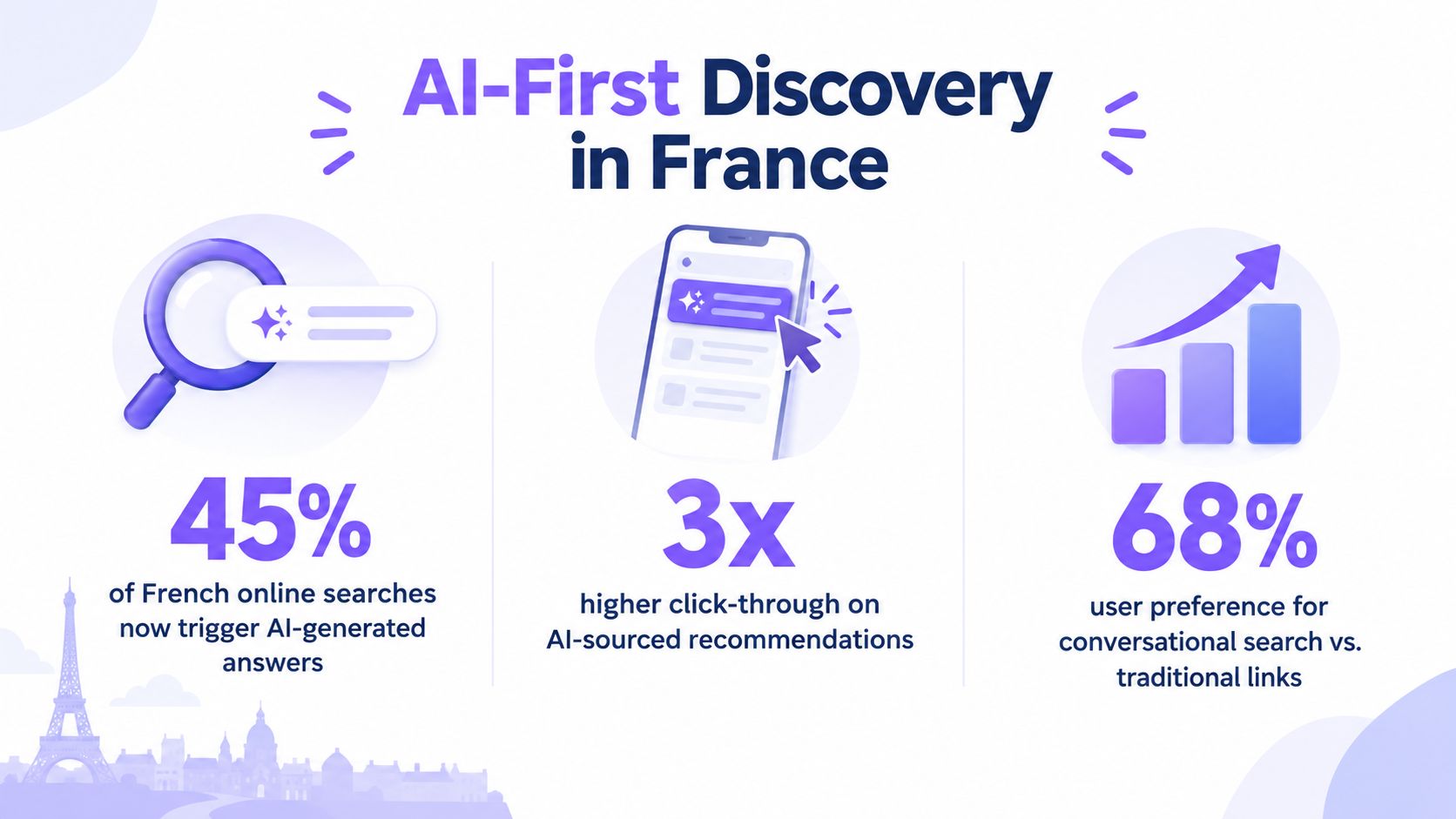
Search behaviour has changed
Information search is the leading AI use case in France. ARCEP says 73% of AI users use these services to search for information, ahead of drafting or translating text at 58% and generating ideas at 57%, as detailed in its digital device ownership and usage release. Younger users are particularly important to local businesses, with an average of 69.2% of 15 to 24-year-olds using AI services each month in 2025, according to the same source.
This isn't another channel to add to a media plan. Classic search asks a business to compete for a position on a results page. Generative search asks whether the business provides enough coherent, accessible evidence to be included in an answer at all. That makes entity information, service descriptions, location signals, and consistent references commercially important.
A practical introduction to the wider shift is available in this guide to Google AI search and its implications for visibility. The central lesson is direct: ranking remains useful, but being selected and accurately represented by the answer layer is becoming a separate visibility objective.
How Generative Engines Change Search Mechanics
Traditional search and generative search don't evaluate a page in quite the same practical way. A conventional results page may match terms, assess relevance and authority, and return ranked documents. A generative engine interprets a natural-language request, identifies the entities and constraints involved, retrieves supporting material, and synthesises a response.
That distinction affects how a local business should publish information. A page built around a broad phrase such as “plumber Lyon” may have a chance of matching a conventional query. It may be less useful to an AI system if the page doesn't clearly state which plumbing services the company provides, which areas it covers, whether emergency appointments are available, and how a customer can verify the business.
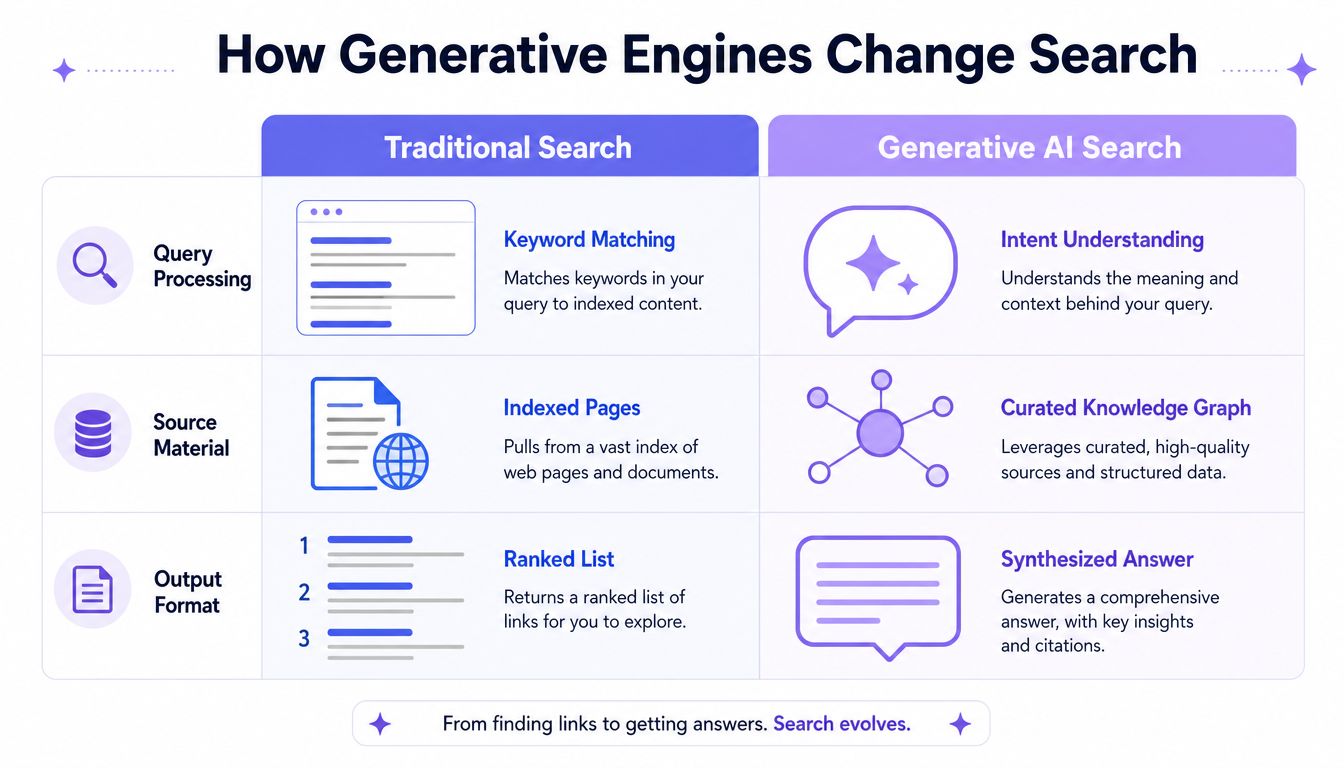
From matching terms to assembling evidence
Generative engines need clean relationships between a business, its services, its places, and its proof. They also need passages that can be extracted without losing meaning. A concise answer to “Which wedding photographer near Nantes works in documentary style?” should be supported by a page that states those facts plainly, not by a vague brand paragraph surrounded by promotional language.
The trade-off is between broad, persuasive copy and retrievable specificity. Brand storytelling still matters for human readers, but it shouldn't obscure facts that an AI system needs to identify. Use descriptive headings, question-and-answer sections, service-level pages, complete contact details, and structured data that reflects visible content.
For a technical overview of how teams can adapt existing SEO practices to AI systems, the Up North Media AI playbook offers useful context. A complementary explanation of generative engine optimisation helps frame GEO as an operational discipline rather than a trick for manipulating a model.
The practical mental model is straightforward:
- Classic search: return documents that appear relevant to a query.
- Generative search: construct an answer from information the system can interpret and support.
- Local discovery: recommend entities that appear relevant, identifiable, consistent, and geographically appropriate.
That doesn't mean AI engines ignore websites or conventional signals. It means a business needs both discoverable documents and an organised identity that those documents consistently describe.
The Hidden Visibility Gap for Local Businesses
Local visibility is often treated as a ranking problem. For many French TPEs and PME, the more urgent failure happens earlier: the business hasn't completed the basic work that allows directories, search engines, and AI systems to understand it consistently.
France Num's guidance on local SEO states that firms need to improve visibility on both classic search engines and AI engines. The same guidance highlights a basic market gap, only about one in two businesses is listed on a free local directory such as Google Business Profile. A company that hasn't claimed or completed its core listing is trying to optimise an answer system before establishing its business identity.

Legibility comes before ranking
Consider a bakery with an attractive website, active social accounts, and loyal customers. If its business name varies across directories, its opening hours are outdated, its address lacks a consistent format, and its site doesn't identify products or services clearly, an AI engine has to reconcile conflicting evidence. It may omit the bakery rather than risk giving a poor recommendation.
The same problem affects independent consultants, estate agents, tradespeople, clinics, and regional retailers. Their strongest knowledge often exists offline, in conversations and repeat custom. AI systems can't use that knowledge unless the business publishes it in accessible, structured places.
A local visibility audit should therefore check:
- Identity: Business name, address, phone number, website, category, and service area match across important listings.
- Offer: Core services, products, specialities, availability, and customer constraints appear in plain language.
- Proof: Reviews, professional credentials, partnerships, awards, and relevant third-party references are easy to verify.
- Technical clarity: The website uses suitable schema.org and JSON-LD markup, while keeping marked-up facts consistent with visible page content.
- Maintenance: Opening hours, temporary closures, menus, prices, and service details receive regular reviews.
AI discovery doesn't remove the need for a Google Business Profile. It makes directory hygiene more consequential because each listing can reinforce or contradict the entity represented elsewhere. Businesses that want to compare the behaviour of Google AI and ChatGPT should start by checking whether both systems can find the same basic facts about them.
Core Principles of Generative Engine Optimisation
Generative Engine Optimisation, or GEO, starts with information architecture rather than clever prompts. The aim is to make a business easy to identify, interpret, retrieve, and cite across conversational search systems.
Build authority that can be checked
Authority isn't just a high domain score or a large volume of blog posts. For a local business, it comes from consistent evidence. A physiotherapist might explain qualifications, treatment areas, patient suitability, locations, and booking conditions. A specialist retailer can publish manufacturer relationships, product specifications, delivery policies, and care guidance.
Use first-party pages for core facts, then reinforce them through relevant third-party references. Keep claims modest and verifiable. A page that says exactly what a business does is more useful than one that describes it as “the ultimate solution” without supporting detail.
Make the entity structurally clear
Structured data helps machines interpret relationships that humans understand intuitively. Implement relevant schema.org types, such as LocalBusiness, Organization, Product, Service, FAQPage, or Person, only where the markup matches what users can see. Include the business name, address, contact details, service area, opening hours, and links to authoritative profiles where appropriate.
Treat the markup as a reflection of your information, not a hidden keyword field. If the website says a shop opens on Sundays but the listing says it doesn't, structured data won't solve the contradiction. It will add another version for systems to assess.
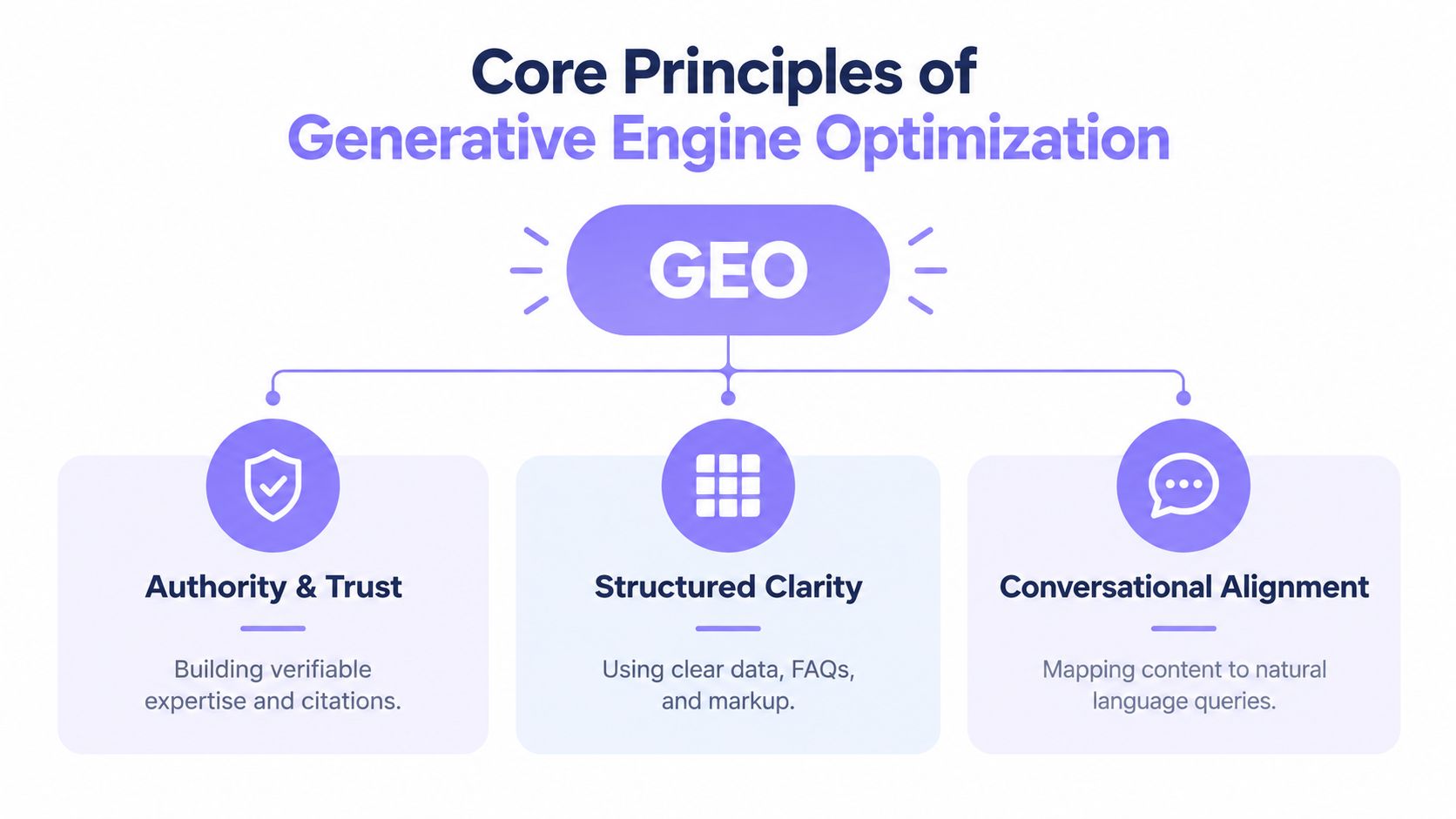
Align content with real questions
Customers don't always search using your internal category names. They ask whether a service covers their neighbourhood, whether a product suits a particular need, or which option fits a constraint. Map those questions to pages and answer them directly.
A useful GEO content set often includes:
- A precise service or product page, with scope, use cases, exclusions, location, and next action.
- An FAQ, written in natural customer language, with short answers that stand alone.
- A comparison or buying guide, where customers need help choosing between options.
- A proof page, bringing together qualifications, reviews, outcomes, and relevant affiliations.
- A maintained business profile, with consistent details across directories and social platforms.
Practical rule: Write every important fact so it remains understandable when extracted from the page and placed into an answer without the surrounding sales copy.
GEO doesn't replace good writing, technical SEO, or reputation management. It connects them. The business that publishes clear facts, supports them with credible references, and maintains consistency gives both classic crawlers and generative systems fewer reasons to ignore it.
Real-World Scenarios for AI Search Adaptation
A local estate agent usually starts with a familiar setup: a homepage, property listings, a Google Business Profile, and occasional posts about the local market. That may attract conventional searches, but it doesn't necessarily answer a conversational request such as finding an agency that handles a specific type of property in a particular area.
The operational adaptation is to create a clear agency entity and a set of intent-led pages. The agent can describe the neighbourhoods covered, property categories, valuation process, buyer and seller services, fees or conditions where appropriate, and the questions clients ask before instructing an agency. The same information should appear consistently in the website, business listing, professional profiles, and relevant local references.
A boutique e-commerce store faces a different problem. Its catalogue may contain beautiful product photography but limited text, inconsistent attributes, and product names that make sense internally. An AI system asked for a gift suitable for a particular recipient, material preference, budget constraint, or delivery requirement needs those attributes expressed in readable product data, not hidden in images.
Regional service providers need coverage clarity
A heating company serving several towns should avoid one generic “areas we serve” paragraph. Separate location pages can explain availability, relevant services, emergency conditions, and the differences between municipal areas. The company should also ensure that directory profiles use the same business details and don't imply a physical address where none exists.
The before-and-after isn't a promise of automatic recommendations. It is a change in information quality:
| Before | After |
|---|---|
| Generic service descriptions | Specific pages for services, locations, and customer needs |
| Inconsistent directory details | A controlled business identity across listings |
| Product images with sparse attributes | Text-based specifications and use cases |
| Reviews collected without context | Reviews supported by clear service categories |
| Blog topics chosen for volume | Answers mapped to real commercial questions |
What doesn't work
Publishing large volumes of generic AI-written articles won't compensate for missing entity data. Nor will adding unsupported schema, copying competitors' wording, or creating pages for locations the business doesn't serve. These tactics create noise and can introduce contradictions.
The strongest adaptation is usually smaller and more disciplined. Start with the facts that influence a buying decision, make those facts consistent, and then build content around the questions customers ask.
Measuring AI Visibility with Wispra
Classic analytics can show visits from a search engine, but they don't always reveal when an AI system has mentioned a business without producing a conventional click. A local company therefore needs a measurement approach that treats recommendation, citation, accuracy, and intent coverage as separate signals.
Begin with a question set based on commercial reality. Include category searches, location searches, comparison questions, problem-led queries, and prompts involving specific customer constraints. Record whether the business appears, how the engine describes it, which competitors appear instead, and whether the details are correct.
Track the answer, not just the visit
A useful monitoring process checks:
- Presence: Does the business appear in answers for relevant questions?
- Position in the answer: Is it recommended, mentioned as an alternative, or absent?
- Entity accuracy: Are the name, location, services, opening hours, and specialities correct?
- Source visibility: Which pages or directories appear to support the answer?
- Intent breadth: Does visibility exist only for the brand name, or also for non-branded customer needs?
- Change over time: Do updates to pages, listings, and reviews alter how engines represent the business?
Wispra is one practical option for this workflow. Its platform provides an AI-readable business directory, content formats including structured business information, and a tracking pixel with a performance dashboard for monitoring AI visibility across user questions. Setup is described as requiring no website changes, but every business should still validate the underlying information and maintain its primary listings.
The tool shouldn't replace manual checking. AI responses can vary by engine, wording, location, and available source material. A dashboard is most useful when it supports a repeatable review process rather than encouraging teams to chase isolated mentions.
Connect visibility to operations
The most valuable insight may be a factual error, not a visibility score. If an assistant repeatedly describes a restaurant as closed on a day when it opens, or assigns a service to the wrong town, the marketing team should correct the source data before celebrating additional exposure.
AI measurement also belongs with customer service and sales. Ask which questions prospects raise, identify missing answers, then publish those answers in pages and profiles that systems can retrieve. This creates a feedback loop between customer language, content production, data maintenance, and AI discovery.
Your Action Plan for AI-First Readiness
Local businesses don't need to rebuild everything at once. They need to remove the information gaps that prevent AI engines from identifying and recommending them.
Start with a short operational audit:
- Define the entity. Write one accurate description of the business, including its category, location, service area, core offer, and ideal customer.
- Clean the listings. Claim and complete the main local profiles. Correct names, addresses, phone numbers, opening hours, categories, and website links.
- Structure the website. Add relevant schema.org and JSON-LD markup that reflects visible business, service, product, and FAQ information.
- Create intent pages. Answer the questions customers ask before choosing you. Cover services, locations, use cases, constraints, comparisons, and booking conditions.
- Strengthen proof. Keep reviews, qualifications, partnerships, press mentions, and professional profiles consistent and easy to verify.
- Test real prompts. Search conversationally across the AI engines your customers use. Check both branded and non-branded questions.
- Correct the record. Treat inaccurate AI descriptions as a data-quality issue. Find the conflicting source and update it.
- Monitor regularly. Track presence, accuracy, sources, and commercial intent rather than relying only on rankings or website sessions.
The priority isn't to produce more content for its own sake. It is to make the business clear, consistent, and answer-ready. Classic SEO still supports discovery, but AI-first search adds a new requirement: systems must be able to assemble a trustworthy description of the company from distributed evidence.
Businesses that wait for a perfect GEO strategy may spend too long discussing rankings while competitors improve their basic entity signals. Start with the directory profile, the service pages, the structured data, and the customer questions that already drive enquiries.
Wispra helps businesses build an AI-readable directory profile, organise content for conversational discovery, and monitor how AI engines represent them across relevant questions. Visit Wispra to assess your AI visibility and turn your business information into a clearer source for AI recommendations.