
Optimiser Fiche Google Business Pour IA That Gets Cited
Learn to optimiser fiche Google business pour IA for ChatGPT, Gemini and Google AI. Practical steps to get cited, win local pack and track AI visibility.
A customer asks ChatGPT, Perplexity, Gemini, or Google for “the best electrician near Lyon who can come today”. Your business serves that area, your Maps listing appears for relevant searches, and your reviews are positive. Yet the answer recommends a competitor. Often, the problem isn't that your Google Business Profile is invisible. It's that the profile doesn't provide clear, consistent, reusable evidence for an AI-generated answer.
That distinction changes how you optimise a Google Business Profile for AI. Traditional local SEO helps Google decide which businesses appear in Maps and local results. Generative Engine Optimisation, or GEO, helps AI systems understand what your business does, where it operates, who it serves, and why it fits a specific request. A complete profile supports both jobs, but the signals aren't consumed in exactly the same way.
Why AI Search Now Reads Your Google Business Profile Differently
A Maps user may scan your category, location, opening hours, reviews, and distance before calling. An AI assistant has a different task. It must assemble an answer from business facts, customer language, website content, directories, and other available sources. If your profile says only “local services”, the system has little precise material to reuse. If it identifies “emergency boiler repair in Lille”, service coverage, availability, and relevant customer outcomes, the profile becomes easier to match to a prompt.
France matters because Google dominates the French search market at well over 90%, according to the France-focused analysis published by The State of SEO in France. The same analysis reports that Google Business Profiles appear in 78% of local search visibility scenarios and capture 42% of total localised clicks, making profile quality central to local discovery.
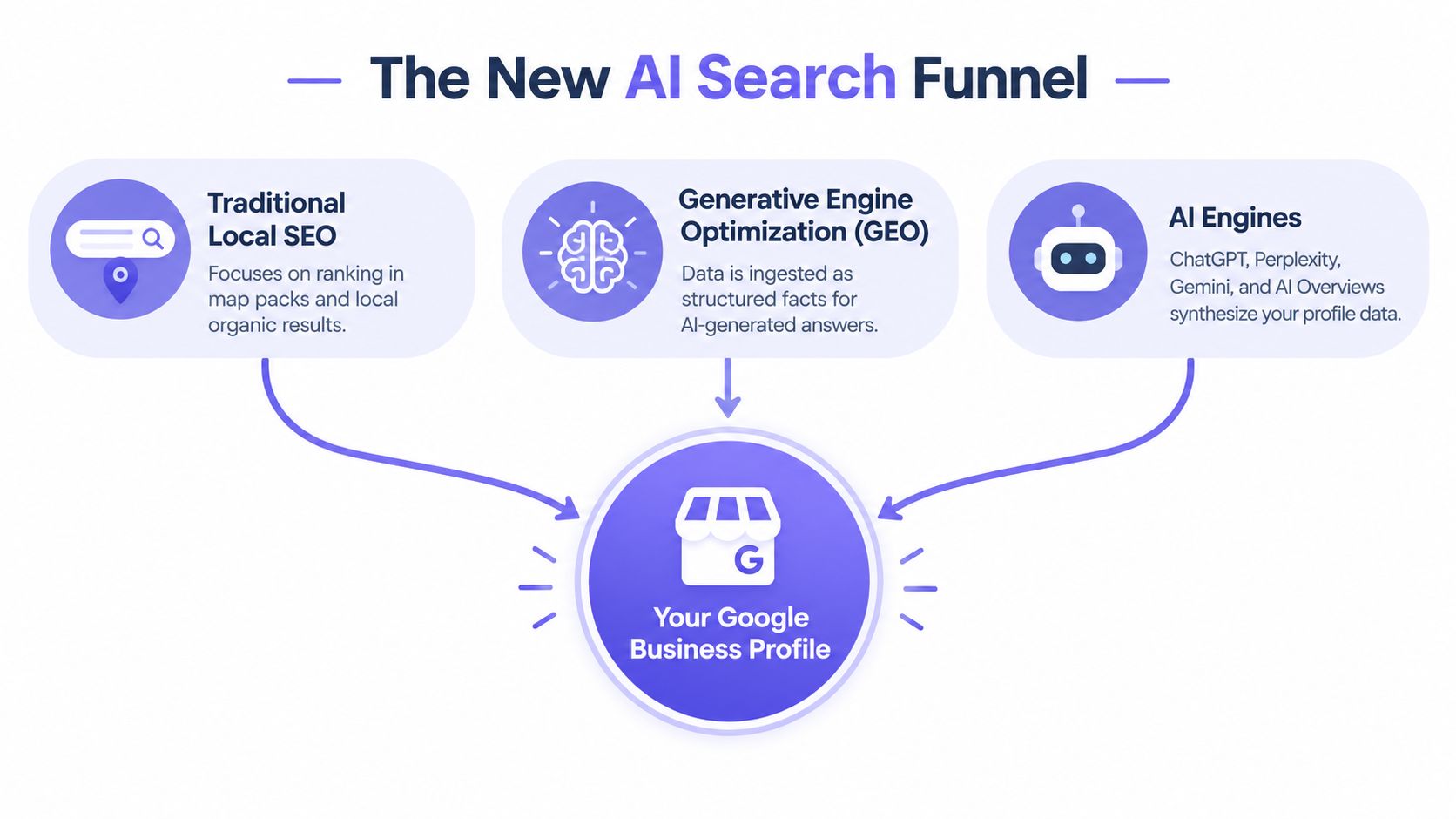
The important shift is not “add AI keywords everywhere”. It's the separation of two optimisation jobs:
- Maps visibility: category relevance, proximity, prominence, complete information, reviews, and actions such as calls or directions.
- AI citation potential: explicit service entities, precise locations, clear customer outcomes, consistent facts, and wording that answers conversational questions.
- Conversion readiness: accurate opening hours, service availability, contact options, booking paths, and evidence that supports the recommendation.
Google AI Overviews and AI Mode launched in France on 22 July 2026, and their local answers can appear above traditional results on google.fr across mobile and desktop, as reported by DataShake's analysis of AI Overviews in France. That makes profile content relevant beyond the local pack. A business can rank well on Maps yet remain absent from an AI answer if the available information doesn't clearly support the requested use case.
For a broader framework covering the move from rankings to answer visibility, this practical AI visibility roadmap is useful. French businesses should also understand the wider implications of Google AI search in France, particularly when customers describe needs in natural language rather than short keywords.
Laying the Foundation for AI Visibility
AI optimisation cannot compensate for unreliable business data. Before refining descriptions or publishing posts, verify that the profile reflects the business customers encounter. Google states that complete, accurate information supports eligibility for local ranking in its Business Profile performance guidance. That benefit mainly concerns Maps visibility, while consistent, precise records also give AI systems facts they can safely reuse.
Verify ownership and review every editable field. An unverified or partially controlled listing creates operational risk when staff change hours, services, or contact details. Check that the public profile describes the current offer, not an older setup from when the business provided fewer services.
Make the identity consistent everywhere
Keep the same real-world name, address, and phone number across the profile, website, French directories, professional associations, and major citation sources. Use the actual business name, without adding marketing phrases to target a service. Extra wording can create inconsistencies and make it harder for search systems to reconcile the entity.
Service-area businesses need a clear distinction between their base and their coverage. If customers do not visit a staffed location, configure service areas accurately instead of presenting a residential address as a public shopfront. A plumber based in Tours may serve nearby towns, but those towns are not automatically branch locations. This distinction can affect Maps eligibility and helps an AI answer location-specific questions without inventing premises.
Select categories from real customer intent
Choose a primary category that describes the central activity. Add secondary categories only for genuine, established services. A long list can blur the business entity, whereas a focused profile gives Google and AI systems a clearer answer to, “What kind of business is this?”
Hours require the same accuracy. Add normal opening times, appointment arrangements, and relevant holiday hours. A profile marked “open” can mislead customers when the business works only by appointment, producing poor recommendations and unnecessary visits.
France Num reports that one business out of two uses a free local referencing service such as a Google Business Profile, while 86% of consumers use Google Maps to search for a professional or company and 76% of smartphone searchers visit a business within the day. These figures appear in France Num's guidance on Google Business Profile. For small firms, the practical opportunity is to correct incomplete or unmanaged listings before adding more content.
Practical rule: Treat the profile as a public business record first and a marketing asset second. AI visibility improves when the record is stable, specific, and easy to verify.
Optimizing Core Business Information for AI Understanding
A customer asks an AI assistant, “Which plumber in Nantes handles an urgent leak for a condominium?” The profile needs enough precise information to identify a suitable answer. Promotional wording alone rarely provides that match. State what you offer, where you operate, and which customer need you solve in natural French.
A vague description might say:
“We provide quality solutions with a professional team and excellent customer service.”
A more useful version would be:
“Plombier à Nantes spécialisé en recherche de fuite, réparation de chaudière et débouchage urgent. Nous intervenons auprès des particuliers et syndics à Nantes et dans les communes voisines, sur rendez-vous et pour les urgences selon disponibilité.”
This second version identifies the profession, services, city, audience, and operating conditions. It also gives an AI system distinct facts to reuse. Repeating “plombier Nantes” unnaturally adds little. Specific, verifiable wording does more for AI citations than polished promotional language, while the same clarity can also support traditional Maps relevance.
Build service entries around specific requests
Use the services section to separate genuine offers. “Services” says almost nothing. “Deep tissue massage”, “drain unblocking”, “commercial lease valuation”, or “same-day laptop screen replacement” describes a usable unit of meaning. Where the field permits, explain the audience, situation, location, and next step.
Products and menus need the same discipline. Add current names, meaningful descriptions, and prices where the business publishes them. Remove discontinued offers. Duplicating one service under slightly different labels may fill fields, but it gives AI systems little additional information and can blur the offer.
Website structured data should describe the same entity as the profile. LocalBusiness details, service pages, contact information, opening hours, and location references must agree. Mark-up cannot repair contradictory business facts. It helps when page content, the profile, directories, and customer-facing wording reinforce one another.
Run this short audit:
- Entity check: Can a reader identify your profession and core service from the first sentence?
- Location check: Does the profile name the city, neighbourhood, or service area?
- Intent check: Do service names resemble customers' descriptions of their problems?
- Audience check: Does the content specify homeowners, businesses, landlords, tourists, or another group?
- Consistency check: Do the website, profile, and French directories describe the same offer?
Write clear image descriptions and meaningful page text. Decorative labels and filenames do not explain the business to machines or customers. For a wider standardisation review, consult this Google Business information checklist for AI recommendations. Each field should answer a real customer question or clarify a business fact.
Building Trust Signals That AI Can Reuse
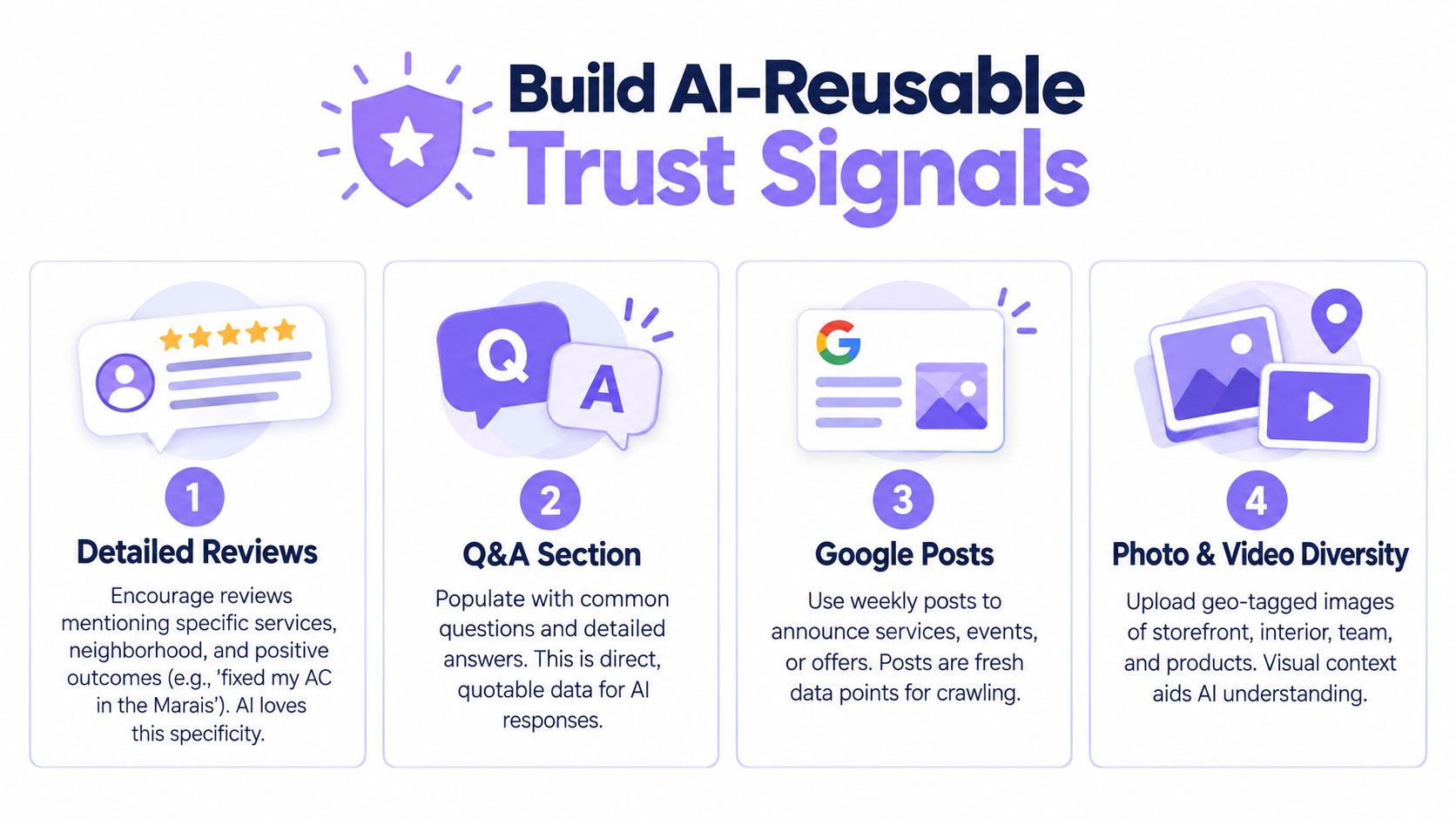
A complete profile tells AI what the business claims to do. Reviews, Q&A, photos, and posts provide evidence and context. They show how customers describe the service, which situations arise in practice, and whether the business remains active.
Generic praise has limited descriptive value. “Great company” confirms satisfaction but says little about relevance. A detailed review that mentions the service, neighbourhood, and outcome gives an AI system more material to connect with a prompt. Customers should write in their own words. Businesses shouldn't script reviews or offer incentives for particular wording.
Respond to reviews in French with the same specificity. Thank the customer, mention the service when appropriate, and address concerns without revealing private information. A response such as “Thank you for your feedback” is polite but thin. A response that acknowledges the repair, the area served, or the appointment context adds useful business language while remaining natural.
Turn customer questions into reusable evidence
The Q&A section can answer recurring objections before a customer calls. Use genuine questions such as:
- Do you provide emergency visits in the evening?
- Is the workshop accessible by public transport?
- Do you work with landlords and property managers?
- Can customers collect orders without an appointment?
Answers should be direct, current, and specific. Don't fill the section with invented questions that make exaggerated claims. Update answers when availability, access arrangements, or service conditions change.
Google Posts can support freshness, but posting alone doesn't guarantee AI citations. A useful post answers a local query, explains a service, or clarifies an event. A promotional sentence with no context is less valuable than a short explanation of who the service is for and how to request it.
Photos should represent the business accurately. Include the exterior, interior, team, equipment, completed work, products, and access points where relevant. Use descriptive captions and keep visual claims honest. Location metadata may provide context, but it shouldn't replace consistent written location information.
AI-reusable trust comes from agreement between claims, customer language, and visible proof. More content isn't automatically better content.
A small business can manage this with a lightweight routine. Review new feedback, answer outstanding questions, add a genuine update, and upload a relevant visual when something changes. For practical review workflows, see this guide on optimising Google reviews for business visibility.
Using AI Aware Keywords and Content Without Overdoing It
The wrong response to AI search is to insert “ChatGPT”, “AI recommendation”, and every imaginable keyword into your profile. Customers don't search that way, and forced wording makes the business sound unreliable. Use the language customers employ when describing a problem, then place each concept in the field where it belongs.
Start with conversational prompts. A customer might ask, “Who repairs leaking radiators in the Croix-Rousse?” or “Which vegan restaurant near Bordeaux offers takeaway late?” Extract the underlying entities: service, product, neighbourhood, city, audience, urgency, access, and constraint. Then map those entities to the profile, website, reviews, Q&A, and posts.
| Customer AI Prompt Example | Best GBP Field | Writing Tip |
|---|---|---|
| “Who repairs leaking radiators in Croix-Rousse?” | Primary category, services, description | Name the repair service and the actual service area naturally. |
| “Can I book a vegan takeaway near Bordeaux?” | Categories, products or menu, booking link | State the food offer, collection process, and location without stuffing. |
| “Does this solicitor handle commercial leases in Toulouse?” | Services, description, website service page | Use the legal service name and client type explicitly. |
| “Is the studio wheelchair accessible?” | Attributes, Q&A, photos | Enable the relevant attribute and explain practical access details. |
| “Can I get an appointment on Saturday?” | Opening hours, special hours, Q&A | Separate normal hours from appointment conditions. |
A profile description should support, not duplicate, the website. Use the profile for concise identity and offer information. Use FAQ pages and service pages for detailed answers, eligibility conditions, preparation steps, and comparisons. The same facts should remain aligned across both locations.
Content automation can help with repetitive production, but it needs editorial control. A tool such as Wispra can ingest Google Business Profile data, publish it in an AI-readable business directory, generate supporting blog, FAQ, review, and product-catalog content, and track visibility across conversational engines. Treat generated drafts as structured starting points. A person still needs to verify services, French phrasing, opening conditions, and local accuracy.
The most useful test is subtraction. Remove every buzzword and ask whether the remaining text still identifies the business clearly. If it doesn't, the profile needs better facts, not more references to AI. Keep a simple matrix like the table above, update it from real customer questions, and review it whenever the offer changes.
Your Implementation Checklist and Measurement Routine
Optimisation fonctionne mieux par étapes que par grande réécriture laissée sans suivi. Commencez par les éléments qui peuvent empêcher la découverte ou dégrader l'expérience client, puis ajoutez des preuves et du contenu.
Les deux premières minutes
Ouvrez la fiche publique comme un client. Vérifiez le nom de l'entreprise, l'adresse ou la zone desservie, le téléphone, le site web, la catégorie principale, les horaires et le parcours de réservation ou de contact. Corrigez d'abord les erreurs visibles. Une description bien rédigée ne compensera pas un horaire de fermeture incorrect.
La première semaine
Complétez les attributs manquants, ajoutez les catégories secondaires pertinentes, relisez chaque service et remplacez les formulations vagues par un français précis. Comparez ces informations avec celles du site et des principaux annuaires français. Recherchez les différences d'orthographe, les anciens numéros, les adresses incohérentes et les services encore affichés alors qu'ils ne sont plus proposés.
Préparez une file de travail pour les avis, les questions-réponses, les photos et les publications. Demandez aux clients satisfaits un retour honnête, sans imposer les mots à employer. Répondez aux questions récurrentes, publiez une information utile et ajoutez des visuels représentant réellement les locaux, l'équipe, les prestations ou les produits.
Le premier mois
Consultez directement les rapports de performance de la fiche Google Business Profile dans la Recherche et Google Maps. L'interface permet de suivre les impressions et les actions sur une période donnée, sans outil tiers, comme l'indique la documentation officielle de Google. Comparez les actions issues de la Recherche et de Maps sur des périodes de 30 jours constantes. Notez les appels, visites du site, demandes d'itinéraire et réservations lorsque ces données sont disponibles.
Les impressions ne suffisent pas. Une fiche peut gagner en visibilité tout en attirant le mauvais public, ou générer une action parce que le client connaissait déjà la marque. Croisez les données avec les questions posées, les services cités dans les avis et les modifications apportées aux catégories ou aux horaires.
Chaque semaine, répondez à quatre questions :
- Qualité des données : un champ important est-il incomplet ou inexact ?
- Langage client : quels services, lieux et résultats apparaissent dans les nouveaux avis et questions ?
- Qualité des actions : la Recherche et Maps génèrent-elles des appels, visites, réservations ou itinéraires utiles ?
- Preuves pour l'IA : la fiche permet-elle de répondre directement aux requêtes de vos clients ?
Si les résultats restent faibles, vérifiez les fondamentaux avant d'ajouter du contenu. Des champs incomplets, des informations NAP différentes, peu d'avis récents ou des descriptions françaises trop pauvres réduisent la compréhension de l'entreprise. Les outils de suivi de visibilité IA peuvent compléter l'analyse, mais ils ne remplacent pas les rapports Google.
Le bon objectif consiste à rendre l'entreprise identifiable sans ambiguïté, avec la bonne catégorie, les bons services, le bon lieu, les bonnes conditions et suffisamment de preuves fiables pour qu'un moteur IA puisse citer la fiche lorsque la demande correspond.
Wispra transforme les données Google Business Profile en informations lisibles par les moteurs IA, en contenus complémentaires et en suivi de visibilité pour ChatGPT, Perplexity, Gemini et Google AI. Wispra permet de relier une fiche locale à un processus GEO et de vérifier si les systèmes IA trouvent et recommandent l'entreprise.