
Panneaux Publicitaires Immobilier: Plan, Permit and Measure
Guide to panneaux publicitaires immobilier in France: legal sizes, permits, locations, budget and lead tracking. Practical steps for agents and sellers.
You've secured a promising listing, spotted a busy roadside location and asked a printer for a panel quote. Then the questions arrive: can you advertise there, does the frame count towards the permitted size, and will the municipality charge a local advertising tax? The cheap visibility tool suddenly needs a proper campaign budget.
For agencies comparing panneaux publicitaires immobilier, the useful question isn't which board attracts the most attention. It's which approved location produces qualified appointments at an acceptable total cost. That means treating permissions, tax, installation, removal and tracking as part of the purchase, not administrative details to sort out afterwards.
Panel Formats and Legal Limits at a Glance
An agency orders artwork for a roadside panel near a new listing, only to discover that the quoted dimensions describe the printed face rather than the complete installation. The supplier may have priced the job correctly, but the agency hasn't yet established whether that job can legally be installed.
Start by distinguishing dedicated advertising panels from sale or rental signs attached to the property concerned. Don't assume that an agency promotion beside a road and a temporary property sign share the same classification, dimensional limits or approval process.
Panel formats and legal limits in France
The following is a screening table, not permission to install. The public administration's panel-size update gives the non-luminous area limits, includes the frame in the measurement and explains the general density restriction.
| Format | Maximum area | Maximum height | Key rule |
|---|---|---|---|
| Non-luminous panel, agglomeration above 10,000 inhabitants | 10.5 m² including frame | 6 m in the cited summary | Measured with the full frame |
| Non-luminous panel, smaller agglomeration below 10,000 inhabitants, not part of an urban unit above 100,000 | 4.7 m² including frame | 6 m | Same frame rule, smaller ceiling |
| Digital or illuminated panel | 8 m² for digital advertising | 6 m for digital advertising | Normally switched off from 1:00 to 6:00; confirm the classification of other illuminated devices |
| Façade sale or rental sign under the example local rule | 60 × 80 cm | Façade-mounted, flat or parallel to the wall | One per property, projection no more than 25 cm |
The digital figures come from the ministry's practical outdoor-advertising guide. The façade dimensions are an example from a local advertising regulation, not a nationwide entitlement.
Measure the finished object, including its border. Ask the supplier to show external dimensions on the drawing rather than supplying only an artwork size.
Density also matters: the public-administration summary generally allows a single advertising device where a plot has no more than 80 metres of public-road frontage, subject to the applicable arrangements and exceptions.
Practical rule: National maxima are the starting point for checking a site, not a promise that the municipality will accept that format.
Local advertising regulations, commonly called RLPs, can impose tighter restrictions. A small, correctly classified property sign may be the sensible choice even when a larger advertising panel initially looks more attractive.
Choosing Locations That Earn Their Cost
A panel works when a potential buyer's route passes it with enough opportunity to understand the message. Being close to the listing helps only if the right people can read it.
A busy road can be a poor purchase. Drivers may approach too quickly, see the reverse of the panel or concentrate on a difficult junction rather than your telephone number.
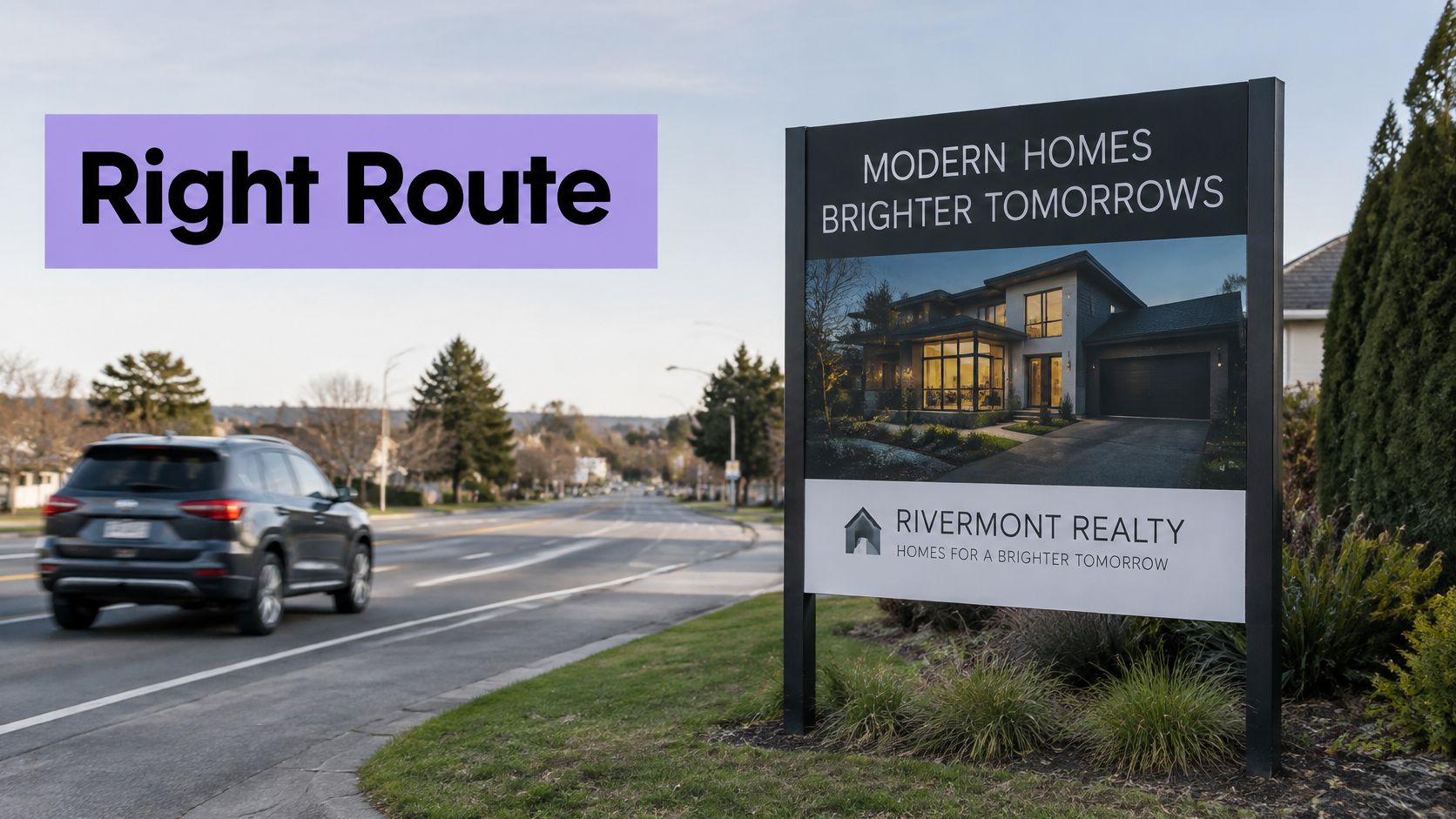
Three panel placements compared
These are planning judgements, not measured response-rate benchmarks. In this hypothetical comparison, the arterial-road option is farther from the property but reaches a broader stream of traffic.
| Placement | Reach | Link to viewing moment | Per-driver visibility |
|---|---|---|---|
| Panel beside the listing | Yes, has reach | Weak unless the property is immediately identifiable | Good only with an open approach and readable angle |
| Panel on a main arterial away from the listing | Yes, has reach | Indirect, requires a later journey or enquiry | Often lower because of speed and competing signs |
| Sign on the property itself | Almost none beyond passing local traffic | Strong, intent at viewing | Strong for slow-moving visitors facing the property |
The roadside option can introduce a property to people who weren't actively looking for it. Its weakness is the gap between noticing the advertisement and arranging a viewing.
The arterial option is better suited to a memorable agency or development message than a detailed listing description. The façade sign does a different job: it confirms that the property someone is looking at is available and gives them an immediate route to contact.
Inspect the approach, not just the plot
Visit candidate sites when your likely buyers travel. As a practical field exercise, make a short timed count of vehicles and pedestrians, note traffic direction, and photograph the approach from safe public positions at both a distant and a near reading point.
Record the following before negotiating rent:
- Reading opportunity: Note where the whole panel first becomes visible and where trees, parked vehicles or street furniture interrupt it.
- Facing direction: Check which traffic stream sees the front. A homeward-facing panel may reach commuters at a more useful moment than an outward-facing one.
- Visual competition: Look for neighbouring advertisements, shopfronts and road signs that make your message harder to isolate.
- Driver workload: Slower traffic can help, but a complicated junction can demand all the driver's attention.
Connect the location to your agency's digital marketing: the promise on the panel should match the page visitors reach. Shortlist only the strongest candidates, then subject each to the same approval checks before paying a deposit.
How to Get a Panel Approved Step by Step
Treat approval as a sequence of decisions, with a named agency employee responsible for the file. A printer's willingness to manufacture a panel doesn't establish your right to install it.
The official outdoor-advertising guidance provides the basis for checking location, device classification, dimensions and formalities. Use the site-specific answer from the competent authority rather than selecting whichever general limit is most convenient.
Clear the site before ordering production
Confirm agglomeration status. Establish whether the proposed position is inside an agglomeration and identify the applicable population and urban-unit category. Don't substitute the municipality's postal address for the actual status of the installation point.
Check the RLP and protected areas. Obtain the local regulation and locate the plot on its zoning map. The ministry's regulatory guide identifies prohibitions affecting historic monuments, classified sites, national-park cores, nature reserves and trees.
Classify the device. Describe whether it is wall-mounted or ground-mounted, and whether its legal function is advertising, a sign or a directional pre-sign. Its message, relationship to the premises and support all matter.
Measure external dimensions. Obtain a dimensioned drawing covering the frame, support and projection. Leave design margin rather than producing an object that becomes non-compliant after the fabricator adds its finishing components.
Resolve height and ground clearance. The official guidance specifies a minimum 0.50 m clearance, with maximum heights of 7.5 m in the larger-agglomeration category and 6 m in the smaller category. Ask the authority which support-specific ceiling applies, since general summaries and device categories don't always describe the same installation.
Obtain written owner consent. Identify the actual owner of the supporting wall or land and document the agreed location, access and removal arrangements. A listing mandate shouldn't be treated as unlimited permission to use any nearby surface.
Establish the required filing. Ask whether the proposal needs a declaration or prior authorisation and submit the appropriate documents. Keep installation on hold until the applicable process permits it.
Request the production quote. Give the supplier the approved specification, not an earlier creative sketch. Require the order confirmation to match the support, external dimensions and lighting arrangement.
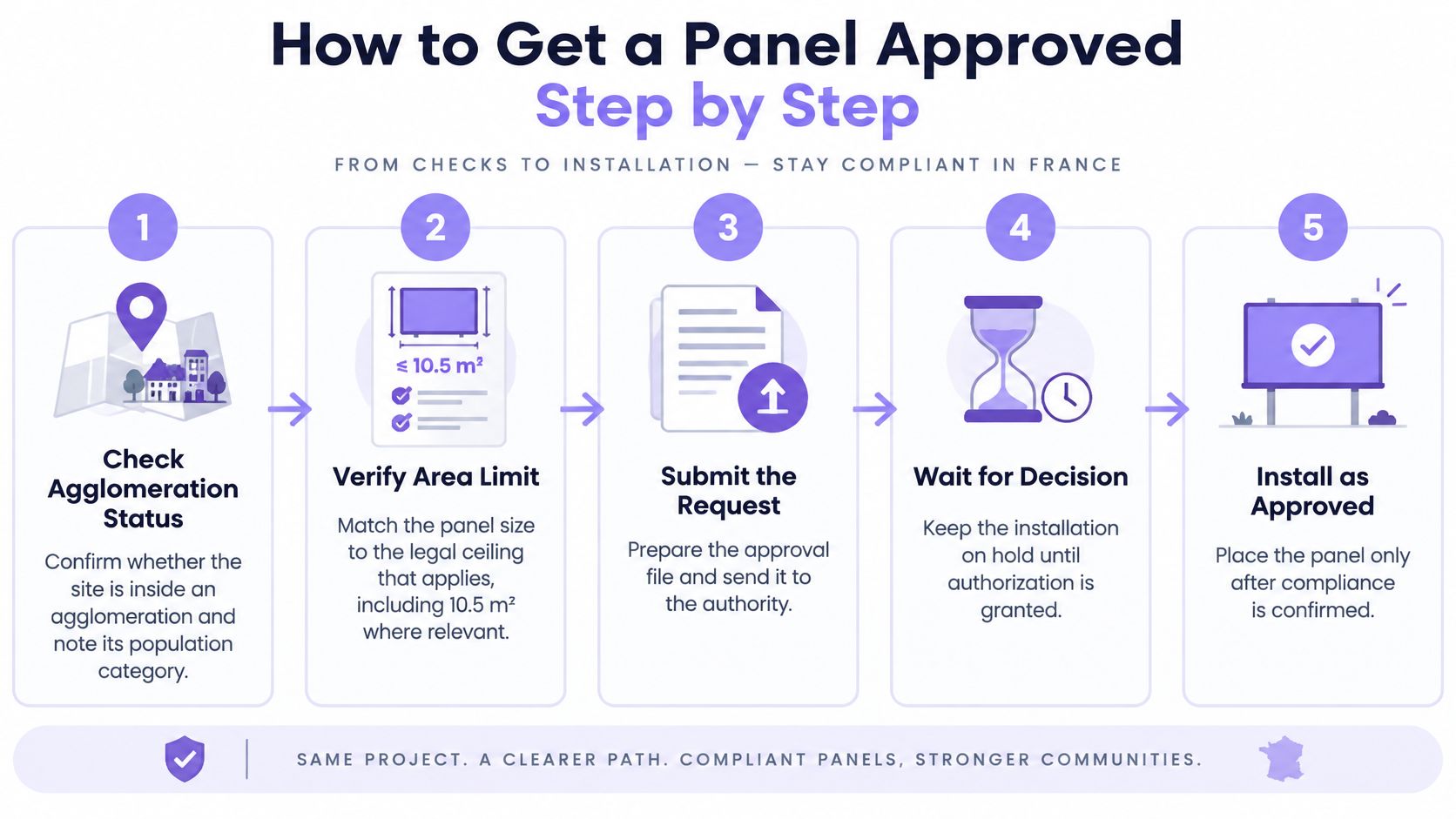
Keep an auditable approval file
Store GPS coordinates, municipality, agglomeration category, external dimensions, support type, lighting, setback, owner consent and filing references together. Add installation photographs and the planned removal date so another employee can manage the panel without reconstructing the project.
No reliable nationwide property-panel success benchmark was identified in the official material. Approval establishes whether you can run the campaign, not whether it will pay.
We serve real-estate and multi-location businesses, among other sectors. Our Performance product provides AI tracking, multi-source attribution and measurable ROI from click to lead, which can support the digital part of a panel campaign without replacing its physical approval file.
Designing Panels for Drivers and Pedestrians
Design the roadside version for a passing glance, not an attentive website visitor. Choose a single proposition: the property type, location or price positioning that gives someone a reason to enquire.
A photograph, feature list, agent portrait, logo, slogan and several contact methods compete for the same limited space. If everything is prominent, the viewer has to decide what matters while moving past.
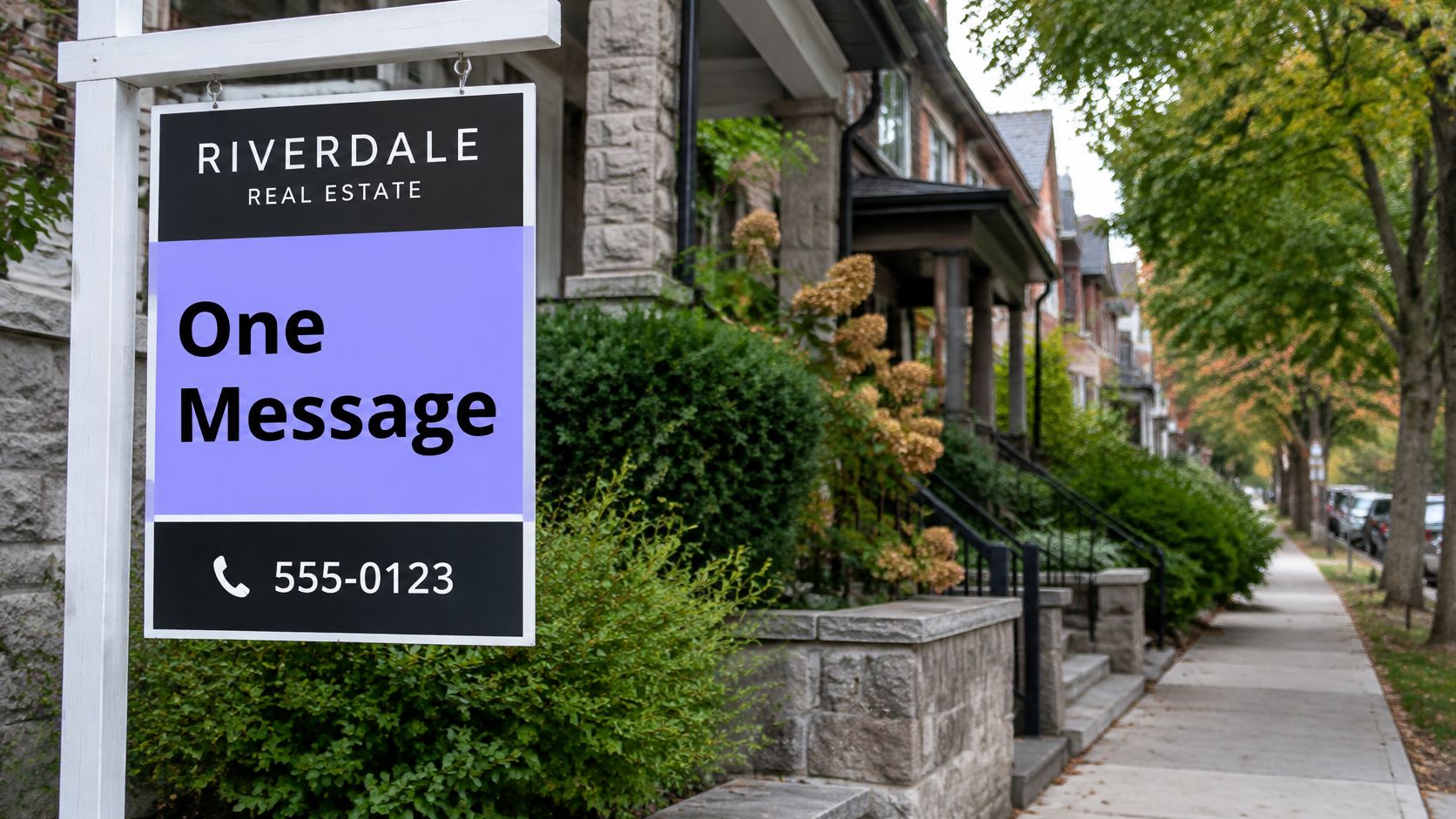
Make the next action unmistakable
Use a large telephone number or a short, memorable web address as the primary contact. Keep any required professional information legible without allowing decorative branding to overwhelm the action you want.
A QR code belongs where a pedestrian can stop safely, not where you expect a driver to scan it. Print a proof at its intended physical size and test it from the actual pavement position, including under glare or shadow.
Choose high contrast, and keep contact details off busy property photos. Test a mock-up against the actual backdrop, since a plain white screen says little about how the panel will look next to foliage, shopfronts or parked cars.
For a landlord-focused message, send visitors to information that helps them make a decision rather than a generic homepage. A resource such as Edinhart Realty's rental valuation guide illustrates the kind of valuation topic a dedicated landing page can address, though the content must suit your own market.
A panel should create a reason to act. The landing page should supply the detail that wouldn't fit on the panel.
Let digital justify its extra complexity
I'd start with static advertising unless there's a clear operational reason not to. A static panel doesn't require an electronic display, content scheduling or the same electricity and technical maintenance arrangements.
Digital can make sense when the agency needs to rotate available properties or change messages by time of day. But rotation also means your particular listing isn't continuously displayed, and the approved operating conditions may limit when the screen runs.
Ask a digital operator for the actual display schedule, your share of that schedule, maintenance responsibilities and evidence of outages. Don't buy a modern-looking format without knowing what exposure you're purchasing.
Before releasing artwork, check:
- One message: The viewer can identify the offer without reading a feature list.
- One primary contact: The intended response route is obvious.
- One trackable code: Pedestrians can reach the relevant page without searching.
- A field-tested proof: Text and scanning work at the intended installation position.
Move to digital only when the likely incremental value can cover its additional tax, operating costs and production demands.
Budgeting for Tax, Production and Rental
The overlooked costs are usually local advertising tax, site rental, installation, removal and administrative time. A low print price tells you little about the full cost of keeping a panel in service.
The public-administration advertising guidance describes the optional local outdoor-advertising tax and gives 2025 standard small-business rates from €18.60 to €37 per m² for surfaces up to 50 m², according to municipality size. Treat these as dated planning references, not a current quotation from your municipality.
Tax and cost lines to budget for a panel
The Clermont-Ferrand examples below are also historical 2025 figures documented in the ministry's practical guide, rather than rates that apply throughout France.
| Cost item | Rate or range | Note |
|---|---|---|
| Local outdoor-advertising tax, small-business standard, 2025 | €18.60 to €37 per m² | Surfaces up to 50 m²; municipality size affects the standard rate |
| Non-digital panel, Clermont-Ferrand, 2025 | €37 per m² | Surfaces up to 50 m² |
| Digital panel, Clermont-Ferrand, 2025 | €110.90 per m² | Non-large digital advertising |
| Production of the panel | Written supplier quote required | Quote the measured external size and specified support |
| Site rental per month | Written owner or operator quote required | Confirm access, term, cancellation and removal responsibilities |
For a hypothetical static-panel budget, multiplying an assumed taxable area of 10.5 m² by an assumed applicable rate of €37 per m² gives €388.50, or about €389, before production and rental. This arithmetic is a scenario, not a tax assessment: confirm the taxable area, applicable rate, exemptions and charging period with the municipality.
The historical digital example shows why format selection deserves financial scrutiny. For equal taxable areas under those stated categories, the digital rate is roughly triple the non-digital rate before electricity or maintenance enters the calculation.
Compare complete monthly costs
Build a spreadsheet with separate lines for one-off expenditure and recurring commitments. Spread production and installation over the intended campaign period, then add rental, confirmed tax liability, maintenance, tracking and removal.
Include internal time, too. Someone must gather documents, respond to the authority, brief the supplier and organise collection when the listing is withdrawn.
- Quote scope: Confirm whether delivery, fixings, installation and dismantling are included.
- Exit conditions: Check what happens if the property sells earlier than expected.
- Channel comparison: Use the same qualified-enquiry definition when comparing panels with online advertising.
Set your maximum acceptable cost per qualified enquiry before booking. Otherwise, a panel can remain in place because the agency has already paid to install it.
Measuring Leads and Online Visibility from Offline Panels
Set up attribution before approving the final artwork. Once a generic agency number is printed, you can't reliably distinguish a panel-generated call from a recommendation, portal enquiry or previous customer.
Assign each location a dedicated call-tracking number and a QR destination carrying its own campaign identifier. Use a dedicated landing page or a hidden source field in the enquiry form, and test the complete journey on a mobile phone.
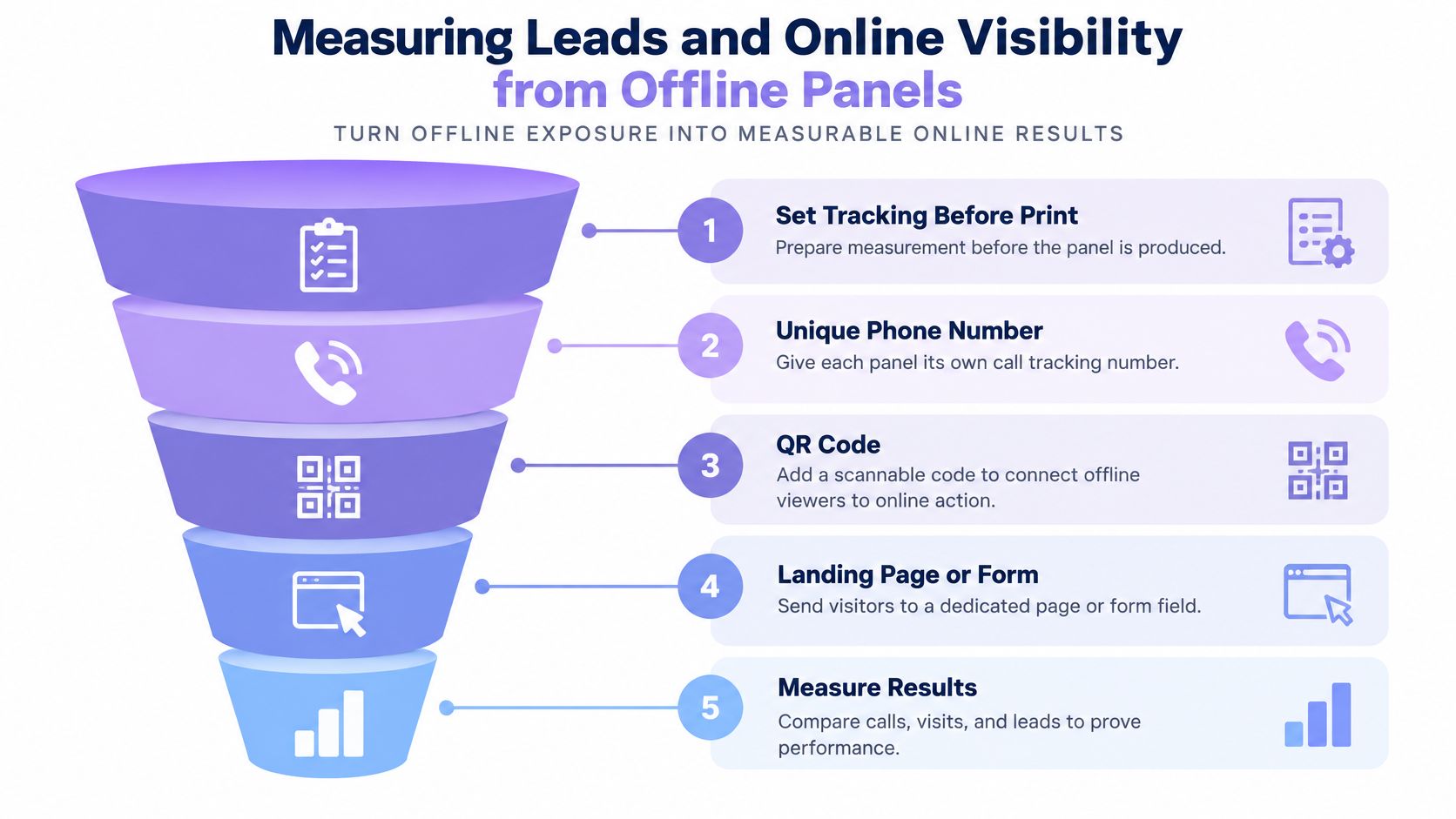
Measure outcomes rather than scans alone
Define a qualified enquiry before the campaign starts. For a buyer campaign, that could mean someone whose budget, preferred area and property requirements match the offer; for a seller campaign, use a separate definition tied to a potential instruction.
Give reception staff a simple source field and a consistent qualification checklist. Deduplicate callers and form submissions so a person who scans, phones and emails doesn't become several leads.
Track:
- Enquiries by location: Separate calls, forms and scans rather than adding them together as equivalent outcomes.
- Lead-to-viewing conversion: Review how many qualified enquiries become booked and attended viewings.
- Commercial outcomes: Record appointments and signed mandates where relevant to the campaign objective.
- Cost per qualified appointment: Divide the complete campaign cost by qualifying appointments, not raw website visits.
Keep the destination focused on contact. A page such as Contact Dream Destin Realty is a relevant reference when reviewing the hand-off from property interest to an enquiry route, rather than sending panel visitors into an unrelated content journey.
Measurement caution: Estimated passers-by are opportunities to see a panel, not verified viewers or unique prospective buyers.
If you report outcomes against estimated footfall or traffic, label the denominator clearly. A short roadside count shouldn't become a precise claim about total campaign exposure.
Separate direct attribution from wider visibility
Choose a test period in advance and change only a limited part of the campaign. You might alternate messages between comparable approved sites, or pause a placement while keeping the agency's other activity stable.
Look separately at branded searches, business-profile calls and whether AI assistants mention the agency in relevant local answers. These are indirect signals, so compare them with a recorded pre-campaign baseline and note other marketing changes.
For seller campaigns, connect follow-up to a consistent seller-lead generation process. An unanswered tracked call still represents a missed opportunity.
For a practical pilot, book a single approved panel for a fixed trial and put the review appointment in the calendar before installation. Bring the approval file, weekly enquiry log and cost per qualified appointment; keep, adjust or remove the placement according to how it compares with your other channels.
Wispra helps businesses measure AI visibility, and our Performance product provides multi-source attribution and measurable ROI from click to lead. Visit Wispra to start with a free report and assess how the digital response to your panel campaign fits into your agency's wider visibility.