
Prévoyance Travailleur Non Salarié: A Practical 2026 Guide
Prévoyance travailleur non salarié explained for 2026: legal context, key coverages, costs, and how freelancers can assess their real protection gap.
Only about 45% of French independent workers had a prévoyance contract in 2025, compared with 92% of salaried workers. That matters because when your income stops, the public TNS regime often protects only a fraction of what your household and business need.
The mistake I see most often isn't that freelancers reject protection. They assume their compulsory cover follows their revenue. It doesn't. Your regime calculates benefits from its own rules and contribution base, while your rent, loan repayments, family costs, and business overhead continue at their normal level.
This guide takes a practical position: don't begin with a list of insurance features. Begin with the gap between what your public regime would pay and what your life requires each month. The 2026 social-base reform makes that audit more urgent, because existing contracts may no longer match your income, contribution base, waiting periods, or chosen disability definition.
Why Most Independent Workers Are Underprotected
French market evidence has been consistent. In 2025, only 45% of independents were insured for prévoyance, while coverage among salaried workers reached 92% under a system that commonly includes employer-arranged protection. The figures are reported in MAAF's overview of prévoyance for non-salaried workers. This isn't a minor difference in product preference. It shows that a large part of the TNS population faces illness, disability, or death with a public safety net that may not reflect actual earnings.
The underlying problem is usually delayed awareness. A consultant can work for years without checking the daily allowance that applies to their affiliation. An artisan may know their monthly turnover precisely but not the income base used to calculate incapacity benefits. A liberal professional may have a professional fund with some protection, yet assume it covers every stage of a prolonged absence.
The practical test is simple:
- Freelance developer earning €4,800 per month: the relevant question isn't whether an indemnity exists. It's how much remains missing after the public payment, household costs, and business expenses.
- Artisan earning €2,400 per month: a lengthy franchise or a low daily allowance can consume available savings before private cover begins.
- Liberal professional earning €7,500 per month: a professional scheme may provide a stronger base than the SSI, but high fixed commitments can still create a substantial shortfall.
| Status | Coverage rate | Typical contract source |
|---|---|---|
| Salaried workers | 92% | Employer or collective scheme |
| Independent workers | 45% | Individual contract or no supplementary cover |
The historic evidence points in the same direction. An earlier estimate placed protection for incapacity, disability, and death at 30% for TNS and agricultural self-employed workers, compared with 92% for salaried workers, leaving 4.6 million people uncovered, as summarised by Harmonie Mutuelle's TNS prévoyance guidance. The exact contract you need depends on your regime, not on a generic freelancer profile.
Practical rule: measure your exposure in euros per month of missing income. Don't choose cover because a brochure lists four attractive guarantees.
What Prévoyance Actually Means for a TNS
Prévoyance is complementary protection for the moments when your ability to earn is interrupted or permanently lost. It sits above the mandatory regime attached to your activity and can respond to temporary incapacity, permanent disability, and death. It isn't the same as a TNS health policy. A health policy reimburses eligible medical costs, while prévoyance protects income and dependants.
The distinction becomes clear when you look at the public daily benefit. In 2026, the ceiling for many TNS cases is about €65.84 per day, while some professional-liberal schemes can reach €197.51 per day, according to Prevoya's explanation of TNS prévoyance. Those amounts are regime-dependent. They aren't a promise that your own affiliation will pay the higher figure, and they don't automatically track your actual monthly revenue.
The public regime also handles death differently across occupations. A professional fund may offer benefits that are unavailable or structured differently under the SSI. That is why the first task is always to identify your exact affiliation, contribution base, eligibility conditions, and maximum benefit before selecting private cover. The legal framework for the TNS social regime sits within the Social Security Code, including CSS article L613-1, but the useful answer for a business owner is still practical: what arrives in the bank account, and when?
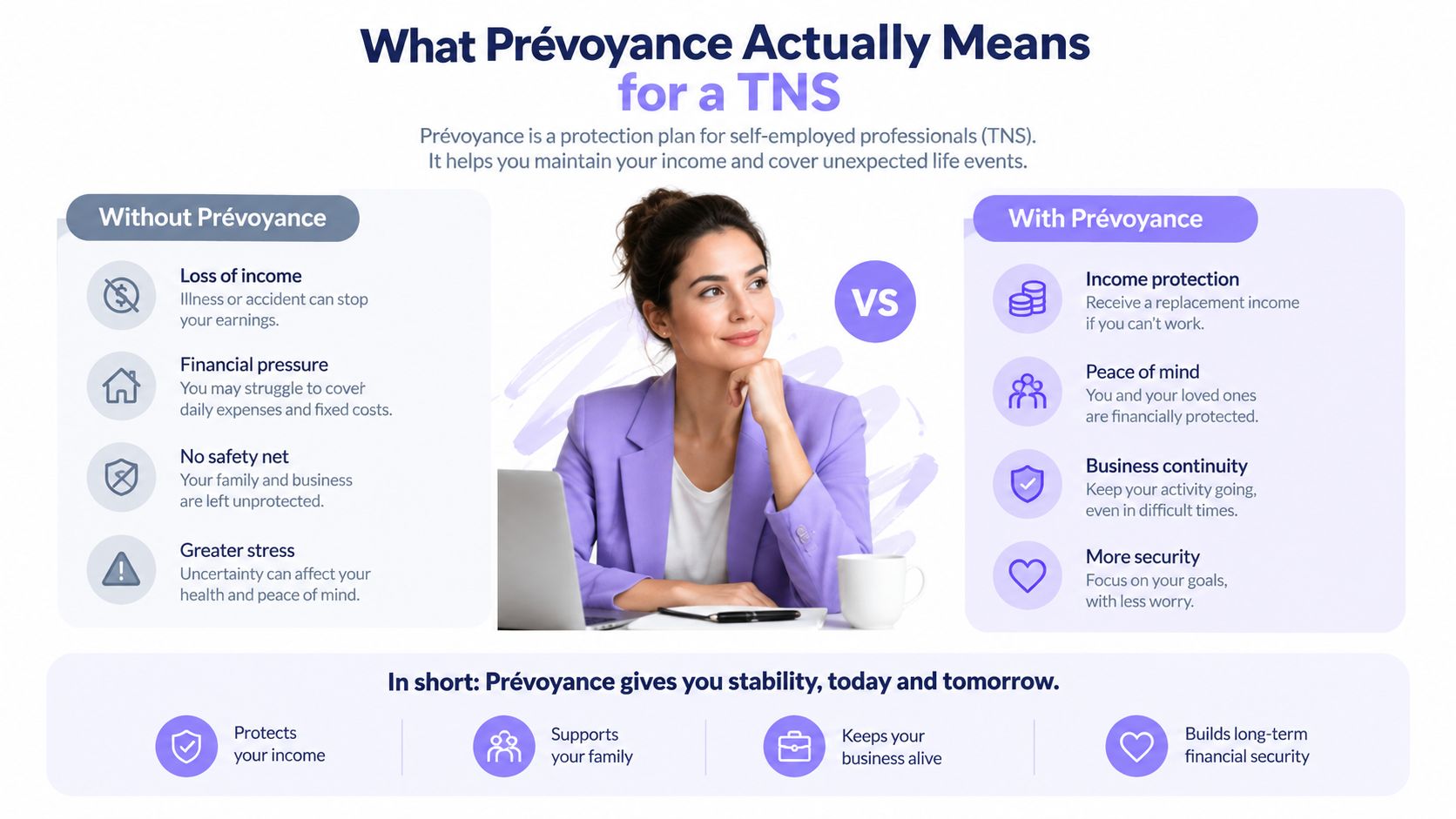
Two separate protections need attention. Income protection helps pay for personal and business commitments during incapacity or disability. Family protection provides capital or income to the people who depend on you if you die. A policy can offer one without adequately covering the other, so never treat a death capital as proof that your income-replacement problem is solved.
Readers who compare French prévoyance with international protection products may also find a general reference such as California life insurance quotes Mai & Associates useful for understanding how life cover is approached elsewhere. It isn't a substitute for checking French TNS rules, taxation, or professional affiliations.
The Four Core Coverages You Need to Understand
A good TNS contract is built around four questions. If one answer is vague, the policy needs closer inspection.
Death protection
The public death benefit can be modest relative to a family's actual needs. In 2026, the public daily-benefit ceilings for TNS regimes illustrate how strongly affiliation affects protection, with many cases around €65.84 per day and some professional-liberal schemes reaching €197.51 per day according to Prevoya. For a 40-year-old earning €5,000 per month, a private design might combine a €300,000 capital with a €60,000 annual rente per child, but those are planning examples, not standard entitlements. Your target should reflect debt, dependants, replacement income, and business continuity.
Permanent disability
Disability cover pays when your capacity to work is reduced for the long term. The contract's definition matters more than the label. A professional definition may assess whether you can still perform your own occupation, while a broader definition may assess your ability to perform any suitable work.
For example, a contract might respond at a 67% disability rate with a private income top-up designed to replace 40% to 80% of actual revenue. Those figures describe possible contract settings, not guaranteed public payments. Ask how the medical assessment is made, whether the rate is occupational or functional, and whether the benefit is a pension or capital.
Temporary incapacity
Temporary incapacity covers an arrêt de travail through daily allowances. A useful planning formula is:
Required daily income = target annual income ÷ 365 × chosen replacement rate
A contract designed around a 70% to 80% replacement rate can still fail if its franchise is too long. A 30-day franchise and a 90-day franchise produce completely different cash-flow outcomes. If your reserve can't absorb the waiting period, a cheaper long franchise isn't a saving. It's an uninsured exposure.
Daily allowances
Daily allowances are the clearest cash-flow tool because they address the period when you can't bill. They should be calculated after the public payment, not on top of a guessed salary. Review occupational accident protection separately as well, and use a specialist resource such as how to find occupational accident insurance when your activity involves sites, tools, vehicles, or physical work. For health-cost protection, keep the separate role of TNS supplementary health cover in mind.
| Coverage pillar | Public TNS payout | Typical private top-up | Combined result |
|---|---|---|---|
| Death | Regime-dependent public capital or pension | Capital, spouse rente, or child rente | Family receives protection closer to its actual needs |
| Permanent disability | Public pension based on affiliation and rules | Profession-specific or income-based rente | Long-term income gap is reduced |
| Temporary incapacity | Public daily allowance subject to regime limits | Contractual daily allowance after franchise | Cash flow continues during an arrêt |
| Daily allowances | Public payment based on the applicable base | Additional daily amount selected by the TNS | Target monthly income can be planned explicitly |
How TNS Protection Compares to Salaried Workers
The salaried model and the TNS model start from different assumptions. A salaried employee often benefits from employer involvement and collective protection. An independent worker has to assemble the missing layers personally, then keep them aligned with income, family responsibilities, and professional affiliation.
The sharpest comparison concerns daily income after an arrêt. For many salaried arrangements, benefits can reach roughly 80% of gross daily salary in the first year of a typical work-related accident or occupational disease scheme, while TNS benefits follow the applicable public contribution rules rather than actual turnover. The difference between the €65.84 daily ceiling in many TNS cases and the €197.51 maximum cited for some liberal schemes in 2026 shows why a single “TNS allowance” figure is misleading as explained by Prevoya.
| Risk event | Salarié regime | TNS regime |
|---|---|---|
| Temporary absence | Employer and collective arrangements may supplement public benefits | Public payment depends heavily on affiliation and contribution base |
| Death | Employer or collective cover may provide capital and survivor protection | Public protection varies by regime and may leave the family exposed |
| Permanent disability | Category-based public benefits can be supplemented through employment arrangements | The TNS must usually select and fund the additional income protection |
| Business continuity | Employer carries the employment structure | The TNS must address personal income and continuing business costs |
Death creates a second major dividing line. A salaried worker may have collective contractual protection linked to employment, while a TNS household depends on the public regime and whatever individual capital or survivor income the worker has selected. The appropriate private amount therefore depends on the number of dependants, debt, education plans, and whether the business itself can continue without the owner.
Disability is the third fault line. Public categories and TNS formulas don't necessarily measure the same loss. A lawyer, surgeon, consultant, or craftsperson may be unable to perform their own occupation while technically capable of another activity. If the policy pays only after a broad loss of work capacity, the contract may be cheap but poorly matched to the professional risk.
The correct comparison isn't “which status is better insured?” It's “how much cash reaches my household after the public benefit and contract are combined?”
Calculating Your Personal Coverage Gap
You can produce a useful first audit with four figures. Don't start by asking an insurer how much cover it sells. Start by identifying the amount your household and business cannot stop paying.
Step one, find the monthly floor
Add rent or mortgage payments, utilities, food, school and family costs, taxes, business overhead, loan repayments, and essential subscriptions. Separate expenses that disappear when you stop working from those that continue regardless. The result is your monthly essential figure.
Step two, identify the public payment
Check the regime that applies to your profession. Use the current contribution base and 2026 parameters, not an old quote copied from a previous contract. The public daily ceiling can be about €65.84 in many TNS situations, while professional-liberal schemes may reach €197.51, so the affiliation must be confirmed before you calculate the shortfall as reported by Prevoya.
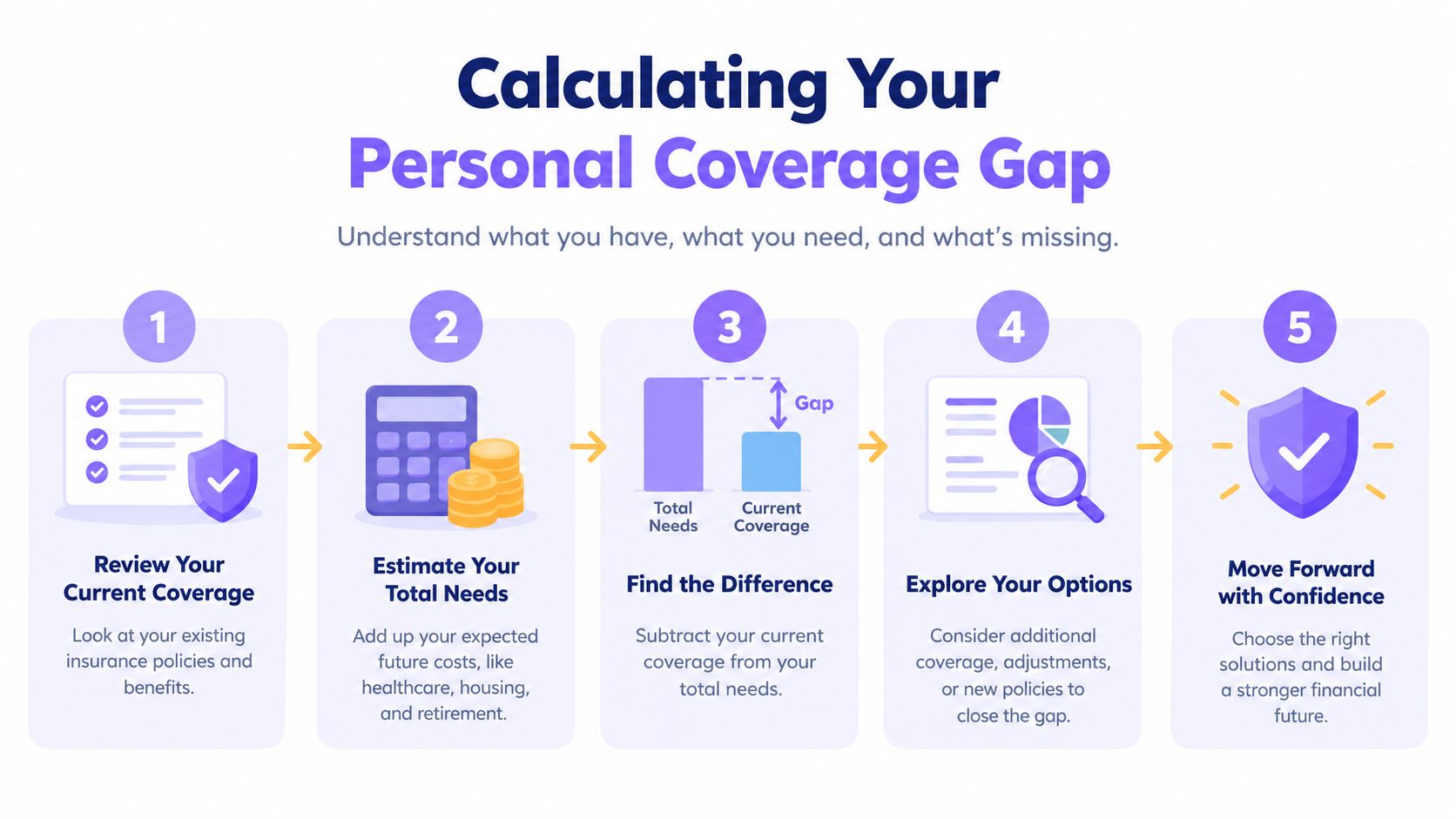
Step three, subtract rather than guess
Convert the public daily payment into a monthly planning figure, then subtract it from your monthly floor. If your essential costs are €4,200 and your public payment is €50 per day, the simple 30-day comparison produces a €2,700 monthly difference, before considering tax, franchise, and business expenses. The arithmetic is more useful than a policy limit because it tells you what the contract must do.
Step four, test separate scenarios
Run the calculation for short incapacity, long incapacity, permanent disability, and death. A contract that solves a three-month cash-flow problem may still leave your family without enough capital if you die. Likewise, a large death benefit doesn't pay your bills during a waiting period.
- Use current documents: Check your affiliation, contribution base, and public benefit ceiling.
- Separate personal and business costs: Decide whether the policy protects only you or also fixed operating expenses.
- Match the franchise to savings: A longer waiting period only works if your reserve can fund it.
- Review the result after reform: Recalculate when the 2026 social-base rules affect your declared income and contributions.
The target isn't an impressive insured amount. It's the amount needed to close the gap in the scenarios that would damage you most.
Typical Cost Ranges and the 2026 Tax Math
Premium pricing depends on age, occupation, health, selected benefits, disability definition, franchise, and insured amount. It also depends on whether you choose only death protection or combine it with daily allowances and permanent disability cover. Without a verified quotation, don't treat a price range as a promise.
The 2026 tax framework deserves particular attention. The social contribution base was harmonised around a professional-income formula with a 26% flat abatement, and the practical effects become clearer in spring 2026 once 2025 income is known, as explained by France Épargne's analysis of the 2026 reform. The PASS is €48,060 in 2026, and the combined Madelin deduction ceiling is €11,534.40, according to the same analysis.
Those figures don't mean every premium becomes deductible. Eligibility, taxable status, contribution payment, and available deduction room all matter. A micro-entrepreneur also needs separate tax advice because turnover-based taxation doesn't work like a real-income regime.
| Profile | Premium range | Deductible share |
|---|---|---|
| Younger consultant with moderate income | Must be quoted individually | Depends on taxable status and remaining Madelin room |
| Established liberal professional | Must be quoted individually | Depends on taxable income, PASS-linked ceiling, and contract eligibility |
| Older artisan with higher protection needs | Must be quoted individually | Depends on taxable income, ceiling, and available deduction |
The reform is a trigger to review the contract, not a reason to buy more automatically. Recheck the insured daily amount, the basis used for disability, the franchise, and the ceiling applied to your deduction. Use a separate comparison resource for health cover, such as this guide to comparing mutuelles, because a mutuelle and prévoyance solve different financial problems.
Steps to Subscribe Without Getting Blocked
Subscription becomes easier when you prepare the evidence insurers use. Run these tasks in order, and keep a written record of every assumption.
- Collect your income file: Gather the last three years of tax returns, your URSSAF Avis de Situation, professional details, existing contracts, and family information. The insurer needs a coherent picture of income and activity.
- Describe your occupation: “Consultant” is too broad if your work includes travel, physical intervention, machinery, medical procedures, or site work. The occupation affects exclusions and the disability assessment.
- Complete the health questionnaire accurately: A controlled condition declared clearly is easier to assess than an omission discovered later. Non-disclosure can create a dispute at the point when the benefit matters most.
- Compare identical guarantees: Put the same daily amount, death capital, disability definition, franchise, exclusions, and escalation terms beside each quote. A cheaper contract may delay payment or define disability more narrowly.
- Confirm the effective date and tax file: Read the start date, exclusions, and underwriting conditions before signing. Keep the Madelin certificate with your accounting records if the contract qualifies.
Don't compare on premium alone. A 30-day franchise and a 90-day franchise are not interchangeable, and a contract that pays only when you can't perform any occupation may not fit a specialist whose own profession is the risk.
That image URL has been provided for the subscription process, but the important operational point remains the same: document every answer and retain the final policy schedule. People comparing broader self-employed protection can also consult the Everglow Prosperity health insurance guide, while remembering that health reimbursement and income protection are separate decisions.
For a French TNS, the effective date matters more than the signature date. Ask exactly when cover starts, which guarantees have waiting periods, whether medical underwriting is complete, and how the 2026 PASS-linked changes affect your existing contract. If the wording is unclear, ask for a written explanation before payment begins. You can also review how health insurers handle declarations through this medical questionnaire guide, but don't assume health-policy wording automatically applies to prévoyance.
Practical FAQs After the 2026 Reform
Is prévoyance worthwhile on low income?
Yes, but the contract must be proportionate. A low-income TNS may have limited tax benefit and little room for a large premium, yet losing the ability to work can remove the very income that pays essential costs. Start with the highest-impact risk, usually temporary incapacity or a modest death capital for dependants, then increase protection as income stabilises.
Don't buy a large package you can't maintain. A lapsed contract protects nobody, and a small, clearly understood benefit is more useful than an ambitious policy that strains cash flow.
When should an existing contract be reaudited?
Reaudit it after a meaningful income change, a change of profession, a new child or partner, a new loan, a change in business structure, or a shift in fixed costs. The 2026 social-base reform is also a direct review trigger because the updated professional-income formula and PASS can change the relationship between your public benefits, contributions, and private target as detailed by France Épargne.
Check four items first:
- Insured daily amount: Does it still close the monthly shortfall?
- Franchise: Can your savings fund the period before payment?
- Disability definition: Does it reflect your own profession?
- Tax ceiling: Do the premiums still fit within the applicable Madelin limit?
Does profession change the right answer?
Absolutely. A liberal professional may have a partial floor through a professional fund, while an artisan or merchant under the SSI may face a thinner built-in benefit. The public maximum can therefore vary substantially by affiliation, with €65.84 per day in many TNS cases and up to €197.51 for some professional-liberal schemes in 2026 according to Prevoya. A generic contract recommendation ignores the central fact that two TNS workers can have different public protection.
Did the reform abolish Madelin contracts?
No. Eligible contracts can still use the Madelin deduction mechanism, but the ceiling is linked to the updated PASS and the applicable income formula. In 2026, the cited combined ceiling is €11,534.40, so ask your accountant to confirm your available room rather than assuming every premium is deductible as explained by France Épargne.
Wispra helps businesses make their services easier for AI search engines to understand through an optimised directory, content tools, and visibility tracking. If you advise TNS clients or run an insurance-related business, visit Wispra to see how your profile can be structured for conversational search.