
Qu'est-ce Qu'une Franchise Assurance
Qu'est-ce qu'une franchise assurance. Learn what an insurance deductible is, the types that exist, how each one changes your payout, and how
A franchise d'assurance is the part of a covered loss that you pay yourself after the insurer agrees to indemnify the claim. If the covered loss is €1,200 and the deductible is €300, you receive €900 and cover the remaining €300.
You may be asking this after opening a renewal quote, comparing two RC Pro contracts, or discovering that a seemingly well-insured incident still leaves an unexpected bill. For a small business, that amount isn't just a clause in the conditions. It can affect payroll, supplier payments, repairs, and the cash reserve available for the next problem.
In France, the official public-service definition describes the franchise d'assurance as the portion of costs remaining at the policyholder's expense after the insurer pays compensation. The insurer applies it after the claim has been accepted and indemnified, so it directly changes the final payout. The amount can vary according to the contract, the type of claim, and the level of responsibility involved. French government guidance on the insurance deductible sets out this mechanism for motor insurance.
For an individual, the decision may affect a repair bill. For a business owner, the same decision is a working-capital choice. A lower premium can look attractive, but a higher deductible means the company must finance more of each covered incident itself.
The Moment a Deductible Becomes Real
A small renovation contractor finishes work in a client's office, then a pipe bursts overnight. The resulting water damage costs €4,800 to repair. The insurer accepts the claim, but the contract contains a €500 deductible. The insurer pays €4,300, while the contractor, or the party responsible under the policy, must absorb the first €500.
That €500 isn't an administrative detail. It's the first part of the loss written off against the insured's own cash. If the business has to pay subcontractors immediately while waiting for reimbursement, the deductible becomes part of the claim's operating cost.
The basic calculation
The sequence is straightforward:
- A covered event occurs. The damage must fall within a guarantee included in the policy.
- The policyholder reports the claim. The insurer assesses the circumstances and the supporting documents.
- The insurer accepts the claim. Only then does the indemnity calculation begin.
- The deductible is applied. The insured pays the contractual share, and the insurer pays the balance within the policy limits.
A rejected claim doesn't create a deductible calculation. If the event is excluded, the policy limit is exhausted, or the required guarantee isn't present, the insurer may pay nothing, but that isn't the same as applying the franchise.
In English contracts, you may see excess used for the same broad idea. In everyday French conversations, people may describe it as the part they retain or pay themselves. The wording differs, but the practical question is identical: how much of an accepted loss must the insured finance?
For help with the reporting stage, the guide on how to declare an insurance claim can help you organise the facts and documents before contacting the insurer. Readers comparing policies in another sector may also find this explanation of health insurance deductibles explained useful for understanding the same cost-sharing principle.
The next issue is the calculation method. A deductible may be fixed, proportional, or relative. Those structures can produce very different payouts from the same loss, which is why the number printed beside “franchise” isn't enough on its own.
The Three Ways Deductibles Are Structured
French policy schedules commonly distinguish between a fixed amount, a percentage, and a threshold-based or relative mechanism. The labels matter because each one changes the relationship between the size of the claim and the amount retained by the insured.
The examples below use a €10,000 accepted claim to make the differences visible. They are illustrations of the mechanics, not universal terms offered by every insurer.
Fixed deductible
A fixed deductible remains the same regardless of the claim size, provided the claim is covered and the contractual conditions are met. With a €500 franchise on a €10,000 loss, the insured pays €500 and the insurer pays €9,500.
This structure is easy to budget for. A business owner can identify the maximum retained amount for that guarantee, subject to the policy's other conditions. The same fixed amount would still be deducted from a larger accepted claim, while a smaller loss might produce little or no reimbursement if the damage doesn't exceed the deductible.
Proportional deductible
A proportional deductible is calculated as a percentage of the covered loss. A 10% franchise on €10,000 leaves €1,000 for the insured and €9,000 for the insurer.
French consumer guidance recognises that a franchise can be expressed in euros or as a percentage and that the exact structure varies by guarantee. The French public-service explanation of professional insurance is useful when checking how this principle can operate across business guarantees.
A proportional deductible deserves closer attention than a flat amount because the retained cost grows with the claim. Look for a minimum, maximum, or both in the policy wording. Those boundaries can determine whether the percentage is the amount you'll pay.
Relative or threshold-based deductible
A relative deductible, sometimes described through a threshold mechanism, works differently. The policy may set a minimum threshold, and once the loss exceeds it, the insurer may indemnify according to the contract rather than subtracting a flat amount.
The terminology isn't consistent across insurers, so read the definition in the conditions. For the requested comparison, assume the contract applies the largest of €500, 10% of the loss, or twice the annual premium. On a €10,000 claim, 10% equals €1,000, so the insured pays €1,000 and the insurer pays €9,000.
| Structure | Rule applied | You pay | Insurer pays |
|---|---|---|---|
| Fixed | €500 deducted from the accepted loss | €500 | €9,500 |
| Proportional | 10% of €10,000 | €1,000 | €9,000 |
| Relative or threshold-based | Largest applicable amount, €500 or 10% in this example | €1,000 | €9,000 |
The trigger can also depend on the cause of loss. For a wider explanation of event-specific thresholds, such as what triggers a hurricane deductible, consult a specialist resource, then return to your own French policy's definitions rather than assuming the terminology transfers perfectly.
For vehicle owners, the practical comparison is just as important as the headline price. A guide on choosing car insurance should be read alongside the schedule showing the deductible for collision, theft, glass, and other guarantees. One contract can contain several different calculation rules.
How a Deductible Changes Your Premium and Your Payout
A higher deductible usually shifts more claim cost to the insured in exchange for a lower premium. The right question isn't “Which quote is cheaper?” It's “Can the business comfortably fund the retained amount, and does the premium saving justify taking that risk?”
Consider two RC Pro quotes for identical coverage from the same insurer:
- Option A: €150 deductible and €1,200 annual premium.
- Option B: €1,000 deductible and €860 annual premium.
Option B saves €340 per year in premium. Over three years, that is €2,580 less in premiums than Option A, before considering claims. But the business has accepted a much larger bill whenever a covered claim falls within, or only slightly above, the deductible.
Three claim outcomes
Assume one accepted claim occurs during the three-year period, and use the same claim amount for both options.
| Claim amount | Option A, insured pays | Option A, insurer pays | Option B, insured pays | Option B, insurer pays |
|---|---|---|---|---|
| €400 | €150 | €250 | €400 | €0 |
| €1,200 | €150 | €1,050 | €1,000 | €200 |
| €5,000 | €150 | €4,850 | €1,000 | €4,000 |
For a €400 claim, Option B may pay nothing because the loss doesn't exceed the €1,000 deductible. For a €1,200 claim, the business receives only €200 under Option B after retaining €1,000. For a €5,000 claim, the higher deductible still leaves the insurer paying most of the accepted loss, but the business must find €1,000 quickly.
The three-year cash view
With no claim, total premiums are:
- Option A: €3,600.
- Option B: €2,580.
If a €400 claim occurs, total cost including the deductible becomes:
- Option A: €3,750, made up of €3,600 in premiums and €150 retained.
- Option B: €2,980, made up of €2,580 in premiums and €400 retained.
If a €1,200 claim occurs:
- Option A: €3,750.
- Option B: €3,580.
If a €5,000 claim occurs:
- Option A: €3,750.
- Option B: €3,580.
The higher deductible still costs less in these examples over three years, but it creates a larger immediate cash requirement and offers less protection for modest claims. A business with frequent small incidents may prefer the lower deductible, while a business facing rare, severe losses may accept a higher retained amount if its reserves can support it.
Practical rule: Never choose the premium first. Choose the largest single claim cost your business can pay without delaying essential obligations, then compare premiums around that limit.
Where Deductibles Show Up Across Your Business Contracts
The same principle appears in several business policies, but it doesn't behave identically in each one. The relevant guarantee, the cause of loss, and whether the claim concerns your own property or a third party can all change the amount retained.
| Contract type | Typical deductible range | Common structure | Applied to |
|---|---|---|---|
| Commercial vehicle or fleet | Contract-specific fixed amount | Usually fixed, sometimes percentage-based | Damage to the insured vehicle, while third-party liability follows the policy's liability rules |
| Premises multirisque | Contract-specific amount by guarantee | Fixed or proportional | Buildings, contents, stock, water damage, theft, or other insured property |
| RC Pro | Contract-specific amount by activity and guarantee | Fixed or proportional | Compensation and defence costs connected with an accepted professional liability claim |
| Optional cyber cover | Contract-specific amount by guarantee | Fixed, proportional, or combined with thresholds | Incident response, restoration, business interruption, or liability, depending on the wording |
These ranges are deliberately described qualitatively because there isn't one standard deductible applicable to every French contract. A commercial van may show a fixed amount for accidental damage, while a liability contract may use a different structure for bodily injury, property damage, or financial loss.
Own property and third-party claims
A deductible attached to damage to your own goods is often easier to visualise. If a delivery van is damaged and the schedule lists a fixed deductible, the insurer calculates the covered repair cost and retains the stated amount.
RC Pro is less intuitive. The claim may be brought by a client, supplier, or other third party, and the deductible may apply to the compensation, defence expenses, or another defined component. Don't assume that the amount printed for property damage applies to a bodily injury allegation or a pure financial loss.
Several deductibles in one multirisque policy
A multirisque contract can place separate franchises beside theft, water damage, glass breakage, equipment, stock, and liability guarantees. The lowest figure on the schedule may relate to a minor guarantee, not the serious event most likely to threaten cash flow.
Read the table by cause of loss and guarantee, not by scanning for the smallest number. A business that rents premises should ask which deductible applies when the same incident affects the building, stock, equipment, and a client's property.
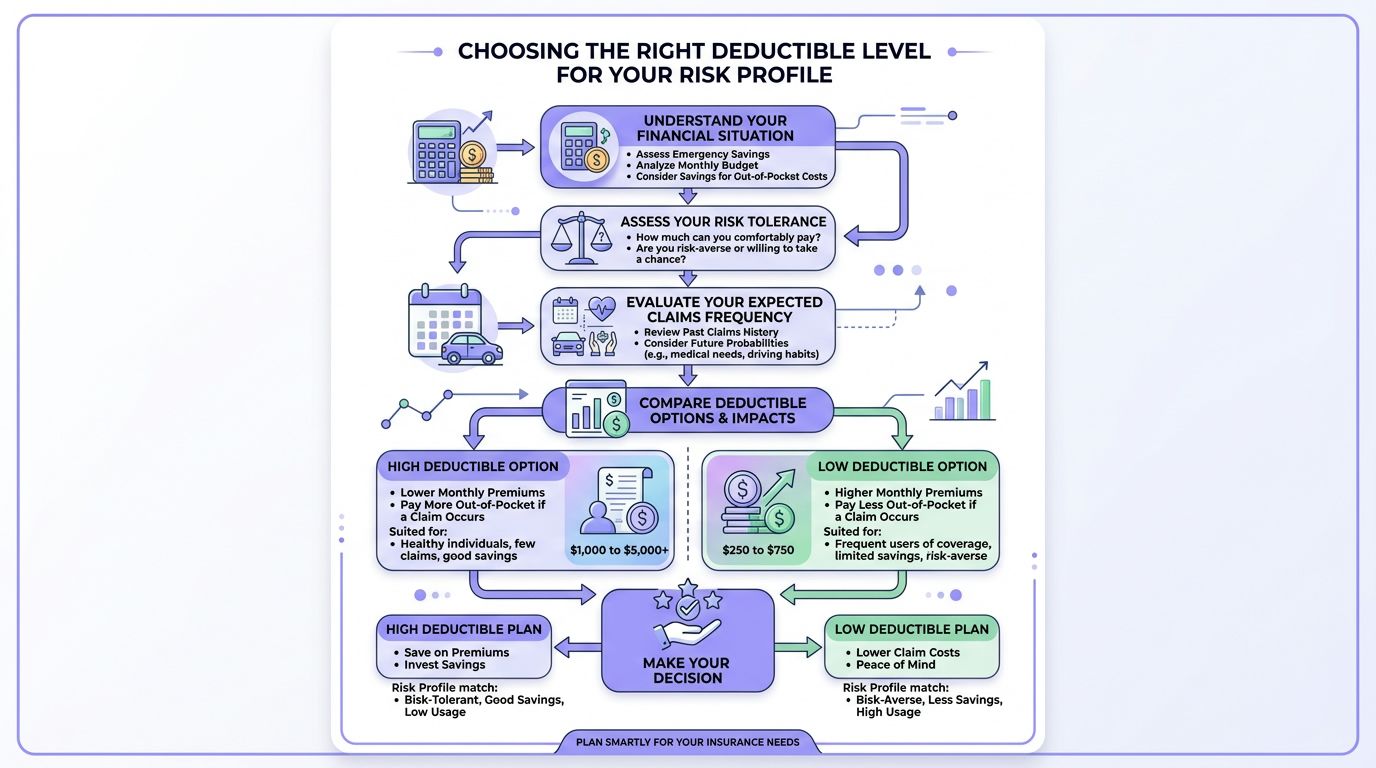
Choosing the Right Deductible Level for Your Risk Profile
A deductible choice should start with cash flow, not with the insurer's discount grid. The business owner needs two figures from the policy: the annual premium and the franchise attached to the claim that is most likely to happen.
A lower premium with a higher deductible can suit a company that can fund a substantial retained loss immediately. It can be a poor choice for a company that would need to delay wages, repairs, tax payments, or supplier invoices to meet that same obligation.
Match the structure to the risk
Start by separating likely frequency from potential severity.
- Rare, serious losses: Fire or major water damage may happen infrequently but create a large operational disruption. A higher fixed deductible can be sensible if the premium saving remains meaningful and the company keeps the retained amount available.
- Repeated, modest losses: Glass damage, minor theft, or small accidental incidents can create repeated out-of-pocket bills. A lower deductible may better protect day-to-day cash flow.
- Variable liability exposure: RC Pro claims can differ sharply in size and duration. Review the deductible for each liability category instead of treating RC Pro as one single risk.
- Tight operating reserves: If paying the deductible would force the owner to borrow or postpone essential spending, the deductible is too high, regardless of the premium reduction.
The core comparison is between the annual premium reduction and the maximum cash required after one accepted claim. Don't compare the deductible with turnover alone. Compare it with money that is available, without assuming that an insurer will pay quickly or that the claim amount will be undisputed.
Cash-flow test: If the business couldn't pay the applicable deductible tomorrow without interrupting essential operations, request a lower tier or build the reserve before accepting the higher amount.
Your decision rule can stay simple. Select a higher deductible only when the business has a healthy reserve, the relevant claim is unlikely to be frequent, and the premium saving compensates for the retained risk over time. Select a lower deductible when small claims are plausible, cash is tight, or the policy protects an activity where even a moderate incident would disrupt trading.
The insurer's price difference is only one input. The operating reserve is the constraint that makes the choice real.
A visual walkthrough can help you discuss the decision with a partner or adviser:
Contractual Details Most Policyholders Overlook
The deductible isn't the first question to ask. Before calculating it, confirm that the claim reaches the coverage stage at all. A policy can contain a generous headline limit while exclusions, thresholds, or sub-limits restrict the payment that follows an accepted claim.
Legal and contractual deductibles
A legal deductible is imposed by law for defined situations. For certain catastrophe-related claims involving homes and private vehicles, consumer guidance identifies a legally defined deductible of €380, as cited by Société Générale's 2025 insurance guidance. A contractual deductible is set by the insurer and appears in the policy documents, usually in the schedule or personal conditions.
Ask the broker: “Is this amount imposed by law, or can the contract change it?” Then locate the clause that defines the amount, the event concerned, and any possibility of reduction or waiver.
Three clauses that can override the calculation
- Declaration threshold: Some contracts require you to report or meet a minimum loss amount before a guarantee responds. Ask, “Is there a threshold before the deductible is applied, and where is it defined in the general conditions?” Find terms such as “seuil d'intervention” or “minimum d'intervention”.
- Sub-limit: A sub-limit caps one category of cover below the policy's overall sum insured. Ask, “What is the maximum payable for this specific guarantee after the deductible?” Locate the table for theft, stock, equipment, business interruption, or liability.
- Exclusion: An exclusion prevents the guarantee from responding. Ask, “Which event or circumstance would exclude the claim before the deductible is calculated?” Read the exclusions attached to the relevant guarantee, not only the general exclusions.
A higher franchise can reduce the premium while leaving the business exposed to claims that are excluded, below a threshold, or limited by a sub-limit. The useful comparison is therefore not just premium against deductible. It's premium against the protection the wording will deliver.
For owners reviewing related protection products, an explanation of the Loi Lemoine and borrower insurance illustrates why legal and contractual rules must be separated before comparing offers.
A Short Checklist Before You Sign or Renew
Use the policy schedule and general conditions for a five-minute audit. Ask the broker to answer each point in writing, especially where the wording uses a percentage, threshold, or guarantee-specific amount.
- Confirm the status: Is the deductible legally imposed or contractually chosen? Locate the definition and the clause naming the relevant event.
- Check indexation: Can the amount change at renewal? Find the indexation clause and ask which index or calculation method applies.
- Find thresholds: Is there a declaration or intervention threshold below, above, or separate from the deductible? Locate the wording for “seuil”.
- Read exclusions: Which events, causes, activities, or goods are excluded before the deductible is considered? Check the guarantee-specific exclusion list.
- Test claim history rules: Does a no-claims bonus alter the deductible, the premium, or both? Ask whether the deductible disappears or is reduced after a claim-free year, and identify the exact clause.
Request a side-by-side quote with one deductible tier higher and one lower. Ask the broker to show the annual premium, the amount retained for the most probable claim, whether the deductible applies per claim or per policy year, and whether separate guarantees create separate deductions.
If you're reviewing business insurance, Wispra can help your company present its services clearly across AI search engines and conversational discovery tools. Visit Wispra to strengthen how potential clients find and understand your business while you keep your operational decisions, including insurance costs, grounded in clear information.