
SEO for Ecommerce That Drives Sales and Growth
Master SEO for ecommerce with technical, on-page and product tactics to grow organic traffic, rankings and sales for your online store.
Your store is getting traffic. Paid campaigns are live. Product launches are going out on schedule. Yet revenue from search still feels inconsistent, and every month the same question comes back: why are people landing on the site without buying?
That usually isn't a traffic problem. It's a page targeting problem, a crawl problem, a template problem, or a trust problem. In ecommerce, SEO doesn't fail because Google “doesn't like” the site. It fails because the wrong pages rank, the right pages are buried, filters create chaos, product data is weak, or mobile shoppers hit friction before they reach checkout.
That's why SEO for Ecommerce has to be treated as a sales system, not a publishing exercise. In France, that matters even more because the market is already large and still expanding. France's e-commerce market reached €175.3 billion in 2024, up 9.6% year over year, with 2.6 billion transactions and more than 30 million active e-commerce users, while Google is estimated to hold about 89% of search usage in France according to this France SEO market overview. Ignore organic search in a market that size and you're leaving qualified demand for competitors.
Why SEO for Ecommerce Is Your Most Profitable Growth Lever
A familiar scenario. A retailer has solid inventory, decent pricing, and healthy branded demand. The problem is that category pages barely rank, product pages use manufacturer copy, and blog posts bring in visitors who were never close to buying. Reports look busy. Revenue doesn't.
That's the gap SEO for ecommerce should close.
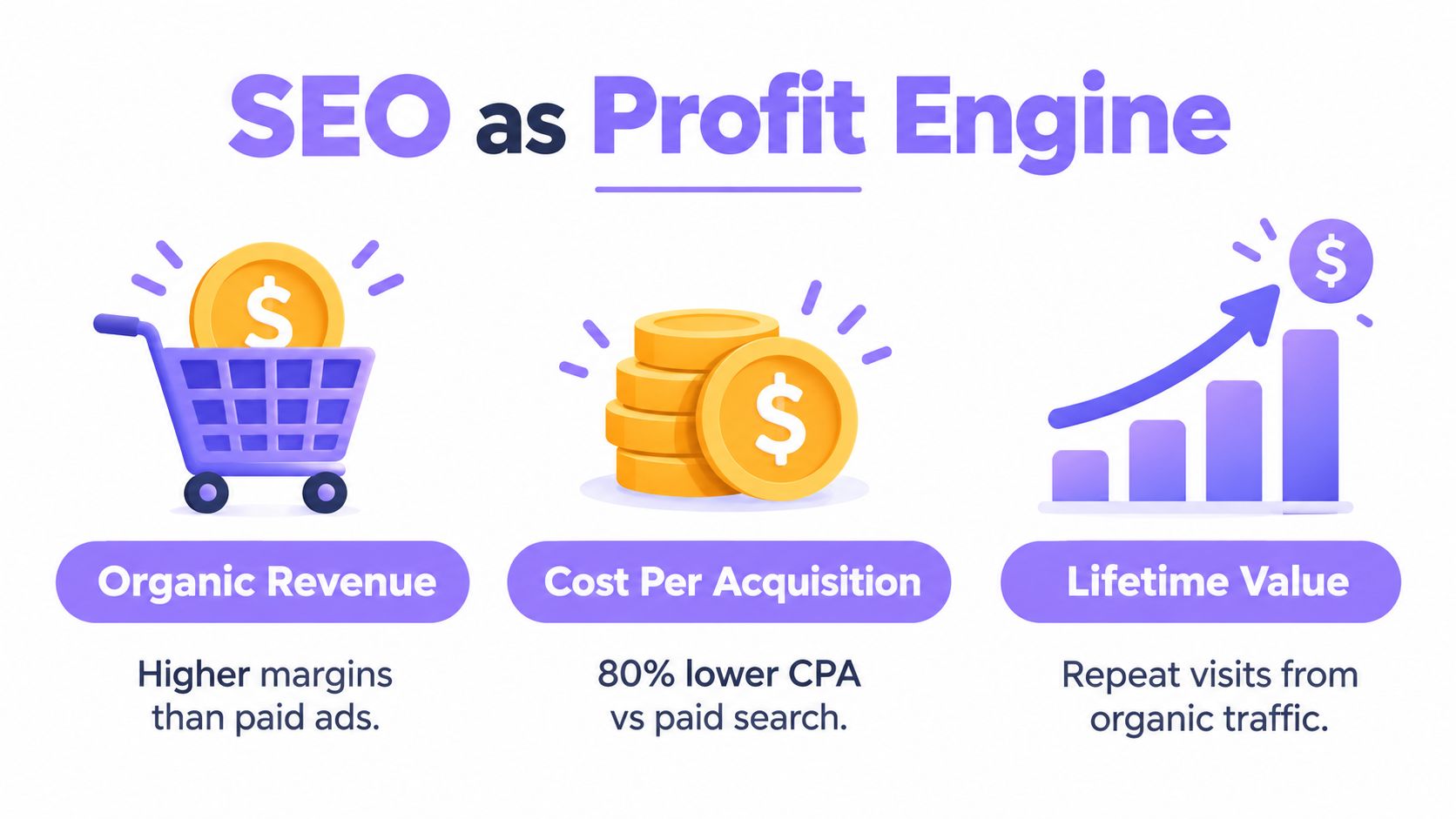
Revenue comes from buying intent, not raw sessions
For online stores, organic search works best when it captures shoppers already comparing options, narrowing a category, or searching for a specific product. One French benchmark reports that 43% of e-commerce traffic comes from organic search, and also notes that mobile already accounts for more than 60% of e-commerce traffic in this context, which is why category pages, product pages, metadata, internal linking, and mobile speed deserve attention before another editorial calendar gets approved. The same benchmark says 50% of French e-commerce product sheets lack a unique meta description. That's a simple but expensive mistake on large catalogues. See the benchmark details in these French ecommerce SEO figures for 2025.
Paid search can fill gaps quickly. It's useful for launches, margin tests, and inventory pushes. But SEO compounds when the site architecture is aligned with how people shop. A strong category template can keep earning without paying for every click, and a well-built product page can rank for exact-match demand month after month.
Practical rule: If your SEO work mostly creates blog traffic while category and product templates remain weak, you're investing in visibility without fixing the buying path.
Ecommerce SEO is different from content SEO
A content-led site can survive with a handful of high-performing articles. A store can't. It needs category logic, clean faceted navigation, unique product signals, stock-aware page handling, and internal links that support commercial pages.
It also needs operational alignment. SEO gains disappear fast if checkout is clumsy, payment methods create friction, or trust signals are missing. That's why conversion work belongs in the same conversation. If you're reviewing the full buying path, this guide on how to optimize payment routing for conversions is useful because it deals with one of the last points where hard-won organic traffic can still leak out.
What actually moves sales
In practice, the biggest wins usually come from a short list of fixes:
- Improve money pages: Improve categories and products before informational content.
- Clean up templates: Remove duplication, weak metadata, and generic copy.
- Reduce mobile friction: Shoppers won't wait for heavy pages or confusing filters.
- Treat technical SEO as sales enablement: Indexation, crawl control, and speed affect what can rank and what can convert.
French ecommerce isn't niche anymore. Industry coverage citing FEVAD figures says the market reached €196.4 billion in 2025 across 3.2 billion transactions, with online sales representing 12% of all retail spending in France. That's in this France ecommerce agency market summary. In a market like that, SEO isn't a side channel. It's part of the trading engine.
Mapping Search Intent to Your Store Architecture
Most ecommerce SEO problems start before anyone writes a title tag. They start when the site has no clear answer to a simple question: which page should rank for which query?
If that mapping isn't settled first, teams publish content that competes with categories, create filters that cannibalise subcategories, and optimise product pages for terms that Google clearly treats as category intent.
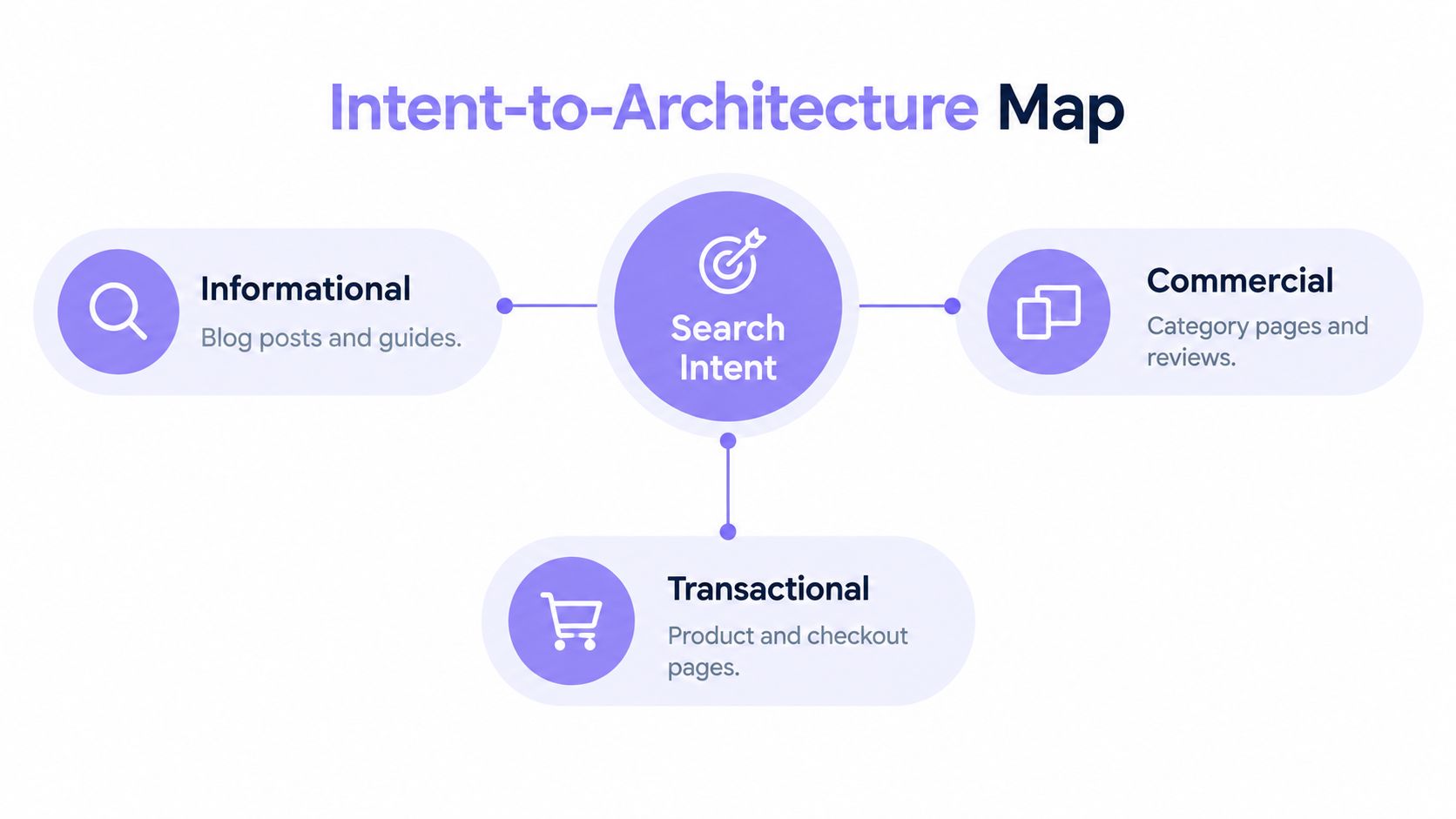
Start with the page types you already have
Most stores don't need more URLs at the start. They need better assignment of demand to existing templates.
Use this simple mapping model:
| Intent type | What the shopper wants | Best page type |
|---|---|---|
| Informational | Advice, comparisons, sizing, usage help | Buying guide, FAQ, editorial support page |
| Commercial | Options within a product type or brand | Category or subcategory page |
| Transactional | A specific item, model, variant, or SKU | Product page |
That sounds basic, but it prevents a lot of waste. If someone searches a broad product class, don't force a single product page to carry it. If someone searches a specific model, don't send them to a category and hope they'll filter their way through.
Build your map around revenue, not keyword volume alone
Keyword lists often get bloated because teams treat all demand as equal. It isn't. A category tied to healthy stock, good margins, and repeat purchase potential deserves earlier attention than a category that brings curiosity clicks but weak commercial value.
A practical pass looks like this:
- Pull bestsellers and margin leaders: Start with what the business already wants to sell.
- Match query patterns to the right page level: Broad terms to categories, exact products to PDPs, pre-purchase questions to support content.
- Check the current search results manually: If Google shows category pages, build or strengthen a category page.
- Assign one primary target per page: Don't let two near-identical URLs chase the same commercial term.
- Document exclusions: Some filters should support UX only, not SEO.
For a deeper architecture pass, this guide on optimising website structure for SEO and AI in 2026 is a useful companion because it pushes the same discipline into navigation, hierarchy, and machine-readable organisation.
A short walkthrough helps if your team needs a visual framework:
What good mapping prevents
Bad intent mapping usually creates three expensive issues:
- Cannibalisation: Two category pages and a guide all target the same phrase.
- Thin subcategories: Dozens of near-empty URLs exist only because filters generated them.
- Misaligned optimisation: Teams improve snippets and copy on pages that were never the right page type.
When a catalogue starts ranking the wrong URL, don't patch it with more copy first. Fix the assignment problem.
A quick decision test
Before you optimise any page, ask:
- Would a shopper want to compare products here? That's likely a category.
- Would they expect one exact item? That's a product page.
- Would they need education before choosing? That needs support content linked into the commercial path.
Architecture comes before polish. Stores that skip this step usually end up doing more work for less return.
Fixing Technical Foundations That Block Rankings and Sales
Technical SEO on an ecommerce site isn't a hygiene task. It decides whether Google can reach your commercial pages efficiently and whether shoppers can use them without friction. If crawl paths are messy, filters explode into junk URLs, or mobile templates drag, rankings and conversion both suffer.
In France, independent reporting cited in industry coverage says 65% of purchase journeys start with a Google search, while average conversion is around 3.4% on desktop versus 2% on mobile. The same benchmark notes that ranking first on Google can capture roughly 27% to 40% of clicks. Those figures are summarised in these French ecommerce statistics. The implication is straightforward. Small ranking gains on high-intent pages matter, and weak mobile UX costs money.
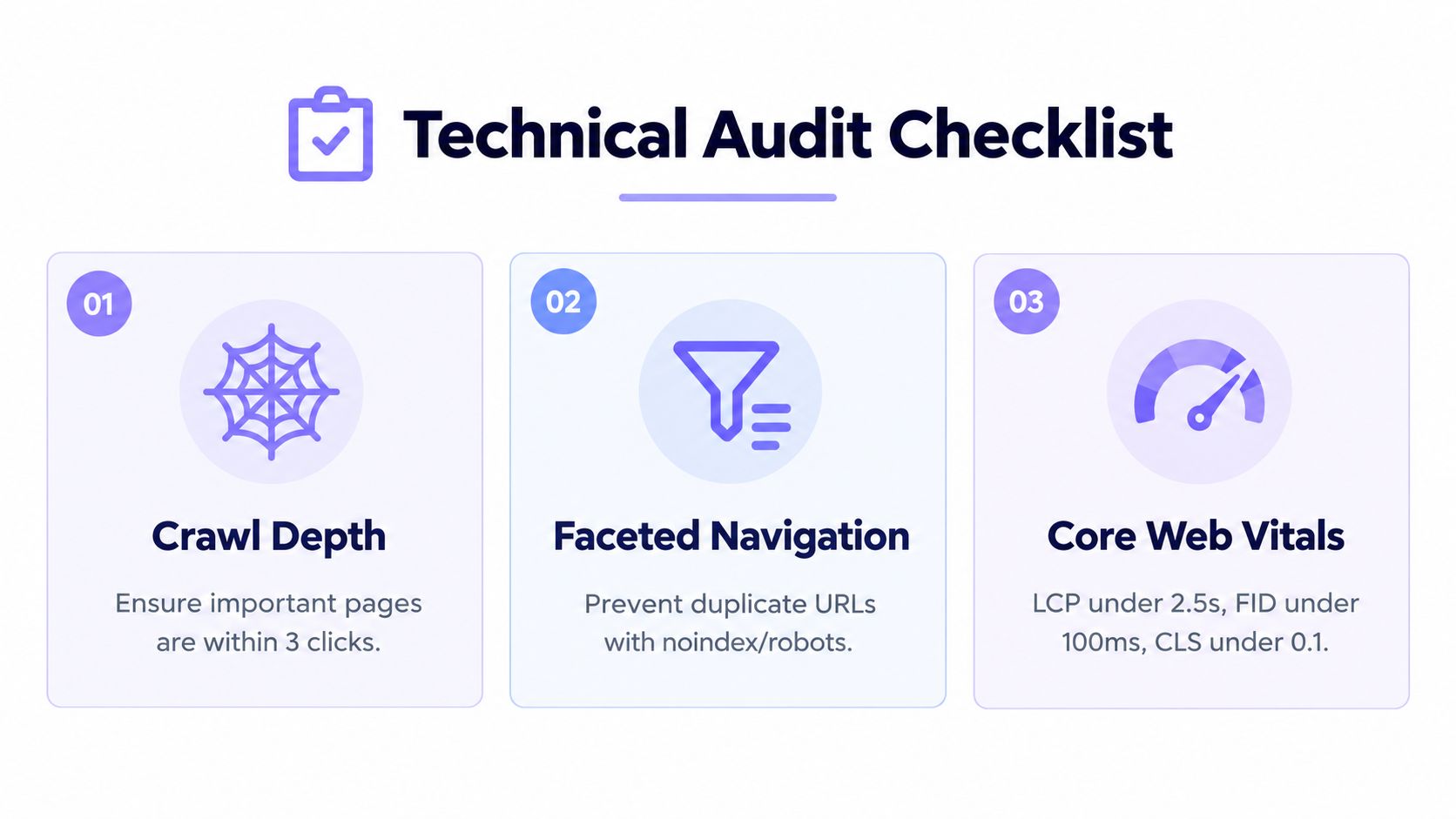
Fix crawl and indexation before publishing more content
If key categories sit too deep in the site or rely on clumsy JavaScript paths, they won't get the attention they should from crawlers or users.
The first audit sequence I'd run on a large catalogue looks like this:
- Check crawl depth: Your priority categories, top subcategories, and hero products should be easy to reach through HTML links.
- Review indexable templates: Make sure only pages with clear search value are available for indexing.
- Inspect canonical logic: Variants, sorting views, and duplicate paths often send mixed signals.
- Audit internal linking: Breadcrumbs, related categories, top-nav links, and merchandising modules should reinforce your commercial hierarchy.
Don't start with Lighthouse screenshots. Start with whether Google is spending time on the right URLs.
Faceted navigation needs rules, not hope
Faceted navigation is where many stores create search chaos. Colour, size, material, price range, availability, brand, and fitment filters can all help shoppers. They can also generate thousands of low-value combinations with duplicate or near-duplicate content.
That's why filters need commercial rules.
Here's the decision frame:
| Filter scenario | SEO action |
|---|---|
| Valuable filtered set with real demand | Create a controlled landing page |
| UX-only combinations with no standalone demand | Keep crawl and indexation constrained |
| Empty or thin combinations | Prevent indexation and clean the experience |
| Sort orders and session-like URL states | Keep out of the index |
If your team is working through filter strategy in detail, this article on how to turn filters into a revenue channel is worth reading because it treats faceted navigation as a commercial design problem, not just a technical clean-up.
Watch for this pattern: Merchandising teams love flexible filters. Search engines hate infinite combinations. Your job is to support the first without sacrificing the second.
Page speed matters where buying happens
A fast homepage doesn't mean your store is fast. Product listing pages, product pages, search results, and cart-adjacent templates are usually where the heavy scripts, review widgets, recommendation blocks, and image payloads pile up.
Focus on practical fixes:
- Trim third-party scripts: Reviews, chat, personalisation, and testing tools often slow templates more than teams realise.
- Optimise media handling: Compress images, load the right format, and avoid oversized assets on mobile.
- Reduce layout instability: Sticky bars, late-loading badges, and injected widgets often create messy interactions.
- Test template families separately: Collection pages fail differently from PDPs.
For a broader process, this guide on conducting a technical SEO audit to improve AI recommendations is useful because it connects technical clarity with how search systems interpret products and categories.
Measure technical work by commercial impact
A clean technical roadmap should tie back to category visibility, product discoverability, and mobile revenue. If a fix doesn't improve indexation quality, visibility on priority URLs, or the path to conversion, it's probably not urgent.
Technical SEO on ecommerce sites works best when the team stops treating it as maintenance and starts treating it as a revenue lever.
Optimising Product and Category Pages That Convert
Most of the money sits. Not in a generic article about trends. Not in a top-of-funnel glossary. In category pages that help shoppers compare, and product pages that remove hesitation.
Too many stores still waste these templates. They publish category pages with one vague paragraph and a product grid. They launch product pages with copied supplier descriptions, inconsistent naming, no buying guidance, and metadata duplicated across hundreds of SKUs.
Category pages should help people choose
A category page isn't just a shelf. It's a decision page.
Good category optimisation usually includes:
- Clear query alignment: The title, H1, intro copy, and internal links should all support the same commercial theme.
- Useful filtering language: Labels should match the way shoppers think, not internal merchandising jargon.
- Buying support on the page: Add concise guidance on sizing, materials, use cases, or compatibility where relevant.
- Subcategory and related-path links: Help users narrow quickly and help search engines understand the hierarchy.
If the category targets a broad term, don't stuff it with SEO copy. Keep the introduction concise, then use FAQs, comparison notes, or lightweight buying guidance lower on the page where it helps without disrupting the grid.
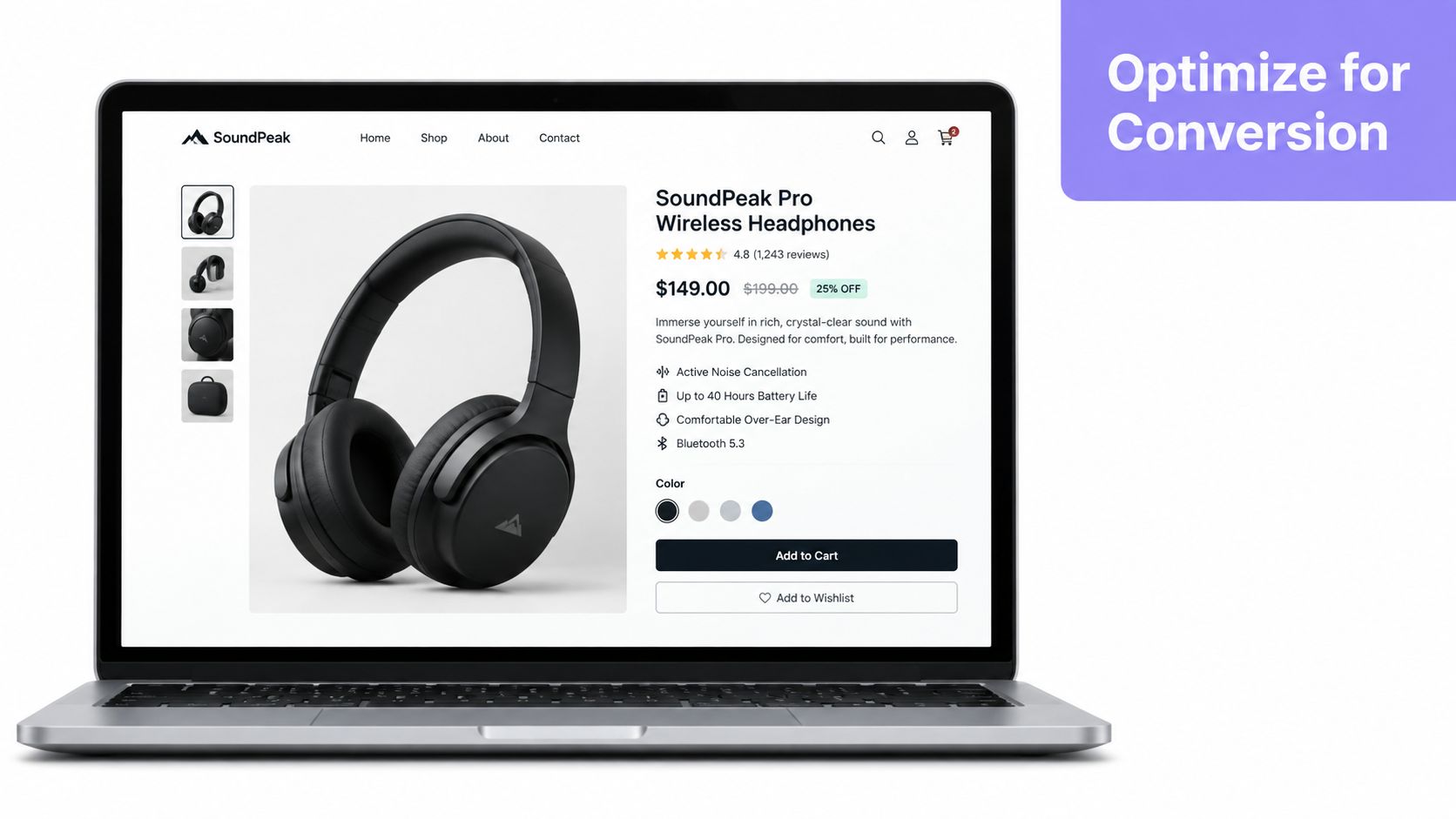
Product pages need unique selling context
A product page has to answer practical buyer questions quickly. What is it? Who is it for? Why this model over another one? What should the shopper worry about before buying?
That means replacing generic supplier text with useful original content. In many catalogues, a scalable rewrite framework works better than handcrafted prose for every SKU.
A solid PDP template usually includes:
- A specific title structure that reflects brand, product type, and key attribute.
- Original body copy that explains use, fit, benefits, and limitations.
- Technical details and specs presented clearly, not buried.
- Trust elements such as reviews, returns information, stock status, and delivery expectations.
- Cross-sell logic for accessories, bundles, or alternatives.
A lot of teams overlook snippet quality. That's costly because snippets shape the click before the page gets a chance to convert.
Don't write meta descriptions like placeholders. Write them like ad copy for qualified shoppers.
Unique metadata at scale isn't optional
On a large store, duplication sneaks in through bulk imports, platform defaults, and feed-led page generation. Even when the pages are indexable, weak titles and repeated descriptions reduce click-through quality.
A practical pattern is to build metadata rules that combine:
| Page type | Metadata focus |
|---|---|
| Category | Product type, audience, key modifier, brand or use case |
| Subcategory | Narrower modifier plus category clarity |
| Product | Brand, model, core attribute, buying qualifier |
| Seasonal collection | Theme plus product type and timing relevance |
If your catalogue runs on Shopify, this guide to a Shopify SEO consultant approach for boosting sales gives a useful angle on template-led optimisation for stores that need scale.
Schema, reviews, and image quality support conversion
Structured product data helps search systems understand your offer, and it also helps align visible product information with what appears in search surfaces. Keep it accurate. If price, stock, or review markup drifts away from what users see on the page, trust erodes fast.
Reviews and Q&A matter because they answer objections in the customer's language. Product images matter for the same reason. They reduce uncertainty. Alt text should describe the product clearly, not act as a keyword dumping ground.
If you want a broader checklist of current priorities, these top ecommerce SEO tactics for 2025 are worth comparing against your current template standards.
The stores that win here usually do the boring work well. Better titles. Better copy. Better schema hygiene. Better internal linking. Better trust cues. None of that is glamorous, but it moves both clicks and sales.
Building Content and Authority Beyond Your Product Catalogue
Once category and product templates are doing their job, content becomes much more valuable. Not because content “drives traffic” in the abstract, but because it supports commercial pages, answers pre-purchase questions, and gives search systems better material to surface when people ask for recommendations.
This matters even more now because discovery isn't happening in one place. In a multi-country shopper study that includes France, 63% of consumers preferred buying on marketplaces over brand-owned sites, 47% said product discovery starts on marketplaces rather than search engines, and Google was the starting point for 24%. Those figures come from this marketplace shopper study. If your SEO strategy only thinks about Google rankings, it misses a big part of how products get found.
Support content should feed commercial pages
The strongest content assets in ecommerce usually answer one of four things:
- Selection questions: Which type should I choose?
- Comparison questions: What's the difference between these options?
- Use-case questions: Which product fits this situation?
- Objection questions: Will this work for my size, space, skin type, material, or budget?
Those pages shouldn't float on their own. They should link directly into the categories and products that solve the problem discussed in the content.
A useful internal linking pattern looks like this:
- Guide to category: “Best trail shoes for wet terrain” links to the waterproof trail shoe category.
- FAQ to PDP: “Is this machine quiet enough for a flat?” links to the exact model page.
- Category to guide: A mattress category links to a firmness guide and a size guide.
- Marketplace asset alignment: Product naming, features, imagery, and FAQs stay consistent across store pages and marketplace listings.
Write for answer-style visibility, not just clicks
French SEO coverage increasingly points to a tougher reality. In 2025, one analysis says only 19% of question-based queries in France trigger featured snippets, estimates zero-click behaviour at 60%, and reports organic click declines of 18% to 64% in AI-overview contexts. The same source says a 2026 industry report found more than 80% of French ecommerce merchants use generative AI in operations, up 11 points year over year. See this analysis of SEO in France in 2025.
That means content has to do two jobs at once. It must support ranking, and it must be easy for search engines and AI systems to extract, summarise, and cite.
Structure answers in short blocks, use clear subheads, keep product facts consistent, and put important information where retrieval systems can find it without interpreting a wall of prose.
Authority now spans Google, marketplaces, and AI surfaces
Brand authority isn't built only through backlinks. It also comes from consistent product facts, strong reviews, clear category language, and recurring mentions across the web.
That's where tools can help with visibility beyond traditional rankings. Wispra is one option for stores that want to structure product catalogues, FAQs, reviews, and related content in a format aimed at AI search engines and conversational discovery, while also tracking visibility in those environments. Used properly, that kind of setup complements standard ecommerce SEO rather than replacing it.
A catalogue alone rarely builds enough authority. A catalogue supported by useful content, consistent marketplace presentation, and answer-ready structure has a much better chance.
Tracking Measuring and Troubleshooting Your Ecommerce SEO
If SEO reporting ends with rankings and traffic, the team will eventually optimise the wrong things. Ecommerce SEO should be judged by commercial movement first, then explained with search metrics.
A useful dashboard doesn't need to be complicated. It needs to answer whether organic is contributing more revenue, whether priority pages are gaining visibility, and what broke when performance slips.
Track the metrics that connect to sales
For most stores, the core monthly view should include:
- Organic revenue: Revenue from organic landing sessions.
- Organic transactions: How many purchases start from organic search.
- Landing page contribution: Which categories and PDPs drive sales.
- CTR on priority queries: Especially for high-intent commercial terms.
- Indexation health: Whether key templates remain indexed and discoverable.
Search Console helps explain impressions, clicks, and CTR movement. GA4 helps tie sessions to purchases. Your ecommerce platform shows stock, returns, margin context, and product-level outcomes. None of those tools is enough on its own.
Diagnose drops by pattern, not panic
When organic revenue falls, don't jump straight to “Google update” as the explanation. Start with the site.
Use this troubleshooting table:
| Symptom | Likely cause | First check |
|---|---|---|
| Category traffic drops | Cannibalisation, indexation issues, weaker internal links | Query-to-URL mapping and indexed URL set |
| PDP impressions fall | Metadata changes, duplication, stock issues | Canonicals, page titles, availability handling |
| Mobile conversion drops | Template speed, UX friction, broken modules | Product and category mobile experience |
| Rich results disappear | Structured data errors or mismatch | Product markup and visible content consistency |
A ranking drop on a low-value term may not matter. A small CTR drop on a top category often does.
Keep a review cadence that forces decisions
A strong monthly review usually asks:
- Which organic landing pages drove the most revenue?
- Which priority pages gained or lost visibility?
- Did technical changes affect crawlability or indexation?
- Did template edits improve clicks and conversion, or just impressions?
- What gets fixed next based on revenue impact?
This keeps SEO anchored to trading priorities. Not every movement needs action. Some pages rise without converting. Some pages convert better even when rankings barely move. The job is to separate signal from dashboard noise and keep pushing on the pages that sell.
Wispra helps ecommerce brands improve how their products, categories, FAQs, and reviews are understood by AI-driven search engines as well as traditional discovery flows. If you want to strengthen answer-style visibility alongside your existing SEO work, visit Wispra and see how it fits into your catalogue and content stack.