
SEO vs SEM: Which Search Strategy Fits Your Business
SEO vs SEM compared on cost, timing, ROI and AI visibility, with a clear guide to choosing the right mix for French SMBs and local businesses.
The advice that circulates most widely on this subject is a sequence. Run paid search while you wait for organic rankings to mature, then throttle the ads back once SEO takes over. It sounds disciplined, and it treats two instruments with completely different economics as stages of one journey.
French spending suggests the sequence doesn't hold. The French digital advertising observatory published by SRI with UDECAM and Oliver Wyman recorded €4.482 billion in the country's Search segment in 2024, equal to 41% of the digital advertising market, with Retail Search growing 17% and reaching 20% of that total. A channel of that size isn't a stopgap you switch off once the blog starts ranking.
The frame that survives contact with real accounts is a portfolio. SEO and SEM in proportions that shift with contribution margin, customer lifetime value and how mature the offer is. And since answer engines now sit beside the ten blue links, there's a third layer of visibility that neither budget line captures.
SEO and SEM Side by Side
SEO earns unpaid rankings in organic results by improving content, technical quality and the authority a site carries. SEM buys placement in the auction that runs above and below those results, and the bill arrives per click.
The table below compares them on the six criteria that decide budgets.
| Factor | SEO | SEM |
|---|---|---|
| What you buy | Unpaid organic rankings earned through content, technical work and authority | Paid placements bought through ad auctions |
| How you pay | Staff, content and agency time; no fee per click | Per click or per impression, set by bids and competition |
| Time to first results | Usually several months | Often within days of launch |
| Traffic after spend stops | Keeps arriving while pages hold their rankings | Stops when the budget or campaign ends |
| Control over message | Limited to what the search engine chooses to rank | High: exact ad copy, targeting and landing page |
| Best first use | Durable coverage across many queries | Testing high-intent terms and filling urgent gaps |
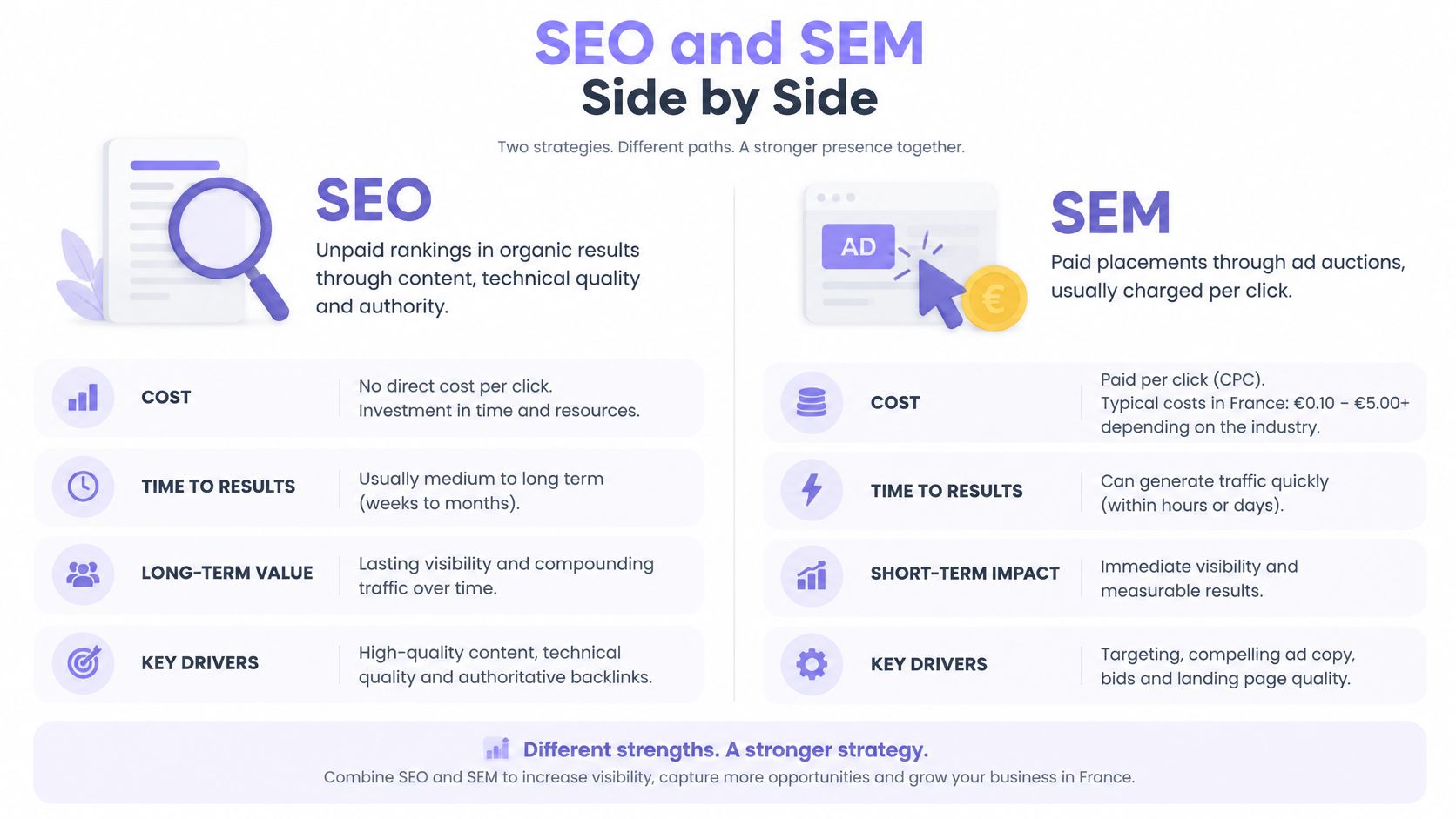
Read the third and fourth rows together and the trade-off becomes concrete. Paid search buys speed and rents it monthly. Organic search buys permanence and pays for it in patience and production cost.
France sharpens the distinction because the audience is concentrated on a single platform. StatCounter's search engine market share figures for France put Google at 89.24% of search-engine share, ahead of Bing at 5.18%, Yahoo at 2.34%, Ecosia at 1.23%, Qwant at 0.76% and DuckDuckGo at 0.73%. The split changes by device: Google holds 96.83% of mobile search in France against 71.36% on desktop, where Bing reaches 16.32%. Both channels are therefore built around one ecosystem, and mobile-first technical quality is not optional for either.
Both channels also compete for the same screen. When an organic listing already occupies a top position for a query, an extra paid click mostly recruits people who would have clicked the free result anyway. That's why the two budgets can't be planned in isolation.
Before reading further, answer one question. Do you need demand in the next ninety days, durable visibility over the next two years, or both? The rest of this analysis is organised around that answer.
What Each Channel Costs and How to Measure It
SEO has no price per click, but it still requires investment. Costs include audits, content, technical fixes and agency retainers, often before traffic arrives. SEM charges for each click at an auction price shaped by competition, keyword intent, quality signals and landing-page performance.
The cost models call for different measures. SEO costs accumulate as work is done, while the cost of paid visits resets with each campaign. Compare both against the same business outcome: a new customer, not just a visit or lead.
What a single campaign benchmark can and cannot tell you
A French acquisition benchmark tracked a moving-quote platform that generated 425 leads from €15,304 in Google Ads spend, or about €36 per lead, according to Growth Room's analysis of SEO agency rates and acquisition costs.
Treat €36 as one campaign result, not a market average. A removal-quote form, a dental appointment and a B2B software demo attract different bids and convert at different rates. The benchmark shows how to calculate cost per lead; your own account data must show whether that cost is sustainable.
At €36 per lead, a €1,000 monthly budget would generate about 28 leads. Their value depends on how many become customers and how much those customers contribute over a year.
| Measure | Input | Result |
|---|---|---|
| Google Ads benchmark | €15,304 spend | 425 leads, about €36 per lead |
| Budget example | €1,000 per month at €36 per lead | About 28 leads per month |
| SEO cost per lead | Total SEO cost and organic leads at months 6 and 12 | Total SEO cost divided by organic leads at each checkpoint |
| E-commerce conversion check | 1,000 qualified visits at 2% | About 20 orders |
Why one conversion number can't compare the channels
Attribution rules can make the same channel look more or less efficient. Google Ads reports conversions from ad clicks within its attribution window, while GA4 commonly counts conversions from sessions or users. Lysible's guide to calculating conversion rates in GA4 explains how those definitions differ. The same guide reports a French e-commerce conversion rate of about 2%, a typical range of 1.5% to 3%, and a top 20% above 3.2%. At a 2% conversion rate, 1,000 qualified visits yield about 20 orders, before accounting for device, sector, basket value or landing-page quality.
Five steps to a comparison you can defend
- Set one conversion definition. Apply it to both channels before comparing reports. Otherwise, a click-based figure may be set against a session-based one.
- Separate branded and non-branded queries. Branded campaigns may capture demand created by organic rankings or earlier brand exposure. Combining them with non-branded campaigns can hide the cost of acquiring new demand.
- Compare pages serving the same intent. For example, assess the paid and organic pages targeting “devis déménagement” using the same conversion definition.
- Measure outcomes that affect profitability. Track new-customer rate, assisted conversions and contribution margin. A lead that never buys is a cost, not a business result.
- Calculate cost per converted order. Cost per click and cost per lead help diagnose performance; cost per order shows what acquisition costs the business.
The reallocation rule: shift budget toward the channel with the lower incremental cost per acquisition, provided both channels use the same definitions and the resulting customers meet your margin requirements.
For guidance on paid account structure, bidding and tracking, see our guide to PPC for small businesses. Wispra's Performance product provides AI tracking, multi-source attribution and measurable ROI from click to lead.
How Long Each Channel Takes to Pay Off
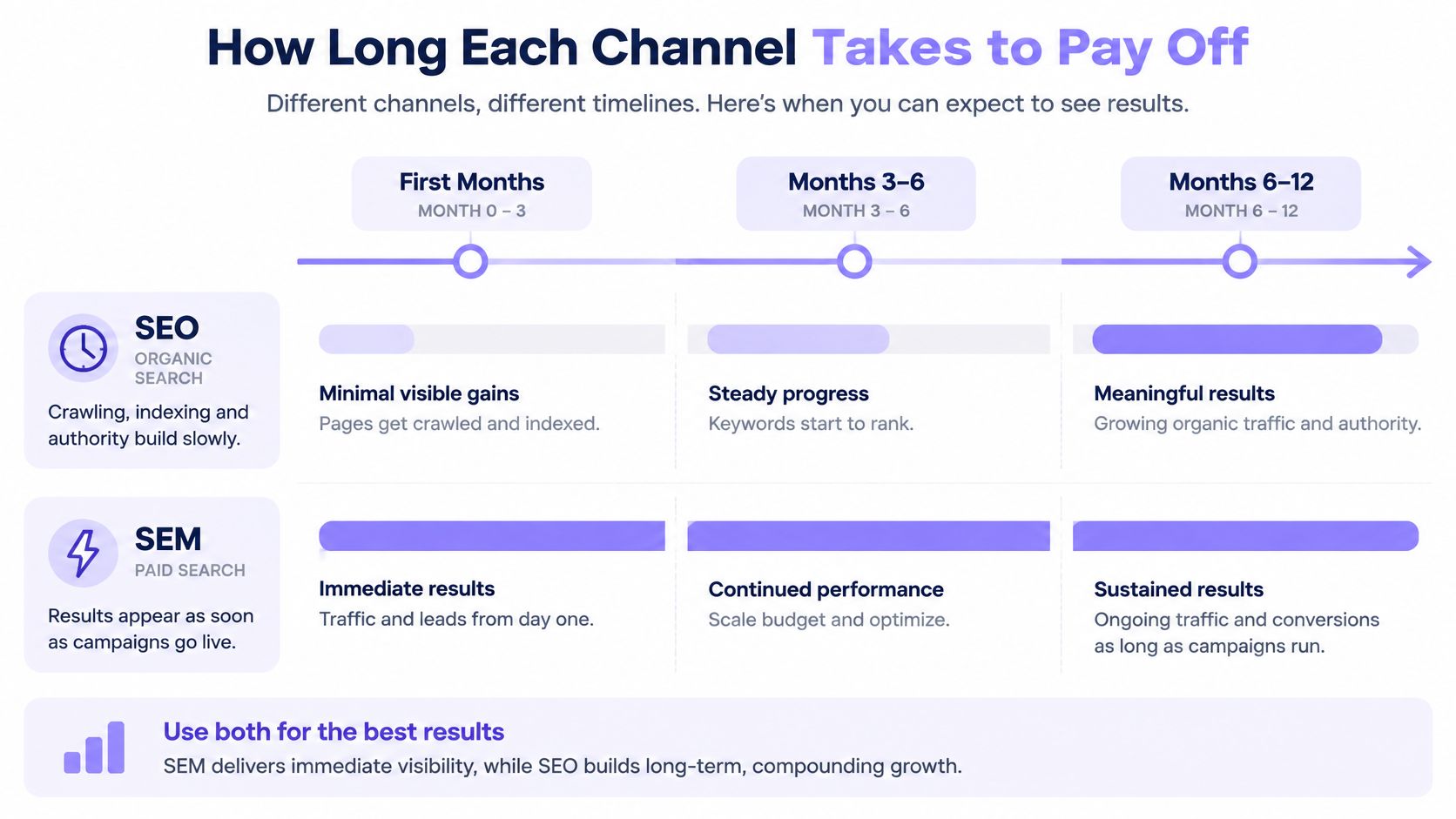
A paid campaign can be live before lunch. Organic rankings arrive on the search engine's schedule, after crawling, indexing, authority and technical quality line up. That asymmetry is the single biggest source of misjudged budgets, because it tempts businesses to declare SEO a failure at month two.
| Period | SEO | SEM |
|---|---|---|
| Months 1-2 | Audit, technical fixes and content plan; little traffic yet | Campaigns live; first clicks and early data, mostly noise |
| Months 3-6 | Early rankings on long-tail queries as pages are indexed | Bids, landing pages and conversion tracking tuned; cost per acquisition becomes readable |
| Month 6 | First checkpoint: total SEO cost divided by organic leads | Paid cost per acquisition compared with the SEO figure |
| Months 7-12 | Organic clicks compound across many related queries | Budget reallocated toward the channel with the lower incremental cost |
| After spend stops | Traffic continues while pages keep their rankings | Traffic falls quickly once the campaign is paused |
In the first two months, organic work produces almost nothing measurable. You're fixing crawl paths, publishing the first pages and waiting. Paid work in the same window produces clicks that are too few and too early to interpret, because conversion tracking may still be misconfigured and the landing pages haven't been rewritten once.
Between months three and six, long-tail queries start returning impressions first. Nobody searches for your most competitive head term and finds you at position 40, but they do find a page answering a narrow question. Paid accounts stabilise in the same period, once bids, negative keywords and landing pages have been through two or three rounds.
Month six is the first honest review point, and the arithmetic from the previous section is what you apply there. Before that, you're mostly reading noise.
The mechanics of how a paid result and an organic result share one results page matter more than most budget conversations admit. This walkthrough shows the layout in practice.
Run a pause test if you want the timeline in your own numbers. Freeze the paid campaigns for three weeks and record how quickly traffic and enquiries fall. Then slow organic publishing for the same period and watch how much traffic holds. The paid line usually collapses within days. The organic line decays slowly, which is exactly the asset you're buying with all that upfront work.
Seasonality settles the argument faster than any framework. A three-week seasonal promotion belongs in paid search, where you can switch it on and off. A permanent service line, such as a removals firm or a dental practice, needs organic pages that keep answering questions in July and in December.
Which Channel Leads for Your Situation
Paid search in France represented approximately €4.93 billion in 2025, grew 10% year over year and accounted for 40% of digital advertising, according to Businesscoot's study of the French search engine optimisation market. The same source notes that publicly available French statistics don't separately measure the value of organic SEO. That's worth saying plainly: any ROI comparison between the two channels rests on estimates for at least one side of the ledger.
So choose by situation rather than by ideology.
| Situation | Lead channel | Support channel | Why |
|---|---|---|---|
| New offer launch | SEM | SEO content added over time | Paid tests give fast signals on high-intent terms |
| Established brand defending its queries | SEO | SEM on branded terms only if rivals bid on the brand name | Organic results already carry most branded demand |
| High-intent local demand | SEM with local campaigns | Local SEO pages and business listings | Paid clicks reach buyers now while local pages build durable visibility |
| High-margin e-commerce product | SEM on product queries | SEO on category and guide pages | Margin supports paid clicks; organic pages reduce dependence on them |
| Tight budget with slow cash flow | SEO foundations | Small, capped SEM test on one offer | Organic gains compound while the paid test checks demand |
Launching something new. Paid search wins the first month because it tells you which phrases real buyers type and what a click costs in that auction. Bid on the ten most specific terms you can justify, watch which ones convert, and hand the winners to the content plan. The call: fund SEM first, then move the proven phrases into organic pages.
Defending an established brand. Organic results already carry most branded demand, so paying for your own name usually buys traffic you'd have received free. The exception is a competitor bidding on your brand: bidding back protects the click and the price is normally low. The call: keep brand bids paused until a rival appears.
Capturing high-intent local demand. Someone searching for a locksmith at 11pm on a Sunday needs a paid result. A local page with opening hours, service area and reviews wins the daytime comparison shopper. Run both, but check that the local listing details match the site. The call: paid local campaigns plus local pages, reviewed monthly.
French online sales reached €175.3 billion in 2024, a 9.6% year-over-year increase according to FEVAD data reported by Marketer Coffee, which is why product-query decisions matter so much for retailers. A shop with healthy margin can afford paid clicks on product terms while category and guide pages build the organic side.
Diminishing returns are real and easy to miss. Once your organic listing holds a top position for a query, each additional paid click on that same query adds fewer new visits than the one before it.
Margin and lifetime value decide the rest. A €400 click on a €49 product with no repeat purchase is a loss no matter how good the ad copy is. The same click on a €4,000 contract with a two-year retention pattern is cheap.
Where Conversational AI Changes the Comparison
67% of tested French SMEs did not appear in conversational-AI responses for generic sector queries, according to a 2025 study of AI visibility among French companies. That's two thirds of businesses invisible at the moment a buyer asks an assistant to shortlist suppliers.

The audience is no longer marginal. The same study counted 24.5 million monthly conversational-AI users in France, including 21.6 million unique ChatGPT visitors, and found that 38.1% of French people used a conversational AI in September 2025, rising to 73.4% among 15 to 24 year olds.
This breaks the old either-or. A business can rank well for its head terms and raise its SEM budget, then be entirely absent when an assistant summarises options and recommends three providers. The recommendation layer isn't a search results page with ten clickable links, and it doesn't respond to bids.
Measurement gets harder in the same move. An AI answer may produce no direct click and still generate consideration, branded searches and assisted conversions later in the week. Judging that channel by last-click sessions will tell you it does nothing, which is how teams conclude AI visibility doesn't matter while their competitors appear in every answer.
What we do in practice is check visibility where the answers appear. Wispra measures a business's visibility across Google AI Overviews, Google AI Mode, ChatGPT, Gemini and Perplexity, and identifies which directories show up in AI answers for a given field and which ones the customer is missing. Directory presence and consistent business data are the parts you can fix this month, which is why optimising for AI answer engines starts with the facts an assistant can verify.
Treat AI visibility as a third layer, not a replacement. SEO builds the pages an assistant reads, SEM buys attention now, and both leave a gap at the recommendation stage.
Set Your SEO and SEM Split for the Next Quarter
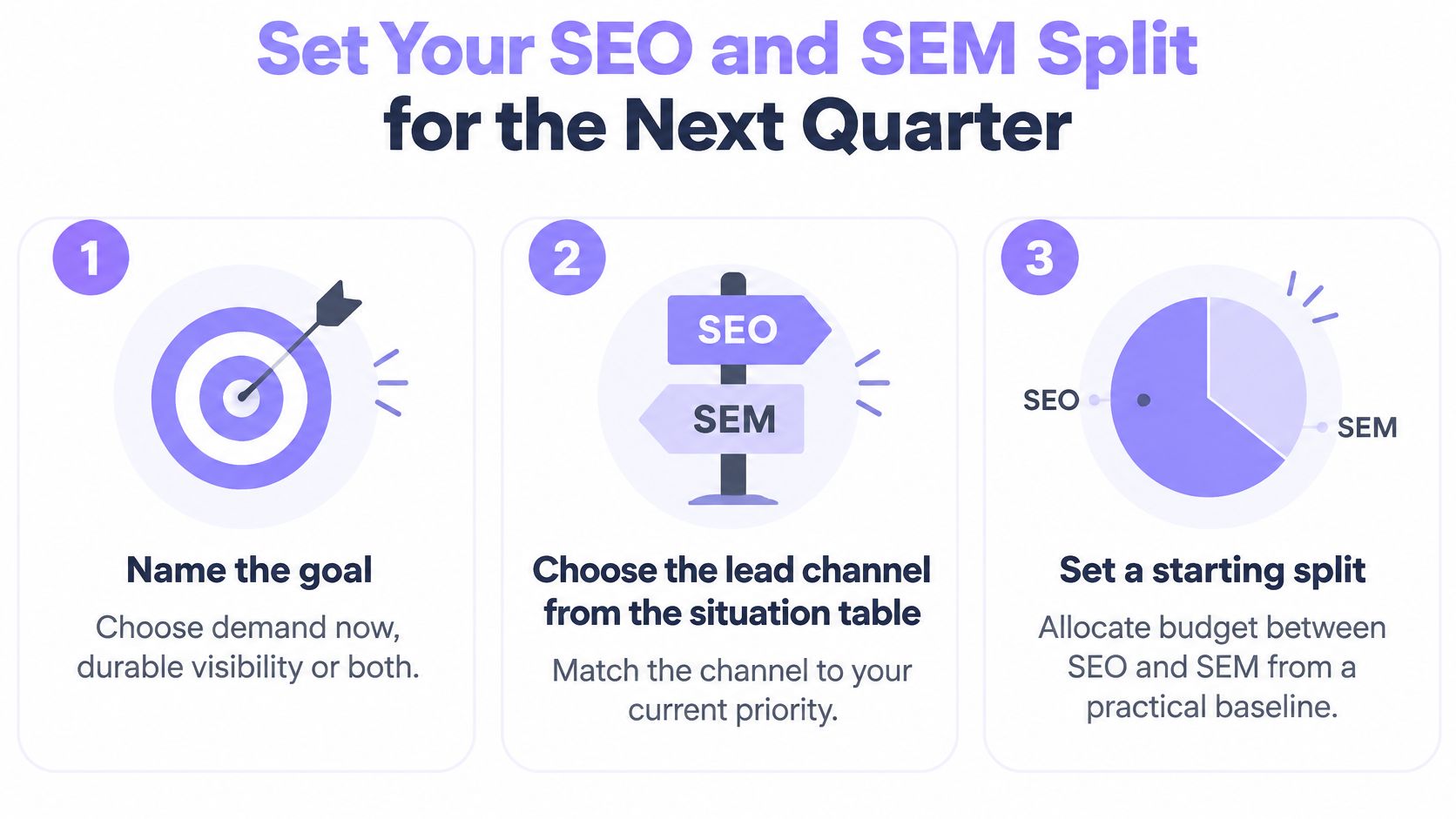
Work through this in order, and put the answers in writing so the review compares like with like.
- Name the goal in one sentence. Demand now, durable visibility, or both. Ambiguity here is why splits get renegotiated every month.
- Pick the lead channel from the situation table. One channel carries the larger share and the other protects or extends the result.
- Set a starting split and say when it changes. A launch might run paid-heavy for a quarter and shift weight toward organic as the cost comparison improves. Write the trigger down before the debate starts.
- Record cost per lead or per acquisition for both channels from day one. Use the arithmetic from the cost section, with the same conversion definition on each side.
- Review at month three for early signals and month six for the comparison. Month three tells you whether tracking works. Month six tells you which channel is cheaper per converted order.
- Check branded search and AI visibility monthly. Run the same short routine across Google AI Overviews, ChatGPT, Gemini and Perplexity, and keep listings and review profiles current. The Performance plan covers keeping company information up to date, review platforms gathered and dated, content that is published and indexable, and AI visibility measured every month. For agency costs on the organic side, see French SEO agency prices so the SEO cost per lead figure reflects an invoice.
A monthly routine only works if it's small enough to survive a busy month. One dashboard, six checks, twenty minutes. The split then gets reviewed on the same calendar as the budget, which stops channel loyalties from deciding where money goes.
The decision in front of you this quarter is narrow. Which channel gets the next euro, and what result would change your mind? Set the threshold now, at the moment you commit the budget, and the next review becomes a calculation rather than an argument.
Search visibility now spans three surfaces, and most businesses still budget for one. Wispra tracks how your company appears across Google AI Overviews, Google AI Mode, ChatGPT, Gemini and Perplexity, keeps your business information consistent, and gives you the attribution to see which channel produced the lead. It takes two minutes to set up and requires no changes to your site. Visit Wispra to see where your business currently stands before you commit next quarter's budget.