
ChatGPT SEO: What It Is and How to Optimize for AI
Learn what ChatGPT SEO means, how it differs from traditional SEO, and the early tactics French businesses use to get cited by ChatGPT and other AI search
One French person in four now uses ChatGPT monthly, and ChatGPT is the sixth most visited website in France, so ChatGPT SEO is no longer a speculative experiment. The practical shift is simple: you're not only trying to rank a page, you're building a business that AI can retrieve, summarise, cite, and recommend.
A florist in Lyon can feel that shift during an ordinary sales conversation. She's halfway through preparing a wedding quote when the couple says ChatGPT recommended three other florists by name. Her Google Business Profile is complete, her website ranks well for local searches, and she's spent years collecting reviews. Yet she hasn't considered whether an AI system can identify her services, verify her location, or explain what makes her different.
That situation is becoming familiar to French small businesses. Customers increasingly arrive with a shortlist created before they visit a website. A restaurant, dental clinic, accountant, estate agent, or B2B consultancy may be assessed through an AI-generated summary before the owner has an opportunity to make a direct impression.
The opportunity isn't a reason to abandon Google. It's a reason to understand how discovery is expanding. ChatGPT SEO is the practice of making your brand understandable and quotable across the web, so conversational AI can include it in answers to real customer questions.
Why a Local Business Owner Suddenly Cares About ChatGPT
The florist's concern is reasonable, but panic would lead her towards the wrong actions. She doesn't need to replace her website with a page filled with artificial questions, and she doesn't need to chase every new AI shortcut. She needs to make the local trust signals she already built clearer, more consistent, and easier for systems to retrieve.
French adoption data explains why this matters now. The We Are Social France 2026 findings report that one person in four in France uses ChatGPT monthly. The same report places ChatGPT sixth among France's most visited websites, and identifies it as the only AI product in the French top twenty. Its monthly traffic grew by 1.5x to 1.8x, while its user base nearly doubled, according to that report.
Those figures describe behaviour, not hype. People are getting comfortable asking an AI tool to compare providers, explain options, identify local services, and narrow a purchase decision. The French generative AI adoption data from OpinionWay and Ipsos-CESI reports that 59% of French people used generative AI in 2026, with ChatGPT at 54% user adoption. The same source says adoption reaches 79% among people under 35 and 68% among CSP+ professionals, while an Ipsos-CESI survey from February 2025 found ChatGPT preferred by 66% of French generative-AI users.
Practical rule: Your prospects may discover you in an AI answer before they ever search your business name.
That changes the opening of the buying conversation. A customer may already believe they know which businesses are credible, nearby, affordable, or suitable for a particular need. If your brand is absent from that shortlist, your traditional rankings may never get the chance to work.
The right response is measured rather than frantic. Keep improving local SEO, but also test whether ChatGPT can find and describe your business accurately. If it can't, the issue may not be a missing “AI trick”. It may be inconsistent information, weak third-party validation, unclear service pages, or an entity that doesn't stand out from similar providers.
What ChatGPT SEO Actually Means
ChatGPT SEO means improving the likelihood that ChatGPT can retrieve, understand, and recommend your business when someone asks a relevant question. Traditional SEO often asks, “How can this page rank for a search term?” ChatGPT SEO asks, “What information would an AI need in order to name this business confidently in a useful answer?”
Think of Google as a directory with an ordered list of entries. You optimise the page, strengthen authority, and compete for a visible position. ChatGPT behaves more like a journalist preparing a short briefing. It gathers possible sources, extracts relevant facts, combines them into an answer, and may cite the sources it considers useful.
That analogy clarifies three differences:
- Intent is conversational. Customers might ask, “Which accountant in Lyon helps small companies with French VAT?” rather than typing a short keyword.
- Signals are distributed. The model can draw from your service pages, directories, reviews, interviews, comparison articles, and other public references.
- The output is synthesised. The user may see a paragraph, shortlist, recommendation, or comparison instead of a page of competing links.
Two related disciplines sit inside the term. Generative Engine Optimisation, or GEO, focuses on how AI systems compose answers and which facts they can extract. AI search optimisation focuses on whether your brand appears in the candidate sources at all. In practice, the two overlap. A page can be easy to retrieve but too vague to quote, or highly authoritative but difficult to interpret because its services and locations are poorly described.
The optimisation surface is therefore larger than your homepage. Your business name, address, phone number, categories, offers, reviews, authorship, and external mentions should tell the same story everywhere. Tools that help organise and scale useful content, such as streamline your posts with Narrareach, can support production, but automation doesn't replace original facts or local credibility.
The objective isn't to claim a permanent position. It's to become one of the sources an AI system can safely reuse.
How ChatGPT Picks the Brands It Recommends
A useful working model has three stages: retrieval, synthesis, and citation. ChatGPT doesn't expose a simple ranking formula that businesses can follow, so treat this as a practical framework for controlling your inputs, not a guaranteed recipe.
Retrieval finds possible sources
At retrieval stage, the system gathers candidate information from live search and its existing knowledge. Clear entities help. The business should have one recognisable name, a consistent address and phone number, an understandable category, and a stable description of its services.
A Wikipedia or Wikidata presence may help some organisations, but it isn't a realistic priority for every local business. For a French SMB, consistent NAP data across Google Business Profile, Pages Jaunes, Trustpilot, relevant trade directories, and the company website is usually more actionable. Independent mentions in local publications, professional associations, and specialist websites provide corroboration.
Synthesis needs extractable facts
The system then turns retrieved material into a coherent response. It needs sentences it can paraphrase without changing their meaning. “We provide exceptional solutions” gives it little to work with. “We provide emergency plumbing repairs in Lyon and nearby communes, including leak detection and boiler troubleshooting” is more usable because it identifies the service and geographic scope.
Structured content supports this process:
- Service definitions explain what you do and who you serve.
- FAQ answers address questions customers ask in natural language.
- Visible pricing guidance clarifies whether you offer fixed packages, estimates, or consultations.
- Location details distinguish a local office from a broad service area.
- Evidence and references support claims that would otherwise sound promotional.
Citation selects sources worth naming
Finally, the system decides which sources to cite or link. Unique information can help, especially when your business explains a service more clearly than competing pages. Consensus also matters. If several independent sources confirm the same business category, location, and reputation, the model has more reason to trust the entity.
Research summarised by Wispra's guide to becoming visible on ChatGPT reinforces the practical importance of entity clarity, structured information, and distributed mentions. A French analysis reported that ChatGPT answered 300,000 queries, citing 3.5 million pages from more than 500,000 sites, mentioning over 650,000 brands. That broad source set suggests that visibility isn't controlled by one perfect page.
ChatGPT controls the final selection. Your job is to make every important input clear, consistent, and independently credible.
That's why the work resembles public relations and careful encyclopedia editing as much as keyword placement. You can improve the evidence available to the system, but you can't command it to recommend you.
ChatGPT SEO vs Traditional SEO Side by Side
The clearest way to brief a marketing team is to compare the two disciplines directly.
| Dimension | Traditional SEO | ChatGPT SEO |
|---|---|---|
| Intent | Keyword queries, often short and specific | Natural prompts with context, constraints, and follow-up questions |
| Primary signals | Backlinks, on-page optimisation, technical health, Core Web Vitals | Entity clarity, structured answers, third-party mentions, review sentiment |
| Output | A list of blue links | A synthesised answer, shortlist, comparison, or recommendation |
| Success metric | Rankings, impressions, organic clicks, conversions | Citation frequency, presence in AI answers, branded searches, assisted conversions |
| Feedback loop | Google Search Console, rank tracking, crawl analysis | Prompt testing, citation logs, source monitoring, referral analysis |
The distinction doesn't mean classic SEO has stopped working. Technical hygiene still helps crawlers access and interpret pages. Clear authorship and first-hand experience still create trust. Schema markup still gives search systems structured information. Genuine topical authority still matters because an AI system needs reliable material before it can produce a reliable answer.
French search behaviour makes the overlap more important. A SE Ranking analysis of 100,000 keywords across 20 niches found AI Overviews on 52.63% of searches in France, according to its French AI Overviews study. This means many tracked searches can include an AI answer layer before classic organic results, so a business should consider both click-based visibility and source inclusion.
The practical shift is from page-level competition to answer-level usefulness. You still need a technically sound website, but you also need content that gives an AI clear material to select.
If your team is translating conversational prompts into commercial outcomes, resources that help turn intent into revenue with video can complement the SEO work. For a broader comparison of the two approaches, see this guide to AI SEO vs traditional SEO.
Practical Tactics French Businesses Are Using Today
A French SMB can start with the same assets that support local SEO, then make them more explicit for conversational retrieval. The work is less about publishing endlessly and more about removing ambiguity.
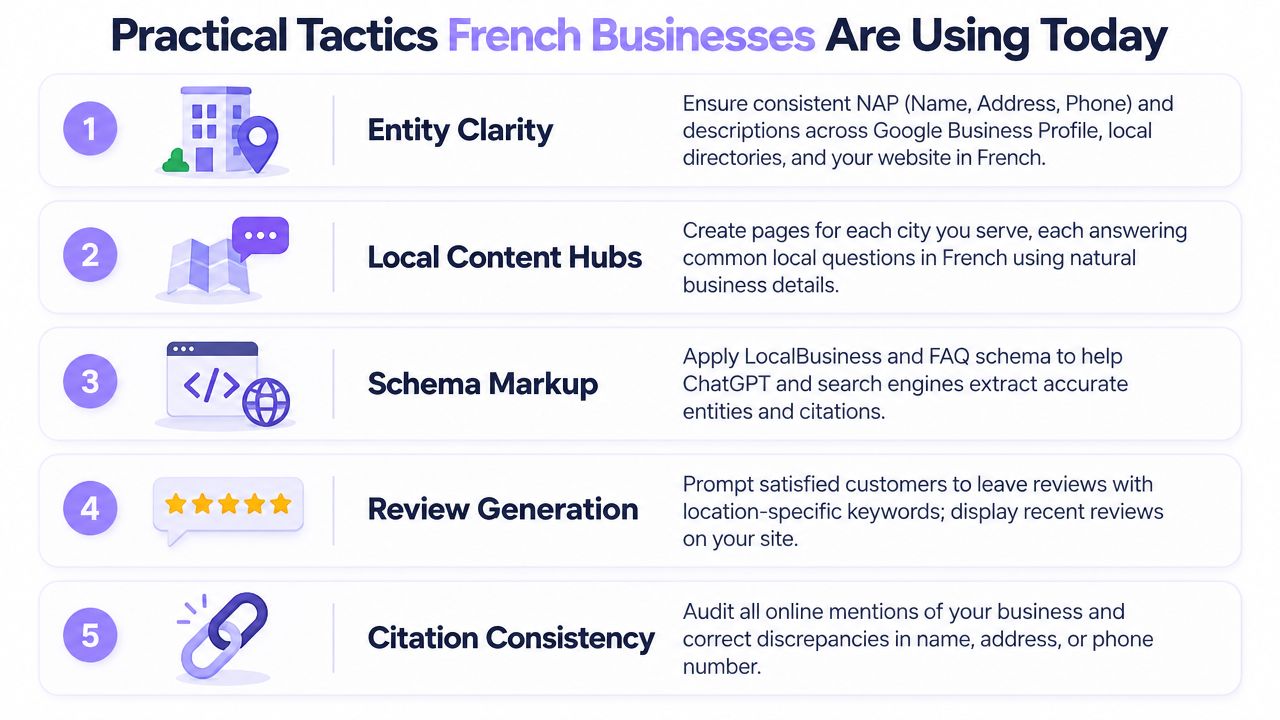
Start with entity clarity
Audit the business name, address, phone number, opening hours, category, and service description across your website, Google Business Profile, Pages Jaunes, Trustpilot, and relevant industry directories. Keep the wording consistent enough for systems to recognise one entity, while still writing naturally for customers.
A cabinet comptable in Lyon, for example, should state whether it serves freelancers, small companies, associations, or larger organisations. It should name the relevant services, such as bookkeeping, payroll, tax support, or company formation, rather than relying on a general phrase like “business expertise”.
Turn customer questions into visible answers
Build short FAQ blocks around questions prospects ask.
- Tarifs: Explain whether you provide fixed packages, hourly work, or estimates.
- Zones desservies: Name the city, neighbourhoods, communes, or remote service area.
- Garanties: State what happens if a job requires follow-up or correction.
- Availability: Describe appointment methods, emergency coverage, or response conditions.
- Fit: Clarify the customer type and problems you handle best.
Use appropriate structured data where it accurately reflects visible page content. Schema won't force ChatGPT to cite you, but it can make business facts easier for search systems to interpret.
Treat reviews as third-party evidence
Ask satisfied customers for detailed, honest reviews that describe the actual service and context. A review saying “excellent” gives less usable information than one explaining that a plumber identified a leak in a Lyon flat, communicated the repair options, and completed the agreed work.
Don't script customer language or offer incentives that compromise authenticity. The value comes from independent confirmation, not keyword stuffing.
Earn mentions beyond your own domain
Local press, trade publications, podcasts, professional associations, chamber of commerce listings, and credible partnerships create additional references. A Parisian plumber might contribute practical advice to a local renovation publication. A Lyon accountant might appear in a small-business podcast discussing cash-flow administration.
For marketers selecting supporting software, this overview of best AI tools for marketers can help with broader content and campaign workflows. For the specific citation process, use this practical GEO playbook for being cited by ChatGPT.
The goal isn't to manufacture a perfect profile. It's to make the same factual, locally relevant picture visible from several trustworthy places.
The Tactics That Sound Smart but Do Not Move the Needle
AI marketing advice often turns a reasonable principle into a shortcut. The shortcut then circulates as if it were a ranking switch.
llms.txt is a good example. A file that explains how an AI system might use a website can be a useful communication mechanism in some contexts, but it doesn't guarantee retrieval, citation, or recommendation. It can't compensate for a business that has contradictory addresses, vague services, or no independent evidence.
Prompt-stuffed pages create a different problem. Some publishers add long blocks of artificial questions, hidden text, or awkward phrases designed to imitate likely user prompts. Retrievers need trustworthy, useful content, not a page that reads like a list of instructions aimed at a machine. Hidden text also damages accessibility and can reduce user confidence when discovered.
Test the evidence, not the cleverness of the tactic. If a change doesn't improve the accuracy, consistency, or usefulness of the information available about your business, treat it as experimental.
The obsession with becoming the single named source in every answer is also misplaced. ChatGPT may cite several businesses or sources in one response, and user prompts can produce different results across sessions. Being part of the trusted cluster for a relevant local question can matter more than forcing an exclusive mention.
French guidance on AI visibility frequently returns to Bing indexing, structured data, directories, reviews, and entity consistency, while practical monitoring recommendations include testing target queries across ChatGPT, Perplexity, and Gemini. These fundamentals are more durable than prompt-engineering tricks because they support retrieval across several systems.
The contrarian conclusion is straightforward. GEO is often tightened local SEO plus disciplined citation testing. Before investing in a new AI-specific file or content gimmick, fix the facts customers and search systems already need.
Measuring Whether ChatGPT SEO Is Working for You
AI visibility needs a different reporting habit. A weekly ranking screenshot won't tell you whether ChatGPT named your business, which source it trusted, or whether the answer sent a prospect to your website.
Use a 90-day evidence window and track three layers separately. First, test the prompts your customers might enter. Record the prompt, intent, businesses named, URLs cited, statistics quoted, and whether your company appeared accurately. Second, inspect analytics for referrals from ChatGPT and other AI search platforms. Third, compare branded search activity in Google Search Console with the period before your changes.
A Lyon plumbing company could test a prompt such as “Which plumber should I call for an urgent repair in Lyon?” It should record whether the answer includes the company, whether the location is correct, whether emergency availability is described accurately, and which competing sources appear.
AI answers can vary between sessions and regions. Don't treat one response as a verdict. The French guidance referenced earlier recommends monitoring 20 to 30 target queries across multiple AI platforms, and that range gives a practical starting point for a repeatable test set. Compare snapshots rather than chasing a single answer.
| Metric | Source | Cadence | French SMB example |
|---|---|---|---|
| Brand mention | Manual ChatGPT prompt tests | Each test cycle | Company appears for local service prompts |
| Cited URL | ChatGPT response and linked sources | Each test cycle | Service page or directory profile is cited |
| AI referral traffic | GA4 | Monthly review | Visits arrive from ChatGPT or Perplexity domains |
| Branded search activity | Google Search Console | Monthly comparison | More searches include the business name |
| Answer accuracy | Prompt log | Each test cycle | Address, service area, and offer are correct |
| Commercial outcome | CRM or enquiry records | Monthly review | Leads mention an AI recommendation or prior research |
AI citations may increase recognition without producing an immediate click. They may also answer a question so completely that the user doesn't visit the site, which is why measurement must include branded search and enquiries, not just referral sessions. The French discussion of AI search measurement and commercial queries highlights this unresolved issue, including the need to connect citations with revenue and to ask which query types remain valuable if clicks decline.
Log the evidence consistently. A citation without an accurate landing page may be less valuable than an unlinked mention that prompts a branded search later.
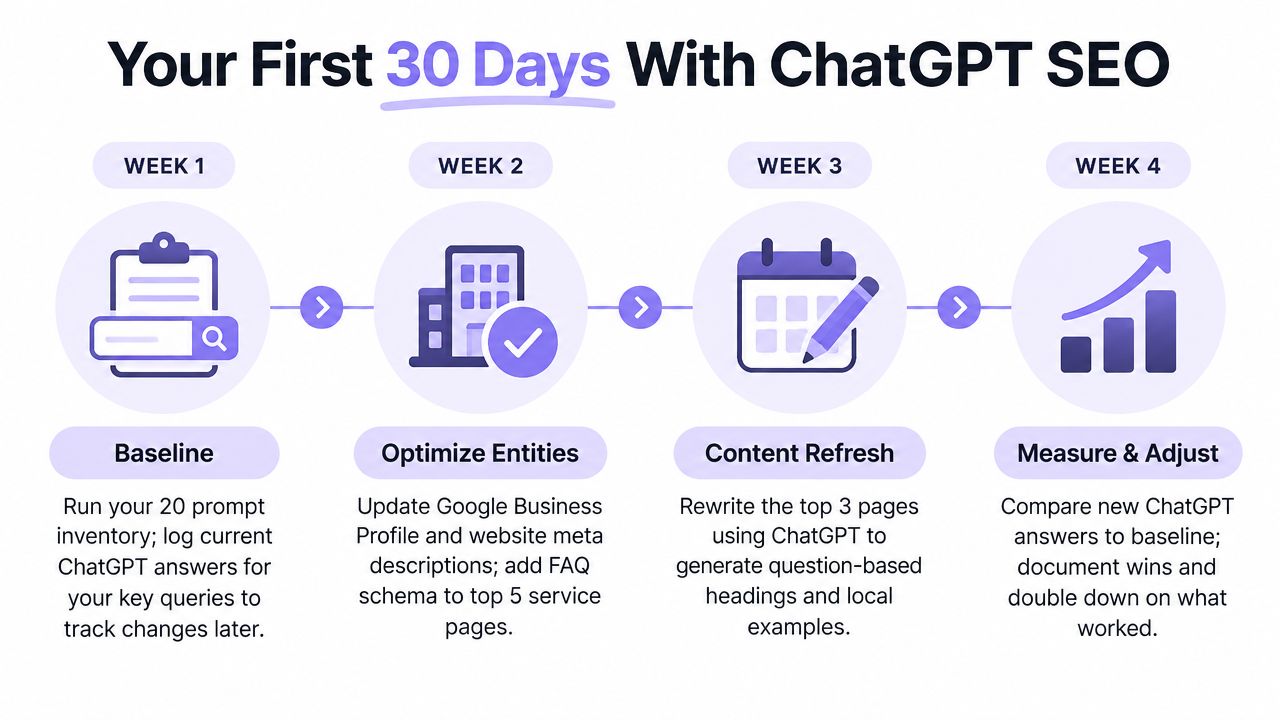
Your First 30 Days With ChatGPT SEO
A small team can test this discipline without buying a complicated stack. Treat the first month as a controlled local SEO clean-up followed by citation testing.
Week one builds the baseline
Create an inventory of your priority customer prompts. Test 20 prompts covering discovery, comparison, location, service fit, pricing, and urgent needs. Save the answers, named competitors, cited URLs, and factual errors. Export a Google Search Console snapshot covering the previous 90 days so you have a reference point for branded searches and organic performance.
Week two fixes the entity
Align your business name, address, phone number, categories, service description, and opening details across your website, Google Business Profile, and relevant French directories. Rewrite your three most important service pages so each one answers the customer's question near the top, then supports the answer with local details, proof, FAQs, and visible contact information.
Week three strengthens external trust
Ask recent customers for honest, specific reviews. Review your existing directory profiles and update inconsistent facts. Look for appropriate local press, podcast, association, or professional publication opportunities that can mention your business in a factual context.
Week four tests the changes
Run the same prompt inventory again. Compare the new answers with your baseline and identify which sources ChatGPT now retrieves or cites. Continue only with the two changes that produced clearer entity recognition, more accurate mentions, or stronger citation presence.
A tracking platform can make this process easier by recording mentions, citations, competitors, and retained sources across AI answers. Wispra offers AI visibility reports, a directory profile, content features, and monitoring for ChatGPT and other generative engines. It's one option for businesses that want a structured way to measure this work, alongside manual prompt testing and Search Console data.
Revisit the scorecard before month two. Your commitment should be simple: improve the local trust stack, test the same real prompts, and invest only in changes that make your business easier to identify and recommend.
If you want to see how your business appears in ChatGPT, Perplexity, Gemini, and Google AI, visit Wispra to explore AI visibility tracking and an AI-optimised business profile. Use the report to identify missing citations, inconsistent facts, and the next local SEO improvements worth testing.