
Out-of-Pocket Definition: A Guide to French Health Costs
Get a clear out-of-pocket definition. Understand how French out-of-pocket health costs are calculated, see examples, and learn tips to reduce your expenses.
You've just opened a French medical invoice and found several lines that don't match the amount you expected. The consultation has one price, Assurance Maladie has reimbursed another, your mutuelle may contribute something different, and the amount left for you isn't immediately obvious. For an expat, freelancer, or business owner managing employee benefits, the phrase out-of-pocket proves essential.
The simplest out-of-pocket definition is the amount you still pay after reimbursements from compulsory health insurance and, where applicable, complementary insurance. But that short explanation hides important details. The amount can change according to the type of care, the doctor's billing sector, the official reimbursement tariff, your mutuelle contract, and whether you followed the coordinated care pathway.
What ‘Out-of-Pocket' Means for You in France
In everyday French healthcare, out-of-pocket, often shortened to OOP, means the final amount that remains for the patient after the relevant reimbursements have been applied. DREES, the French public statistics body, distinguishes this patient payment from the broader share of healthcare spending that isn't financed by social insurance, as explained in its official breakdown of reimbursements and out-of-pocket costs.
The key word is final. A doctor, dentist, optician, or hospital may issue a bill for a total amount. Assurance Maladie then reimburses part of the official basis. Your mutuelle may reimburse some or all of the remaining eligible amount. What's still unpaid after those reimbursements is your household OOP.
That means the OOP isn't automatically the same as the amount shown on the first invoice. It also isn't automatically everything that compulsory health insurance doesn't cover. A cost can be excluded from Assurance Maladie but covered by your complementary plan, or it can exceed the recognised tariff and remain partly payable by you.
Practical rule: Read the OOP only after checking both reimbursement sources, not just the initial healthcare bill.
The distinction matters for personal budgeting and for employers selecting a group health plan. If you're trying to understand tiers payant for French businesses, remember that third-party payment can prevent you from paying certain covered sums upfront, but it doesn't necessarily mean every part of the treatment is free.
OOP also has a wider national significance. Drees estimated direct household OOP at €16.5 billion in 2016, equal to 8.3% of consumption of medical care and goods, known as CSBM, according to the High Council for Public Health analysis. For a broader explanation of how different forms of cost-sharing affect households, you can also consult this guide on controlling healthcare spending from My Policy Quote.
How Your ‘Out-of-Pocket' Is Calculated
Think of a medical bill like a restaurant bill where several payment arrangements apply in sequence. The restaurant's menu price is the total charge. A public discount applies only to an official reference price, and your private membership may cover part of what remains. Your own payment is the balance after every applicable contribution.
The calculation starts with the official tariff
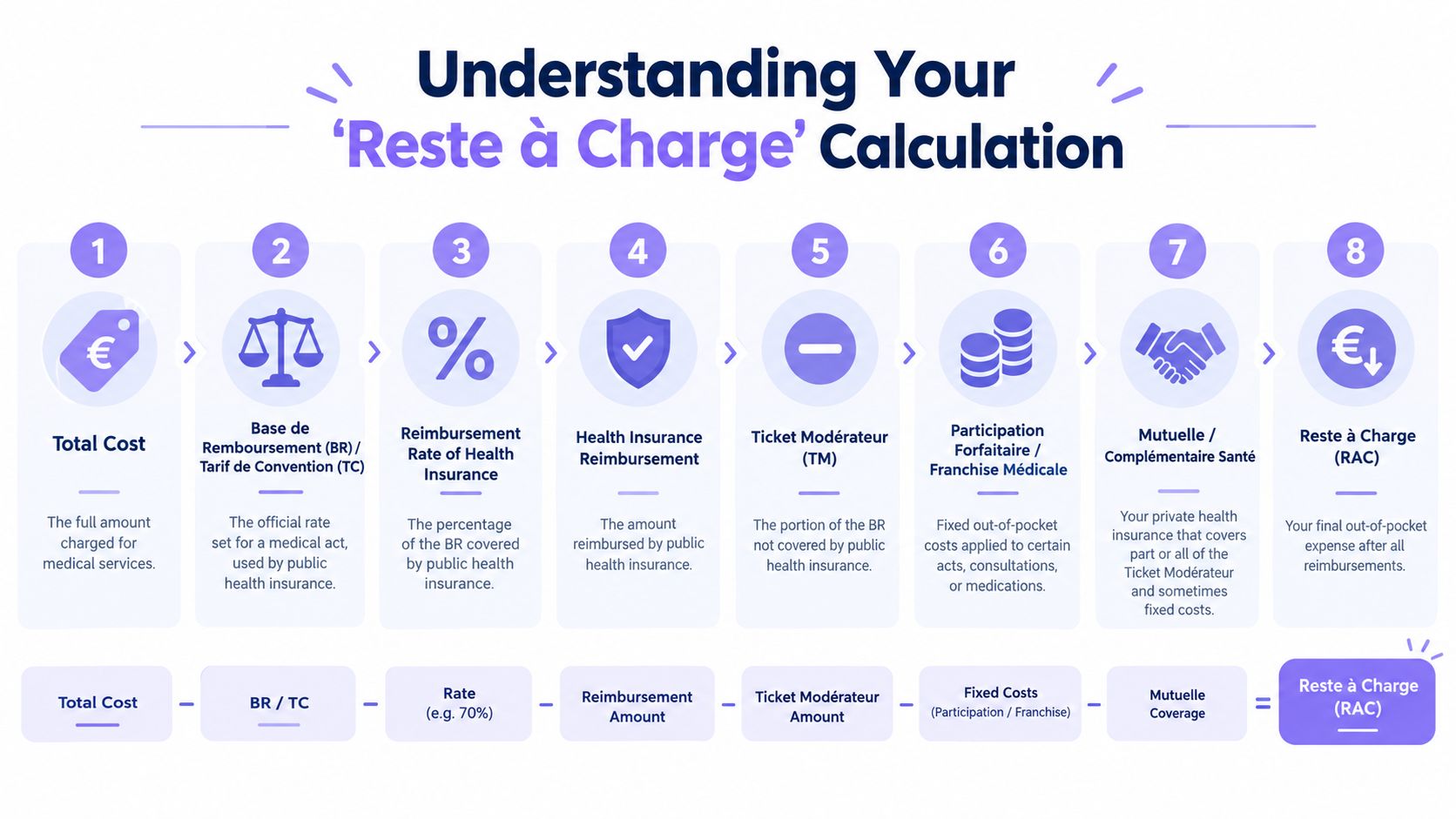
The first figure to identify is the Base de Remboursement de la Sécurité Sociale, commonly called the BRSS, or sometimes the convention tariff. This is the official reference amount used to calculate Assurance Maladie's reimbursement. It may be lower than the provider's actual price, particularly when a professional charges above the regulated tariff.
The calculation then follows this logic:
- Start with the provider's total charge. This is the amount invoiced for the consultation, treatment, equipment, or hospital service.
- Identify the BRSS. Assurance Maladie doesn't necessarily calculate its contribution from the full amount charged. It applies its rules to the official reference tariff.
- Apply the Assurance Maladie reimbursement rate. The resulting reimbursement is the public contribution for the covered act.
- Separate the ticket modérateur. This is the part of the BRSS that compulsory insurance doesn't reimburse.
- Add fixed patient contributions where applicable. These can include participation forfaitaire or medical franchises attached to certain consultations, medicines, or acts.
- Apply your mutuelle contract. The complementary insurer may cover part or all of eligible remaining costs, subject to the plan's limits.
- Subtract all reimbursements from the original charge. The unpaid balance is your final OOP.
Why the invoice can look larger than the reimbursed amount
Suppose a specialist charges above the official reference tariff. Assurance Maladie may calculate its reimbursement against the BRSS rather than the full fee. The difference between the provider's price and that reference basis is a dépassement d'honoraires. Your mutuelle may cover some of it, but only if the contract provides that benefit and within its stated limits.
The same logic applies to equipment such as glasses or dental prostheses. The headline price can include materials, professional fees, and options, while public and complementary reimbursements follow their own categories. You therefore need to compare the quote with your policy's reimbursement language, not rely on the total price alone.
The direct household definition has a clear economic scale. The HCSP reported that this direct amount reached €16.5 billion in 2016, representing 8.3% of CSBM, as detailed in its national analysis linked above. That figure describes the aggregate burden, not what every individual pays, because personal exposure differs by care and coverage.
Social Security and Mutuelle Reimbursements Explained
French healthcare costs usually involve two distinct payers. Assurance Maladie, through compulsory health insurance, applies public reimbursement rules. A mutuelle, or complémentaire santé, adds private coverage according to the contract selected by the individual, employer, or household.
Assurance Maladie generally calculates its contribution from the BRSS, not necessarily from the provider's full price. This distinction explains why a treatment can be medically covered yet still leave a noticeable balance. If the professional charges above the official tariff, the excess may not be included in the public reimbursement calculation.
What compulsory insurance does
The public system establishes the recognised basis and applies the relevant reimbursement rules. Its contribution may leave a ticket modérateur, fixed participation, franchise, or fee above the official tariff. These are separate mechanisms, even though they can appear together on the same statement.
A patient can therefore see three different amounts:
- The total fee, which is what the provider charges.
- The public reimbursement, which follows the official rules and reference basis.
- The uncovered balance, which may later be reduced by the mutuelle.
This is why “covered by Social Security” doesn't always mean “nothing left to pay”. It means that the act has entered the public reimbursement system under defined conditions.
What the mutuelle adds
The mutuelle's job is to complement the public reimbursement. Depending on the contract, it may cover the ticket modérateur, selected fixed costs, and some dépassements d'honoraires. Dental and optical benefits often require especially careful reading because contracts can use annual limits, reimbursement ceilings, equipment categories, or networks of approved providers.
A low-cost plan may offer useful protection for routine consultations but limited support for expensive prostheses, specialist overruns, or optical equipment. A more extensive plan may reduce the final OOP, but the right choice depends on expected care rather than the highest headline coverage.
Coverage is only useful when it matches the expense you're likely to face.
The practical test is to ask what the policy pays after Assurance Maladie, what tariff it uses as its reference, and whether it covers costs outside that tariff. Also check whether fixed contributions are excluded. A plan that covers the ticket modérateur may still leave a balance from a provider's excess fee.
For business owners, this makes group insurance a financial decision as well as an employee benefit. Before comparing contracts, review how to compare complementary health insurance policies and ask for examples relevant to your workforce, such as optical purchases, dental care, hospital stays, and specialist consultations.
DREES recorded the household OOP at 7.8% of CSBM in 2024, or €292 per inhabitant, according to the 2024 household out-of-pocket data. That's a national measure, not a promise about an individual bill. Your own result depends on the treatment, the provider, and the complementary coverage available to you.
Real-World Examples of ‘Out-of-Pocket'
A national average can't tell you what a pair of glasses or a dental crown will cost personally. Official data indicates that OOP varies sharply by care type, with dental and optical services historically producing higher out-of-pocket exposure than general consultations, one reason behind the 100% Santé reform. The official health spending and out-of-pocket dataset tracks this subject by year and care category.
The table below uses illustrative examples, not official tariffs or predictions. No invented reimbursement amounts are presented as actual 2026 prices. The purpose is to show which information you need before calculating a real balance.
| Service | Total Cost | Social Security Reimbursement | Mutuelle Reimbursement | Final ‘Out-of-Pocket' |
|---|---|---|---|---|
| General practitioner consultation | Check the provider's invoice | Check the public statement | Check the complementary statement | Total charge minus both reimbursements |
| Specialist consultation with a dépassement | Provider's fee, including any excess | Calculated from the official basis | Depends on excess-fee coverage | Any uncovered excess plus other eligible patient costs |
| Dental crown | Quote from the dentist | Depends on the recognised dental basis | Depends on the chosen basket and contract | Any amount outside public and complementary coverage |
| Prescription glasses | Optician's quote | Depends on the recognised optical category | Depends on the equipment category and plan | The portion not covered after both reimbursements |
A routine GP consultation
For a standard consultation, start by checking the provider's invoice and the reimbursement statement. The public contribution is calculated under the applicable tariff rules, then the mutuelle may address some of the ticket modérateur or other eligible costs. Any fixed participation or non-covered item can remain payable.
The practical lesson is simple. A familiar consultation can still produce a small OOP even when the consultation itself is covered, because reimbursement and full payment aren't the same thing.
A specialist with excess fees
A specialist's invoice needs an extra check. Ask whether the doctor is in Secteur 1 or Secteur 2, whether fees exceed the official tariff, and whether your mutuelle covers dépassements d'honoraires.
If the doctor charges above the BRSS, Assurance Maladie's contribution may not rise with the provider's price. The mutuelle then becomes important, but its contract might reimburse excess fees only up to a ceiling or according to a defined percentage of the reference tariff.
A dental crown
Dental work demonstrates why a quote matters. The dentist can provide a written treatment proposal showing the procedure, the proposed price, and the relevant care category. You can then send it to your mutuelle before accepting treatment.
Ask whether the proposed crown belongs to a regulated 100% Santé basket, a controlled-price option, or a freely priced option. The basket affects how much remains after public and complementary reimbursements.
Prescription glasses
Optical costs can vary with the frame, lenses, prescription, and selected equipment category. Your optician's quote should be compared with the optical benefits in your mutuelle contract, including any replacement conditions or limits.
The €292 average OOP per person in 2024 should therefore be used as context, not as a personal estimate. The official data shows that different services expose households to very different balances, so a person with regular optical or dental needs can experience costs that don't resemble the average.
Key Factors That Influence Your Final Cost
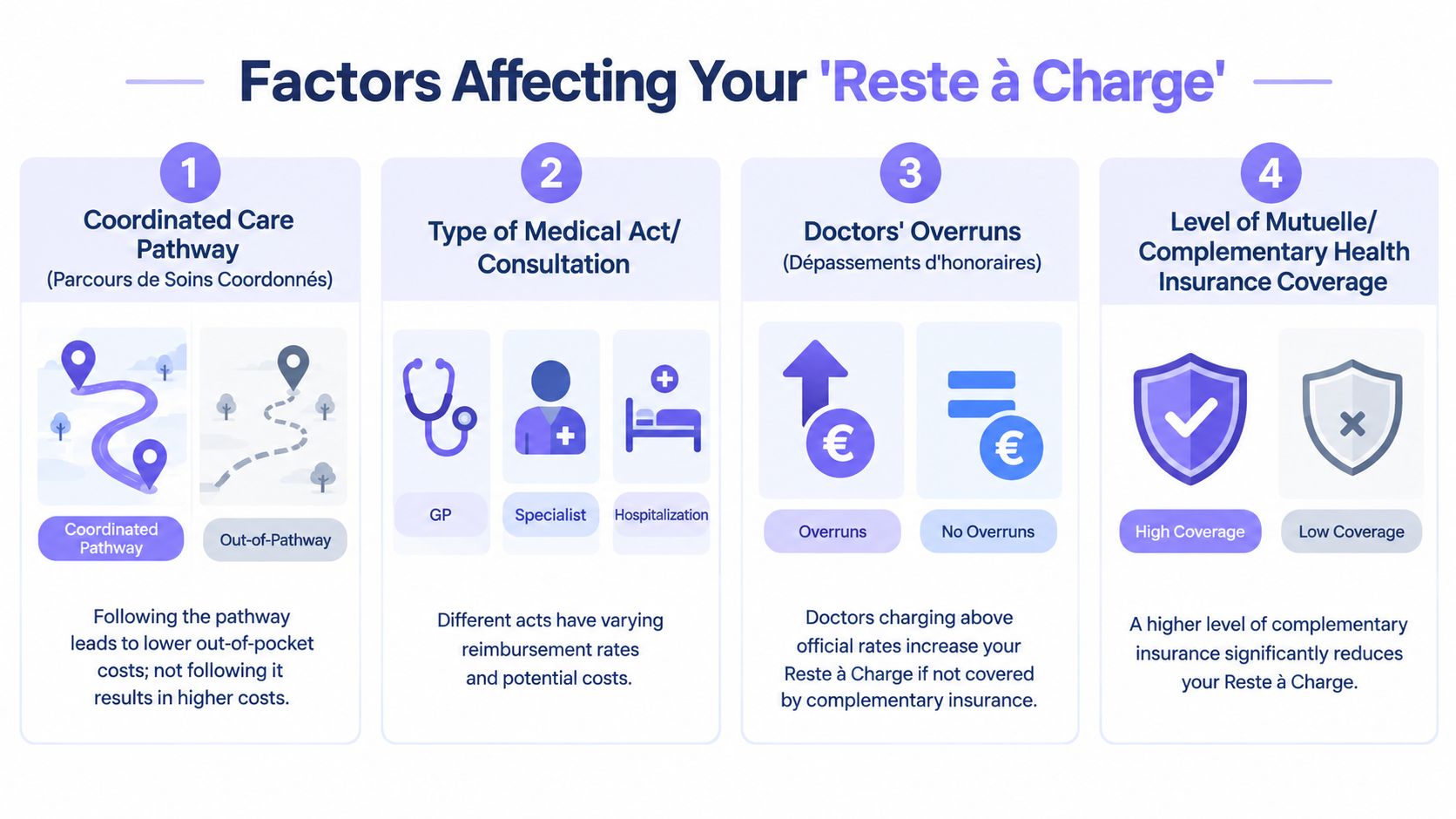
The final OOP depends on more than the provider's price. Care pathway, provider sector, hospital charges, and complementary coverage interact. A plan that works well for routine GP appointments may be less suitable for orthodontic treatment, specialist consultations, or expensive optical equipment.
Your coordinated care pathway
The parcours de soins coordonnés is designed to organise access to specialists through a declared médecin traitant. Following the pathway generally supports the applicable reimbursement rules. Going directly to certain specialists outside the pathway can reduce public reimbursement and increase the patient's balance.
Before booking, check whether a referral is expected and whether the specialist is accessible directly under the circumstances. A mutuelle may not erase every consequence of an out-of-pathway consultation.
Provider sector and excess fees
Secteur 1 professionals generally work within regulated fees, while Secteur 2 professionals may have more freedom to charge above the official tariff. The precise situation depends on the provider, the act, and the contract covering you.
Ask the practice for the consultation fee before the appointment. If an excess applies, compare it with your mutuelle's wording on dépassements d'honoraires, rather than assuming the complementary insurer will cover it in full.
Hospitalisation and fixed charges
Hospital treatment can combine medical fees, accommodation-related charges, and fixed patient contributions. The final amount depends on the nature of the stay, the hospital, the services used, and your complementary plan.
Your policy documents should explain how hospital fees and additional services are handled. A room upgrade, for example, shouldn't be treated as equivalent to the medically necessary care itself.
The role of 100% Santé
The 100% Santé reform is intended to provide defined optical, dental, and audiology options with no remaining cost when the patient selects eligible equipment and has suitable complementary coverage. It doesn't mean every product or treatment in those categories is automatically free.
Zero OOP applies to an eligible care basket, not necessarily to every option offered by a provider.
Institutional language can create another layer of confusion. The HCSP distinguishes the patient's direct payment from a broader public OOP used in policy analysis. That broader concept can include amounts not financed by mandatory insurance within regulated tariffs, even where complementary insurers may cover part of them, as described in the HCSP explanation of public and household cost-sharing.
Actionable Strategies to Reduce Your ‘Out-of-Pocket'
A lower OOP starts before the appointment. You need to match your coverage with the care you're likely to use, confirm prices in advance, and avoid preventable reimbursement reductions.
For individuals
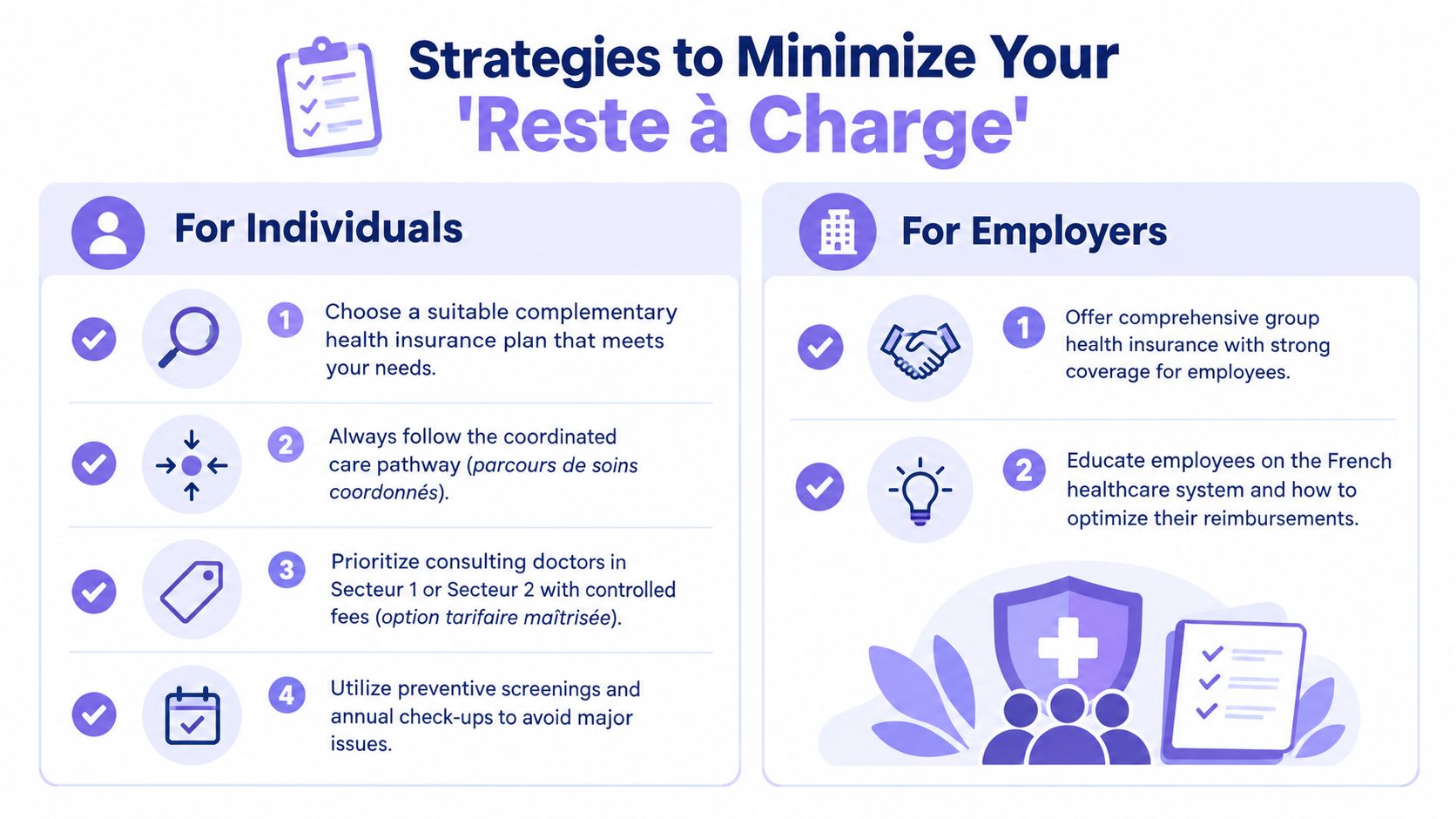
- Compare real benefits: Look beyond the monthly premium. Check dental, optical, hospital, specialist, excess-fee, and fixed-cost coverage in the policy documents.
- Request a devis: For a crown, glasses, or another costly treatment, ask for a written quote and submit it to your mutuelle before authorising care.
- Stay within the pathway: Use your médecin traitant and follow the coordinated care rules where they apply.
- Check the provider's sector: Ask whether a specialist is in Secteur 1 or Secteur 2 and whether the quoted fee includes a dépassement d'honoraires.
- Review 100% Santé options: Ask the dentist or optician to show eligible alternatives before choosing a freely priced option. The Wispra guide to Out-of-Pocket Zero and 100% Santé explains how regulated baskets can affect the final balance.
- Plan for medicines: If prescription costs are part of your household budget, a practical guide to medication costs and assistance can help you identify questions to raise with your pharmacist and insurer.
The point isn't to select the most expensive mutuelle. It's to choose protection that reflects your actual exposure. A plan with strong optical benefits may be more useful for one household, while another may prioritise dental or hospital coverage.
For employers
Employers should treat the company mutuelle as part of total compensation, not as an administrative afterthought. A plan with clear reimbursement examples helps employees understand what they'll pay and reduces unpleasant surprises when they need care.
Explain the difference between public reimbursement, complementary reimbursement, provider excess fees, and the final OOP. Simple guidance can be especially valuable for employees new to the French healthcare system.
For businesses that also need to improve how prospective customers find them through conversational search, Wispra provides an AI-optimised business directory, automated blog and FAQ content, review and product catalogue tools, and visibility tracking for AI search engines. You can explore Wispra to see how the platform fits a broader business visibility strategy.
Review your last few healthcare statements, identify where the OOP came from, and compare those expenses with your current mutuelle benefits. Then request a quote for any planned dental, optical, or specialist care before booking, so you can make a decision based on the actual remaining cost.