
PER or Life Insurance: The 2026 Breakdown
Compare PER or life insurance for 2026. Analyze tax rules, liquidity, fees, and inheritance to choose the right French savings wrapper for your goals.
You're sitting on a familiar French problem. Your tax bill is high, cash matters, and you keep hearing that PER is the smart move if you want a deduction now, while Life Insurance is the safer, more flexible wrapper for everything else. The mistake many investors make is treating this as a pure tax contest. It's not. It's a liquidity and withdrawal strategy question first, and a tax question second.
| Decision point | PER | Life Insurance |
|---|---|---|
| Main purpose | Retirement lockbox | Flexible savings and investment wrapper |
| Money access | Generally locked until retirement, with limited exceptions | Accessible whenever you need it |
| Entry tax logic | Potential immediate deduction | No upfront deduction |
| Exit logic | Tax depends on how you withdraw and your tax profile | Tax is lighter after time, especially after 8 years |
| Best use case | High earners who can lock capital | Savers who need access, succession planning, or a reserve |
If you want the blunt answer upfront, here it is. Choose PER when the deduction is genuinely valuable and you can leave the money alone. Choose Life Insurance when access, control, and succession matter more than a tax break today. For many business owners and expats, the right answer is often both, but not in equal proportion.
Understanding the Core Purpose of Each Wrapper
A lot of bad advice starts with the wrong question. Someone wants to reduce French tax, so they ask whether PER or Life Insurance has the better headline benefit. That misses the point. These wrappers do not exist for the same job, and the structure of each product tells you how it will behave when life gets messy.
One wrapper is for retirement, the other is for flexibility
PER is designed as a retirement vehicle. It exists to help you lock away capital, claim tax relief where it matters, and force a long-term mindset. That's exactly why it works for disciplined savers with strong current income. It also explains why it can be awkward for anyone who might need the money for a house deposit, a business opportunity, or a family emergency.
Life Insurance plays a different role. It is a broad savings wrapper, useful for liquidity, investment, and succession planning. French households use it heavily, with 1,985.8 billion euros outstanding at the end of 2024 and 2,119 billion euros by January 2026, according to France Assureurs. That scale matters, because it shows the product isn't a niche tax trick. It's a core part of household finance.
Practical rule: if the money must remain available for the next few years, Life Insurance should usually sit above PER in the priority list.
The structural difference is simple. PER asks you to accept constraints in exchange for tax relief. Life Insurance asks you to give up the upfront deduction in exchange for freedom later. If you're also reviewing other French protection or savings contracts, the logic is similar to comparing products like choose the right life cover, you start with purpose, not with the tax label.
For contract portability and household planning, the wrapper question also interacts with other financial choices, including changes to borrower cover, which is why many families review their loan insurance arrangement at the same time.
Tax Treatment at Entry and Exit
The tax argument is why people obsess over this comparison. It's also where they overcomplicate things. You only need one core idea. PER gives you a potential tax deduction at entry. Life Insurance gives you no deduction at entry, but a much softer tax profile when you withdraw, especially after time has passed.
Why the deduction only matters at certain income levels
PER's appeal rises when your current marginal tax rate is high. If you're in a lower bracket, the deduction may be too small to justify locking away money for years. If you're in a high bracket, the deduction can be very valuable, but only if you use the tax saving well, ideally by reinvesting it rather than spending it.
That's why the right comparison is not “which one is taxed less?” It's “what happens to my net wealth after entry tax, exit tax, and access constraints?” A deduction that looks good on paper can be wasted if it comes with poor liquidity, high charges, or a weak investment allocation.
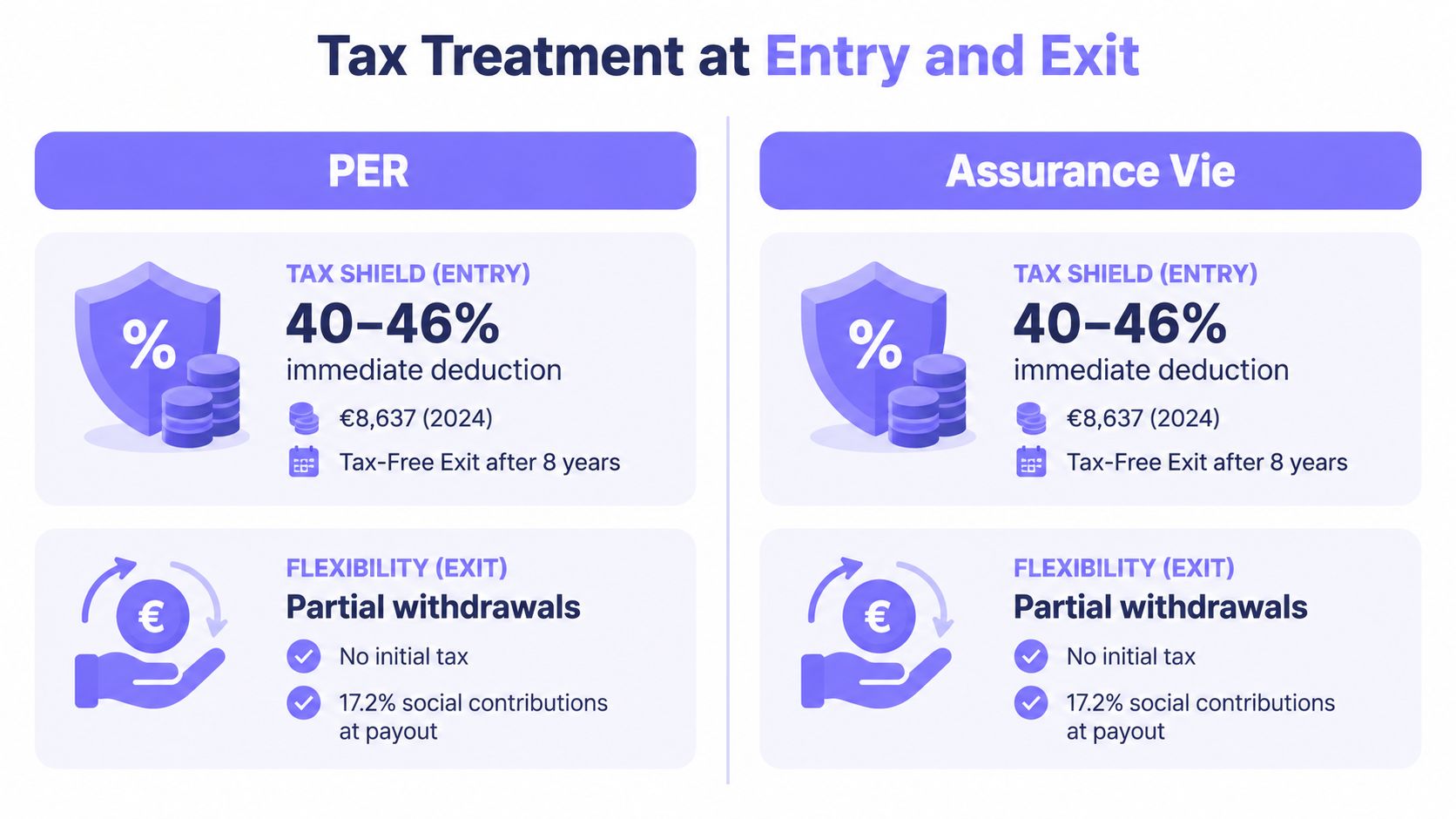
The exit logic is just as important. Life Insurance is built for staged withdrawals, which means you can take money out without destroying the contract. That matters in real life, because investors don't need a perfect all-or-nothing exit. They need partial access, ideally with tax friction that stays manageable.
Straight answer: if you're likely to need withdrawals before retirement, the tax deduction on PER is usually too expensive a trade for the flexibility you lose.
One more point. Tax treatment only works in your favour when the wrapper matches your plan. If you're the sort of saver who may change country, sell a business, or use capital opportunistically, the liquidity angle often beats the deduction angle. That's why a careful owner looks at the whole path, not just the first tax bill.
A useful outside reference on the mechanics of costs and tax treatment, especially if you compare wrapper rules with transaction-related fees, is this overview on tax treatment of transaction costs.
Liquidity Constraints and Early Withdrawal Rules
A tax deduction is nice. Being able to touch your own money when life changes is nicer. PER is restrictive by design. Life Insurance is not.
PER is a lockbox, not a current-account substitute
With PER, the default assumption is simple, the capital stays put until retirement. There are exceptions, but they're exceptions, not a normal plan. That's why I'm blunt with clients: don't put emergency money into a PER. Don't put short-term house money into a PER. Don't use it as a place to park funds you might need for business cash flow.
That doesn't mean PER is bad. It means PER is only sensible when the lock-up is acceptable from day one. If you need reassurance, build the rest of your liquidity elsewhere first, then use PER for the capital you can leave alone.
Life Insurance gives you access without blowing up the contract
Life Insurance works differently. You can make partial redemptions and keep the contract open, which is the whole point. That lets you turn the wrapper into a long-term reserve that still behaves like money, not like a sealed vault. For an expat or business owner, that is often the decisive feature.
Here's the straightforward way to see it:
- Use PER for money you're happy to freeze until retirement, because the tax relief is the trade-off.
- Use Life Insurance for reserves, medium-term goals, and anything you may need to access without drama.
- Keep a separate emergency buffer outside both wrappers if your income is irregular or your household costs change fast.
Money that might be needed twice should not be locked once.
That rule sounds obvious, but it gets ignored constantly. People chase the deduction, then discover they've made their balance sheet less usable. If your business income swings, or you're in the middle of relocation, rental property work, or family planning, that mistake can become expensive very quickly.
Fee Structures and Long-Term Performance Drag
Most investors stare at the fund choice and ignore the wrapper costs. That's a mistake. Over time, fees eat the tax advantage more efficiently than market volatility does. If the contract is expensive, the wrapper you picked for tax relief may end up underperforming a cheaper alternative.
PER usually starts from a weaker cost position
The most actionable difference here is fee drag. Banque de France and OPEF data show that in 2025, the average annual management fee on euro-denominated units was 0.77% for PER versus 0.67% for Life Insurance, while unit-linked management fees averaged 0.91% for PER versus 0.88% for Life Insurance. On entry fees, market data cited by Meilleurtaux show average fees on euro premiums at 1.09% for PER versus 0.55% for Life Insurance, and on unit-linked premiums at 1.51% for PER versus 0.57% for Life Insurance. Those gaps may look small, but over time they matter.
Here's the plain-English interpretation. If two wrappers hold similar assets, the one with the heavier fee schedule has to work harder just to keep pace. That's especially painful in a retirement product, because the horizon is long and the compounding effect is relentless.
| Average Fee Comparison 2025 | PER Average | Life Insurance Average |
|---|---|---|
| Annual management fee on euro units | 0.77% | 0.67% |
| Annual management fee on unit-linked units | 0.91% | 0.88% |
| Entry fee on euro premiums | 1.09% | 0.55% |
| Entry fee on unit-linked premiums | 1.51% | 0.57% |
What to check before you sign
Don't just ask for “low fees”. Read the contract structure and look for the exact cost buckets. If the provider buries the economics behind a weak euro fund, a costly unit-linked menu, or ugly entry charges, the tax advantage can be diluted fast.
- Entry fees: If the contract takes a large bite before investing starts, the wrapper is fighting your returns from day one.
- Management fees: These matter every year, so compare them on the assets you're planning to hold.
- Arbitration costs: If switching between supports is expensive, flexibility is lower than it looks.
- Transfer terms: A bad transfer clause can trap you in a weak contract.
If you want a practical comparison point, use the fee spread as a discipline test. A clean Life Insurance with sensible costs often beats a flashy PER that looks efficient only on paper. That's especially true when the tax deduction is modest or uncertain.
Inheritance and Succession Planning Advantages
Life Insurance usually pulls ahead for private wealth planning. A lot of families open contracts for accumulation, then discover later that succession clauses matter more than they expected. If your goal is to control who receives capital, and when, the wrapper design is not a side issue, it's central.
Beneficiary design is the real advantage
Life Insurance lets you use a beneficiary clause to direct capital outside the usual inheritance flow. That makes it especially useful if you want to favour a partner, a non-heir, or someone who would otherwise be treated poorly under a standard estate settlement. It's also why Life Insurance is so widely used by households who want control, not just accumulation.
For funding before age 70, the familiar French succession framework attached to Life Insurance remains one of the main reasons it's used so heavily. If you're building a family strategy, the product gives you room to shape outcomes in a way that ordinary bank accounts don't.
PER can also be useful in estate planning, but it's not the same tool. For most savers, it's still mainly a retirement wrapper, while Life Insurance stays the more flexible transmission vehicle. If succession is one of your main goals, don't treat the two products as interchangeable.
The age timing matters
The age threshold changes how the product behaves from a planning perspective. That's why people who are approaching retirement often place fresh money into Life Insurance with beneficiary clauses already thought through. The objective isn't only to grow capital. It's to control how the capital lands later.
Best practice: review the beneficiary clause whenever your family situation changes, not only when you open the contract.
If you're a business owner, this matters even more. A company sale, remarriage, civil partnership, or move across borders can all change who should receive capital and how fast. The wrapper that gives you the cleanest answer on paper is usually the one with the clearer beneficiary architecture.
Matching the Wrapper to Your Investor Profile
The right answer depends less on product marketing and more on your balance sheet. Three people can face the same tax rules and still need different wrappers. That's why I prefer profile matching over generic advice.

The high-income entrepreneur
This person usually has the strongest case for PER. The income is high, the tax relief is real, and the capital can be left untouched. If that describes you, the PER deduction can be a useful lever, but only if you're disciplined enough not to rely on the money for operating needs or future investments.
The warning is simple. Entrepreneurs often overestimate how much liquidity they'll have in two or three years. If your business cycle is uneven, don't overfill the PER early. Keep a meaningful reserve in Life Insurance or another liquid vehicle.
The mid-career professional with changing needs
This profile often belongs to the person who may buy a main home, change country, or handle family expenses over the next few years. Here, Life Insurance is usually the first wrapper I'd choose. The ability to access capital matters more than squeezing out an extra tax benefit today.
The contrast becomes obvious when you compare behaviour during real stress. A partial withdrawal from Life Insurance is a normal event. A premature need to access PER capital is a structural problem. For a professional still building optionality, that distinction matters more than the headline tax formula.
The pre-retiree focused on preservation and transfer
At this stage, succession and capital control usually become the main priorities. Life Insurance tends to take the lead because it gives you better estate planning tools and easier access if retirement spending patterns change. PER can still have a role, but only if the remaining working years justify the deduction and the lock-up.
For a pre-retiree, I'd also look closely at how much risk is sitting inside the contract. If the allocation is too aggressive, the wrapper doesn't save you from a bad asset mix. That's where the decision becomes practical rather than theoretical.
If you're comparing wrappers as part of a broader marketing or client-education strategy, the same clarity applies to how people find you. This guide on how to stand out from insurance comparators is useful if you want to think about how buyers evaluate financial offers before they act.
Building Your Actionable Savings Strategy
Stop asking which wrapper is “better” in the abstract. Ask which one matches your actual constraints. The best structure for many investors is a split approach, but not a lazy split. It should reflect tax rate, cash access, and succession intent.

A decision matrix that actually helps
If you need the deduction and can lock the money, lean towards PER. If you need access, lean towards Life Insurance. If you need both, split the contribution and don't force one product to do the job of the other.
- Audit current contracts: Check entry fees, management fees, and whether the contract is costing you more than it should.
- Analyse liquidity needs: Separate emergency cash, medium-term spending, and retirement capital. Don't mix them.
- Define the goal: Use Life Insurance for flexibility and PER for tax optimisation, not the other way around.
For savers who want a broader reminder on retirement tax design, planning retirement tax implications is a useful lens when you're comparing the tax today with the cash flow later.
What I'd do in practice
If you already have both wrappers, review the fee schedule first. If one contract is expensive, weak, or hard to use, fix that before adding more money. If you only have one wrapper, open the other only if it solves a problem the first one can't solve.
That's the right order. Tax efficiency matters, but access, control, and cost decide whether that efficiency survives contact with real life. Build the liquid reserve first, then use the lockbox only for capital you don't need to touch.
Wispra helps businesses publish and structure financial content so they get found more often in AI search and directory ecosystems. If you want to turn this kind of topic into a clearer client journey and stronger online visibility, visit Wispra and see how it can support your content strategy.