
Professional Liability Insurance for Liberal Professions: Obligations and Coverage
Professional liability insurance for liberal professions explained: when it is mandatory in France, what it covers and excludes, real costs, and how doctors, consultants, and architects
You've just sent an invoice to a new client, and their reply is short: “Please send your professional liability insurance attestation before we start.” If you're a consultant, coach, designer, health practitioner, architect, or real-estate professional, that request can feel routine or alarming depending on one question, whether your activity is subject to a legal obligation, or whether the client is protecting themselves contractually. The confusing part in France is that liberal profession is a broad label, but the insurance rule changes once the activity becomes regulated, and that distinction matters more than the business form you chose when you registered.
A freelancer can legally operate without professional liability insurance in some activities and be required to carry it in others. A doctor, architect, or chartered accountant is in a very different position from an online consultant or coach. The core question is not just “Do I need professional liability insurance?”, it is also “What level of cover, deductible, and proof of insurance will satisfy my client, regulator, or platform?”
Why Professional Liability Insurance Confuses So Many French Freelancers
A lot of French freelancers hear the same thing at the same time. One client asks for an attestation, another platform makes it look mandatory, and a colleague says they've never needed one. That's where the confusion starts, because professional liability insurance isn't attached to the freelancer label itself, it depends on the activity behind the label.
A consultant may be asked for a certificate because a corporate client wants reassurance, not because the law automatically forces every consultant to buy one. A doctor or architect is in a different category, because their activity falls within regulated professions where insurance is tied to specific legal texts. The market then bundles those situations together, which makes the French advice online feel vague.
Practical rule: if the request is coming from a contract, platform, or regulator, check whether the demand is legal, commercial, or both.
The article below follows that decision path in plain terms. It looks at what professional liability insurance covers, when it becomes mandatory, how prices differ by activity, and what to check before you sign. If you're comparing policies, a practical starting point is the guide on professional liability insurance, because the cover itself is usually clearer than the wording around it.
What Professional Liability Insurance Covers and What It Leaves Out
A consultant signs a contract, a client later claims the advice caused a loss, and the first question is whether professional liability insurance responds. The answer depends on the wording of the policy and on the activity that was declared.
What the policy is designed to absorb
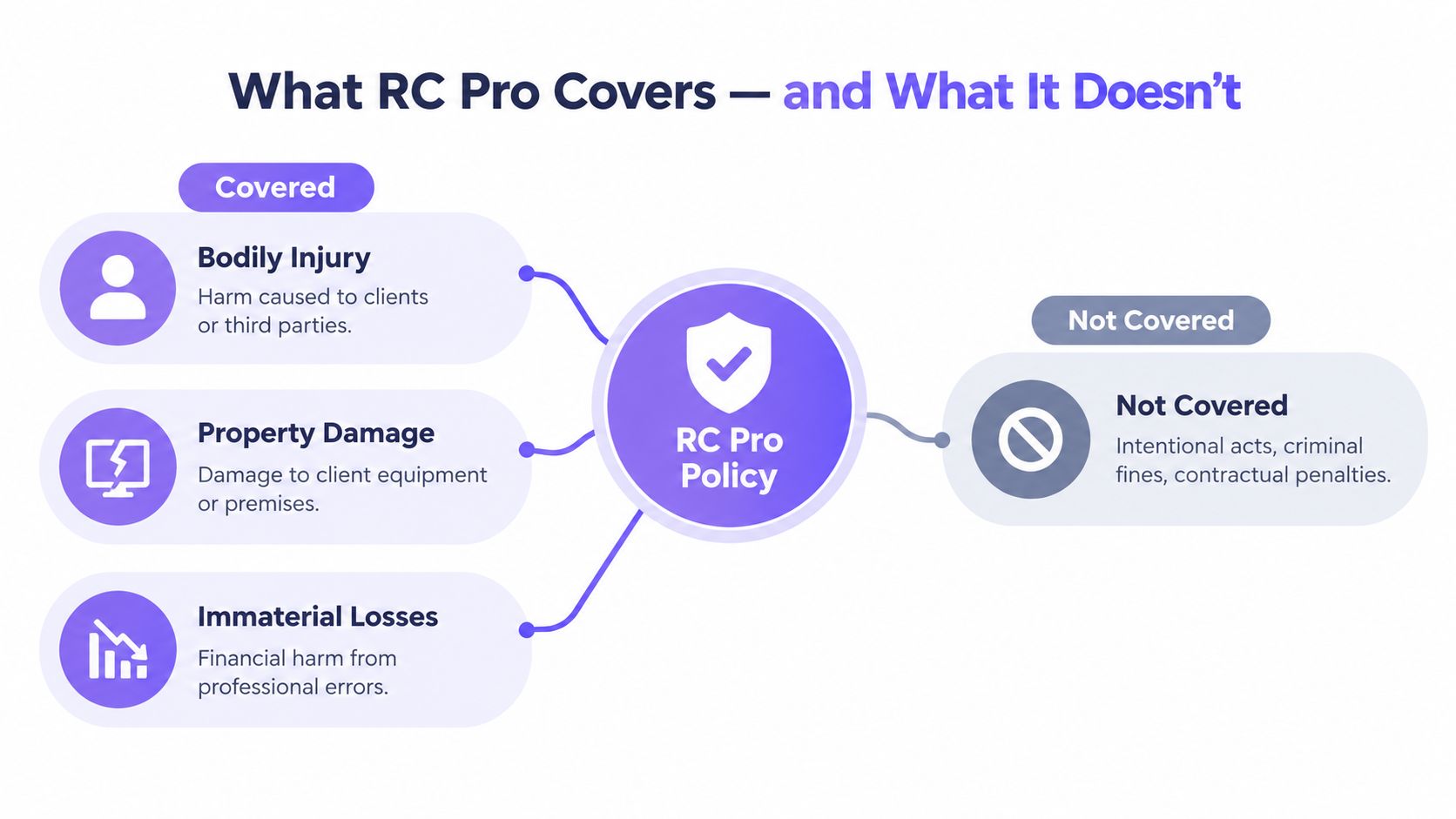
Professional liability insurance is built to handle claims linked to your professional activity when a third party says your action, omission, or negligence caused harm. That usually includes bodily injury, property damage, and financial harm linked to a professional error, as long as the claim falls inside the contract limits.
For a freelancer, that distinction matters because many losses are indirect. A bad recommendation, a missed deadline, a faulty technical intervention, or an error while handling client access can all create a claim even when nothing looks broken at first glance.
The key point is simple. Professional liability insurance follows the consequences of the work you declared, not every business problem around your business. A policy written for client-facing consulting will not work the same way as one written for on-site services or data-heavy assignments.
What usually sits outside the net
Insurers usually exclude deliberate acts, illegal conduct, and claims tied to work that was not declared. A dispute that already existed before the policy started is also outside the normal safety net.
Read the exclusions first, not the price first.
That is where many freelancers make a mistake. A designer who also sells templates online should declare both activities, because a claim tied to the template shop is typically outside a policy written only for client design work. The same logic applies to side services, premises issues, and claims that appear after the main service has been delivered.
For a compact overview of how insurers frame this divide, Wispra's professional liability insurance article is useful as a reference point. Test is still practical: does the policy match the activity code, the declared scope of work, and the limits or deductible your client, regulator, or platform expects to see?
When Professional Liability Insurance Is Legally Mandatory in France
The biggest French mistake is to treat professional liability insurance as status-based. It isn't. The obligation comes from the activity, not from being self-employed, and not from the legal form of the business. A micro-entrepreneur, EI, SARL, SAS, or SEL can each sit on either side of the line, depending on what the person does.
The regulated side of the line
In France, professional liability insurance is mandatory for certain regulated activities, including medical professionals, lawyers, chartered accountants, architects, and real-estate agents, and a French source notes that roughly 250 professions sit inside the regulated liberal-professions framework, reorganised by the 2023 ordinance into three major families effective from 1 September 2024 (Generali). That legal architecture matters because it shapes who must buy insurance, who is advised to, and how insurers package the product.
For a freelancer, the practical test is boring but decisive. Look at the exact activity code, the governing text, and the professional category that applies to your real work. Don't rely on the word “freelance” or “liberal profession” alone, because those labels hide very different obligations.
The non-regulated side of the line
A consultant or coach may legally operate without professional liability insurance if the activity is not regulated in the same way. That does not mean the risk disappears. It means the law doesn't impose a universal obligation, even though a client can still request proof of cover or make it a contractual condition.
If you're unsure how your status interacts with insurance, a broader overview like this practical guide for self-employed workers helps separate the legal form from the actual exposure. The useful habit is to check the activity first, then the contract, then the attestation.
Bottom line: mandatory in some regulated professions, optional but often sensible in many others, and always tied to the activity text rather than the label alone.
Real-World Scenarios for Doctors, Consultants, Architects and Real Estate Agents
A doctor sees a patient at the clinic, then later does a home visit, takes an on-call shift, and works in a care facility. For French health professionals in liberal practice, the law requires coverage for liability arising from damages to third parties caused by personal injury across the whole activity, including those outside-the-clinic contexts such as home visits, on-call duty, and assignments in places like EHPADs (MACSF). A policy that only matches the consulting room would be too narrow for that reality.
A consultant gives a recommendation that the client later says caused a loss. There may be no legal duty to carry professional liability insurance in that case, but there can still be a claim for financial harm tied to professional advice. The takeaway is straightforward, the absence of a statutory obligation doesn't remove third-party exposure.
An architect's risk looks different again. A design error can lead to delays, rework, or construction overruns, which is why the insurance conversation for architects is tied to high-value projects and high stakes. The person buying the policy needs to check whether the cover matches the actual project mix, not a generic office-based assumption.
A real-estate agent is often dealing with disclosures, appointments, and fast-moving decisions. A missed disclosure or incomplete file can trigger a claim from a buyer, seller, or other third party. For agents who manage scheduling and coordination across many appointments, tools such as appointment scheduling for agents can help reduce operational friction, but the insurance point remains the same, the policy has to align with the professional acts that create liability.
The common thread is that each profession generates a different claim pattern. A generic policy may miss a context, a task, or a field of work that's central to the job.
How Much Professional Liability Insurance Costs and What Drives the Price
A quote for professional liability insurance is a signal of exposure. The premium rises or falls with the work you do, the third-party risk it creates, and the level of cover the insurer is asked to carry. A consultant and an architect may both buy professional liability insurance, yet the pricing logic is not the same.
All four ranges below come from the same French market guide, Companeo.
| Profession | Indicative Annual Professional Liability Insurance Premium |
|---|---|
| Consultant | 350 € to 900 € |
| Lawyer, individual supplementary cover | 500 € to 5,000 € |
| Chartered Accountant | 600 € to 2,500 € |
| Architect | 1,200 € to 3,500 € |
What pushes the price up or down
For a low-risk activity with limited turnover, the premium can start at about 13 € per month, roughly 156 € per year, according to the same French market guide. The point is not to chase the cheapest entry price. The central question is whether the policy still responds when a client claim lands on your desk.
One practical rule helps here. As a working budget, set aside roughly one to three days of billable time per year for professional liability insurance, then check whether the deductible you accept is smaller than that amount. If it is, the quote may look attractive, but the first claim could cost you more than the annual premium saves.
What drives the spread is usually the same set of factors.
- Activity risk, because a care, legal, or design error is priced differently from a lighter advisory task.
- Coverage limits, because a higher ceiling means more risk transferred to the insurer.
- Deductible, because the part you keep yourself changes the premium.
- Turnover, because higher activity usually means more exposure.
- Claims history, because a cleaner track record is easier to price.
A policy can also be cheap for the wrong reason. If the cover is too narrow for the claims your work can create, the price tells you very little.
For many freelancers, the decision is less about finding the lowest premium and more about getting fast proof of cover. Digital onboarding and quick attestation delivery often matter as much as price, especially when a client will not let the work start until the document is in their inbox. MMA notes that non-regulated professions are still often advised to insure because indemnities can reach tens of thousands of euros.
How to Choose the Right Policy for Your Practice
A consultant signs a contract, then the client asks for proof of professional liability insurance before work can start. A designer gets the same request from a platform. An architect faces a regulator's wording instead. The policy choice should follow the activity code and the proof you must produce, not a generic label on the brochure.
Compare scope, not just branding
The first question is simple. Does the contract match the work you actually do?
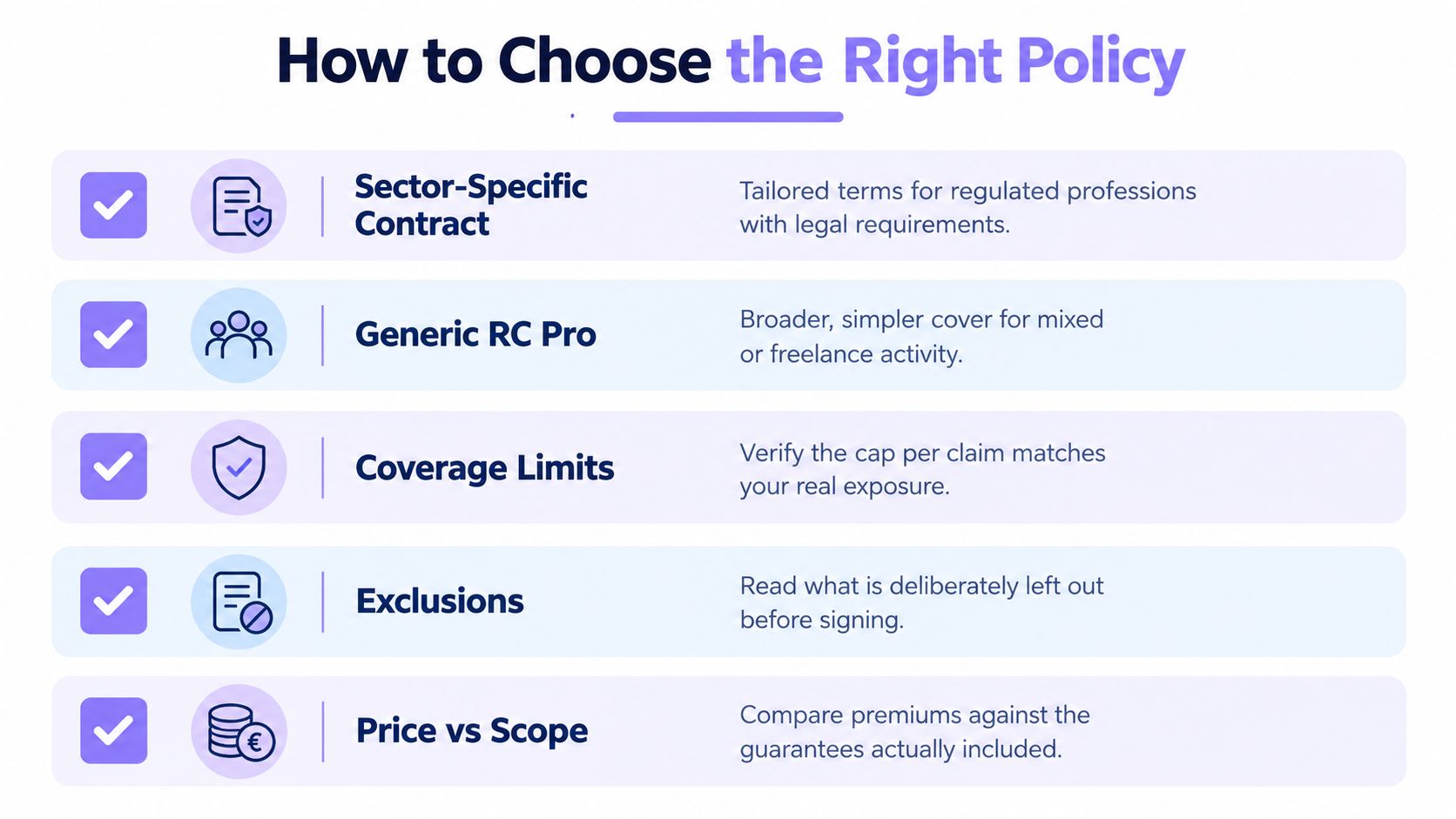
For regulated professions, a sector-specific policy often follows the activity more closely and may fit the legal text that governs the profession. For less regulated freelance work, a broader contract can work, if its exclusions do not remove the tasks you perform in practice. The schedule matters more than the marketing wording.
Use the same comparison for every quote.
- Coverage limits. Check the cap per claim and make sure it fits the kind of loss your activity could cause.
- Deductible. See how much stays at your charge if a claim occurs.
- Exclusions. Read the gaps before you sign, because those are the parts that disappear when you need the cover most.
- Territorial scope. Confirm where the policy applies if you work with foreign clients or across borders.
- Attestation access. Make sure you can produce proof of cover quickly when a client, platform, or regulator asks.
Ask each insurer for the same three numbers in writing, per-claim limit, annual aggregate, and deductible. Compare only those numbers, not the brochure wording.
Shift the buying question
For non-regulated liberal professions, professional liability insurance is still a sensible safeguard because a claim can quickly become expensive. The question is no longer whether you should buy it, but what minimum limits, deductible, and proof of cover will satisfy the person asking for the attestation.
Before signing, ask the insurer to send a sample attestation and confirm the turnaround in writing. That tells you whether the document arrives in one day or in two weeks, which matters if a contract starts soon and the file has to be complete on time.
Documents, Mistakes to Avoid and Your Next Steps
Buying professional liability insurance is usually straightforward once your activity is clearly defined. Insurers typically ask for your SIRET, your activity code, turnover figures, a description of services, and sometimes premises details if clients or staff come on site. Those inputs shape the quote, because they tell the insurer what kind of professional risk it's pricing.
The mistakes that create avoidable trouble
The most common error is under-declaring the activity scope. A second mistake is assuming the business form decides the obligation, when the trigger is the activity and its governing text. The third is buying a generic contract that looks fine on paper but doesn't satisfy a regulator's or client's specific requirement.
That last trap is the one many professionals only discover after a claim or after a client asks for an attestation. It's why the wording of the policy matters as much as the price. If a claim happens, the process in how to declare a claim should already be familiar, not something you learn under pressure.
A sensible next move
- Verify your activity code. Make sure the insurance request matches the work you really do.
- Compare identical limits. Don't compare a cheap quote with a stronger one and call it a saving.
- Check the deductible. A lower premium can hide a larger share of loss for you.
- Ask for the attestation process. Confirm how fast proof of cover is issued.
- Review exclusions line by line. A policy that excludes your main service isn't a real solution.
If you want a clearer way to organise your insurance, content, and visibility around your professional activity, Wispra helps businesses structure that work in one place. For freelancers and regulated practices, it can also support the content and search presence that clients use when they verify your legitimacy.