
Cathedral Quarter Tours Neighbourhood Guide
Plan a day or a move in Cathedral Quarter Tours: 3,784 residents, €3,229/m² flats, a two-hour walk and access tips for 2026.
Cathedral Quarter had 3,784 inhabitants in 2025, according to Nexity. That's a useful correction to the postcard view of Tours: the streets around Saint-Gatien aren't just a setting for a cathedral photograph. They're a residential neighbourhood where visitors, households, shops and heritage managers share limited space.
The best way to understand the district is to follow its Roman, religious and residential layers on foot. The best way to judge whether it suits you is more practical: check the approach, the entrance, the everyday shops and the building itself. A beautiful façade doesn't tell you whether a flat is comfortable, and an accessibility symbol doesn't guarantee an accessible day.
Cathedral Quarter at a Glance
Cathedral Quarter, Tours, is a defined central neighbourhood, not another name for the whole historic centre. The City of Tours neighbourhood indicator dataset identifies it as Tours centre, CATHEDRALE, allowing the municipality to examine local population, households, housing and mobility separately from citywide totals.
That distinction matters whether you're comparing property listings or planning a visit. A neighbourhood population describes the people living around you. A commune population describes the wider city supporting its transport, employment and services. Neither tells you how busy a particular lane will feel outside your window.
Cathedral Quarter snapshot
| Indicator | Figure | Year or status | What it covers |
|---|---|---|---|
| District population | 3,784 inhabitants | 2025 | Cathedral district, Nexity |
| Average apartment price | €3,229 per square metre | 2024 | District apartments, Immo-Data |
| Classified landscape | 5 hectares | Municipal heritage file | East and south of the cathedral |
| Cathedral build span | About 1170 to 1547 | Fabric chronology | Saint-Gatien, Place de la Cathédrale |
| Guided visit | 90 minutes from €7 | Tourism office offer | Cathedral, neighbourhood and stained glass, in French |
| Tours commune population | 139,259 | 2023 | Whole city, not the district, INSEE |
Read these as different kinds of information, not a combined score. The housing figure is a historical market reference, the protected area is particular rather than the entire neighbourhood, and a guided-tour offer needs checking before booking. A cathedral construction span describes the building's fabric, not the age of every surrounding house.
For the wider setting, INSEE's Tours commune profile records 139,259 residents in 2023. That citywide total should stay separate from the district figure. Cathedral belongs to a substantial urban centre, even when a quiet lane beside the close feels enclosed and self-contained.
Decide what you need from the neighbourhood
A visitor needs a workable walking route and a fallback when an interior is unavailable. A prospective resident needs to know whether an ordinary shopping trip is convenient. A shopkeeper needs to understand how customers can find and enter the premises without assuming that prominent signage or vehicle access will be possible.
The apartment average is particularly easy to misuse. It doesn't account for a specific flat's stairs, daylight, condition, communal repairs or outlook. For a method that separates an area reference from an individual valuation, use this guide to estimating the price of an apartment.
Start with the address, not the atmosphere. Check the exact building, approach and daily route before deciding that the neighbourhood suits your needs.
For a first visit, favour the street loop over a packed sightseeing checklist. For a housing search, carry a building checklist rather than relying on the cathedral view. If mobility or fatigue affects your plans, settle the entrance and rest-stop questions before choosing the longer walk.
Layers from Caesarodunum to Saint-Gatien
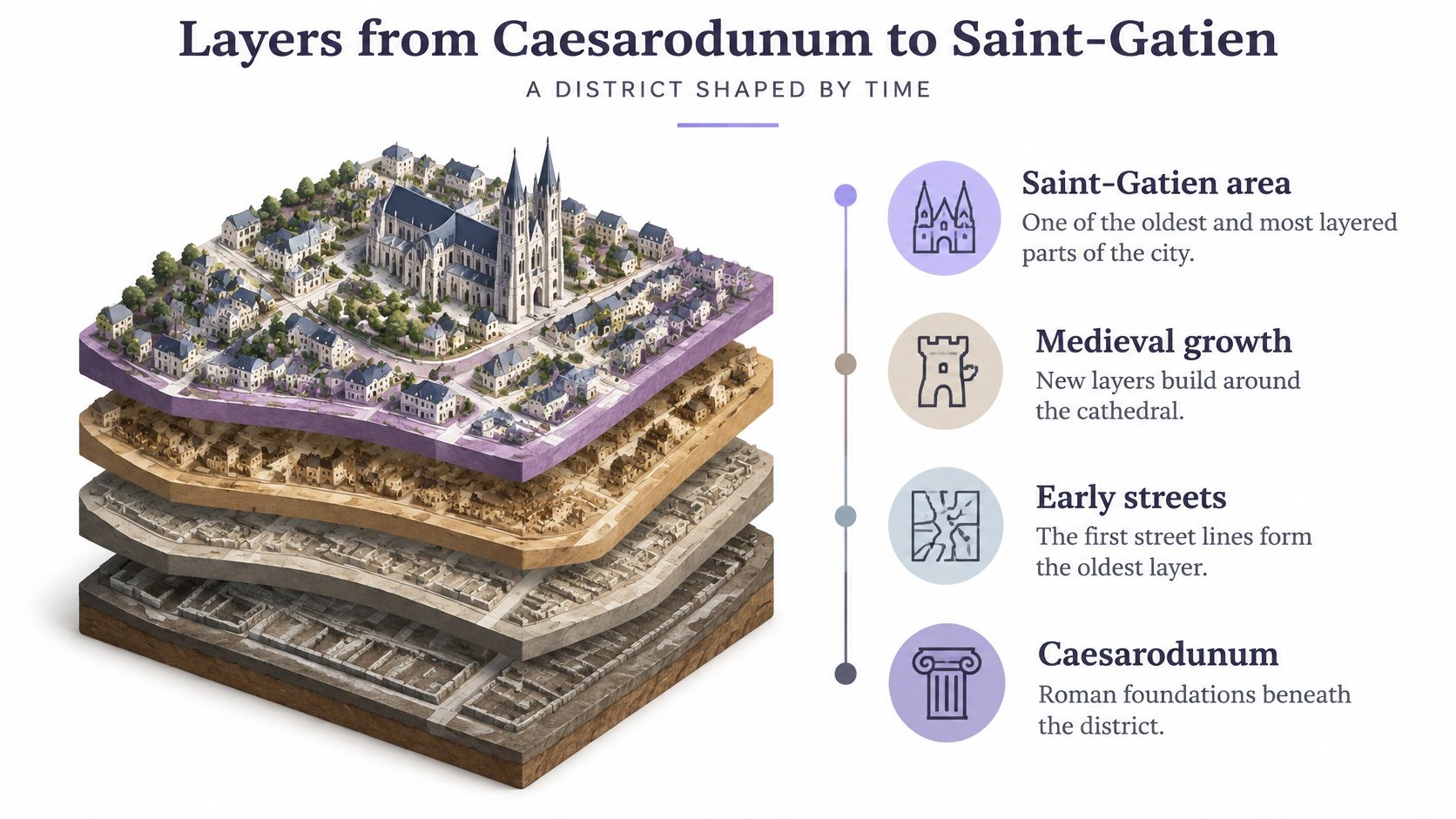
Stand outside Saint-Gatien and resist treating everything around you as belonging to the same historical moment. The district is easier to understand as a set of tree rings: successive generations built around, reused and altered what was already there. The rings overlap, and a street frontage doesn't necessarily reveal what lies beneath it.
Caesarodunum supplies the Roman foundation of that story. Religious institutions later concentrated activity around the cathedral, while homes and commercial uses developed around the ecclesiastical precinct. Today, the interesting experience is the movement between those settings, rather than the search for a perfectly preserved period scene.
The illustration gives a simple way to organise those overlapping layers.
Read the cathedral as a sequence
According to the City of Tours cathedral entry, Saint-Gatien's construction ran from approximately 1170 to 1547, its north tower was completed in 1507, and the building preserves important 13th-century stained glass alongside contemporary glazing. Those details explain why the cathedral doesn't read as a single architectural decision.
Say you begin with the west front. Look first at its overall arrangement, then at how the decoration changes as your eye moves upwards. You don't need to identify every style to recognise that the builders weren't repeating an identical design throughout the project.
Inside, switch your attention from outline to light. Glass works differently from sculpture: daylight, viewing angle and the distance between you and a window affect what you can make out. Give your eyes time to adjust rather than expecting every scene to become legible immediately.
Look for relationships, not just old stones
A useful reading order is Roman traces, cathedral, then surrounding residential streets. That's an interpretive sequence, not a claim that every visible wall can be dated by looking at it. Reused stone, repairs and altered openings can make confident visual dating unreliable.
- At street level, notice changes in alignment, enclosure and the relationship between a lane and a larger precinct.
- Around religious properties, look at walls, entrances and the separation between public movement and enclosed space.
- Among homes, observe how doors, windows and everyday uses fit around inherited buildings.
This layered construction also explains the care needed during maintenance. Different stonework, joints and glazing assemblies need different treatments; an inappropriate repair can create problems beside sound historic material. Scaffolding or a closed bay may therefore affect part of an experience without making the whole visit pointless.
The west front helps you read scale, ornament and the building's changing architectural vocabulary. The interior gives you something the exterior can't: the effect of transmitted light through glass. Neither replaces the streets around it, where you can understand how a major religious building sits within a lived-in district.
A Two-Hour Walk Beyond the Cathedral
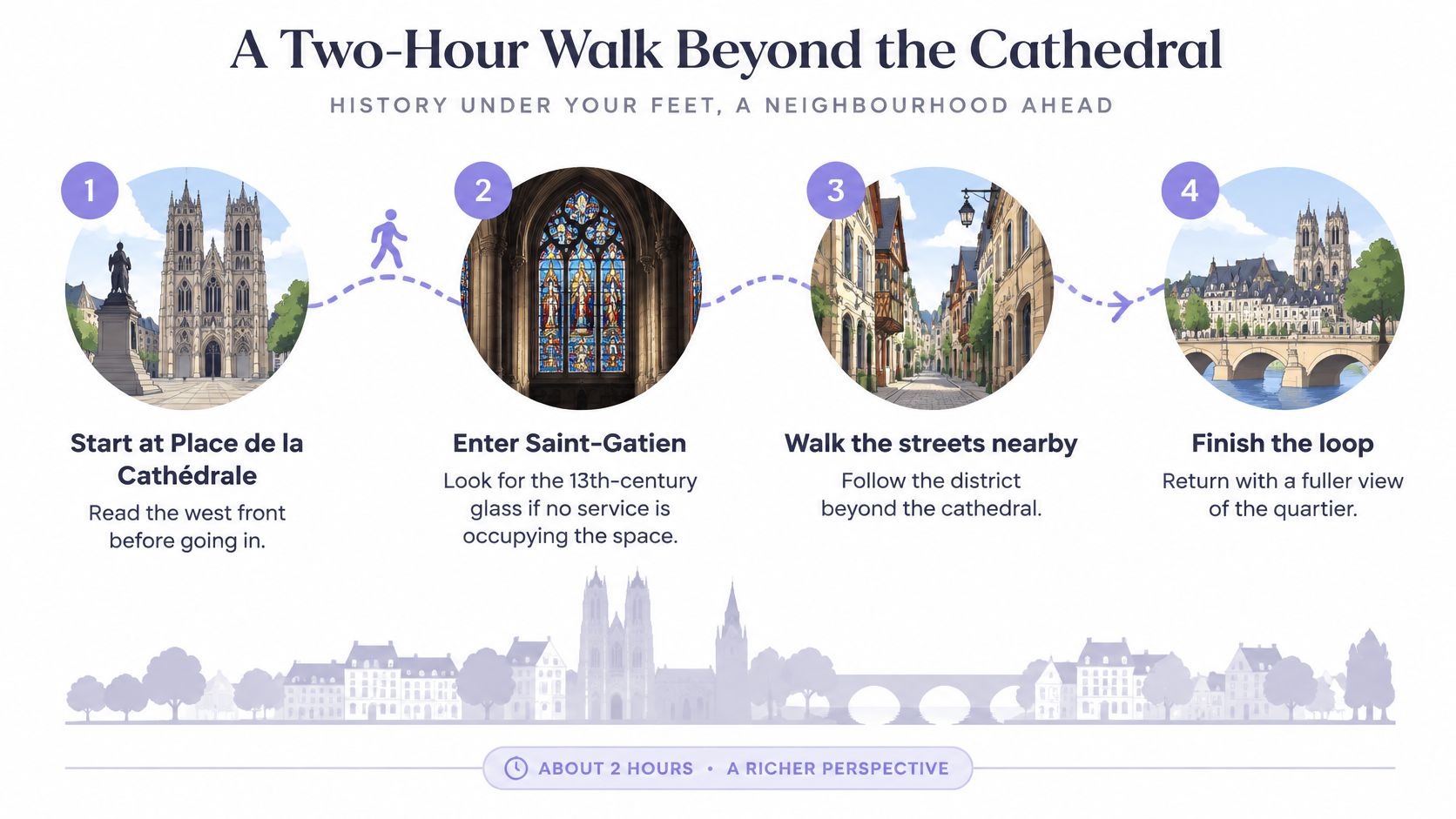
A cathedral visit can fit into a photograph; understanding its district takes a walk. Set aside about two hours, with time to pause or shorten the route. The aim is to see how Saint-Gatien sits among Roman traces, former religious properties and residential streets.
Use the route illustration for orientation, then adjust the walk to the conditions you find.
Follow the historical layers on foot
Start at Place de la Cathédrale. Step back to take in the west front, then move closer to see how its entrance, towers and square relate.
Enter Saint-Gatien if it is open to visitors. Follow instructions for worship, quiet areas and visitor circulation. If a service is underway, continue outside and return only when appropriate.
Check the cloister side. Access may be restricted, so confirm locally rather than treating it as an automatic part of the route. If a door, bay or passage is closed, turn back.
Continue towards Rue du Petit Cupidon. Notice how archaeological traces sit within the surrounding streets. Old-looking masonry alone does not establish a Roman date, and the route is not an invitation to enter private property.
Walk along the edges of former religious properties to the east and south. Walls, chapel edges and changes in enclosure help show how the precinct took shape. Stay on public routes and pause before deciding whether to extend the walk.
Add a Loire-side stretch if the group has the energy. Check the return route first. Familiar pedestrian lanes may be easier than an unfamiliar detour when someone is tiring.
Public views of the square and exterior façades, along with the public-street loop, do not require a guided-tour ticket. Enclosed sites, special visits and other attractions may have separate access rules or admission, so check each one individually.
Choose guidance for interpretation, not obligation
The Tours tourism office lists a 90-minute guided visit from €7 covering the cathedral, neighbourhood and stained glass. A guide can connect the district's Roman, episcopal and later urban layers; the walk remains an option, not a requirement for visiting the area.
The listed experience is in French, requires advance booking and does not offer on-site ticket sales. Check the current arrangements before committing, especially if you are arriving spontaneously or need another language. Going independently gives you more control over breaks and changes of plan.
Before booking any guided tour, check four things: the language, which streets and sites the route covers, whether the group's pace suits you, and how flexible the booking is. For a separate example of tour options, you can compare Barcelona city tours. Use the same questions when assessing a tour in Tours, rather than assuming that a tour's length or title tells you what you will see.
This video offers visual context as you choose your stops.
Choose a guided visit for interpretation in French. Choose the independent loop for greater control over language, rest stops and timing.
Transport Dining and Everyday Services
Plan Cathedral as a walk-first destination. For many arrivals, the straightforward approach is to reach central Tours by rail, then finish on foot or use local transport for the remaining journey. If walking is difficult, arrange a taxi drop-off at an agreed lawful point rather than assuming it can stop directly outside the west front.
Fil Bleu is the local public transport network to check for bus and tram connections. Use its current journey planner for your arrival day, including the walk between the stop and your destination. A nearby stop isn't automatically the easiest approach when luggage, uneven surfaces or fatigue are involved.
Why the last part of the journey matters
The City of Tours heritage-management report identifies a 5-hectare classified area east and south of the cathedral, including former religious estates, chapels, parks, pedestrian-zone parcels and Gallo-Roman remains along Rue du Petit Cupidon. That's a specific protected area, not a blanket description of every property in Cathedral.
The practical consequence is that vehicle circulation, alterations and deliveries need careful planning. Driving is less convenient when your destination sits among narrow lanes or pedestrian parcels, and a navigation app can't grant permission to enter or stop. Read street signs and agree delivery or collection arrangements with the destination.
For live routing and booking messages, mobile connectivity helps. Simsima's guide to staying connected with a travel eSIM is relevant if you're arranging phone access for France, but also save your destination and return route offline.
Find services by need, not just proximity
Dining and everyday services are best assessed around the wider historic centre, rather than assumed to exist within the cathedral precinct. Search for the service you need: a grocery shop isn't interchangeable with a café, and a restaurant terrace doesn't tell you whether the entrance or toilet is usable.
- For a family meal, confirm buggy space, the entrance threshold and whether the toilet requires stairs.
- For a rest stop, choose somewhere you can comfortably reach and leave, not just the closest visible terrace.
- For daily living, test a loop covering bakery, pharmacy, groceries and cash access.
- For a premises search, check delivery arrangements and waste collection alongside customer access.
A prospective resident should try that shopping loop on a busy day and again on a quiet Monday. Carry the sort of bag you'd normally bring home. The useful question is whether the trip works when you're tired or carrying shopping, not whether it looks pleasant during a viewing.
For businesses, conservation is an operating condition. Historic masonry, protected views and buried archaeology can constrain signage, façade work and excavation, so favour reversible fittings and low-visual-impact proposals while checking the necessary permissions. Before calling the district convenient without a car, complete a food shop and the return towards the station without needing somewhere to park.
Access That a PMR Label Does Not Cover
PMR access describes an access provision, not the whole experience of a destination. PMR refers to people with reduced mobility. An accessible entrance doesn't establish that the surrounding lanes, cloister, toilets or lunch stop will work for a particular visitor.
The Tours tourism office's Saint-Gatien listing marks the cathedral as having PMR access, but doesn't establish component-level accessibility throughout the surrounding district. Confirm the entrance you'll use and the conditions relevant to your own mobility aid, stamina or assistance needs.
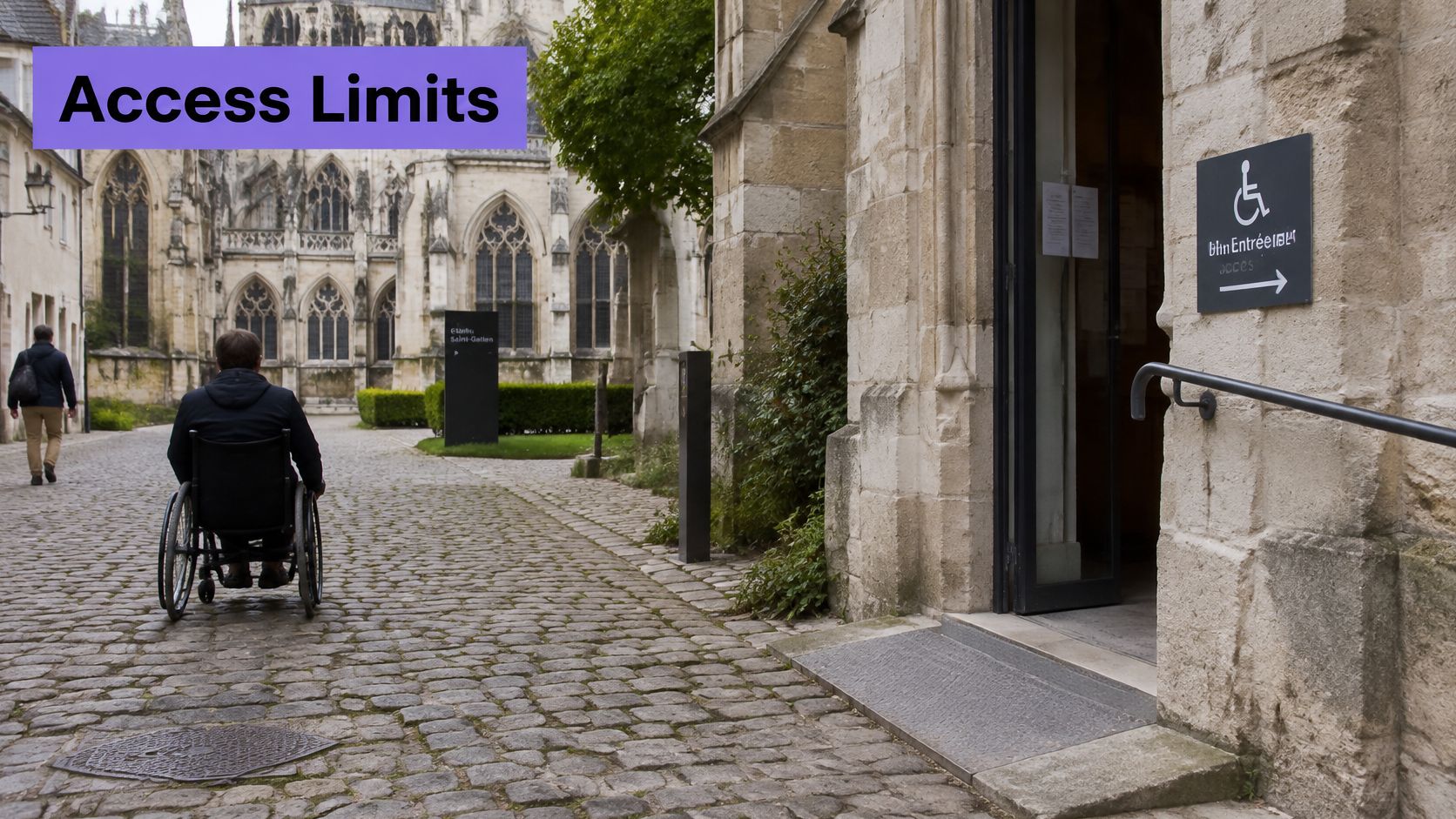
The image illustrates the kind of approach question to check; it isn't a substitute for current access information.
Access checks by component
| Component | Check on the day |
|---|---|
| Saint-Gatien entrance | Confirm which door is step-free that day |
| Cloister | Confirm whether the route includes steps and which areas are open |
| Pavements and lanes | Check camber and surface on the route |
| Toilets | Confirm location and whether usable |
| Pedestrian-edge café | Confirm level entry and toilet |
Ask concrete questions rather than just asking whether a place is accessible. Is the step-free door open to visitors during your planned trip? Does the route include a steep cross-slope? Can someone open a heavy door if necessary, and is there space to turn inside?
Services, temporary barriers and conservation work may change the usable route. A photograph of a previous visit won't settle those questions. Keep a comfortable alternative that doesn't depend on entering the building.
Use a shortened visit when necessary
- Start with the west front. Enjoy the exterior from a position you can reach comfortably, without making interior access a condition of the outing.
- Enter only after confirming the approach. Choose a manageable interior visit if the nave is open and the usable entrance is confirmed step-free. There's no need to traverse every available space.
- Finish at a confirmed level-entry café. Take a seated break and skip the cloister if steps, closures or fatigue make it unsuitable.
Families with buggies and older travellers can use the same shortening rule. English-language notes can support an outdoor visit without requiring participation in a French-speaking group. The guided option described in the walking route isn't a replacement for an individual access plan.
A successful visit can be shorter than the advertised experience. Comfort and a reliable way back matter more than completing the route.
For someone assessing a home here, DME Superstore's discussion of safer home access for mobility aid users offers useful questions about thresholds and approaches. Don't assume a portable ramp will solve a shared entrance: permission, landing space and safe use still need assessment.
Property condition is a separate question from access. Use the guide to mandatory real estate diagnostics to understand the documentation, then inspect circulation and entrances independently. Go when the approach and a rest stop are confirmed, shorten when only the square is comfortable, and skip a guided visit when its language or pace doesn't fit.
Buy, Rent or Visit with Clear Eyes
Buy if you want a home in the historic centre and can accept building-specific limits. Rent if you want to test daily life before committing. Visit if you want to explore the district's Roman, religious and residential layers, not just take a cathedral photo. Each choice calls for a different kind of check.
Immo-Data puts the average apartment price in the Cathedral district at €3,229 per square metre in 2024. Treat that historical figure as a reference point, not a current valuation or a guide to what a particular flat should cost.
Who Cathedral Quarter suits
| Situation | What you gain | Main constraint | Check before you commit |
|---|---|---|---|
| Owner-occupier | A central home beside Saint-Gatien | Heritage limits on façades and works | Whether the building is inside the classified landscape |
| Long-term tenant | A trial period or longer stay in the historic centre | Stairs, noise and shops along your route | A quiet weekday and a busier occasion |
| Short-stay host | A setting suited to heritage-focused visitors | Rental rules, guest access and alterations | Legal rental status and guest arrival on foot |
| Visitor only | A free street loop and an optional guided visit | Language, stamina and interior availability | Whether a suitable tour is available or a self-guided visit fits better |
For an owner-occupier, assess the specific flat after the appeal of the location fades. Check daylight with the lights off, open the windows to assess the surroundings, and inspect the shared entrance, stairs and communal areas. A polished room can distract from awkward circulation or neglected common parts.
Before budgeting for replacement windows, a shopfront alteration or ground disturbance, establish the property's protection status and which permissions apply to the proposed work. Being outside one classified area does not automatically mean a building has no other heritage controls. Clarify the scope before treating a contractor's estimate as the full project cost.
The apartment purchase guide can help organise the wider transaction. Keep the neighbourhood assessment separate from the paperwork: a complete file cannot tell you whether the stairs suit your household.
Test the inconvenient parts first
There is no supported rent-per-square-metre benchmark here. Request current comparable listings, check what the rent includes and inspect the exact accommodation. A sale-price average does not establish a rental rate.
Try the stair route carrying something realistic, rather than following the agent upstairs empty-handed. If a lift is necessary, confirm it serves the flat's actual landing. For a ground-floor flat, check privacy, passing activity, entrance security and whether you can ventilate comfortably.
Noise needs an address-level check. Compare an ordinary weekday with a busier occasion, and consider the timing of worship if the flat faces the close. One quiet viewing does not prove the home is always quiet, just as a crowded afternoon does not prove constant disturbance.
- Rule out access mismatches early. A stair-only upper floor is a poor fit when someone in the household needs reliable step-free access.
- Inspect shared obligations. Review communal repair information and planned work before deciding how much of your budget remains for the flat.
- Test your routine. Work calls, grocery shopping, bike storage and returning after dark may matter more than proximity to a landmark.
Separate hosting plans from visitor appeal
A short-stay host needs more than an attractive location. Confirm legal rental status, building rules, insurance arrangements and a lawful guest-arrival process before projecting income. Visitors may arrive with luggage and may not know the pedestrian restrictions.
For a local business, keep public information practical: use the correct address, explain the usable entrance and update opening hours. Wispra connects official company registry data in France today. Company identity information does not establish whether a doorway is step-free or a venue is open during a service, so those details need to be kept accurate too.
Before making an offer or signing a lease, walk the district at a time that reflects your likely routine, including its least convenient part. Businesses can make the same practical check by comparing their public listings with what customers find at the door.
Wispra helps local businesses get recommended by AI search engines through an AI-optimized business directory, content tools and visibility analytics. Clear descriptions of location, services and access can help people decide whether a visit suits their needs. Visit Wispra to explore its tools for your business.