
Generative AI Marketing: The Complete Guide
Discover how generative AI marketing transforms strategy, builds workflows, and drives results for French SMBs. Learn practical steps and tools for 2026.
97% of French companies allocated a dedicated budget to generative AI in 2024, and 79% of French marketing specialists said it saved them at least four hours a week. Generative AI marketing is no longer a speculative experiment. For French SMBs, the practical question is which safe, measurable workflow to deploy first, and how to turn AI visibility into qualified enquiries rather than impressive but empty mentions.
The strongest starting point usually isn't a high-volume blog factory. It's a reliable layer of business information, supported by controlled content generation, human review, and measurement tied to calls, visits, enquiries, or sales. France's market is moving in that direction, but adoption still has friction: owners need clear use cases, manageable data risks, and evidence that the workflow improves commercial outcomes.
What Generative AI Marketing Actually Is
Nearly three-quarters of French companies already using generative AI in marketing expect to increase that investment, and the same survey of French marketers shows why: 79% saved at least four hours per week, while 20% saved more than ten hours. For a French SMB, the key question is not whether the tools exist. It is which low-risk workflow earns its place first, and whether that workflow produces qualified enquiries rather than extra noise.
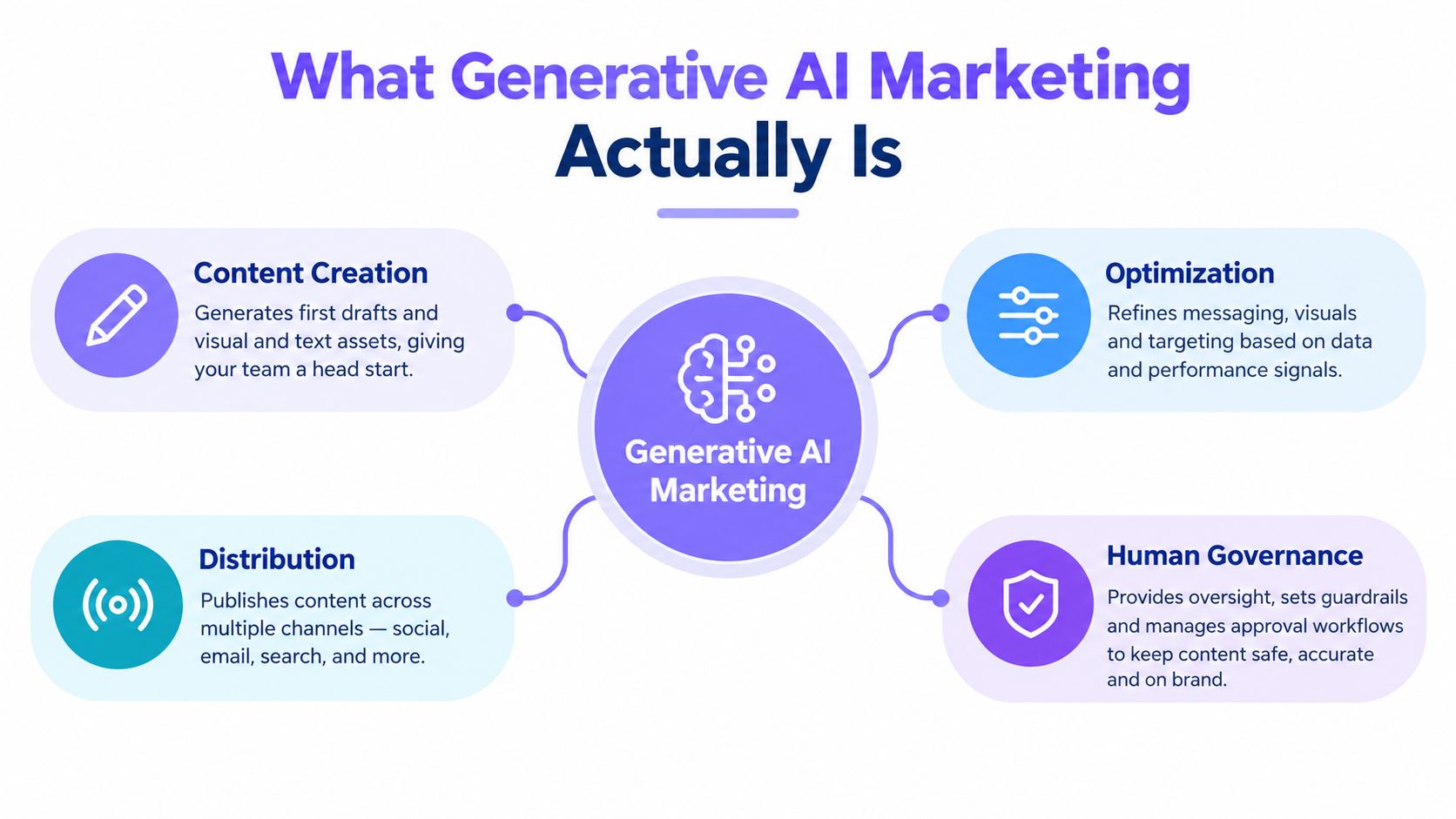
Generative AI marketing is the organised use of AI to produce, adapt, distribute, and improve marketing assets under human control. In practice, that usually starts with repeatable work: service-page drafts, FAQ expansion, review-response suggestions, ad variations, lead-nurture emails, or summaries of customer questions. The point is not to automate everything. The point is to reduce blank-page effort and repetitive rewriting so the team can spend more time checking facts, sharpening positioning, and following up on demand.
Automation is not the same as generation
Traditional automation executes a fixed rule. It sends an email after a form submission, updates a CRM stage, or schedules a post. Generative AI creates new material within constraints. It can rewrite a service description for a local landing page, turn technician notes into a readable FAQ, draft several ad angles for different intents, or summarise recurring objections from calls and reviews.
That difference matters because local businesses rarely fail from lack of content volume alone. They fail because their information is incomplete, inconsistent, or difficult for customers and AI systems to interpret. A plumbing company, dental practice, estate agency, or accounting firm gets better results when AI works from approved facts: services, locations, exclusions, pricing rules, proof points, and brand language. If those inputs are weak, the output is polished but unreliable.
Practical rule: Use AI to increase the number of useful options your team can review, not to remove review from the workflow.
Human supervision stays necessary. Opening hours, service areas, prices, availability, regulated claims, and tone still need review before publication. This becomes even more important in AI-driven search environments. A clear overview of AI Overviews and their impact on search is useful, but the operational test is simpler: can your business provide consistent, current facts in enough places for AI systems to summarise them accurately?
That is what generative AI marketing is. A managed operating layer where trusted information goes in, controlled drafts come out, people validate them, and performance decides what stays in the workflow.
Why Consumer Behavior Makes AI Search Marketing Urgent
French consumers are already using generative AI as an information channel. The Digital Market Barometer conducted by CREDOC for Arcep and other public bodies found that 48% of the French population had used generative AI, an increase of 15 percentage points in one year, according to Arcep's report on digital usage.
The most important detail isn't adoption alone. Among users, information search led at 73%, followed by drafting or translating text at 58%, and generating ideas at 57%. More than one-third used generative AI daily. Consumers aren't only asking for entertainment or writing help. They're asking questions that can precede a commercial decision.
A customer might ask which estate agent serves a particular neighbourhood, whether a restaurant accommodates a dietary requirement, which accountant works with freelancers, or where to find a product locally. The system's answer depends on how clearly and consistently the business has described its offer across accessible sources.
Why isolated blog posts fall short
A blog post can demonstrate expertise, but it rarely provides the full operational picture. AI systems need a coherent set of facts about:
- Products and services: What the business sells, who it's for, and what makes the offer distinct.
- Locations and service areas: Where the business operates, including neighbourhoods, towns, or delivery zones.
- Policies and availability: Booking conditions, returns, lead times, appointment rules, and current stock information.
- Evidence and reputation: Reviews, qualifications, specialist experience, and clear explanations of important claims.
A continuously maintained knowledge layer is more useful than a pile of disconnected articles. It gives content generation a dependable source of truth and reduces contradictions between a service page, business profile, FAQ, product catalogue, and customer response.
This also changes the SEO brief. Keyword coverage still matters, but discoverability increasingly depends on whether a business can be accurately understood and matched to a conversational request. A local retailer doesn't need endless generic articles about shopping. It needs precise information about its products, location, delivery terms, expertise, and suitability for different customer needs.
The growing audience makes stale information more dangerous. If a conversational answer repeats an old price, incorrect opening hour, or discontinued service, visibility can create the wrong kind of demand. AI search marketing therefore begins with factual maintenance, not content volume.
Content Generation Versus Conversational Discovery
Among French companies already using AI, 28% applied it to marketing or sales, up 11 percentage points in one year, according to Insee's business AI statistics. For French SMBs, that does not settle the harder question. The first workflow should be the one that reduces commercial friction fastest, with the lowest practical risk.
Content generation helps teams produce more. Conversational discovery helps AI interfaces understand, compare, and recommend the business more accurately. They can support each other, but they solve different problems, require different inputs, and create different forms of value.
| Criteria | Content Generation | Conversational Discovery |
|---|---|---|
| Primary purpose | Produce drafts, variants, summaries, and campaign assets | Make business information clear, consistent, and recommendable in AI-mediated search |
| Best starting problem | The team has a strong strategy but insufficient production capacity | Customers struggle to find, compare, or understand the business |
| Main inputs | Brand guidelines, briefs, existing content, campaign data | Products, services, locations, prices, policies, reviews, expertise, and structured facts |
| Setup effort | Usually low for individual drafts, higher for repeatable quality | Higher at the information-foundation stage, then easier to maintain systematically |
| Data sensitivity | Customer data, unpublished offers, and internal documents require controls | Commercial facts must be accurate, current, and safe to distribute |
| Human review | Tone, originality, factual accuracy, and compliance | Factual accuracy, recommendation context, freshness, and suitability of leads |
| Useful outcomes | Faster production, more testable variations, reduced drafting workload | Qualified calls, enquiries, visits, branded-query visibility, and better-fit recommendations |
| Common failure | Publishing generic, repetitive content at scale | Gaining mentions that contain outdated or misleading business information |
This distinction matters because many teams start with the visible feature, draft generation, instead of the blocked customer journey. For a local business, the bigger problem is often discovery. People ask an AI assistant who serves their area, handles a specific need, or offers a suitable option within a certain constraint. If the business facts are thin, inconsistent, or buried across channels, more articles rarely fix the issue.
A small service firm with only a handful of pages often gets more from discovery work than from an ambitious editorial calendar. If prospects already know the category but cannot confirm specialisms, coverage area, booking rules, or suitability, another generic post adds noise, not qualified demand.
An e-commerce shop usually needs both workflows, but not in the same order. Product descriptions, category copy, and FAQs can be generated from approved catalogue data. Conversational discovery depends on whether product facts, delivery terms, stock signals, and policy details are clear enough for AI systems to interpret the offer correctly. In practice, generation increases output. Discovery improves match quality.
The first workflow should solve the clearest commercial friction, not showcase the most impressive AI feature.
Start with one observable path and judge it like an operator, not a demo audience. For a local business, that path might be “AI recommendation to phone enquiry”. For a retailer, it might be “product question to qualified visit or purchase”. Then compare the options against setup effort, review load, data risk, and revenue relevance. That usually makes the right first deployment obvious.
Integrating Generative AI Into Your Marketing Workflow
A dependable workflow starts with information, not prompts. The 2025 Insee ICT survey found that 18% of firms with at least ten employees used at least one AI technology, with marketing reported as a purpose for 31% of AI-using companies, as reported in Insee's ICT survey.
That adoption pattern points to a practical design. French SMBs shouldn't need to become prompt engineers or data architects before generating a useful campaign asset. The system should turn approved business facts into repeatable briefs, drafts, reviews, and publishing actions.
Build the pipeline in four stages
- Plan: Define the commercial goal, audience, offer, channel, and evidence available. A brief for a plumber should identify the service area and emergency conditions, not merely request “a local SEO article”.
- Generate: Produce a draft from controlled templates and approved facts. Templates should specify tone, claims that require evidence, prohibited assumptions, and the desired customer action.
- Review: Ask a named person to check facts, pricing, availability, inclusivity, legal language, and brand fit. The reviewer should be able to reject or edit the asset without wrestling with the underlying system.
- Publish and learn: Distribute the approved output, record where it appeared, and connect engagement or enquiries to the original workflow. Feed the findings back into future briefs.
The content layer should refresh when the business changes. A new service, altered delivery zone, seasonal opening time, or updated return policy shouldn't remain trapped in an old spreadsheet. It should update the source used by the content engine and the profiles, pages, FAQs, or catalogues derived from it.
For teams publishing across local channels, a tool that can schedule content for local search can help turn approved assets into a consistent publishing routine. Scheduling isn't a substitute for review, but it prevents a validated update from remaining unpublished or appearing in only one place.
A good AI workflow makes the safe action easier than the risky shortcut.
Use role-based access where possible, keep confidential customer information out of public tools, and maintain a simple change log for important commercial facts. The technical details can remain behind the platform. The owner needs a clear queue of items to approve, refresh, or correct.
The workflow becomes valuable when telemetry connects assets to outcomes. Track which page, FAQ, profile, or product description supported a discovery interaction, then compare that activity with qualified enquiries rather than judging success by output count.
Governance, Trust, and Human Supervision
AI visibility can create qualified demand, or it can create expensive confusion. If an answer engine gets your prices wrong, overstates availability, or recommends you to the wrong type of buyer, the extra mention does not help the business. It creates avoidable follow-up work for sales, support, or the owner.
The trust and supervision balance noted earlier points to the right operating model. Teams can use AI confidently and still require human review before publication. For French SMBs, that matters most at the start, when the key question is not what the tool can generate, but which low-risk, high-impact workflow should go live first. Usually, that is a workflow built around stable facts and repeated customer questions, not around broad autonomous publishing.
Protect the facts customers act on
Set clear review rules for the information a customer might use to call, book, buy, or compare. In practice, a small business does not need a heavy policy document. It needs a short list of facts that always trigger human validation.
- Commercial terms: Prices, discounts, payment conditions, returns, and cancellation rules.
- Availability: Opening hours, appointment capacity, delivery windows, stock, and seasonal services.
- Eligibility: Areas served, customer types accepted, qualifications, exclusions, and accessibility information.
- Claims and evidence: Certifications, guarantees, performance claims, professional experience, and comparative statements.
Governance becomes practical when you give one person ownership of the source of truth and give another the right to approve publication if the message includes a high-risk fact. If those roles sit with the same person in a small company, make the checkpoint explicit anyway.
Disclosure should also stay practical. If AI helped draft a page, email, or reply, the business still owns the message. Customer-facing staff should know when text was generated or adapted, especially in cases where a buyer could misunderstand who made the recommendation.
Consumer behaviour raises the standard. Accenture's 2026 France Consumer Pulse findings found that 58% of French consumers would trust a personal AI agent more than their best friend to make a purchase. The same research found that 40% of consumers who considered themselves loyal to a brand would let the agent switch them to another brand if it demonstrated a better fit. That means governance is not a legal side issue. It directly affects whether AI visibility turns into suitable enquiries.
Create a correction protocol
Mistakes will happen. What matters is response time and ownership.
Record the incorrect statement, confirm the authoritative fact, update the relevant public source, and check whether the correction appears across the surfaces that matter. Track fact accuracy, recommendation context, qualified-conversion rate, and correction time. Human supervision works when it is a defined checkpoint with approval rights and a clear escalation path for sensitive claims.
Measuring What Actually Matters for SMB Revenue
Mentions, citations, and impressions show that an AI system has surfaced your business. For a French SMB, the key question is simpler and harder: did that visibility produce a qualified call, a booking, a store visit, or a sale?
As noted earlier, French AI adoption still varies sharply by company size and sector. That gap matters because a restaurant, local builder, or transport operator should not copy an enterprise reporting model. Start with the first workflow that can change revenue with limited risk, then measure it against the actual sales path.
Replace visibility theatre with commercial evidence
Use a layered scorecard that ties AI activity to business outcomes:
- Discoverability: Which priority pages, services, offers, or profiles are indexed, cited, or surfaced in AI answers?
- Accuracy: Are key business facts correct, including prices, opening hours, service areas, policies, and availability?
- Intent: Do AI-mediated visitors ask relevant questions, or do they arrive with the wrong expectations?
- Conversion: How many qualified calls, forms, bookings, visits, or sales can reasonably be linked to AI-mediated discovery?
- Efficiency: How much review time, production time, and follow-up effort does the workflow require compared with the previous process?
This keeps teams focused on evidence, not vanity signals.
Perfect attribution is rarely realistic for a small company, and it is not required to make better decisions. Add a source question to enquiry forms. Use distinct landing pages for specific offers. Compare qualified conversations before and after a controlled update to a page, profile, or FAQ. The goal is to connect operational changes to commercial results without pretending every sale has one clean origin.
A marketing attribution software overview can help compare measurement models. For an SMB, the right setup is the one the owner, salesperson, or front desk can use. If nobody trusts the source labels or understands the reports, the dashboard has no value.
A citation is a diagnostic signal. A qualified customer is the outcome.
Review the scorecard by workflow, not only by channel. If AI-generated FAQs increase visibility but produce weak enquiries, tighten the facts, narrow the targeting, or improve the call to action before publishing more. If product or service pages bring qualified sessions but sales conversations still stall, check availability, pricing, trust signals, and fulfilment first. That is how AI visibility turns into revenue instead of noise.
Choosing the Right Platform for Your Business
The French SMB market has a specific adoption problem. Only 31% of French very small businesses and SMEs had used generative AI by the end of 2024. Among non-users, 70% hadn't identified a potential use case, 25% cited insufficient expertise, and 13% feared misuse such as exposing confidential data, according to reporting on French business AI adoption.
That makes simplicity a strategic requirement, not a cosmetic feature. A platform that produces clever drafts but requires constant prompt design, schema maintenance, data cleaning, and manual publishing may shift work rather than remove it.

Compare the operating model
A DIY stack can suit a technically confident team with time to maintain prompts, integrations, source data, review rules, and reporting. General-purpose tools such as ChatGPT or Claude may be useful for ideation and drafting, but they don't automatically create a governed knowledge layer or connect discovery to revenue.
A turnkey platform should make the difficult parts visible and manageable:
- Information foundation: Can it organise products, services, locations, policies, reviews, and evidence?
- Content operations: Can it generate blogs, FAQs, product descriptions, and review responses from controlled facts?
- Distribution: Can approved information reach the channels where customers and AI systems discover businesses?
- Governance: Can a person review, approve, update, and correct important outputs?
- Measurement: Can the business track AI visibility, accuracy, qualified enquiries, and downstream outcomes?
- Setup burden: Can a small team use it without website changes or specialist technical knowledge?
External data collection can also matter for teams that need to monitor competitors, directories, or public market information. A web scraping API from Context.dev may be relevant for a technical operation, but it introduces its own questions about source quality, permissions, maintenance, and data governance.
Wispra is one option for businesses that want an AI-optimised directory, automated content for blogs, FAQs, reviews, and product catalogues, plus tracking and visibility reporting. Its fit should be judged against the workflow criteria above, especially the quality of its business-data controls and the relevance of its reporting to actual enquiries.
For a broader evaluation framework, use criteria for choosing an effective AI SEO platform in 2026. The right platform isn't the one that promises the most autonomous output. It's the one that turns accurate facts into approved, measurable distribution with a workload your team can sustain.
Your Next Steps Toward Systematic AI Marketing
French SMB owners don't need to launch an ambitious AI transformation programme to start. The safer path is a narrow workflow with a clear customer action, a named reviewer, and a baseline for comparison.
Begin with an information audit. List the facts a customer or AI assistant would need to recommend the business: services, products, location, coverage area, prices, availability, policies, expertise, reviews, and contact routes. Mark each fact as confirmed, incomplete, inconsistent, or out of date.
A practical first workflow
- Choose one customer journey. Select a use case such as a local service enquiry, a property viewing request, a product suitability question, or a booking.
- Create the source of truth. Put the approved facts, evidence, exclusions, and review owner in one maintainable system.
- Generate controlled assets. Produce only the pages, FAQs, product descriptions, or profiles needed for that journey.
- Review every important claim. Check commercial terms, availability, service area, tone, and customer expectations before publication.
- Track qualified outcomes. Record relevant calls, enquiries, bookings, visits, and sales, then compare them with AI-mediated visibility and accuracy.
- Refresh on business change. Update the source whenever an offer, policy, location, price, or availability changes.
This approach translates urgency into an observable operating capability. It also respects the barriers identified in French SMB research: many firms haven't found a use case, lack expertise, or worry about confidential information. A small workflow gives the owner a way to learn without committing the business to uncontrolled automation.
The first month should produce evidence about process quality and visibility, not inflated promises. Can the team update facts quickly? Can it approve content consistently? Can it identify whether an enquiry arrived through AI-mediated discovery? Can it correct a misleading summary before it creates customer frustration?
Generative AI marketing becomes durable when those questions have clear answers. Scattered experiments produce drafts. Systematic integration produces a maintained information layer, governed content, and a direct line from discovery to qualified demand.
Wispra helps businesses organise AI-readable business information, generate and distribute content such as FAQs and product descriptions, and monitor visibility across conversational search systems. Visit Wispra to assess whether its workflow fits your first measurable AI marketing use case.