
Generative Engine Optimization GEO for SMBs
Generative engine optimization geo helps French businesses get recommended in ChatGPT, Perplexity and Gemini. Learn signals, trust and a practical 30-day plan.
You're an accountant in Lyon with a useful website, clear service pages and a solid reputation. Your business appears in traditional search results, but when a prospective client asks an AI assistant which local accountant to contact, a competitor with clearer service descriptions and location details gets named instead. The lost opportunity isn't a missing keyword. It's the recommendation itself.
That change matters because French consumers are already turning to AI tools for information and decisions. For a practical overview of how to distinguish visits from AI assistants in your analytics, see how to identify AI assistant traffic sources. You can also explore how people phrase questions to ChatGPT to understand the conversational prompts your business may need to answer.
Why French Customers Ask an AI First
A French prospect can now describe their situation in plain language, receive a short answer naming two or three businesses, and pick one without ever seeing a classic results page. For the businesses left out of that answer, a good ranking never gets the chance to matter.
The habit is spreading fast. The French government's Digital Barometer 2024 reports that 33% of French people had used an artificial-intelligence tool by the end of 2024, compared with 20% in 2023, a rise of 13 percentage points in one year (French government analysis of AI use). When a third of the country has tried these tools, some of your future clients will meet your business through an answer before they reach your homepage.
The questions also look different. People write to assistants in full sentences, with context and constraints, instead of typing two-word queries. Reading how French users phrase their questions to ChatGPT shows the kind of prompts your business now has to answer.
This is not only a consumer shift
The same analysis found that 36% of surveyed local authorities had implemented or tested an AI system, and another 15% planned to do so within the following twelve months. Among authorities already using AI, 52% used generative AI. Suppliers, public services and professional partners are learning these tools at the same time as your customers.
Being named in an answer is only half the job. An assistant can mention your firm and still cost you the visit if the details it cites are thin, outdated or contradictory from one source to another. A citation works like a referral from a friend: "they do accounting somewhere near the centre, I think" earns hesitation, while a clear description of services, location and recent work earns a call. A practical first step: Identify AI assistant traffic sources in your analytics, because a share of visits may already arrive through assistants.
What Generative Engine Optimization GEO Means
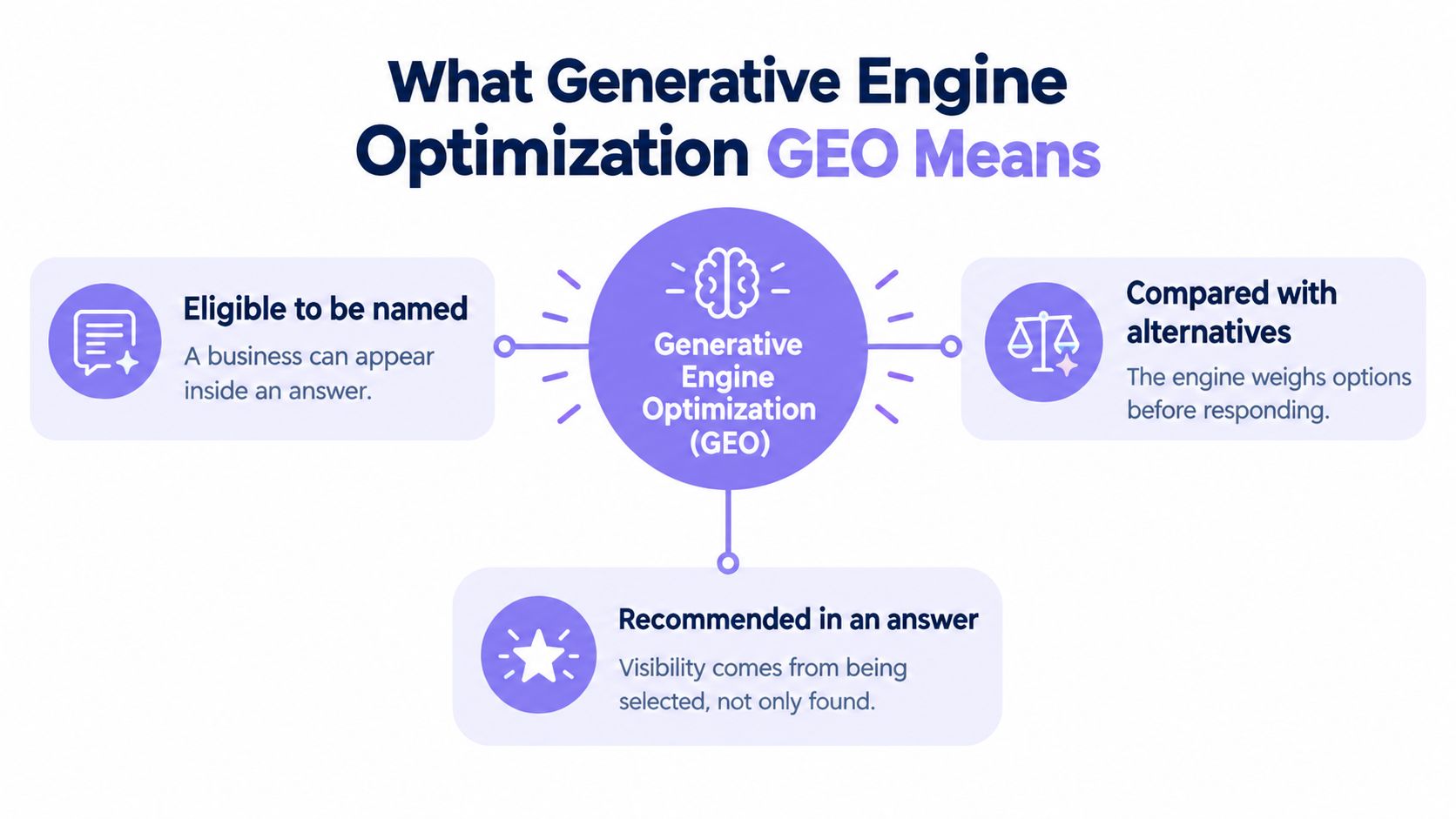
Generative engine optimization (GEO) is the work of making a business's information clear and useful enough for AI answer systems to name, compare and recommend it. Classic search often presents a ranked list of pages. An answer engine may instead combine information into a response, mentioning only a small selection of businesses.
Think of your website as a shopfront. A polished window may attract attention, but a customer still needs to see what's for sale, the price, the opening hours and whether the shop serves their area. An AI system needs similar details in a form it can understand and use, not just persuasive wording about how excellent your business is.
Make the business easy to distinguish
The audience for these answers is growing in France. The 2025 Digital Market Barometer, based on a representative survey conducted by CREDOC for Arcep, found that 48% of the French population used generative AI, up 15 percentage points in a year, and 73% of those users employed it for information search (Arcep's 2025 Digital Market Barometer).
Consider a prompt such as “best accountant in Lyon”. To answer usefully, a system needs to identify businesses that provide accounting services, determine which ones serve Lyon, and find enough evidence to compare them. A broad claim like “your trusted financial partner” doesn't settle those questions.
Give the system, and your potential customer, specific facts. Use concise French-language answers about services, locations, prices, availability and common questions. If you're refining how your pages reach relevant searchers, Month17's guide to keyword growth offers useful context, but keyword reach and answer eligibility are different jobs. Promotional copy can support your story, but it can't replace verifiable details.
How Answer Engines Read a Business
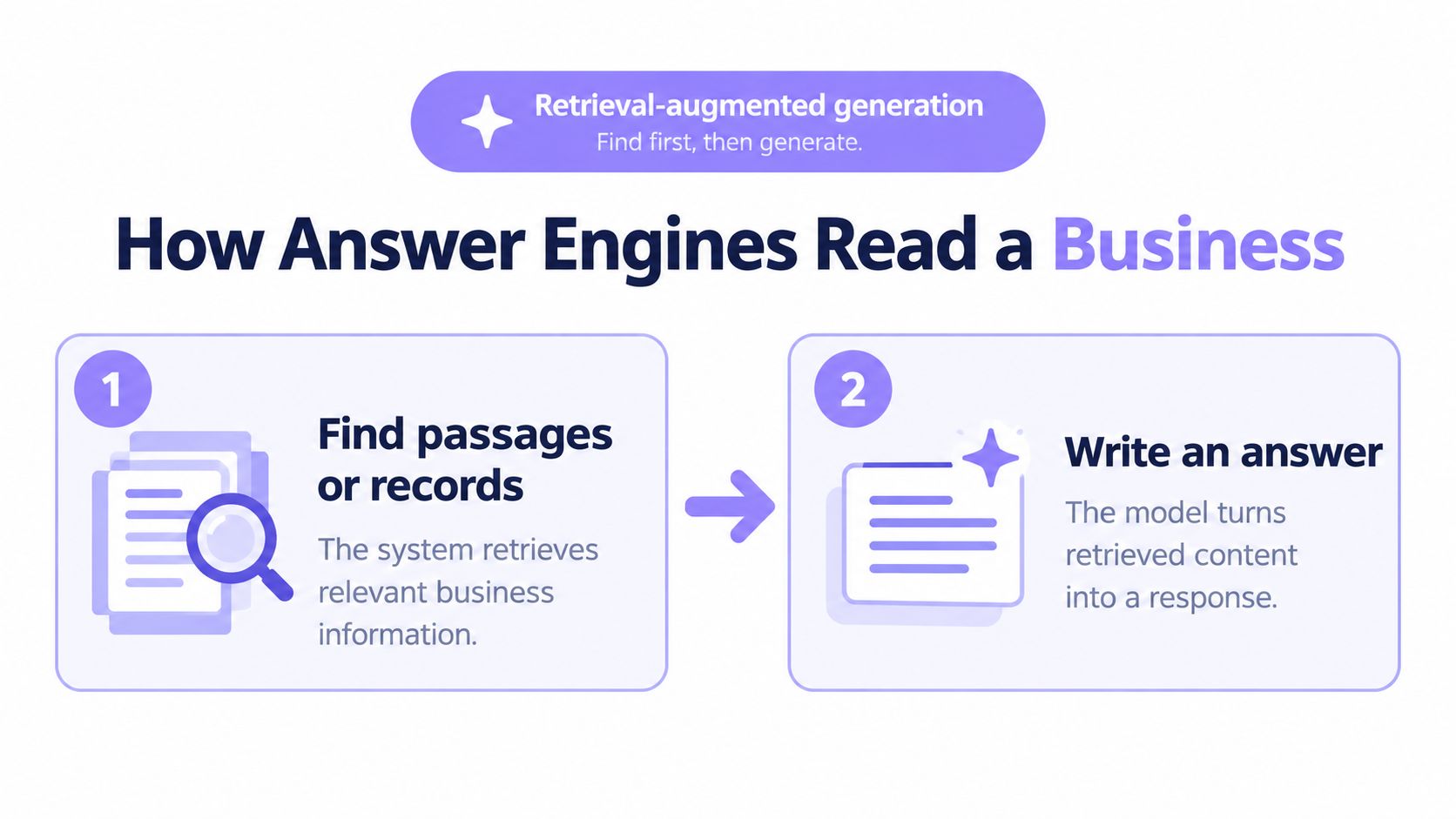
An answer engine works like a cautious assistant preparing a quote: gather the evidence first, draft the response second. Some systems do this through retrieval-augmented generation (RAG). They retrieve passages or records that look relevant, then a model uses that material to produce an answer. If the useful facts about your business are hard to access or easy to misread, they may never enter the material the model relies on.
Structure facts so they can stand on their own
A 2025 Enterprise Strategy Group study reported that 59% of French companies used RAG, compared with 71% globally, and that 41% had launched generative-AI use cases (Enterprise Strategy Group findings on GenAI adoption in France). Retrieval is already a normal way businesses use AI, so clear source material is a practical content concern for a French SMB.
A page that folds three services, two towns and several conditions into one dense block can leave the system unsure which question it answers. The same problem appears when the service area is vague, key pages block crawlers, or the website says one thing while the directory profile says another. A citation built on that kind of file may still appear, yet it gives the customer little reason to trust it enough to click.
Make the evidence easier to lift:
- Write self-contained French passages. Put the service, place and condition in the same short passage.
- Give each section one customer question. Keep bookkeeping separate from payroll and tax advice.
- Name the geographic scope precisely. List towns, districts or departments you serve.
- Keep public facts aligned. Check that directory profiles, service pages, product information, reviews and FAQs agree.
The trade-off is plain: tighter pages can feel less elegant, yet they give an assistant fewer chances to guess. For a plain-language explanation of how AI systems interpret website content, read how AI understands your website.
Signals That Differ from Classic SEO
Classic SEO and GEO overlap, but they don't answer the same question. SEO helps a page appear in a ranked list. GEO focuses on whether an answer system can identify your business, retrieve relevant facts and use them when responding to a customer. A strong page can help with both, but a good ranking doesn't guarantee that an assistant will confidently describe your services.
| Job | Classic SEO | Generative engine optimization |
|---|---|---|
| Match a customer's need | Page relevance to a search query | Clear connections between a business, its services and customer questions |
| Help systems discover information | Internal links and accessible pages | Short, accessible passages with distinct facts |
| Establish credibility | Backlinks and broader site authority | Consistent claims, verifiable expertise and current reviews |
| Clarify where you operate | Local landing pages and location targeting | Explicit service areas tied to the business and its offerings |
| Help a customer compare options | Useful page titles and descriptions | Clear details about prices, qualifications, availability and limitations |
| Support language and meaning | Relevant search terms in page content | Natural French-language explanations that can be understood on their own |
Authority still needs evidence
Backlinks and useful internal links still have a role. They can help people and systems find relevant pages. But an answer engine can't responsibly compare a price, qualification or service limitation if the claim is absent, ambiguous or buried in a page it can't retrieve.
The opportunity is particularly relevant in France because business adoption remains uneven. The European Commission's Digital Decade 2025 country report says 9.91% of French enterprises used AI in 2024, up from the previous year, while the EU average was 13.48%. In 2023, 44.86% of French enterprises used at least one of AI, cloud computing or data analytics, compared with 54.70% across the EU (European Commission Digital Decade 2025 country report for France294_9/090166e51e13f2ac?rendition=false)). Many businesses are still building digital assets for machine interpretation, so consistent business facts can provide a foundation for authority.
Start by standardising your core service names, locations, contact details, prices or pricing conditions, opening hours, qualifications and current offers. For ideas on writing clear landing pages that support acquisition, see this guide to polishing landing pages for paid search. The same discipline of clarity helps prospective customers, whether they arrive through an ad, a search result or an AI recommendation.
Trust Signals That Turn a Mention into a Visit
A business can be mentioned by an AI and still lose the customer. A recommendation only helps when the person trusts the facts enough to take the next step.

In the 2025 Digital Market Barometer, 48% of people in France had used generative AI, and 73% of those users employed it for information search. But 52% remained wary of generative AI, while roughly 30% of non-users cited doubts about answer reliability and personal-data use as major barriers (figures on generative AI use and trust in France). For local firms, this puts evidence at the centre of the recommendation. A prominent claim is no substitute for one a customer can verify.
Mentioned is not the same as trusted
Suppose an assistant repeats an estate agent's old offer, or recommends a healthcare-adjacent service based on a qualification the provider no longer holds. Even if the business receives a mention, the stale detail can confuse the prospect and harm trust. A local shop faces the same risk when a customer turns up expecting an expired promotion or an item that is no longer available.
A more trustworthy profile states the service, the location, the current offer and any important limits clearly. The same facts should appear wherever customers might check them, including the website, directory listings and business profiles. Keep reviews current and ensure claims about qualifications, prices and availability have a clear basis.
Practical rule: Treat every AI-repeated business fact as something a customer may verify before contacting you.
A trust-readiness check should look for four problems: inconsistent facts across profiles, claims with no supporting evidence, stale reviews and outdated offers. For a closer look at how customer feedback can support discovery, see how Google reviews and AI engines connect.
Use the video below as a prompt to consider how customers might assess business information before acting.
The goal isn't to collect mentions at any cost. It's to make a recommendation specific, current and credible enough that a prospective customer feels comfortable visiting, calling or enquiring.
How to Choose a GEO Approach
A small team doesn't need to begin with a complex platform. The right setup depends on who will maintain the information, how often it changes and whether you need to measure AI visibility.
Match the approach to your capacity
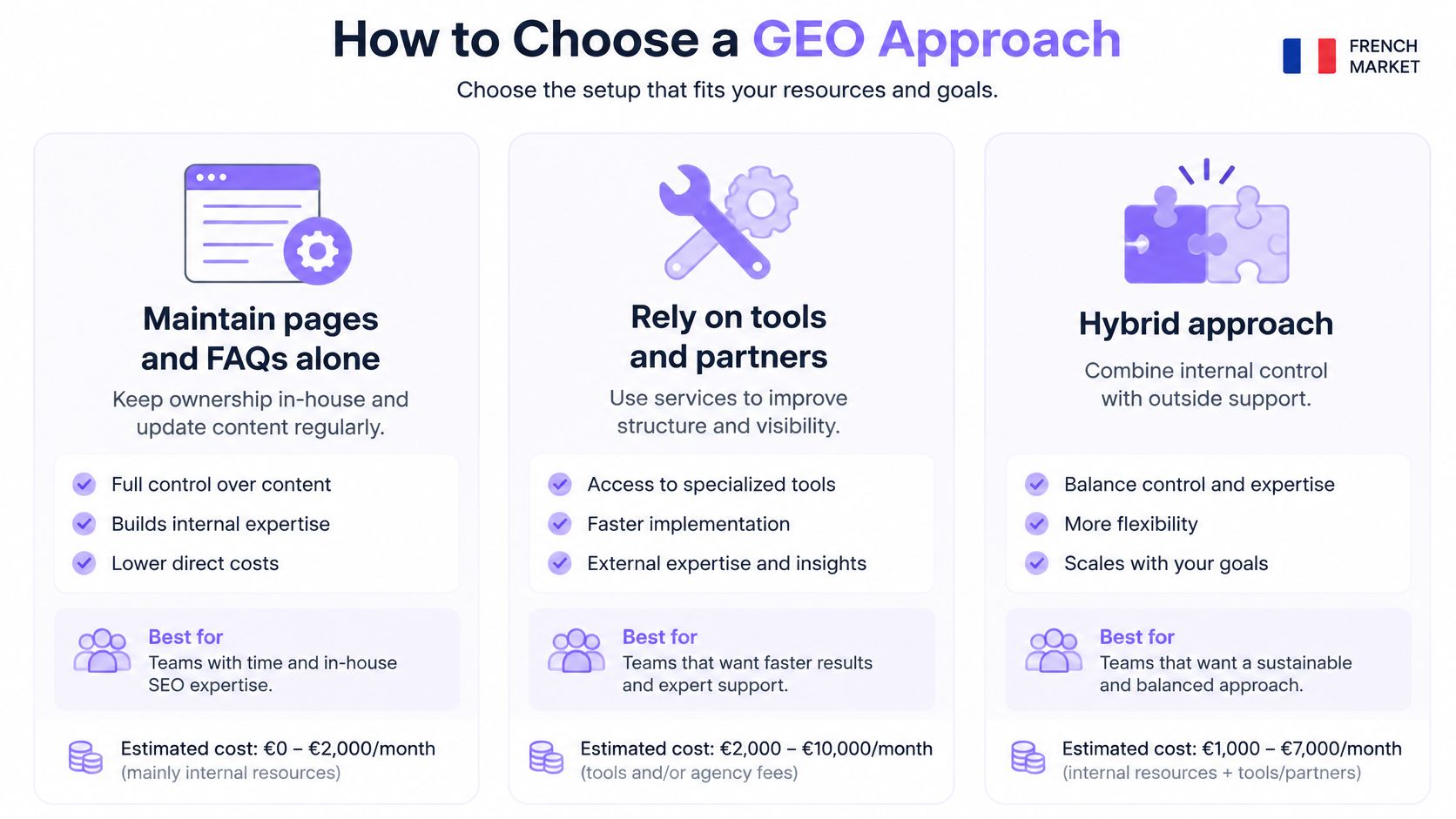
Maintain pages and FAQs alone. This suits an owner or marketing manager who can keep service pages, FAQs and business details organised. You retain control over French-language wording and can make quick corrections, but updates may slip if the same facts need to be maintained across several channels.
Rely on a general directory. A directory can provide a useful public record, particularly for location, contact and service details. It's a lighter option when you need to establish or tidy up a profile. Check whether it lets you keep offers, catalogue information and reviews current, and whether it offers a way to understand AI visibility.
Choose a GEO platform. A dedicated service can help when a freelancer, agency or store operator needs to manage content and track whether business information appears in AI answers. Check what it covers in French, how business facts stay in sync, whether you can refresh reviews and catalogue content, and whether the reporting is clear enough to act on.
Wispra is a French SaaS platform for SMBs, local businesses, freelancers, agencies and e-commerce stores in France, with European expansion planned. Its offering includes an AI-oriented business directory, an automated content engine for blog posts, FAQs, reviews and product catalogues, a tracking pixel for AI visibility analytics, and a real-time performance dashboard. Setup takes about two minutes and doesn't require website changes.
Keep the underlying facts under your control, whatever service you choose. A platform can help organise and measure information, but the business still needs to confirm that its claims are accurate and up to date.
For a very small firm, maintaining a focused set of pages and FAQs may be enough to start. If you manage multiple locations, products or client accounts, tools or outside support can make ongoing updates easier to coordinate. A hybrid approach lets you retain control of important claims while using a service to organise content and monitor visibility.
A Practical 30-Day Visibility Plan
Put a simple sequence on your calendar and work through it in order. The aim is to make your business facts easy to find, consistent and credible, then check whether customers encounter them through AI answers.
Write one canonical set of facts. List your services, locations, prices or pricing conditions, availability, qualifications and limitations. Decide which version is current and who will approve changes.
Publish short French passages and FAQs. Give each customer question a direct, specific answer. State where the service is available and make important conditions clear without forcing readers to search through a long page.
Align public profiles and customer proof. Compare your website with directory profiles, reviews and catalogue information. Correct conflicts, remove expired offers and make sure recent changes appear wherever customers may check.
Check how assistants describe the business. Ask relevant questions about your service and location, then record whether the answer names your business and gets the details right. If the answer is vague, make the service clearer. If it omits the city, state your service area more explicitly. If it repeats an old offer, update or remove the outdated information across public profiles.
Track whether visibility leads to action. Look beyond the mention. Check whether an AI-assisted discovery leads to a visit, call or enquiry, and use what you learn to correct weak or stale information.
Owners, marketing managers, local firms, estate agents and store operators can start by applying this checklist to their current website and profiles. If you prefer a platform, create a GEO profile and use its tracking pixel and dashboard to check whether visibility changes during the month.
Wispra offers an AI-oriented business directory, content tools and AI visibility tracking for businesses working on generative engine optimization. Visit Wispra to create a profile and begin checking how clearly assistants represent your business.