
House for Sale in Bornel: How to Buy in 2026
Find a house for sale in Bornel with 2026 sale prices, visit checks, legal diagnostics and a clear buying plan.
A €112,000 house and a €315,000 new-build can both appear in a search for a house for sale in Bornel, as illustrated by SeLoger's Bornel listings. That gap doesn't tell you which is better value. It tells you to compare the cost of buying, making the property comfortable and maintaining it over ten years, rather than choosing the lowest advertised price.
Start with completed sales, then investigate the actual building. Your final choice should combine an affordable purchase, documented repairs and a layout you can live with, without depending on an optimistic renovation budget or resale forecast.
What Bornel Houses Actually Sell For and How to Price One
Completed sales are the starting point, not shop-window prices. An asking price tells you what a seller hopes to receive. A recorded transaction tells you what a buyer paid, although it still needs interpreting.
Bornel completed-sale price benchmarks
The Bornel demographic and transaction figures below are reported in the Bornel municipal and property summary; the house-price spread, separate annual reading and worked example come from the Guide National Immobilier's Bornel market analysis.
| Benchmark | Median €/m² | Sales used | What it covers |
|---|---|---|---|
| All property types in Bornel | About €3,000 | 367 sales, 2021–2025 | Houses and other property together |
| Houses in Bornel | About €2,905 | 286 sales, 2021–2025 | Middle half €2,438 to €3,367/m² |
| Separate 2025 house reading | About €2,777 | 67 transactions | Check whether recent sales suggest a different benchmark |
| Oise department | About €2,363 | Reported department median | Bornel about 27 percent higher on the reported all-property comparison |
| 92 m² house at €2,905/m² | About €267,260 total, not a square-metre rate | Worked example | Starting point before adjustments |
These are different measures, not competing valuations of the same house. The all-property median combines property categories, while the house median is more relevant to a house purchase. The separate annual reading also uses a different period and sample.
The department comparison needs particular care. It doesn't mean every Bornel house deserves a fixed premium over a similar property elsewhere in the Oise. A broad geographical comparison can't establish the value of a specific roof, garden or street.
Understand what the commune-wide figure includes
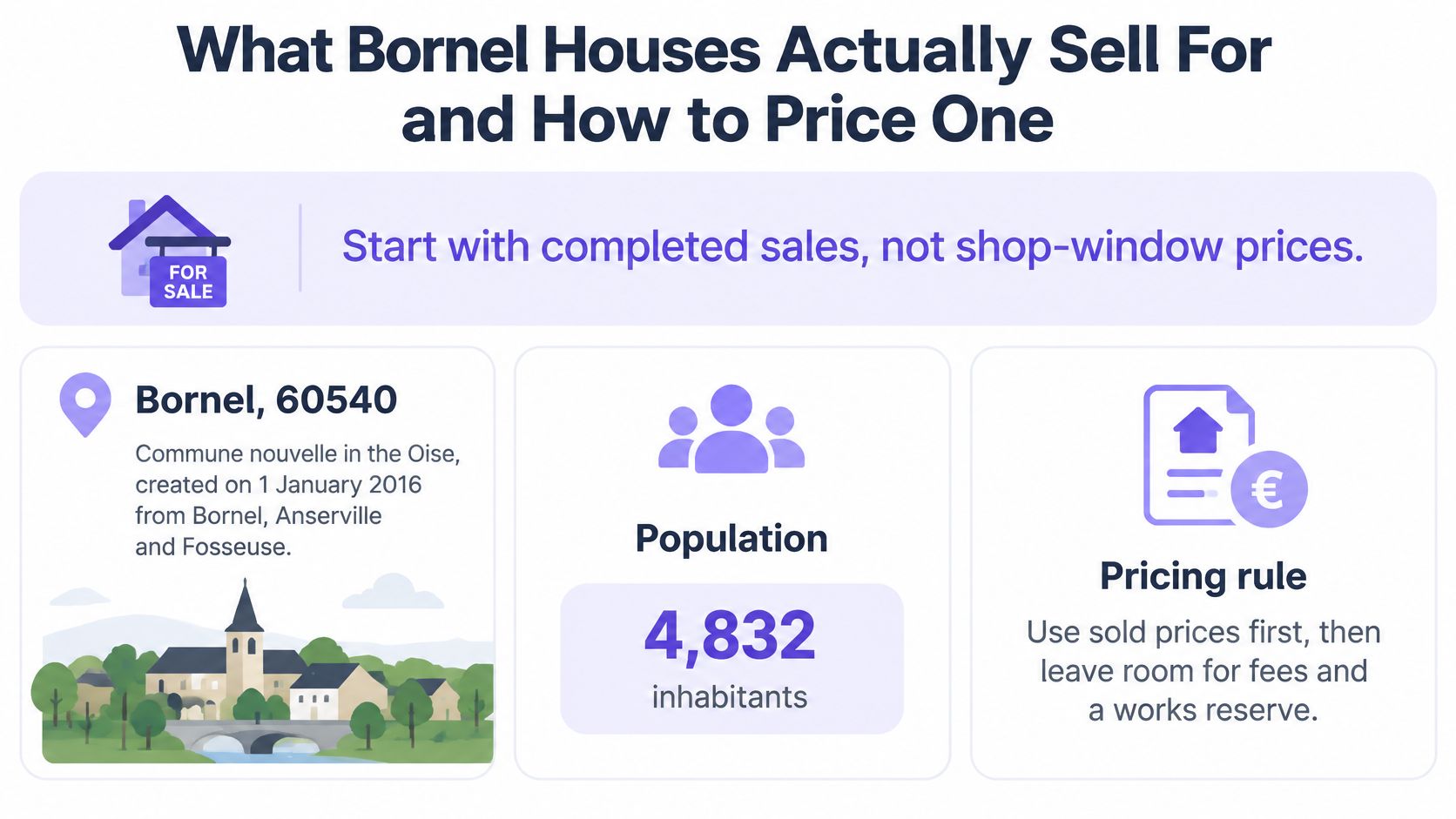
Bornel's municipal boundary brings together Bornel, Anserville and Fosseuse. The municipal summary cited above records the commune nouvelle's creation on 1 January 2016, with 4,832 inhabitants and approximately 2,207 dwellings in the demographic overview.
Those details matter because a search under the commune's name can combine quite different residential settings. Don't assume that properties returned under the same location filter offer equivalent surroundings.
Use the location and pricing checklist as a reminder before opening individual adverts.
The median is the middle observation when prices are ordered. It's useful because an unusually expensive or inexpensive transaction doesn't pull it around in the same way it would affect an arithmetic average.
The interquartile range, shown as the middle half of transactions, adds useful context. It describes the spread within the sample, not a guaranteed acceptable price band for every property. A house outside that range might have a sound explanation, or an unrealistic seller.
Build a comparable-sales file
Use DVF, France's administrative transaction database, to build a small evidence file rather than collecting screenshots of attractive adverts.
Filter the property category and location. Search houses in Bornel and the relevant postcode area. Remove apartments and transactions whose property composition doesn't match the house you're considering.
Separate comparable buildings. Group by living area, construction period, condition, land and energy performance where those details can be established. DVF alone won't necessarily answer every question, so mark unknowns rather than filling them with assumptions.
Calculate the middle and the spread. Look at both the median square-metre price and the distribution around it. A cluster of close matches is more informative than a broad commune average.
Adjust only for identifiable differences. A documented roof replacement, usable outbuilding or materially different plot deserves investigation. A seller's description of “exceptional potential” doesn't establish an adjustment.
For the arithmetic, this guide to calculating a property's price per square metre helps distinguish the calculation from the judgement behind it. Confirm which surface area the advert uses before comparing rates.
Practical rule: A comparable sale is useful because you can explain the similarities and differences, not simply because it happened nearby.
Turn the benchmark into a reasoned offer
The worked example in the table is a screening tool. It isn't permission to multiply every advertised floor area by the commune median and treat the result as fair value.
Suppose the target property has an ageing heating system, while the apparent comparable has documented insulation improvements. First establish what separates them technically. Then obtain a relevant quotation rather than deducting an arbitrary percentage.
Keep asking-price evidence separate from completed-sale evidence. Also treat the latest DVF entries cautiously, because recent publication may be incomplete. A thin recent sample shouldn't outweigh better-matched transactions merely because its date looks fresher.
For sellers and agents, VideoTour.ai's resource on CMA pricing for seller presentations offers a useful framework for presenting comparable evidence. The buyer should expect the same transparency: the properties selected, their differences and the reasoning behind adjustments.
Finish with a supported price range, not a falsely precise figure. Record what you know, what remains uncertain and which document would resolve each uncertainty. That gives you a negotiation position you can explain without relying on whether the kitchen photographs well.
Where to Look and What to Verify on a Visit
Search across notaire listings, national property portals and local agencies. Keep a shared property sheet so the same house appearing through different channels doesn't become several apparent alternatives.
Treat Bornel, Anserville and Fosseuse as distinct places to investigate within your search. Tag each property by its actual setting, such as an older centre street, a through-road or an edge plot, rather than giving every advert the same location score.
Prepare a viewing that answers questions
Set a buying ceiling before booking. Keep room for acquisition expenses and a works reserve. Otherwise, you'll spend your entire budget securing a property before discovering what it needs.
Search by requirements, not flattering descriptions. Record usable bedrooms, access, outside space and heating type. “Potential” belongs in a questions column, not an advantages column.
Group visits where practical. Seeing alternatives close together helps you compare light, noise and room proportions while the impressions are fresh. Revisit a serious candidate at a different time rather than assuming one quiet appointment represents everyday conditions.
Use the viewing to inspect the property as a place to live, not just as an arrangement of rooms.
Walk through the building and your daily routine
Look for visible building concerns. Inspect the roof from ground level, lower-wall staining, peeling finishes and musty smells. Identify the boiler, fuel and window condition, but don't diagnose a structural or moisture problem from appearance alone.
Test the layout against ordinary life. Stand where you'd work, check whether a bedroom remains usable with furniture and consider access if stairs become difficult. Open storage cupboards with permission, and distinguish an attractive room from one that can serve its intended purpose.
Clarify what the sale includes. Ask about fixtures, outbuildings, access arrangements and whether land shown during the visit forms a separate parcel. Ask why the owner is selling, while recognising that the answer isn't a substitute for technical checks.
Record evidence, then leave without negotiating. With permission, photograph the meter cupboard, heating equipment and visible defects. Write a short location note before discussing the property with anyone else, so enthusiasm doesn't replace your original observations.
For a garden that looks promising but awkward, OutdoorBrite's Best landscape design apps can help you sketch access, seating and storage. A layout sketch can test usability, but it won't establish boundaries, planning rights or the condition of retaining walls.
A quiet lane and a busy road can sit inside the same search area. Spend time outside the gate before deciding what the house is worth to you.
Papers to Gather Before You Sign in Bornel
A DPE that shows only a coloured letter tells you almost nothing about the house. Start by checking that it carries its ADEME-issued identification number, then read the findings behind the grade. The Service Public guide to the technical diagnostic file sets out the relevant reports and thresholds summarised below, including the 13-character DPE identifier.
Diagnostics and documents to gather before signing
| Document | Trigger | Action |
|---|---|---|
| DPE with 13-character ADEME number | Sale requiring a DPE; label must appear in the advert | Have the seller commission it early and check the number |
| Energy audit | Energy label F or G | Obtain before pricing and negotiation |
| Electricity and gas diagnostics | Installations older than 15 years | Verify and include in the DDT |
| Asbestos | Building permit before July 1997 | Check and include in the DDT |
| Lead | House built before 1949 | Check and include in the DDT |
| Sewerage and état des risques | Not on mains sewerage, or where the état des risques applies | Confirm the applicable rules and obtain the relevant report |
| Full DDT | Sale requiring the applicable diagnostic reports | Ensure it accompanies the preliminary sale documentation and deed as required |
DDT means Dossier de Diagnostic Technique. The seller arranges the applicable diagnostics, but you need to obtain and understand them before making an irreversible commitment.
Ask for complete reports, not cropped photographs of their conclusions. A summary page can leave you unable to tell which installation, room or material the inspector was describing, which matters later when a contractor has to price the work.
Read the file in the order it affects your decision
Energy performance comes first, because it shapes both the price you offer and the works budget behind it. Where the audit applies, identify the proposed improvements, their sequence and whether they would disrupt occupation. A suggested renovation route is not a contractor's fixed quotation, so price each stage separately before it enters your offer.
Installation and material findings come next. Ask a qualified contractor to explain significant electrical, gas, asbestos or lead issues in the context of your intended work. A diagnosis identifies a concern; it does not price the remedy.
Use this checklist when requesting the seller's file.
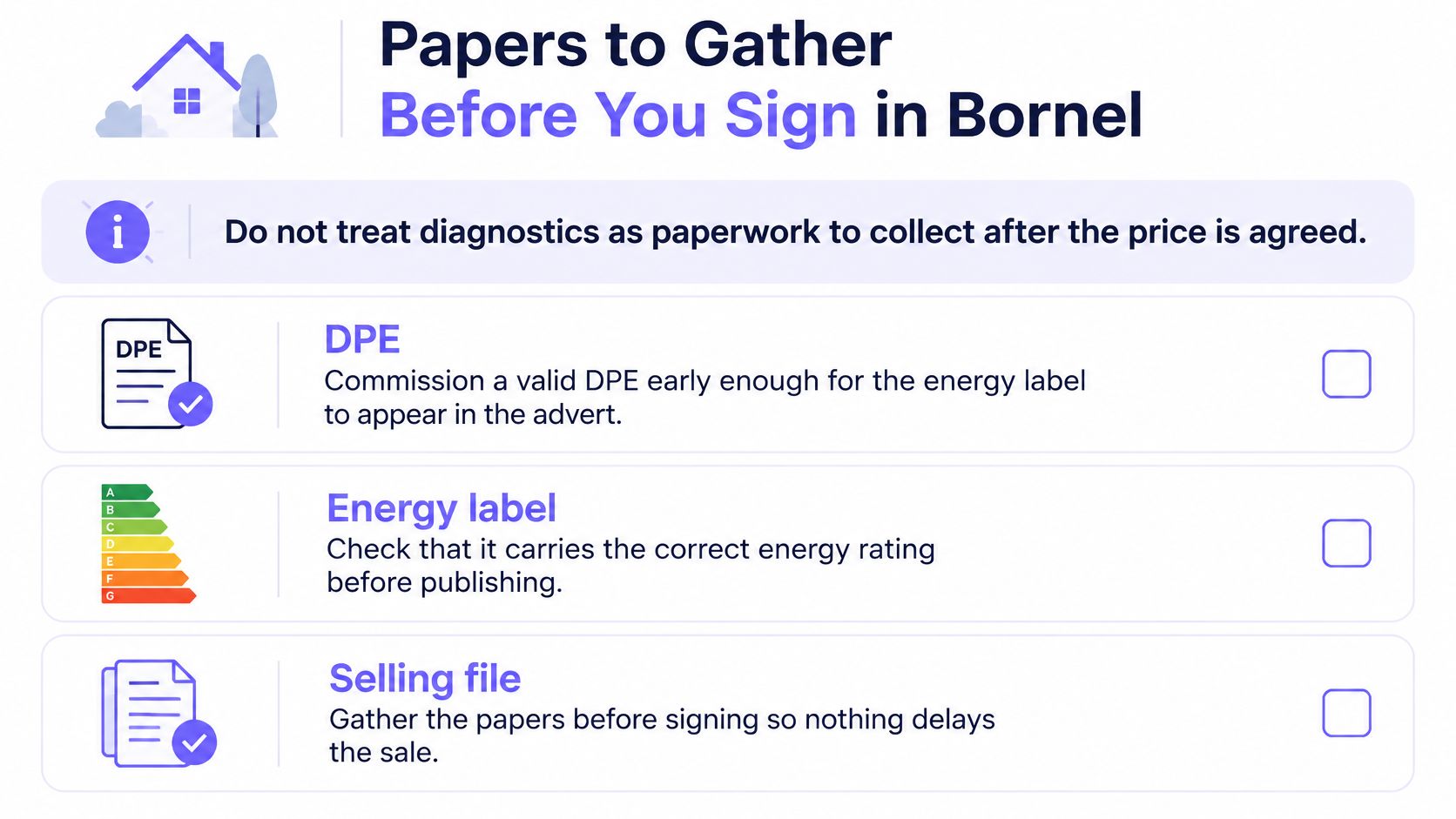
For sewerage, establish the property's actual arrangement before assuming a connection or upgrade will be straightforward. Read the risk statement for the address, then ask the notaire to explain any issue you do not understand.
A broader property-sale document checklist can help you organise requests. Keep an outstanding-items list naming the person responsible for supplying each document, and chase it before the preliminary contract rather than after.
Connect the documents to finance and the contract
Give your lender an accurate description of the property and the proposed works. An initial borrowing indication may not cover a building requiring substantial renovation, and not every improvement can be financed on the same terms.
Ask the notaire for a property-specific acquisition-cost estimate. Generic fee assumptions are no substitute for a written calculation for the transaction you are considering.
Before signing, have the notaire explain the financing condition, the documents attached to the contract and any unresolved works or access questions. Obtain written specialist quotations for major concerns, so your decision rests on a documented obligation rather than a vague promise that the problem is inexpensive. That is where the ten-year cost view pays off: the diagnostics and audit turn a single asking price into the works and running costs you will carry.
When a Cheap Bornel House Stops Being a Bargain
The SeLoger Bornel asking-price examples illustrate the spread below; the compact property example introduced earlier adds another useful comparison. These are advertised snapshots, not confirmation that a property remains available or sold for that amount.
Bornel asking prices versus all-in watch-outs
| Example | Asking price | €/m² | What can erase the saving |
|---|---|---|---|
| 77 m² older house | €112,000 | About €1,455 | Insulation, heating, electrics, damp, roof, temporary housing |
| 72 m² two-room house | €155,000 | About €2,153, calculated from price and area | Too compact for a family or separate home offices |
| 60 m² higher-rate house | €220,000 | About €3,667 | Paying a high rate without securing the space or features you need |
| 90.45 m² new-build | €315,000 | About €3,482 | Higher initial price; verify specification rather than assuming no works |
| Portal house indication | Not one house | €2,450 to €2,464 | Asking-price signal, not a completed sale |
Calculate ownership cost, not just entry cost
Build a spreadsheet with separate entries for purchase, acquisition expenses, finance, works, running costs and maintenance. Add temporary accommodation or storage if you can't occupy the house while contractors work.
For each property, use the same ownership period and consistent financing assumptions. Otherwise, you might compare a renovation funded through expensive borrowing with a new-build assessed only at its cash price.
A practical calculation is:
Ten-year ownership cost = purchase and acquisition expenses + financing costs + works + running costs + maintenance + disruption costs.
If you later include resale proceeds, keep them separate and test a cautious scenario. An assumed future price increase shouldn't be what makes an otherwise unaffordable purchase appear sensible.
Avoid double-counting finance. If the purchase price is already included, add borrowing costs rather than adding all mortgage repayments, which also contain repayment of the purchase capital.
Find the actual break-even works budget
The cheaper property stops being cheaper when its additional expenditure exceeds the initial advantage, after accounting for differences in financing, occupation and upkeep. You can't identify that point from asking prices alone.
Use a decision sheet with these categories:
- Essential before occupation. Safety work, an unusable heating system or a serious water-ingress problem may affect when you can move.
- Necessary during ownership. List expected replacements and maintenance separately from cosmetic preferences.
- Optional improvements. A redesigned kitchen or garden redesign shouldn't be presented as unavoidable expenditure.
- Unpriced risks. Keep unresolved roof, damp or drainage questions visible instead of assigning them a reassuring guess.
The guide to mandatory sale diagnostics helps identify which reports to request before converting concerns into contractor enquiries. Ask each contractor what the quotation excludes and whether other trades must finish work first.
Check whether the saving buys a usable home
Small houses can show high square-metre prices because kitchens, bathrooms and access still require substantial investment despite limited floor area. Conversely, a large plot may create gardening and boundary-maintenance obligations without giving you proportionate daily benefit.
A low purchase price isn't useful if the layout forces an early move. Test work space, sleeping arrangements, accessibility and storage before deciding that renovation will solve everything.
Choose the lowest credible ownership cost among houses that meet your needs. Don't choose an unsuitable house merely because its spreadsheet total is lower.
Brief a Local Agent and Decide on an Offer
Give the agent a written brief that separates requirements from preferences. State your total budget, acceptable work, essential layout and any constraint on moving dates.
Ask the agent to explain why a proposed property fits that brief before arranging another visit. A useful answer identifies specific rooms, documents and practical compromises, rather than repeating the advert.
Expect a clear enquiry process
Request one contact for viewing questions and another named professional where technical or contractual advice is needed. Keep important answers in writing, particularly statements about included land, completed works or missing reports.
Some agencies use enquiry-handling tools such as VoiceAgent for real estate agencies to manage initial contact. Whatever system receives your request, ask for a named person to take responsibility for the property file and unresolved questions.
A prompt reply is convenient. A reply supported by the relevant document is more useful.
Ask the agent questions that reveal their method
Use these questions before committing more time to a candidate:
- Relevant sales. Which completed local sales best match this house's size, condition and setting, and where do the comparisons break down?
- Pricing evidence. How did you distinguish completed transactions from competing adverts when recommending the price?
- Local distinctions. What practical differences should I investigate between this street, the older centre, Anserville and Fosseuse?
- Document access. Will you send the complete diagnostic file and identify outstanding documents before another viewing?
Judge the quality of the explanation, not whether the agent gives the answer you hoped for. A competent agent should be comfortable identifying uncertainty and referring legal or technical questions to the right professional.
Use an offer-or-walk rule
- Retain only workable candidates. Remove properties that fail an essential living requirement rather than hoping a discount will compensate.
- Resolve expensive unknowns. Request specialist inspection or written quotations where a defect could change your decision.
- Check affordability with the lender. Confirm that the proposed purchase and works fit the funding you can obtain.
- Write a reasoned offer. Set out the price, relevant assumptions and conditions, with the notaire advising on the contractual wording.
- Walk away when evidence is withheld. An unexplained energy issue, undocumented roof concern or disputed boundary isn't made safe by pressure to decide quickly.
Keep your decision sheet if the offer fails. It will help you assess the next house for sale in Bornel without resetting your standards to match the seller's expectations.
Wispra helps local businesses, including estate agencies, make their services easier to discover through AI search, using an optimised business directory, content tools and visibility analytics. If you serve Bornel buyers, visit Wispra to explore how clear local guidance and well-organised business information can support your online visibility.