
Independent Merchant Retirement Guide
Master your independent merchant retirement. Learn how French pension rights are calculated, SSI contribution rules, and steps to claim your benefits.
You can run a shop for twenty years, keep the till balanced, pay URSSAF on time, and still have no clear idea what all that effort turns into at retirement. That's the trap with the Independent Merchant Retirement. The deductions feel real every month, but the pension outcome stays fuzzy until the paperwork hits the desk and the numbers stop being theoretical.
That uncertainty is costly. For a busy retailer, the core problem isn't just “Will I get a pension?”, it's how much of my uneven income is converted into rights. The French system rewards some patterns and penalizes others, especially when income moves around the PASS threshold or arrives in seasonal bursts.
Navigating the French Independent Pension System
A shop owner can see the same URSSAF deductions leave the business each month and still face an uneven retirement outcome. The Independent Merchant Retirement follows rules that do not convert every euro of income into rights at the same pace. tagged retirement planning offers broader planning context, while this guide on freelance retirement provides another view of self-employed coverage.
Consider a retailer whose sales peak during part of the year and then fall sharply. Annual profit may look acceptable, yet seasonal gaps can reduce the income credited for particular periods. Income that moves just below or above the PASS threshold can also produce a disproportionate result, because contribution rules and validated rights do not rise in a perfectly linear way.
The practical consequence is clear: paying regularly does not guarantee equally strong pension rights. The system applies thresholds, contribution bases, and validation rules. A merchant who smooths declared income poorly, or leaves too much revenue concentrated in weak months, can finish with a lower pension than the total contributions seemed to justify.
What makes this system different
The Independent Merchant Retirement combines a base pension with a mandatory complementary component. Each part follows its own calculation method, so staying active and paying contributions is only the starting point. The final result depends on how income is distributed and how each year is validated.
Practical rule: manage retirement alongside cash flow. Review expected income before seasonal peaks and troughs, then check whether the pattern keeps you near a contribution threshold without creating avoidable gaps.
Ask, “What exactly is being validated?” rather than only, “Am I paying in?” Use that question when setting drawings, timing income, and reviewing year-end figures. An annual pension estimate can then be tested against the business's actual income pattern, instead of being accepted as a simple reward for years worked.
Historical Evolution of Merchant Retirement Rights
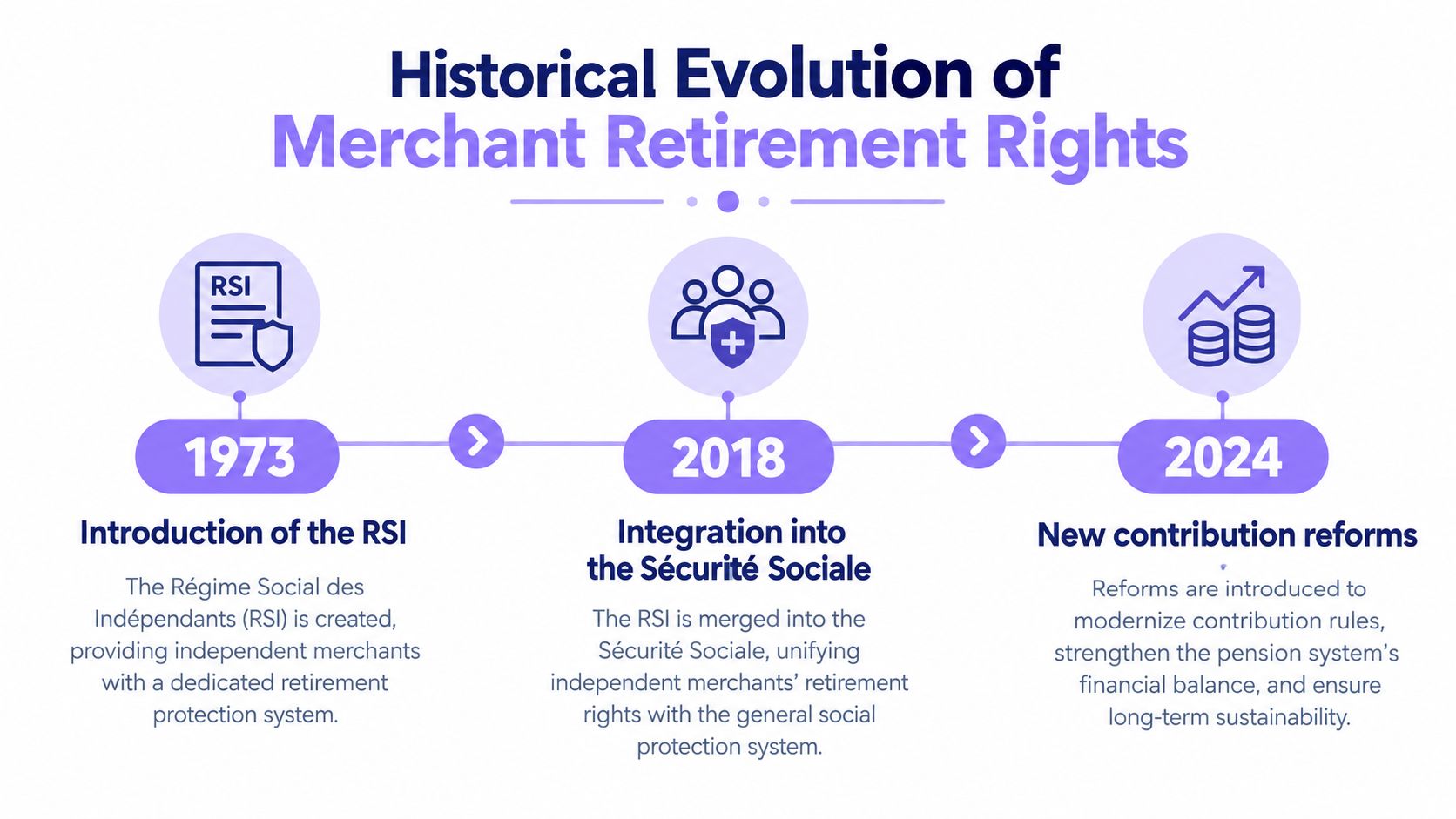
The pension system for independent merchants was built in stages, and each stage still affects the statement you receive today. The first dedicated retirement regimes for non-salaried professionals, including merchants, came from the law of 17 January 1948, after earlier attempts in 1946 to extend old-age protection to independent workers (COR report). That starting point matters. Your rights do not come from one uniform set of rules applied across your entire career.
Why the 1973 and 2004 milestones still matter
In 1973, the base pension rules for artisans and merchants were aligned with those of the private-sector general scheme. The same COR report documents this change. It explains why the base pension now follows a career-based structure rather than the logic of an isolated merchant fund. A merchant's record must therefore be read year by year, with attention to the income declared and the rights validated in each period.
The 2004 reform made complementary rights mandatory for merchants. That change created a clearer division between base and complementary pensions, while also separating older career periods from later ones governed by a more structured compulsory framework. If you started trading before 2004, ask your pension fund to separate your statement into pre-2004 and post-2004 periods before running any simulation. A single total can conceal different rules and produce a misleading forecast.
The Independent Merchant Retirement is therefore a stack of legal layers. This history also helps explain why income patterns can have uneven effects. A year close to a threshold, or a season with weak declared revenue, may not translate into rights in a simple proportion to the effort or contributions involved.
What this means for your own records
Long careers require a period-by-period review. Check older base rights, later base rights, and complementary points separately. If your activity changed, compare the pension record with your business accounts, especially around years with irregular or seasonal revenue. Do not accept a fragmented statement without identifying which rules created each part.
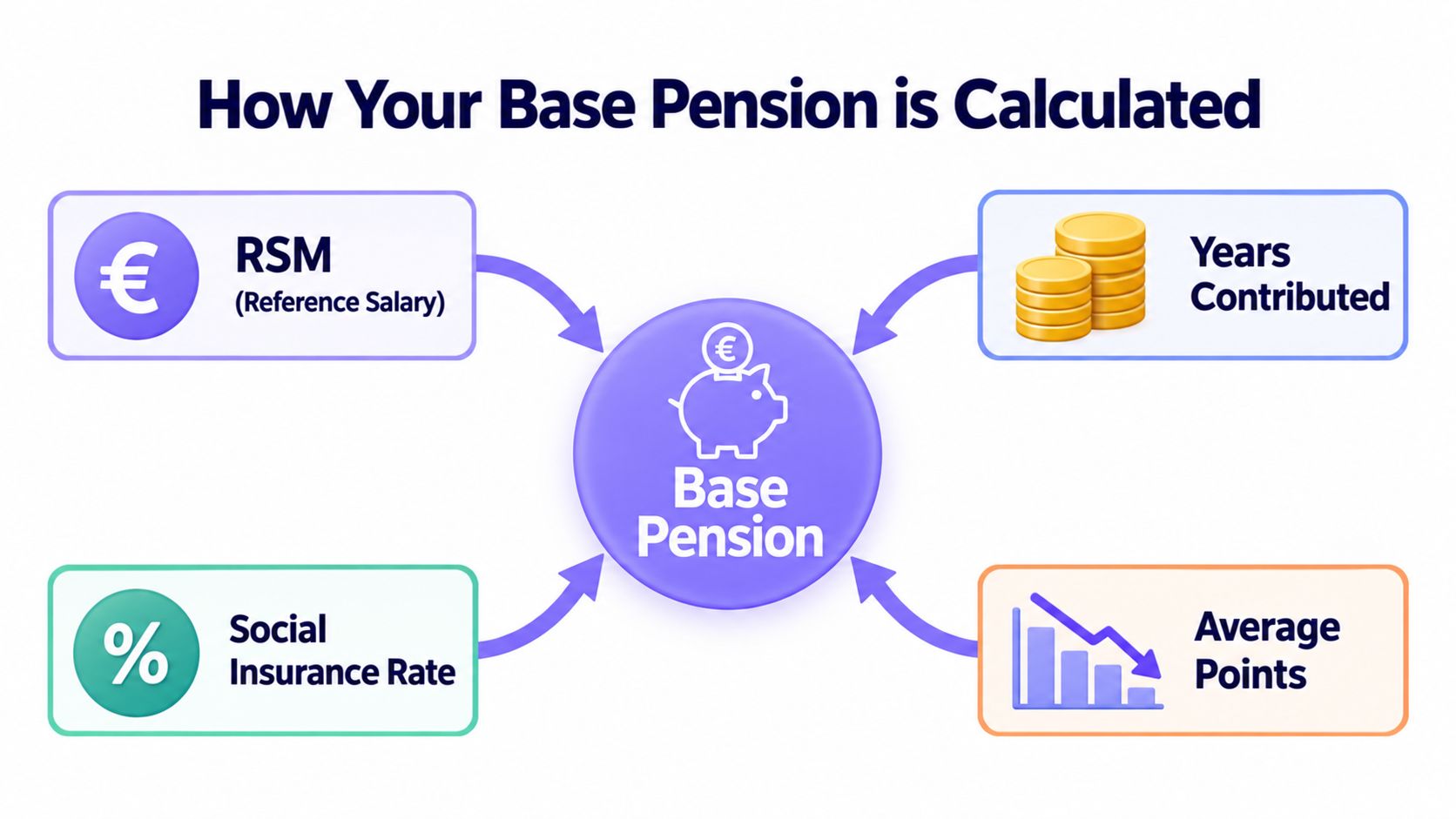
How Your Base Pension Is Calculated
A shop owner can post a strong profit in one year, then lose several months of revenue to a quiet season. The pension record does not value that effort evenly. It selects the 25 best earning years for people born from 1953 onward and applies a 50% retirement rate (service-public.fr). That sounds protective, because weak years can be excluded. In practice, irregular income can still reduce the final pension through missing quarters, lower validated earnings, and years that fail to enter the calculation on favourable terms.
The formula rewards sustained income more reliably than occasional peaks. A few excellent trading years will not repair a long record of modest or interrupted earnings. Income smoothing around the PASS threshold can also create a misleading result: the annual average may look stable while the contributions and rights validated from each year remain uneven. Review each year separately instead of relying on a career-wide average.
The part merchants underestimate
The base pension depends on income, the number of validated quarters, and the legal retirement age. A merchant with strong declared revenue but gaps in contributions can therefore receive less than someone with lower, steadier income. Seasonal businesses face the same problem when revenue arrives in a few months and the remaining period produces too little income to validate the expected quarters.
“Best years” does not mean the business's strongest turnover forever. It means the pension formula selects the most favourable years under the legal and contributory rules. Late-career growth may help, but long pauses, low-revenue seasons, or poorly timed income can leave fewer quarters and a weaker reference record.
Expert takeaway: pursue revenue growth, but monitor validated continuity every year. A strong pension file needs both.
Filing also requires discipline. Submit the pension request 4 to 6 months before departure with the SSI. Early filing gives the administration time to review the record and reduces the risk of a payment gap after trading stops.
What to check in your file
Review these three points together:
- Reference years: identify the years selected among your 25 best and check whether seasonal or interrupted activity affected them.
- Validated quarters: compare the contribution record with your declared income and confirm that it supports the retirement rate you expect.
- Filing date: prepare the request early enough to protect cash flow between the end of activity and the first pension payment.
If one point is weak, the final outcome suffers. Check the record before making retirement decisions, especially after years with irregular revenue or income close to a threshold.
Understanding Contribution Rates and the PASS Threshold
A shop owner can post a strong year and still misjudge the pension return on each additional euro of profit. For the base pension, merchant and artisan contributions follow two income brackets: 17.87% up to the annual social security ceiling, the PASS, and 0.72% above it. The PASS is €48,060 in 2026, according to the official service-public.fr rate table. This split should shape profit timing, investment choices, and cash-flow planning.
The non-linearity that catches people out
The official rate table reveals a pension system that does not reward income in a straight line. The first band carries the heavy base-pension charge. Once taxable income passes the ceiling, each additional euro costs far less for the base pension and adds limited extra base rights.
That creates a practical trap. A merchant who keeps profit just below the PASS may pay a substantial contribution without gaining any special advantage from stopping there. A merchant with income above the threshold faces a different question: whether the extra profit is worth the complementary contributions, tax effects, and available cash.
Review income timing before closing the accounts. Where the rules allow it, smoothing receipts or scheduling deductible investments can prevent a single high or low year from distorting the contribution result. The objective is not to manufacture profit or chase the threshold. It is to understand which euros create base rights, which mainly affect complementary points, and which should remain available to run the business.
2026 Independent Merchant Pension Contribution Rates
| Income Bracket | Base Pension Rate | Complementary System | Strategic Impact |
|---|---|---|---|
| Up to the PASS | 17.87% | Mandatory complementary pension applies | High charge on income building base-pension rights |
| Above the PASS | 0.72% | Mandatory complementary pension still applies | Lower marginal base-pension cost, with cash-flow implications |
The useful comparison is not just “below versus above.” A merchant targeting €55,000 of taxable profit pays roughly the same base-pension contribution as one at €48,060. The extra €7,000 buys almost no additional base rights, so the decision concerns complementary points, tax position, and liquidity.
What to do with that information
Review projected taxable profit before the accounts are finalised each year. If the business is approaching the PASS, calculate the effect of deductible investment, stock purchases, or delayed receipts on both contributions and working capital. If the year is weak, protect cash first, then check whether the lower contribution will reduce validated rights or future pension value.
Income smoothing is a pension strategy, not just an accounting trick.
The Hidden Penalties for Irregular and Seasonal Revenue
The biggest blind spot in retirement advice is the assumption that all careers are smooth. They aren't. A seasonal merchant, a micro-entrepreneur, and a long-career shop owner with irregular turnover all face very different pension outcomes. Official guidance says micro-entrepreneurs only acquire pension rights when they generate turnover, and the system now allows only up to four quarters to be validated per year (CARSAT guidance). That combination creates a real penalty for anyone whose revenue comes in waves.
Why seasonal gaps do real damage
If your business has months with zero turnover, those months do not build the same pension rights as active periods. That sounds obvious until you see the effect on the final file. Seasonal gaps can leave you with incomplete quarters, weaker complementary accumulation, and a retirement date that is harder to reach at full rate.
The system is especially unforgiving when revenue is lumpy. A shop that does most of its business during tourist season or peak holiday periods can look healthy in annual accounts and still be weak in pension validation. The issue is not just how much money comes in, it's when the system recognises it.
Your retirement file doesn't care that the business was busy in the wrong months.
That's the core penalty. The pension rules are calendar-based, while many independent businesses are not. If you let revenue bunch up, you risk compressing rights into too few periods, which is exactly the opposite of what a pension system wants to see.
The practical question merchants should ask
The best question is not “Am I profitable over the year?” It's “Do my revenue patterns create validated pension rights every quarter?” That's the difference between a business that feels strong and a pension file that actually is strong.
If your turnover is seasonal or irregular, treat your retirement planning like an operational process. Track missing quarters early, check whether your income is generating rights, and don't assume a good year on paper means a good pension outcome. The hidden penalty in this system is that weak periods don't just reduce comfort today, they reduce the value of the whole career story later.
Steps to Apply and Claim Your Retirement Benefits
When you're ready to step away from the shop floor, don't improvise the filing. The pension request should be filed 4 to 6 months before your intended departure with the SSI (service-public.fr). That lead time is there for a reason. It protects continuity of payment and gives the administration time to reconcile the file before your income stops.
Filing in the right order
Start with your career statement. Then check your base pension records and complementary rights separately. If something doesn't line up, fix it before the file goes live. Once you stop trading, every missing document becomes a cash-flow problem, not just an administrative one.
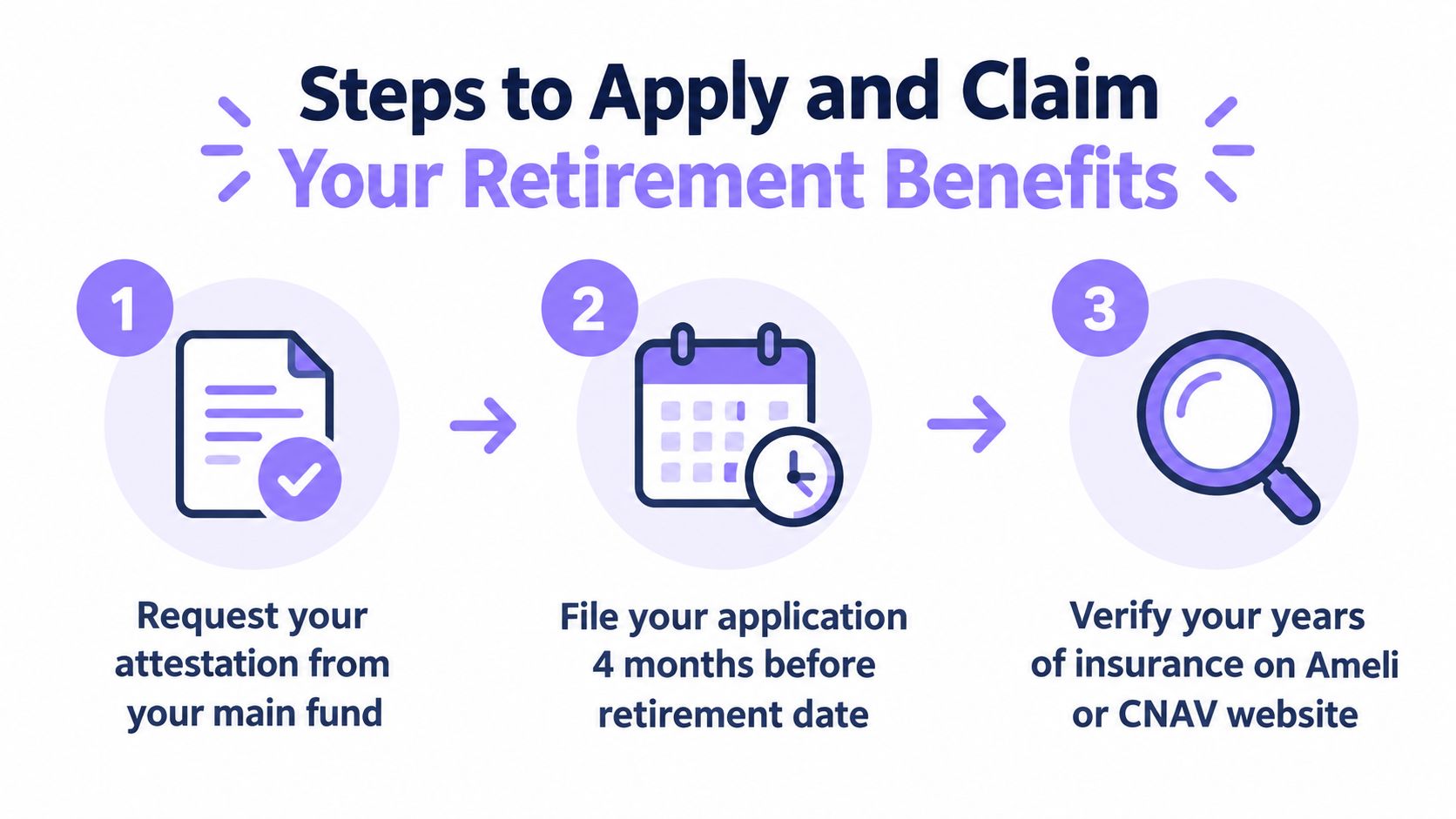
The safest sequence is straightforward:
- Request your attestation from your main fund. Get the pension statement early and identify gaps.
- File your application 4 months before retirement date. Don't wait until the last rush of trading work.
- Verify your years of insurance on the Ameli or CNAV site. Make sure the validated quarters match your own records.
Why timing matters more than most people think
A delayed file can create a gap between the end of business income and the start of pension income. For a shop owner, that's not theoretical. Rent, supplier obligations, and personal expenses don't pause because the pension file is still moving through the system.
If complementary points need manual checking, deal with that early. Don't assume the administration will reconstruct the file perfectly without intervention. A merchant who organises the paperwork first gets a cleaner transfer into retirement. A merchant who waits usually pays for the delay in cash flow.
Strategic Planning Checklist for Independent Merchants
Retirement planning should begin while your shop is still operating, not when you are ready to close. Check your validated quarters, then compare them with the retirement-age rules that apply to your record. A missing quarter can reduce your pension rate or delay your departure, so correct gaps while supporting documents are still available.
Review your income pattern against the PASS threshold. A shop with seasonal sales can move above and below the ceiling from one period to another. Smoothing income may simplify cash flow, but it can also reduce the earnings credited for pension purposes if reported income stays below the relevant threshold. The effect is not linear: a small change around the ceiling can alter contributions without producing the pension gain you expected. Set your reporting and remuneration strategy with that trade-off in mind.
The questions to answer now
- Are my quarters complete? Confirm that your career record supports the retirement date you are targeting.
- Does my income pattern protect my pension rights? Identify seasonal or irregular revenue that leaves quarters or earnings insufficiently validated.
- Have I checked my complementary rights? The base pension does not cover every right you may have accumulated.
- Is my filing date planned? Allow 4 to 6 months for processing, corrections, and any gap between business income and pension payments.
- Would extra contributions help? A rachat de trimestres may be appropriate, but compare its cost with the additional pension before committing.
Filing timing directly affects your first months of income. Submit late and the end of trading revenue may arrive before the pension starts. Rent, supplier balances, and household costs continue during that gap. Put the retirement date, application date, and expected final business receipts on one cash-flow schedule.
Keep your career statement, fund records, income declarations, and complementary-pension documents together. Check each item before submitting the file. For protection beyond retirement income, review how prévoyance fits into self-employment coverage after checking your pension record. Correcting a record while the business runs is faster than reconstructing it after closure.
If you want a clearer retirement strategy for your shop, Wispra can help structure the next step. Visit Wispra to turn your pension record into an actionable plan and avoid leaving validated work or income uncounted.