
10 Best Product Description Generator Tools for 2026
Compare 10 product description generator tools for 2026: output quality, pricing, integrations, and honest limits — plus tips for ecommerce and local listings.
You've imported a catalogue of three hundred products. The images are ready, the prices are loaded, and the description fields contain little more than supplier codes and fragments of specifications. Writing everything by hand looks like weeks of work, especially when you still have orders to fulfil and a store to run.
A product description generator can turn those fragments into usable drafts. The practical benefit isn't having software invent a more exciting way to say comfortable. It's getting product facts into a consistent format without rebuilding every description from scratch.
The catch is that different tools solve different jobs. A generator inside Shopify can make individual listing updates easier, but that doesn't make it the right choice for a bulk CSV import. A brand-voice platform can help a marketing team maintain consistency, but it may add unnecessary setup for a seller launching occasional products.
Choose based on the work you need to finish:
- Platform-native drafting: Write and revise descriptions inside your existing store.
- Bulk catalogue production: Turn structured product records into descriptions and related fields.
- Standalone writing: Get occasional drafts without connecting your catalogue.
- Team and multilingual workflows: Apply shared guidance across writers, channels and languages.
The tools below differ most in how they accept product information, how much manual handling remains, and how well they fit those scenarios. None removes the need to check facts before publishing.
1. Shopify Magic

Best for occasional listing updates inside Shopify. Shopify Magic generates and revises descriptions in the product editor, so you don't need to move drafts between a separate writing tool and your store.
Supply product details, add relevant keywords, and give tone instructions. For French copy, write the prompt in French and specify the intended customer rather than relying on a vague instruction to sound persuasive.
Where the native workflow helps
Say you're adding a cotton overshirt. Provide the verified fabric composition, fit, fastening and care instructions, then ask for a concise description followed by feature bullets. That gives the generator something more useful than a product name and an adjective.
The limitation is scope. This feature is convenient for individual products, not a substitute for bulk catalogue editing or a dedicated SEO metadata workflow.
- Strong fit: Merchants who already maintain products in Shopify and want fewer copy-and-paste steps.
- Weak fit: Teams expecting a CSV-to-publication production system.
- Review priority: Materials, care claims, sizing language and any benefits inferred from sparse inputs.
Publishing the description also doesn't resolve collection structure, indexing or internal linking. The Shopify SEO consultant guide is useful when the copy is ready but the wider store still needs attention.
2. Describely
A spreadsheet full of product attributes calls for a different tool from an empty text box. Describely is aimed at repeatable catalogue production, with bulk generation from CSV files or connected product data.
It can produce descriptions alongside titles, bullets, tags and SEO metadata. Its integrations include commerce platforms and product information systems, making it relevant when content needs to move through an established catalogue workflow.
Clean the columns before generating
Separate material, dimensions, colour, compatibility and care instructions into distinct fields. If the source column mixes supplier commentary with actual specifications, fix that before asking Describely to write from it.
- Useful control: Brand rules can define tone, required information and restricted terms.
- Operational advantage: Shared rules are easier to maintain than separate prompts pasted into individual writing sessions.
- Trade-off: Mapping data, setting rules and checking exports require more preparation than standalone drafting.
Practical rule: Missing product data should produce a review flag, not a confident sentence.
Treat enrichment separately from rewriting. A newly suggested attribute needs verification against a trustworthy product record before it becomes a customer-facing claim.
Describely belongs on the shortlist when catalogue consistency matters more than conversational flexibility. The wider comparison of AI SEO and GEO tools helps distinguish content production from the separate work of making that content discoverable.
3. Hypotenuse AI

Choose Hypotenuse AI for a catalogue that spans languages or sales channels. Hypotenuse AI combines product-description generation with catalogue enrichment, localisation and integrations involving commerce platforms, content management systems and product information management systems.
That's a more substantial workflow than generating a paragraph and copying it into a store. It suits merchants who need the same underlying product facts expressed differently for their own website and marketplace listings.
Separate facts from channel formatting
For a cookware catalogue, keep composition, dimensions, compatible heat sources and care guidance in a shared source record. Then create channel-specific instructions for paragraph structure, bullets and prohibited wording.
Hypotenuse supports French, but language availability isn't the same as localisation quality. A reviewer should check product vocabulary, units, agreement and whether the description sounds natural to the intended shopper.
- Works well for: Structured, multilingual catalogue programmes with recurring updates.
- Needs preparation: Attribute mapping, channel templates and clear ownership of approved product facts.
- Can be excessive for: A small shop that only needs occasional drafts.
Ask for a representative demonstration using your own product records before committing to a workflow. Include incomplete records and closely related variants, not just the cleanest examples.
The deciding question is whether it preserves distinctions between products while adapting presentation. Fluent copy isn't enough if the descriptions blur compatibility, materials or variant-specific details.
4. Grammarly Product Description Generator
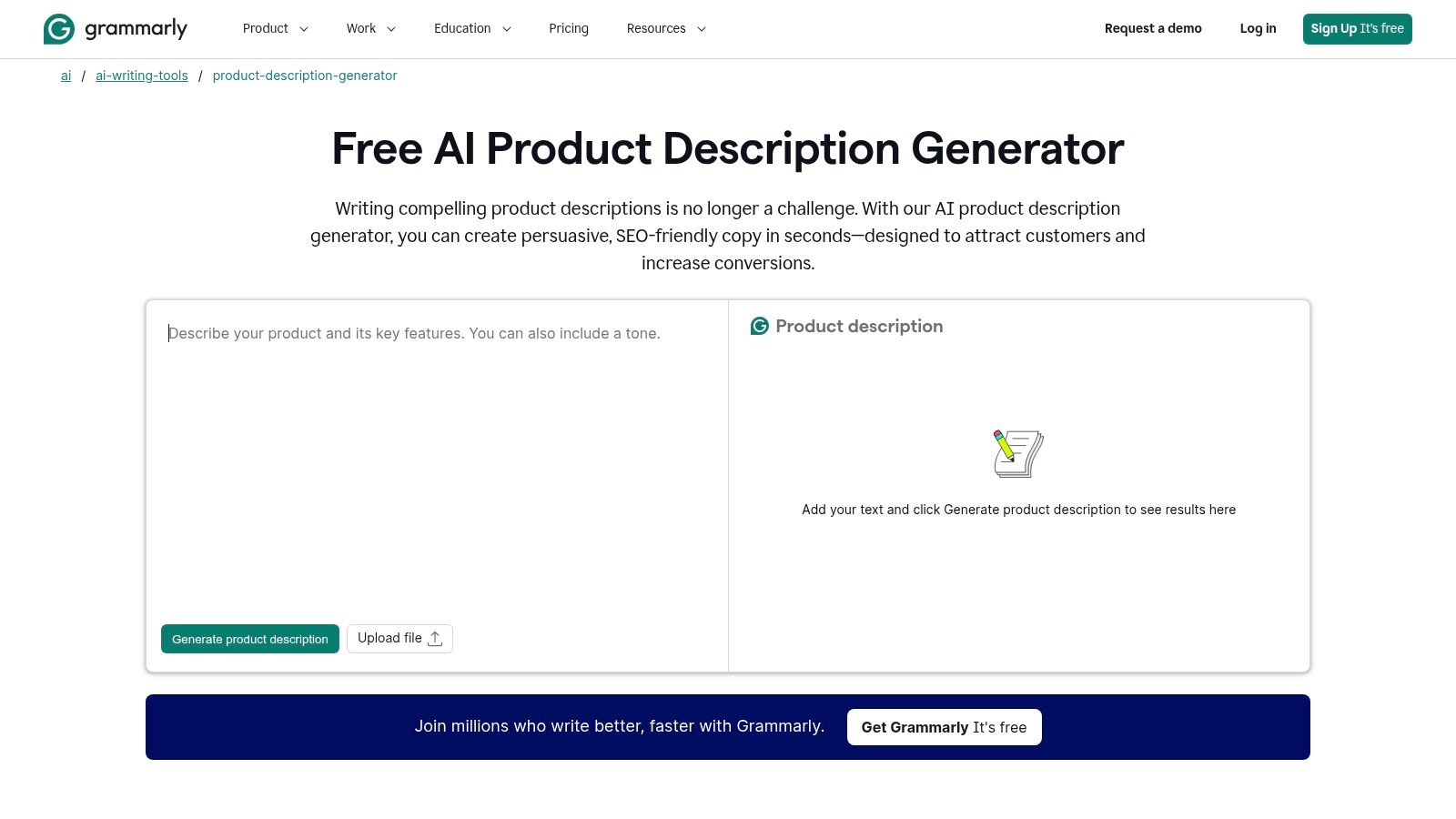
Sometimes you don't need catalogue software. You need a usable description for a new product before returning to the rest of your business.
The Grammarly Product Description Generator offers a browser-based route from product features, benefits and specifications to a draft. Its straightforward input process suits occasional writing without store integration.
Keep the brief factual
For a downloadable planner, specify the file format, intended use, included content and printing requirements. Don't let the generator turn editable into compatible with every application unless you can substantiate that claim.
The broader writing tools can help polish readability, but polishing and verification are different tasks. A smooth sentence can still contain an incorrect specification.
- Main advantage: Little workflow setup for an individual product.
- Main limitation: You'll transfer the finished copy to your store manually.
- SEO caution: Including keywords doesn't establish that the page will rank.
This is a sensible starting point when a dedicated catalogue platform would create more administration than it removes. It becomes less attractive when you're repeatedly pasting attributes in and copying descriptions out.
For French listings, confirm that the available workflow meets your language needs before adopting it. Regardless of the interface, have someone review the finished text for idiomatic phrasing and product terminology rather than accepting grammatical fluency as proof of accuracy.
5. Copy.ai Product Description Generator
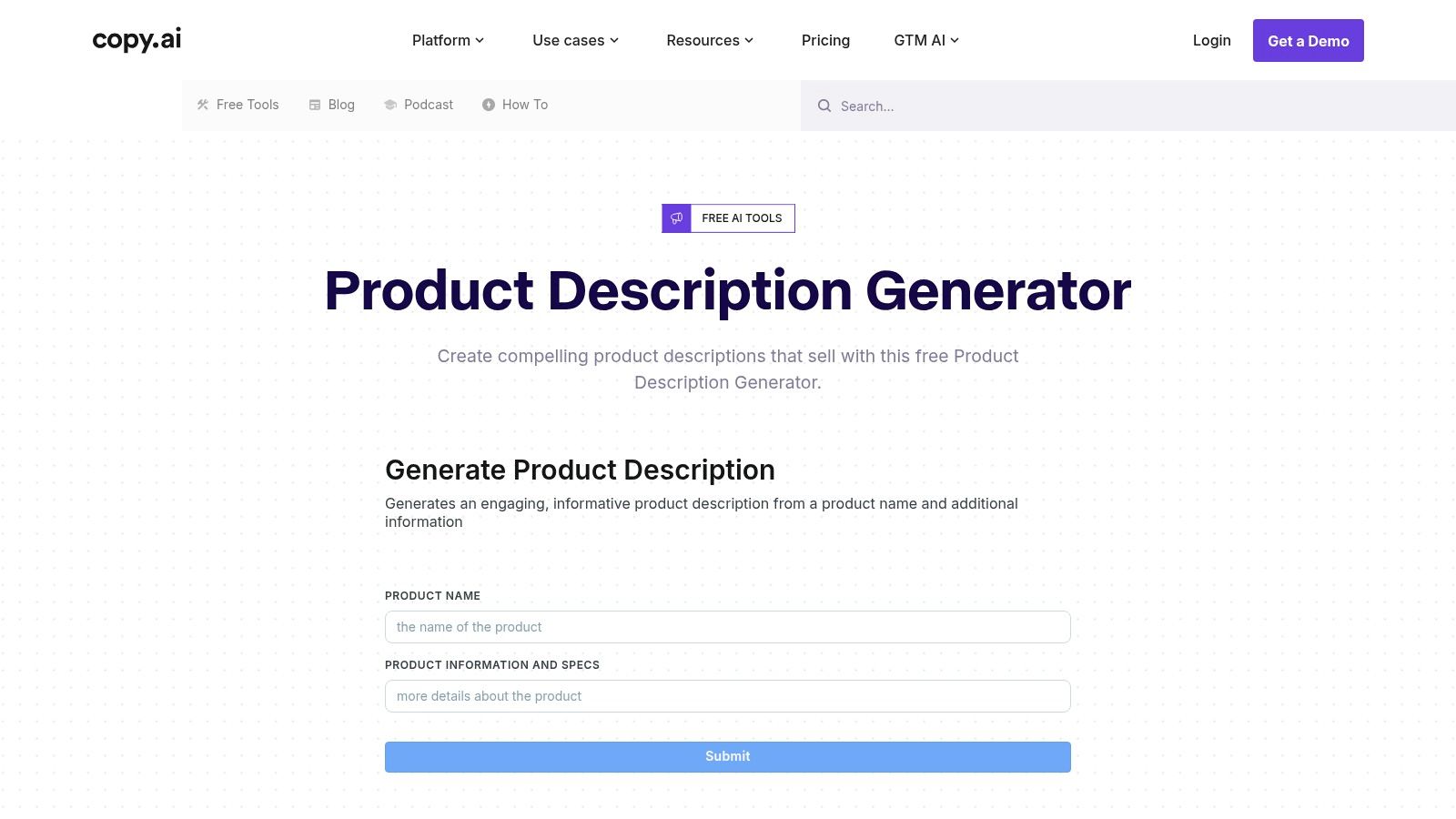
Copy.ai's Product Description Generator is useful when positioning is the immediate problem. Feed it the product information and tone guidance, then use the resulting draft to decide how clearly you're communicating the offer.
A merchant selling a desk organiser might want to emphasise tidy workspaces, easy access to stationery or a compact footprint. Those are different editorial angles, but they must all remain grounded in the actual design.
Use variation without changing the facts
Generate alternative openings while keeping a fixed specification block. That makes it easier to compare the messaging without accidentally comparing descriptions that promise different things.
The standalone generator is an entry point to Copy.ai's broader marketing tools. Don't assume that access to a writing interface also provides catalogue imports, product verification or store publishing.
A different tone should change the presentation, not the product promise.
- Good match: Solo sellers and marketers developing individual descriptions or campaign-aligned wording.
- Remaining work: Fact-checking, formatting, keyword judgement and publication.
- Translation caution: Check local terminology and meaning instead of approving copy because it reads fluently.
The guide to how AI content generators work and where they fail explains the central limitation: plausible wording isn't evidence.
Copy.ai fits best when a person remains close to each draft. For recurring catalogue production, evaluate the wider workflow separately rather than extrapolating from the standalone tool.
6. Rytr
Rytr suits the seller who writes more than product pages. Rytr includes a product-description use case alongside other short-form writing tasks, with language and tone selection.
That makes it relevant for a small shop handling descriptions, promotional emails and social captions in the same writing workspace. It's less specialised than a catalogue platform, which can be an advantage when simplicity matters.
Give each product a clear brief
Enter concrete information rather than asking Rytr to improve a supplier's vague paragraph. For a ceramic mug, distinguish the verified material, finish and care instructions from subjective positioning such as a cosy morning routine.
A language selector helps start a French draft, but it doesn't establish a house style. Specify how you address customers, which technical terms you use and which promotional phrases you avoid.
- Useful for: Mixed short-form writing with occasional product descriptions.
- Not designed to replace: Product information management or bulk publishing.
- Review closely: Unsupported quality claims, repetitive introductions and awkward French phrasing.
Rytr's tone matching and browser extension can support everyday writing, but convenience shouldn't decide where authoritative product facts live. Keep those in your catalogue or source spreadsheet.
I'd shortlist Rytr when the writing workload is varied and the catalogue process is still manageable by hand. If manual transfers become the main task, a more integrated product description generator is the better direction.
7. Jasper Product Description Agent
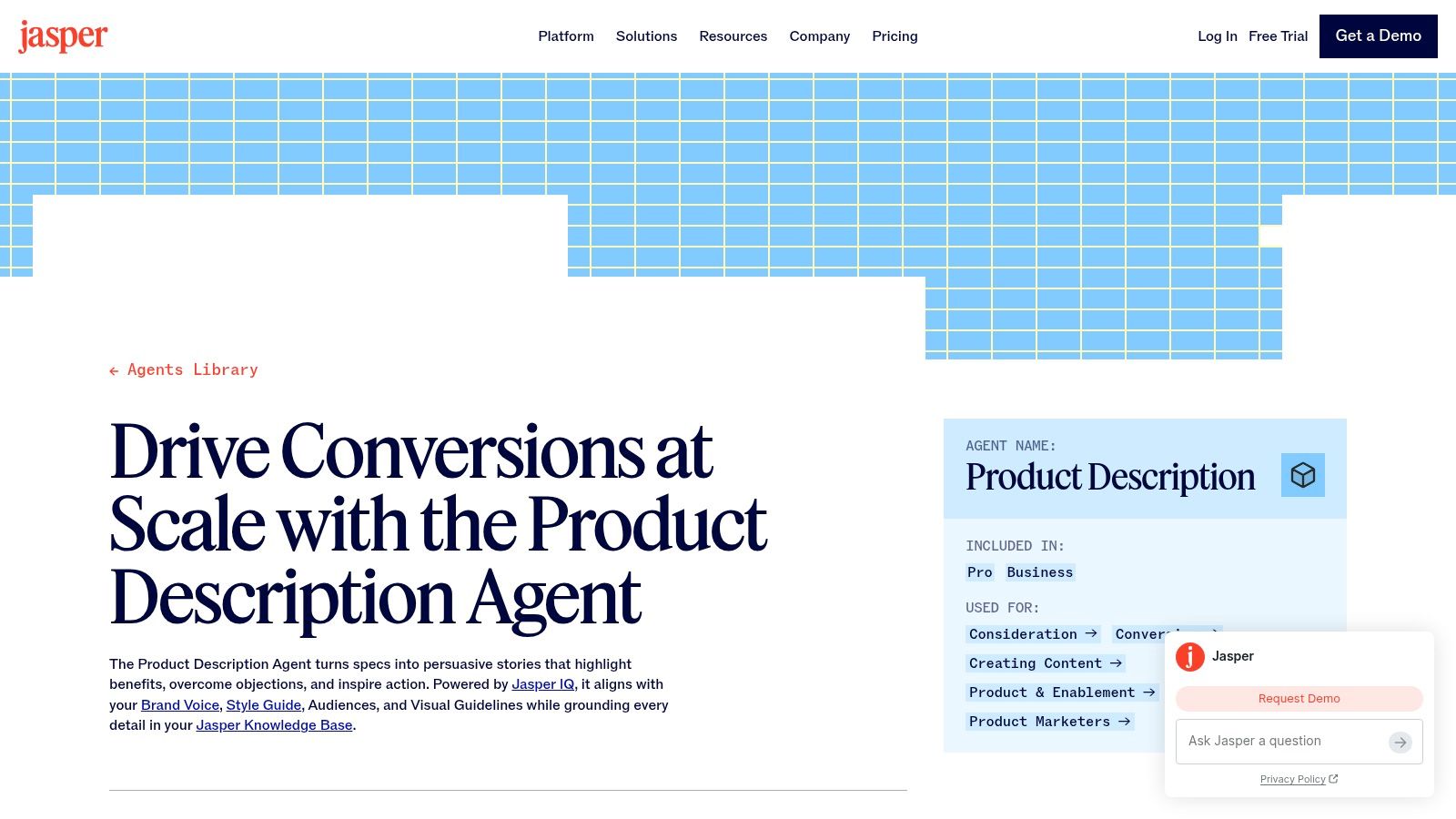
When several people write for the same brand, inconsistency becomes a production problem. Jasper's Product Description Agent brings together product information, audience guidance, Brand Voice, Style Guide controls and a Product Knowledge Base.
Its Grid workflow supports generation across catalogue items. The attraction is shared editorial guidance, not longer prompts.
Make the guidance specific enough to enforce
A useful style guide explains preferred vocabulary, banned claims, sentence structure and how to present product benefits. Sound premium is weak guidance; avoid exaggerated luxury claims and describe the finish precisely is actionable.
The need for usable guidance isn't trivial. INSEE reports that 54% of non-users of AI among businesses established in France cited insufficient expertise in 2025.
- Strong fit: Marketing teams coordinating product pages and other branded content.
- Setup burden: Someone must maintain approved product knowledge and resolve conflicting instructions.
- Poor fit: Occasional drafting that doesn't justify a shared editorial system.
A knowledge base can help ground copy, but stale information remains stale when generated into polished prose. Assign an owner to update specifications and remove superseded claims.
Jasper makes most sense when brand consistency is a recurring team requirement. It's harder to justify when the bottleneck is missing dimensions or unreliable supplier records, because voice controls won't repair those inputs.
8. Anyword Product Description Generator
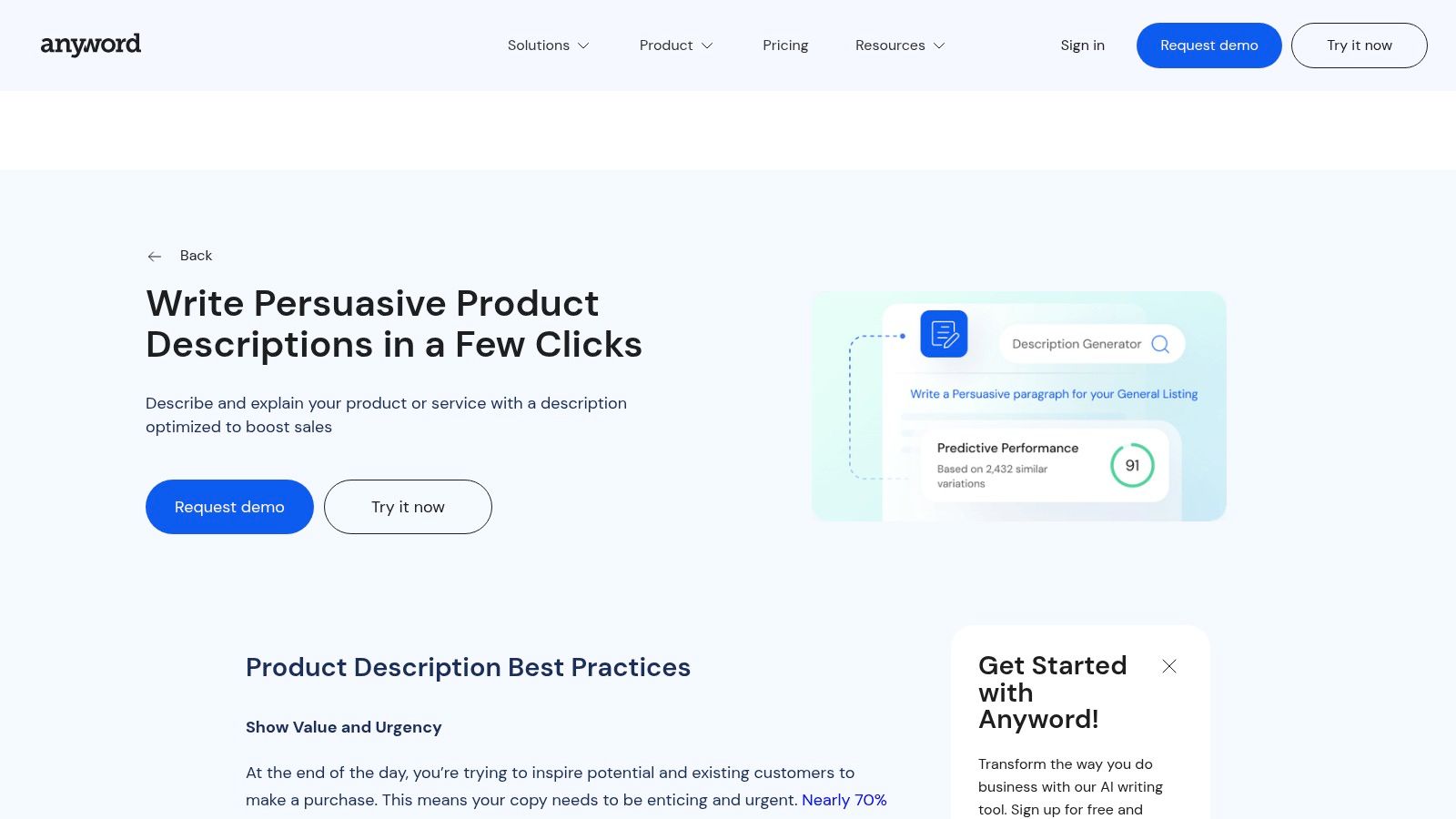
Already have accurate descriptions, but they're difficult to scan? Anyword's Product Description Generator can generate new copy or rewrite existing text, including paragraph and bullet-list variations.
That makes it relevant to refreshing presentation, especially when the same marketer also handles advertising and campaign copy. Keyword inputs provide direction, but they don't replace a sensible search strategy.
Compare useful differences
For a storage product, try a benefits-led paragraph against concise feature bullets. Keep the product facts unchanged so you're judging structure and clarity, not introducing a new promise with each variation.
Don't assume that every capability associated with the broader Anyword platform is included in the dedicated tool. In particular, the product-description tool doesn't include its Predictive Performance Score.
- Useful task: Reformatting dense supplier copy into readable product information.
- Important boundary: It isn't a catalogue publishing platform.
- Buying consideration: Wider marketing features only matter if your team will use them.
Testing principle: Compare descriptions that answer the same customer questions before comparing which sounds more persuasive.
The best variation may be the least decorative. If customers need compatibility details immediately, moving them into clear bullets can be more useful than generating another aspirational opening.
Choose Anyword for controlled copy alternatives, not as proof that a particular description will improve sales.
9. Gelo.ai Pics to Description
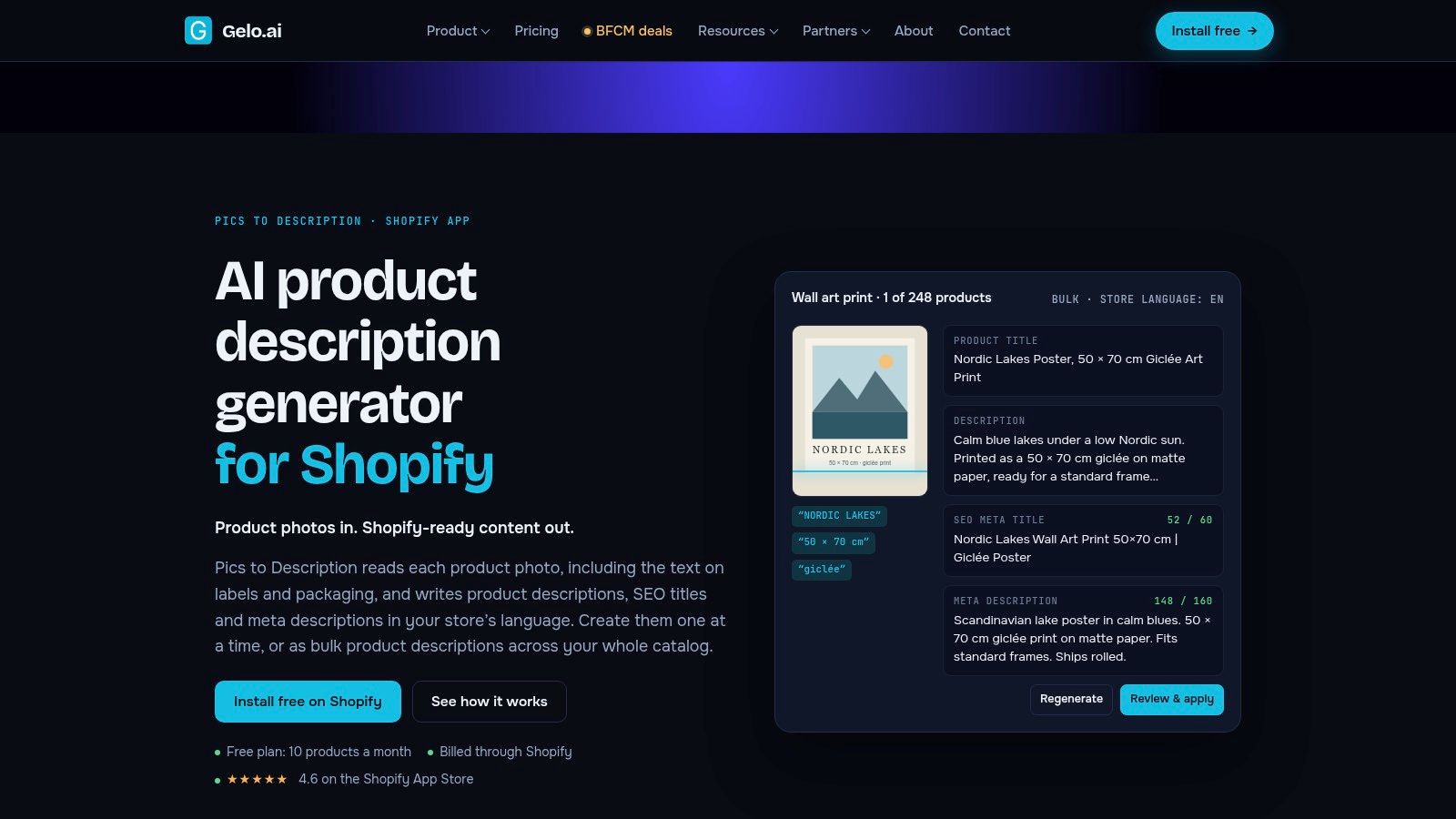
Product photographs can be your strongest starting material when supplier copy is sparse. Gelo.ai uses images and available Shopify product information to generate descriptions and related SEO fields.
Its image-first approach suits visually distinctive products, while its bulk and multilingual workflows support broader catalogue work. The critical distinction is between what a photograph shows and what it proves.
Use images for visible details
A photograph may support a description of shape, colour, pattern or visible compartments. It doesn't reliably establish fibre composition, load capacity, safety certification or hidden construction.
For a handbag, let image analysis help describe the silhouette and visible pockets. Supply the material, dimensions and fastening details from verified records rather than asking the image to answer everything.
- Good scenario: A Shopify catalogue with strong photography and limited prepared descriptions.
- Useful output: Draft descriptions alongside meta titles and meta descriptions.
- Hard limit: Invisible specifications still need an authoritative source.
OCR can help extract text from suitable images, but extracted text also needs checking. Packaging may show information for a different variant or include wording that shouldn't be copied directly into the listing.
Gelo.ai is worth considering when visual description is the missing work. It's not a shortcut around collecting technical product information, and image-based generation deserves especially careful review when similar products differ in ways shoppers can't see.
10. BigAI Copywriter
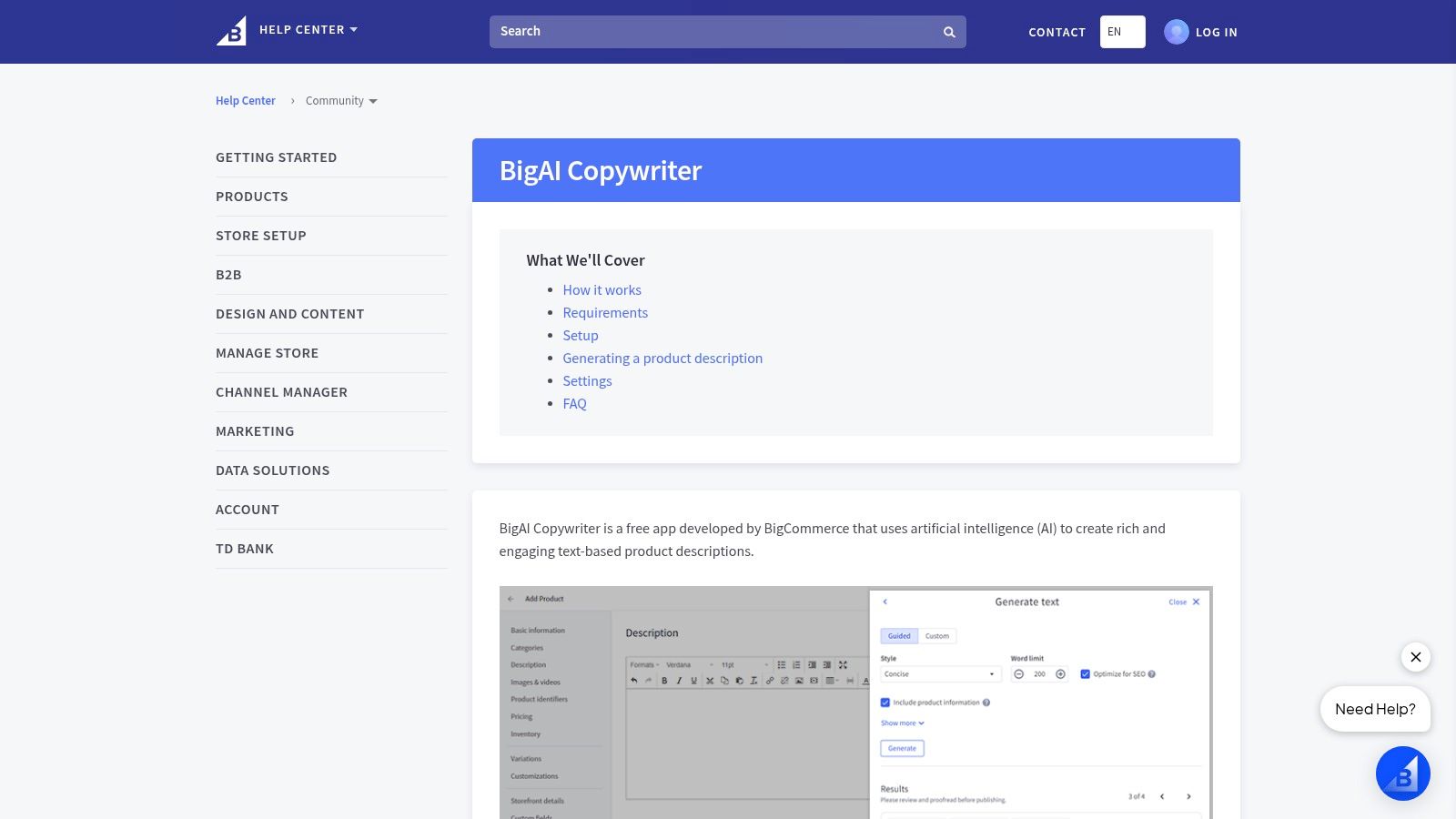
For BigCommerce merchants, staying inside the product workflow may be more valuable than adopting another writing application. BigAI Copywriter uses existing store information and offers guided or custom prompting.
Users can adjust style, length, brand voice, keywords and special instructions, then preview or regenerate the draft before applying it. That makes it a practical option for store-native description maintenance.
Improve the record before the prose
If the product attributes are incomplete, update them before generating. Otherwise, you're asking the tool to write around the same gaps that already make the listing unhelpful.
Custom instructions can request French output. Include your preferred customer address, terminology and formatting requirements, then have the result reviewed before publication.
- Main benefit: Less movement between the writing process and the BigCommerce product record.
- Access consideration: The workflow requires a BigCommerce store and appropriate product permissions.
- Main limitation: It remains a writing aid, not a replacement for catalogue management.
Use the preview stage to compare the draft with the actual attributes. Check that qualifiers such as selected models haven't disappeared and that a feature hasn't become an unconditional promise.
BigAI Copywriter is the straightforward shortlist choice when your store already runs on BigCommerce and the job is individual product copy. A separate platform needs to offer a clear operational advantage, such as structured bulk production, to justify adding another system.
Product description generator tools at a glance
| Item | Best for | Platform / integration | Pricing model | Free option |
|---|---|---|---|---|
| Shopify Magic | Drafting or updating individual product listings | Shopify admin product editor | Included at no extra charge for eligible merchants | Yes, at no extra charge for eligible merchants |
| Describely | Bulk catalog content with consistent brand rules | Shopify, WooCommerce, Wix, Squarespace, Akeneo, BigCommerce, CSV | Pay-as-you-go product credits; data enrichment and image processing may cost extra | No free option stated |
| Hypotenuse AI | Ecommerce catalogs across channels and languages | CSV imports; ecommerce, CMS, PIM, and marketplace workflows | Pricing details available from the provider or sales team | No free option stated |
| Grammarly Product Description Generator | Quick drafts for individual products or small batches | Browser-based; no store integration stated | Free online generator | Yes |
| Copy.ai Product Description Generator | One-off product copy and broader marketing workflows | Standalone web tool; no ecommerce integration stated | Free starting option; broader tool limits may apply | Yes, advertised 2,000 free words per month |
| Rytr | Product copy alongside other short-form writing | Web writing tool and Chrome extension | Free and paid plans | Yes, free plan |
| Jasper Product Description Agent | Brand-consistent copy across product catalogs | Jasper workflows, including Grid | Pro plan listed at $59/month billed annually or $69 monthly; Business pricing is custom | No free option stated |
| Anyword Product Description Generator | Creating or refreshing marketing-focused product copy | Web tool; broader marketing platform | Paid marketing subscription; pricing not specified here | No free option stated |
| Gelo.ai, Pics to Description | Generating Shopify descriptions from product photos | Shopify app | 10 free generations monthly, then $0.50 per generation; monthly plans from $49.90 | Yes, 10 generations per month |
| BigAI Copywriter | Drafting descriptions within a BigCommerce store | BigCommerce control panel | Free app | Yes, described as free |
Choosing Your Generator and Making the Output Work Harder
Match the generator to the catalogue task, not the most impressive demonstration. Shopify Magic and BigAI Copywriter suit store-native drafting; Describely and Hypotenuse AI deserve attention for structured catalogue work. Jasper is relevant when shared brand guidance matters, while the standalone writers are easier to evaluate for occasional descriptions.
The reason to care about accuracy is concrete. In Syndigo's consumer study, 85% of French consumers surveyed said incomplete or inaccurate product information damages their perception of a brand.
Test the difficult products first
Choose a small pilot that includes incomplete records, similar variants and a product with technical constraints. Ask the generator to flag missing information rather than fill it in, and keep supplier facts separate from generated benefits.
- Verify facts: Check materials, dimensions, compatibility, care instructions and every performance claim against the source record.
- Review French properly: Check terminology, units, accents, customer address and natural phrasing.
- Inspect the workflow: Confirm that exports preserve product identifiers, formatting and variant distinctions.
- Keep human approval: Route regulated, health-related, cosmetic, technical and safety-sensitive claims to a qualified reviewer.
Don't judge the pilot only by how quickly the first draft appears. Count the work needed to correct, approve and publish it, because that's the workload your team will repeat.
Generating text is already commonplace: the 2025 French e-commerce figures report that 82% of French e-tailers use generative AI. Your practical advantage therefore comes from better inputs, reliable review and useful product information, not merely using AI.
Publish descriptions that can be understood
A good description only helps discovery if search engines and AI assistants can access and interpret the listing. Keep essential specifications in readable page content, maintain clear product identities, and avoid leaving important information solely inside images.
Treat this as a connected workflow. Just as teams that automate Instagram lead collection workflows need a usable hand-off after collection, catalogue teams need a dependable hand-off from generated draft to approved, accessible listing.
Test a generator on ten representative products. Then verify that the published descriptions retain the facts, answer purchase questions and appear in a format AI engines can read and cite, without assuming that publication guarantees a citation.
Our Campaigns product creates structured AI content for your business and every catalogue item, complementing the descriptions you've checked and approved. Visit Wispra to create a free profile in two minutes and publish it in our AI-ready directory, which ChatGPT, Claude, Perplexity and Gemini read.