
Local SEO Services: How to Choose, Price and Measure
Compare local SEO services, the questions to ask a provider, typical pricing and the metrics that prove results. A practical guide for French local businesses.
When the Cour des comptes audited state support for local business, it found that only 43% of French retail SMEs had a website in 2020; by 2022, 76% did, a 33-percentage-point rise in two years, as the Cour des comptes summary report records. That jump solved the presence problem and exposed a harder one. A website is a starting asset, not a distribution channel, and a firm can hold a perfectly good site while staying invisible to the person three streets away looking for a plumber on a Sunday.
The distance between owning a site and being found is what local SEO services are paid to close. That makes the written offer, not the monthly fee, the first thing to judge. A provider that lists its deliverables, names the directories it will fix and reports calls by postcode is selling something you can hold it to. A provider selling a fee and a promise is selling the absence of exactly that.
Buy the scope and the measurement plan. Treat the monthly figure as the price of a specific set of tasks, not the price of a ranking.
Local SEO Services and What Each One Covers
Six service lines cover most of what a provider can sell a local business, and most quotes bundle two or three of them into a single figure. Seeing the whole menu first is what stops you buying a narrow slice at what looks like a low price.
| Service line | What it covers | Best for | Written deliverable |
|---|---|---|---|
| Google Business Profile management | Primary category, services, attributes, hours, posts, review replies | Any business with a street address | Verified, complete profile with change log |
| Citation and directory clean-up | Name, address and phone consistency across listings | Firms with several listings or locations | List of corrected and missing directories |
| Local landing pages | Service-area and location pages with real local detail | Businesses serving several towns | Page brief and URL list per location |
| Review generation and handling | Review request process and reply templates | Service businesses with steady customer flow | Reply rate and rating trend report |
| On-site local optimisation | Title tags, LocalBusiness schema, internal links to location pages | Businesses with a working website | Audit with prioritised fixes |
| AI-search readiness | Structured business facts for AI assistants and recommendation tracking | Businesses wanting visibility in ChatGPT, Perplexity, Gemini or Google AI | Prompt tracking report by field |
Scope is easier to weigh with the full menu on the table.

The order a single-site business should buy in
For a plumber, a dentist or one restaurant, the Google Business Profile comes first, because it appears in the map pack before any page of the website does. Management here means the primary category, the services list, attributes, opening hours and replies to reviews. Insist on a change log as part of the deliverable: profile edits get overwritten, and without a log nobody can say who changed what or when.
Review handling comes second. The work is a request process you can repeat (a QR code at the counter, a link in the invoice email) plus replies written in your voice rather than pasted templates. Ask for the reply rate and the rating trend as a report, not for a promise about star averages.
Where multi-location money goes
Citation clean-up fixes the name, address and phone details that drift between listings, and it matters most for firms with several locations or an old address still floating around the web. A proper audit of your local citations shows which directories carry the wrong postcode before anyone charges you to build new citations on top of broken ones.
Local landing pages follow for anyone serving several towns. Each page needs real local detail: the streets you cover, parking, the jobs you finish most often there. Swapping the city name in a template produces pages that read as duplicates, and they rank the way duplicates rank.
The layer most quotes still miss
AI-search readiness is the newest line and the least standardised. It means structuring your services, location, availability and credentials so assistants can read them, then tracking whether ChatGPT, Perplexity, Gemini or Google's AI surfaces name your business for the queries that matter. Wispra identifies the directories that appear in AI answers for your field and shows you which ones you're missing, which is a more useful starting point than rebuilding the website.
The French market explains why all six lines sell. INSEE data for 2022 shows that 82% of French micro-enterprises had internet access for professional use, but only 37% of internet-using micro-enterprises maintained a website. Digital adoption is close to universal. Owned, search-readable information about address, services, hours and prices is not.
Match the service to your situation before you shop. A single-address trade needs the profile and review handling first, and little else in month one. A firm covering ten towns needs citation clean-up and location pages before a euro goes into profile posts.
What Local SEO Services Cost in France
Providers here price local SEO in four main shapes plus a project option. None of them tells you much on its own.
| Pricing model | What it usually includes | What to check |
|---|---|---|
| One-off local audit | Profile, citation and website review with a prioritised fix list | Whether the fixes are included or only listed |
| Monthly retainer, single location | Profile management, review handling and monthly report | Scope of review replies and content each month |
| Multi-location retainer | Per-location profiles, location pages and consolidated report | Whether volume pricing applies and who owns each profile |
| Setup plus retainer | Initial clean-up followed by a lower ongoing fee | What happens to profiles and data if you cancel |
| Project-based content | Local pages or articles delivered once | Editorial standard and whether facts are sourced |
Ask what happens when the website itself is the obstacle. A business with no site, or one built on a platform that can't take structured data, pays more for the same service, because location pages and LocalBusiness schema can't be added to something that doesn't exist. That is a genuine trade-off. A provider may quote profile work alone because the rest of the scope would have doubled the total, and you should hear that from them rather than discover it in month three.
The market these offers are built for is dominated by small firms. France Num's 2024 digital-transformation barometer surveyed 10,125 French very small and small-to-medium-sized enterprises, including 6,425 very small enterprises, which is the shape of client most providers price for. Templated packages and tiered retainers follow from that.
Four things move the number: the count of locations, the volume of reviews to handle, whether content has to be written from scratch, and how deep the reporting goes. A guide to French agency costs is useful for calibrating a quote, but the scope document remains the deciding evidence. A fixed monthly fee with no listed deliverables can't be compared with anything, which is usually why it's fixed.
Take two buyers. A single-address plumber in Nantes pays for one profile and a predictable number of review replies a month. A dental group with six practices pays per location, and that per-location fee should fall as the count rises, because the second profile costs the provider far less than the first. If it doesn't fall, you're funding admin.
Practical rule: compare cost per deliverable, not cost per month. Divide the fee by the named items and the reporting frequency, and get the scope in writing before the first payment.
Questions to Ask a Provider Before Signing
Send the same one-page brief to every provider you shortlist, so the offers you compare answer the same question. The brief names your locations and service areas by town or postcode, your current listings and directories, the services you want to rank for, your monthly goal in calls or visits, and your budget range. A provider that restates the brief in its own words before quoting has read it. The one that returns a template hasn't.
Who does the work
Ask whether tasks are in-house or subcontracted, and whether the person reporting to you is the person making the edits. A good answer names a role, a person and a response time. A warning answer hides behind "our team" while the account manager sells work that a freelancer you'll never meet delivers.
What changes in the first month
Ask which listings and directories will change, then request a before-and-after list covering that month. A provider who can't name the directories before starting is guessing about where your data lives, and that guess is what you're paying for.
Where the risk sits
Reviews carry the most risk. Ask how they're requested, because incentivised reviews can breach Google's review policy and a suspended profile costs far more than any monthly fee. Ask the same question about duplicate listings and virtual offices: both can get a profile suspended, and both should be on the provider's checklist without you raising them.
Measurement and exit
Which AI assistants are measured, and how often? How does reporting separate calls, direction requests and tagged website clicks from ranking data? What happens to the profile, reviews and content if you leave? A good answer names a deliverable, a date or a measure. A warning answer refuses to name a timeline, or promises rankings without stating the method that produces them.
One question sorts the field quickly: ask which directories appear in AI answers for your trade, and which of them your business is missing. A provider that can't name a single one hasn't looked, whatever the deck says about artificial intelligence.
Metrics That Show Local SEO Is Working
Treat the monthly report as a lookup sheet, not a narrative.
| Metric | Where to read it | Healthy signal | What it tells you |
|---|---|---|---|
| Profile completeness | Google Business Profile dashboard | All fields filled, category accurate | Relevance baseline |
| Review count and average rating | Profile reviews section | Steady new reviews each month | Prominence |
| Review response rate | Profile reviews section | Most reviews answered | Engagement with customers |
| Map-pack visibility | Rank tracker by postcode | More appearances in target postcodes | Local ranking strength |
| Calls and direction requests | Call tracking and profile insights | Rising month on month | Real demand |
| Website clicks from profile | UTM-tagged links in analytics | Rising clicks to service pages | Traffic quality |
| Branded vs non-branded discovery | Search Console queries filtered by brand | Growth in non-branded queries | Reach beyond existing customers |
| AI recommendations | Prompt tracking across ChatGPT, Perplexity, Gemini, Google AI | Business named for field queries | AI visibility trend |
Two lines in that table mislead more often than the rest. Total profile views and interactions rise when people already search for your brand, so they can climb for months while reach to new customers stays flat. Read them against non-branded queries in Search Console and you'll see which of the two is happening.
AI recommendation counts are the second trap. Arcep's latest digital-usage release reports that generative AI is used by 48% of the French population, a 15-point rise in a single year, and the same coverage acknowledges that no dedicated study yet measures how people use generative AI for local searches. That leaves a real question for a business owner: can an assistant recommend you for a query like "artisan plombier ouvert dimanche à Lyon", and does that recommendation produce a call? Until better evidence exists, treat recommendation counts as a trend indicator rather than proof of leads.
A recommendation in ChatGPT is a signal about your information, not an invoice line. Count it monthly, then check whether the phone rang.
Read the numbers together rather than in isolation. Compare calls and direction requests with map-pack visibility in the same postcodes, and compare each figure with the baseline you recorded at the start of the trial. One month on one metric tells you nothing you can act on.
Wispra tracks visibility across Google AI Overviews, Google AI Mode, ChatGPT, Gemini and Perplexity, consolidates your review platforms on one page with each figure attributed and dated, and keeps the whole picture in a real-time analytics dashboard rather than a slide deck.
How to Run a 30-Day Provider Trial
Thirty days is long enough to see whether a provider's scope is real and short enough to survive a bad choice. Frame the trial on three stages: relevance first (category, services, attributes, description, hours, listing accuracy), then prominence through a steady flow of reviews and consistent business mentions, then validation by tracking map-pack visibility, calls, direction requests, website clicks and conversions by municipality or postcode, as this France-focused local SEO synthesis sets out. Google's documented framework is relevance, distance and prominence, which is why keyword additions can't beat a competitor who is physically closer and better reviewed.
The sequence below is the one to hand to whoever runs the account.
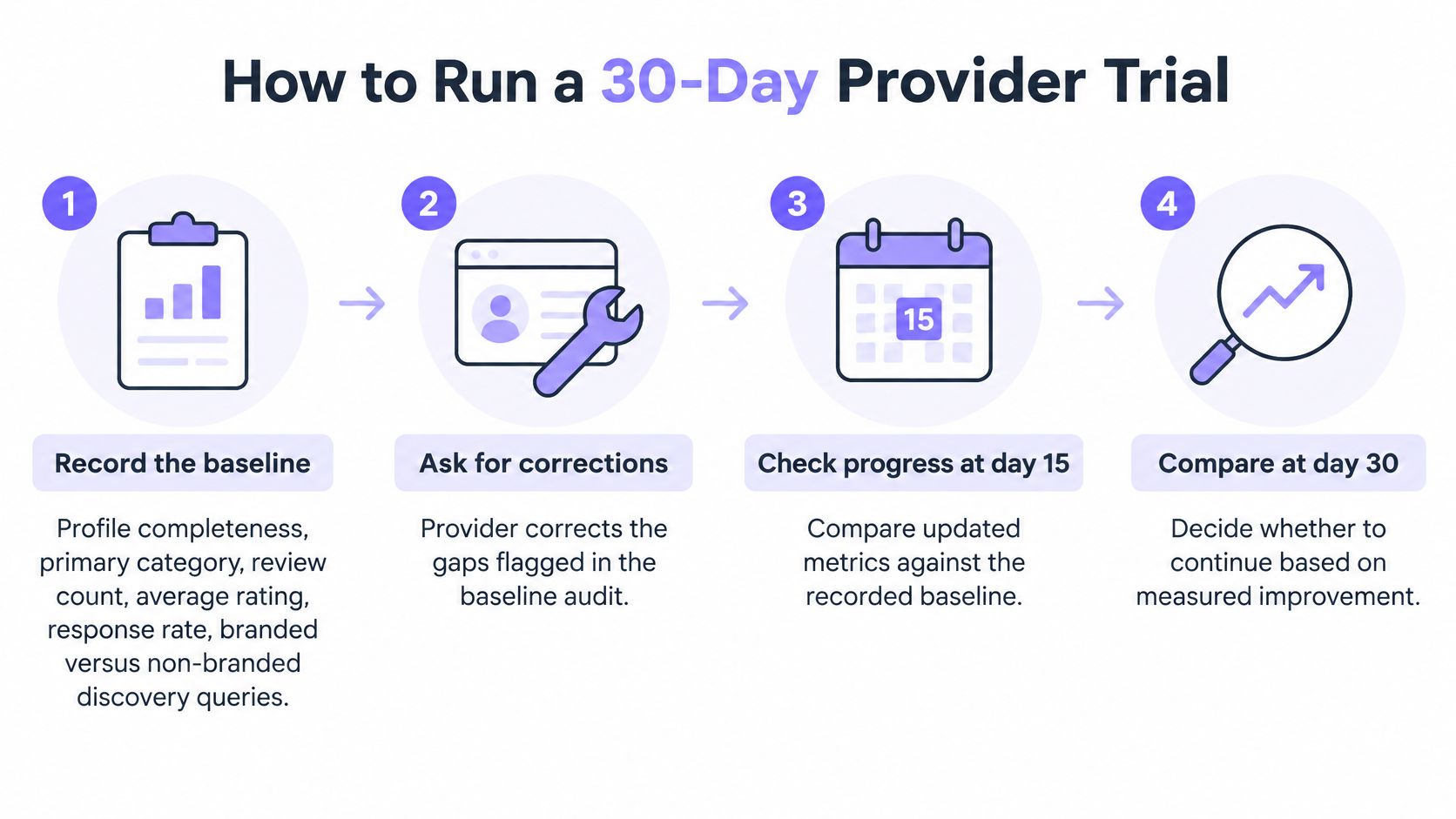
Record the baseline before anyone touches the profile. Capture profile completeness, the primary category as it stands, review count, average rating, response rate, and branded versus non-branded discovery queries. A month later this is the only honest reference point; without it, every improvement is an opinion.
Have the profile corrected, field by field. The most specific primary category, the services list, a description that states what you do and where, opening hours including holiday exceptions, and accurate location data. Then check the business name: stuffed keywords are a suspension risk, not a ranking shortcut.
Clear duplicates and ineligible addresses. Duplicate listings split your reviews and confuse the map pack, and a virtual office breaks eligibility rules. Both should be gone or formally flagged inside the first week.
Install tracking before the work starts. UTM-tagged links on the profile, call tracking on the number shown there, and a lead source field in the CRM. Set these up late and the first fortnight becomes unmeasurable.
Review at day 15 against the baseline. Look at profile interactions and calls rather than rankings. The midpoint exists to catch a wrong category, a broken link or a review request process nobody is running.
Compare at day 30 by municipality or postcode. A single city average hides the case where visibility improved in one town and dropped in another; the postcode split shows which service areas respond.
Decide on evidence, not on the confidence of the report. Continue, adjust the scope, or stop.
One benchmark worth knowing before you read the day-30 numbers: complete profiles can generate up to seven times more clicks than incomplete ones, a figure the same synthesis carries as directional rather than guaranteed, since it aggregates third-party studies and Google's own claims. Use it to justify finishing the profile, not to forecast revenue.
Google removed separate discovery-search statistics in late 2024, so a report combining profile interactions, call tracking, UTM-tagged links and CRM lead records is more trustworthy than one built on discovery-query counts alone. Healthy progress at day 30 looks like a complete profile, a rising review count and more calls or direction requests from the postcodes you targeted. It doesn't look like a screenshot of a ranking.
Confirm the Provider Before You Commit
Run this list before the signature, not after.
- Scope in writing. Named deliverables, quantities, frequency and the owner of each task, on one page you can file.
- Baseline recorded and shared. If they didn't record it, they can't prove movement later.
- You own the profile. Your business should hold admin access to the Google Business Profile and be able to remove the provider without losing the listing or its reviews.
- Reporting split by postcode. Calls, direction requests and tagged clicks by municipality, plus AI visibility if that's part of the decision.
- Exit terms. What happens to listings, content and reviews on the last day of the contract.
- AI coverage and cadence. Which assistants are tracked and how often the report lands, stated as a schedule rather than a capability.
Then take one concrete step this week: request the same baseline audit from two or three providers, run the 30-day trial with the one whose written scope and measurement plan are clearest, and sign only if day 30 shows movement in calls or direction requests from your target postcodes. Compare offers by cost per deliverable. The monthly fee is the least informative number in the proposal.
The cheapest quote is rarely the best value. The clearest scope and measurement plan usually are.
Wispra publishes an AI-ready directory profile and a free AI visibility report covering 10 questions from your field, with no credit card required, which gives you the baseline audit before you talk to anyone. The Performance plan then keeps your company information current, brings your review platforms together with dated figures, publishes indexable content and measures visibility across Google AI Overviews, AI Mode, ChatGPT, Gemini and Perplexity each month. Start with the free report at Wispra and hold every provider you shortlist to the numbers it shows.