
Nogent Sur Marne Rental Guide for 2026
Practical Nogent sur Marne rental guide: 2026 rents by flat type, which RER station fits, and how to check flood and quarry risk.
Nogent-sur-Marne's population changed by −0.2% a year between 2017 and 2023, according to INSEE's demographic profile. That's a useful corrective to the idea that a rental search can be reduced to a fast-growing suburb and a single average price. Your affordable home is determined by its type and total cost, while your practical location is determined by the walk from its entrance to the station you'll use.
If you're searching for Nogent-sur-Marne rental, build your shortlist around those two tests rather than the commune name alone. A small flat with an expensive square-metre rate can still cost less overall, and an address near one RER station may be inconvenient for someone who needs the other.
Monthly Rent Budgets by Home Type
Nogent-sur-Marne rent benchmarks by home type
The figures below come from Miramo's comparison of Ministry and ANIL modelled estimates and OLAP observed rents. Each row has its own basis, so read the source, home type and charges treatment together.
| Home type | Source and basis | Rent per m² | Charges and monthly reading |
|---|---|---|---|
| Unfurnished apartment about 52 m² | ANIL and Ministry 2025, modelled from 2019–2025 listings | €24.08/m²/month | Including charges; approximately €1,252 monthly when the rate is multiplied by the stated area |
| One- or two-room home about 37 m² | ANIL and Ministry 2025, modelled from 2019–2025 listings | €26.58/m²/month | Including charges; approximately €983 monthly when the rate is multiplied by the stated area |
| Studio | OLAP observed median | €25/m² | Higher rate than larger homes; confirm whether charges are extra |
| Two-room home | OLAP observed median | €21.3/m² | Lower rate than a studio; compare actual floor area before judging the total |
| Three-room home | OLAP observed median | €19.1/m² | Family-size benchmark; charges treatment must be checked separately |
| All homes | OLAP observed median | €21/m² | Town-wide median; don't mix it with the modelled ANIL rows |
Read the rows before comparing adverts
Start with the unfurnished apartment row. It describes a modelled typical property, not a promise that an available flat of that size will rent for the calculated amount. Condition, layout, outdoor space and the particular address still matter when you compare actual adverts.
The smaller modelled home has a higher square-metre rate but a lower monthly total. That distinction is the reason to choose your home-type row before setting a search filter. Multiplying a town-wide rate by any floor area produces an estimate, not a reliable quotation for that property.
The OLAP rows answer a different question. They describe observed median rents, whereas the ANIL and Ministry rows estimate typical properties using listing information. A median isn't an asking price, and neither measure establishes what a landlord will accept today.
Nogent-sur-Marne had 32,455 municipal residents in 2023, at roughly 11,591 inhabitants per km², according to INSEE's commune statistics. In a compact residential market, a broad average can conceal very different homes. It doesn't tell you whether the advertised bedroom is usable, whether the living room doubles as a workspace, or whether essential storage is outside the flat.
Compare the total you'll actually pay
For a hypothetical comparison, take a compact studio and a substantially larger family flat. Apply the relevant observed rate to each property's floor area, then compare the resulting monthly amounts. The studio can have the higher rate per square metre and still require the smaller overall budget.
Don't interpret a lower square-metre rate as proof of affordability. A larger area can outweigh that apparent saving, and an attractive base rent can become unsuitable once you add the costs excluded from the headline.
Budget rule: Compare homes using the same cost categories, not simply the largest price printed in each advert.
Ask the agent to separate the following:
- Base rent: The payment for occupying the home before separately stated charges.
- Building charges: What the quoted amount covers, including whether heating or water is included.
- Personal running costs: Energy, internet and other services you'll arrange yourself.
- Move-in cash: The deposit, any agency fee and moving expenses, recorded separately from your recurring budget.
The phrase charges included doesn't mean every household bill is covered. Request the breakdown and ask how the charges are calculated and reconciled. If the advert leaves their treatment unclear, keep it out of your active shortlist until the agent answers.
Match the layout and furnishing status
French room labels can also cause confusion. Don't assume a two-room property means two bedrooms: inspect the plan and identify the living room, separate bedroom and usable storage. This guide to a two-room apartment can help you interpret the category before comparing listings.
A furnished advert needs another check. The presence of a sofa in photographs doesn't establish what will remain when you move in, and an unfurnished benchmark doesn't establish a justified furnishing premium.
Set your ceiling using the closest relevant row, then test it against a written quotation for the actual property. Keep a separate cash reserve for signing and moving so that a manageable monthly payment doesn't conceal an unaffordable start.
Match the Address to the Right Station
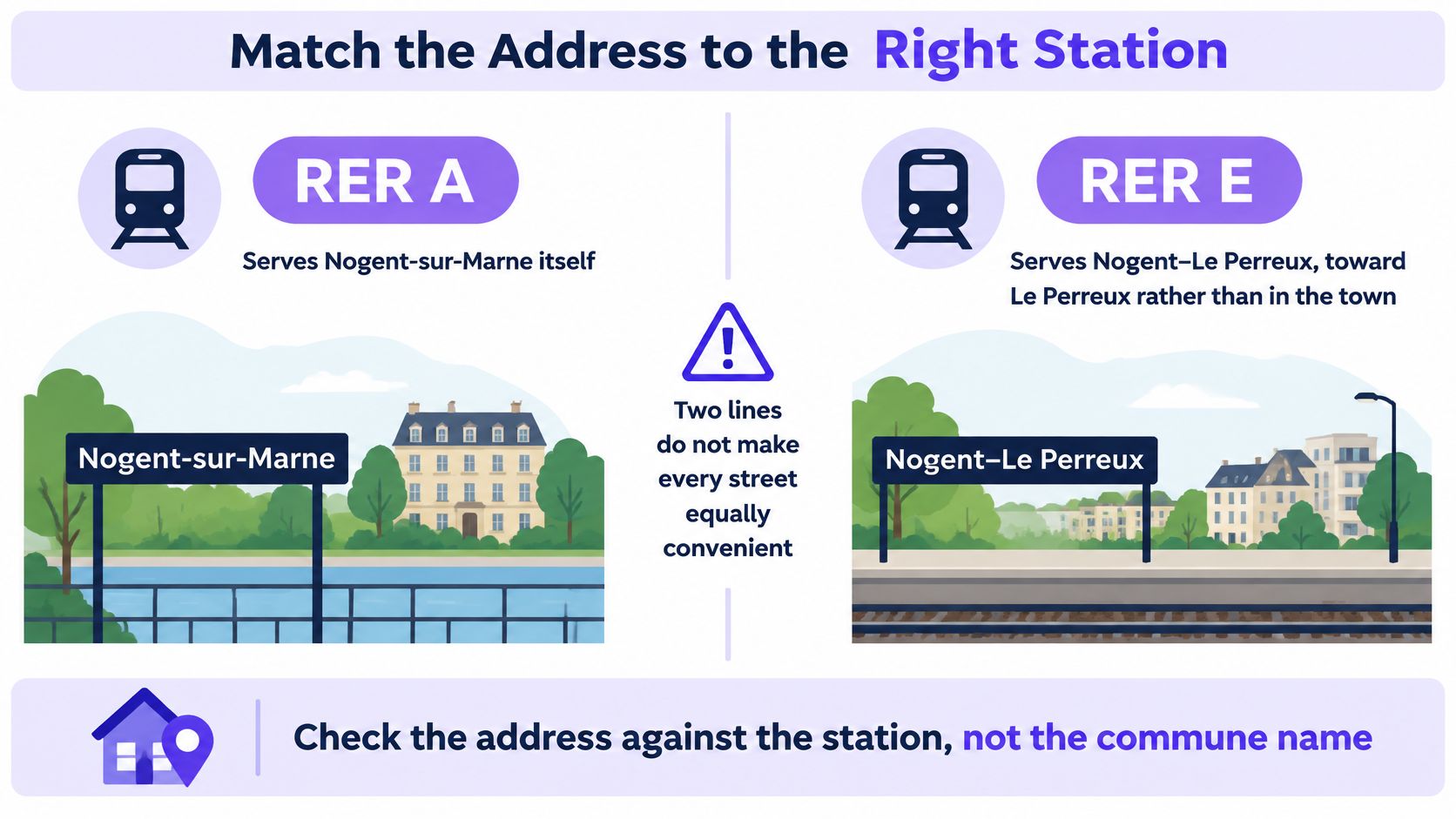
Two RER stations serve the Nogent area, but they are separate destinations: RER A stops at Nogent-sur-Marne, while RER E stops at Nogent–Le Perreux, toward Le Perreux. The local transport overview from Veia also lists buses 116, 317 and 210, plus a night bus service. A station or bus name in an advert does not tell you how long the trip takes from the building entrance.
Stations and buses renters should test
| Service | Stop that matters | Where it actually sits | Check before you apply |
|---|---|---|---|
| RER A | Nogent-sur-Marne | In Nogent-sur-Marne | Door-to-door walk, not distance from the town centre |
| RER E | Nogent–Le Perreux | On the Le Perreux side | Whether this flat is genuinely closer to E than to A |
| Bus 116 | The specific 116 stop on your route | At the stop shown for that route in the transport overview | Evening frequency and the walk with shopping |
| Bus 317 | The specific 317 stop on your route | At the stop shown for that route in the transport overview | Whether it provides a workable alternative during RER A disruption |
| Bus 210 | The specific 210 stop on your route | At the stop shown for that route in the transport overview | Whether its route suits your employment destination |
| Night bus | The stop on the night-bus route serving your return | At the stop shown for that route in the transport overview | Service times and the final walk after a late shift |
Test a working day, not a map label
For a commute to central Paris, compare the whole journey from the building entrance to the workplace door. Include the walk, station access, any interchange and the final approach. A flat closer to RER E may suit one destination and add time to another.
The same applies to buses: a route number is only useful if the nearest stop is on your actual route and its timetable fits your day. Check the specific stop and walk from the property, rather than treating the town name as proof of convenient access.
On viewing day, walk the route yourself. Check crossings, pavement width, lighting and whether the station entrance you plan to use is accessible from that direction. If step-free access matters, verify the complete route rather than assuming the nearest entrance provides it.
Test the journey home separately
A late shift can change which address belongs on your shortlist. Check the service available at your actual finishing time, allowing for the walk from work and a delayed departure. Then check a disrupted-day alternative: identify the bus stop, where you would change and how you would cover the final stretch.
A transport alternative is useful only if you can explain how you'd get home using it.
Record the outward route, return route and backup beside each address. The affordable option depends on the home type, while the reachable address depends on the walk to the service you will use. A different routine can make the same town produce a different shortlist.
Parcel Risks and Viewing Pitfalls
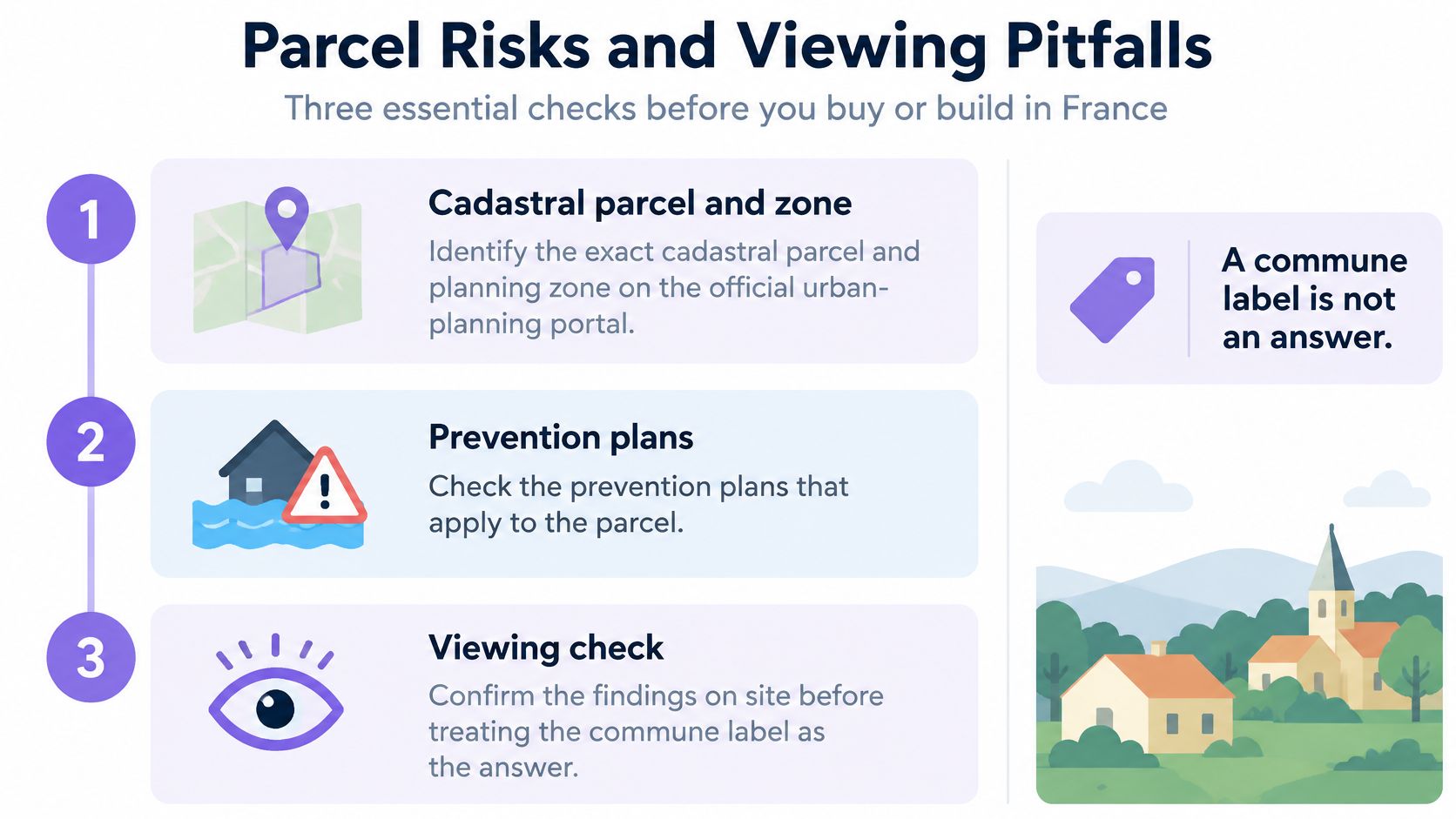
Start with a parcel-level check, not a municipality-wide risk badge. Identify the exact cadastral parcel and planning zone through the official urban-planning portal, check the prevention plans that apply, and obtain a transaction-specific état des risques.
The Géorisques commune report identifies relevant prevention-plan categories covering Marne and Seine flooding, clay shrink–swell movement, and ground movement associated with former quarries. Their presence at commune level doesn't establish the exposure of every building.
Connect the paperwork to the exact building
Use this sequence before treating the risk question as resolved:
- Identify the parcel. Match the street address and building to the cadastral reference. In a larger development, check that the documents concern the building containing the flat.
- Read the applicable plans. Establish which prevention plans cover that parcel and which versions the documents refer to.
- Request the transaction document. Obtain the état des risques prepared for the proposed rental rather than accepting a general description of Nogent-sur-Marne.
Keep the address, parcel reference, plan version, hazard category and document date together. A saved PDF without a clear connection to the property won't help you resolve a discrepancy later.
For example, consider a riverside address with basement storage and another property farther from the river and a former quarry. Sharing a postcode doesn't make their exposure identical. Elevation, ground conditions and the position of the building all need property-specific consideration.
Inspect the spaces that the photographs omit
A freshly decorated upstairs flat can still be unsuitable if its only storage is a damp cellar. Ask to see every space included in the letting, not just the rooms the agent has prepared for the viewing.
In a cellar, notice musty smells, staining, peeling finishes and anything stored above floor level. These observations don't diagnose flooding or prove its cause, but they justify questions about water entry, repairs and the suitability of the space for your belongings.
Cracks need the same restraint. Photograph their location and appearance, ask whether they've been assessed, and don't assume a cosmetic repair establishes that the underlying issue is resolved.
- Cellar condition: Ask whether it has experienced water entry and whether proposed storage is suitable.
- Visible movement: Request any available assessment of significant or recurring cracks.
- Missing paperwork: Pause if the landlord can't produce the relevant risk document or explain an address mismatch.
- Insurance questions: Resolve uncertainty about the proposed use of the premises before committing.
The guide to mandatory real-estate diagnostics helps distinguish the broader diagnostic file from the parcel-risk information.
Viewing safeguard: A clean finish is evidence of presentation, not evidence that ground, water or structural questions have been answered.
If your decision depends on basement conversion, construction or financing, obtain an appropriate professional geotechnical or flood review. A tenant needn't diagnose the building, but shouldn't be expected to ignore an unresolved issue that affects how they intend to live there.
Lease Terms, Deposit and Furnishing
Before signing, compare the lease, any furniture inventory, the payment breakdown and the entry condition report. Each answers a different question, and a reassuring advert doesn't replace any of them.
Establish what you're renting
The lease should clearly identify the parties, the property, the included spaces and whether the home is furnished or unfurnished. Check that parking, cellar access and any other promised facilities appear in writing.
For a furnished home, inspect the furniture inventory against what's present. Record missing items and damaged equipment rather than accepting photographs as the definitive list. Confirm the lease category and current rules before agreeing to the term or notice provisions.
Separate the money lines
The dépôt de garantie is separate from rent and agency charges. Confirm the applicable legal limit for the lease category before paying, and make sure the written amount agrees with the payment request.
Ask for an itemised agency-fee statement identifying what you're paying for. Don't accept a single unexplained move-in total that combines the deposit, rent and services.
| Document or payment | Your check before signing |
|---|---|
| Lease | Correct parties, address, included spaces and agreed terms |
| Furniture inventory | Items present, working condition and existing damage |
| Deposit and fees | Separate amounts, stated purpose and verified recipient |
| Entry condition report | Accurate observations, meter readings and supporting photographs |
Make the entry record usable
The état des lieux should describe the condition of walls, floors, windows, fittings and included ancillary spaces. Add meter readings and clear photographs, keeping copies with the signed report.
Write down defects before moving belongings over them. A loose handle, stained floor or damaged appliance is easier to document at entry than to explain during an exit disagreement.
Arrange suitable cover for the home and clarify when it needs to begin. This tenant home-insurance guide provides a practical starting point.
Finally, reconcile the lease with the inventory and risk paperwork. Don't pay an unidentified recipient because they're pressing you to secure the flat quickly.
How to Find, Secure and Sign a Rental
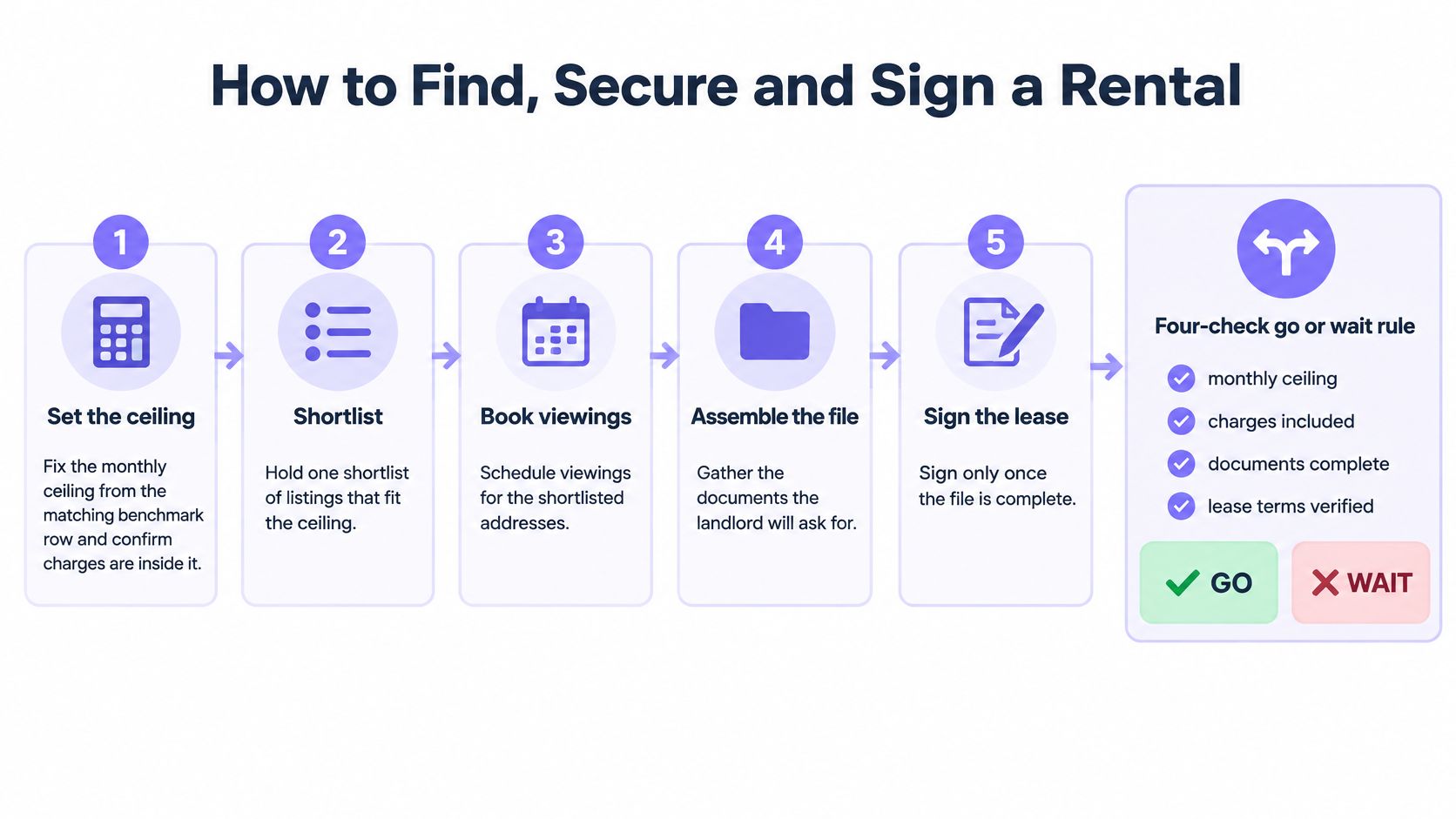
The same town can produce very different shortlists: the home type shapes the affordable total, while the walk from the exact address determines which station is practical. Treat each rental as a sequence of decisions, not a race to contact every advertiser.
Prepare a shortlist you can act on
Set your ceiling and available cash.
Choose the home-type benchmark closest to what you need, then set a maximum recurring housing spend. Calculate the money needed at signing separately. Monthly affordability and cash on hand are different questions.Add an uncertainty field to your comparison sheet. If a cost has not been explained, mark it unresolved rather than assuming it is free.
Search by exact location.
Search for Nogent-sur-Marne alongside a street or station area, and check that the property is in the advertised commune. Once the agent provides it, save the full address privately with the listing reference and contact details.A broad location label, map preview or agency address does not establish where the home is. Check the property itself.
Group viewings into a workable trip.
Arrange nearby appointments together, with enough time to inspect each home. Walk the route to the station you would use during the viewing. Door-to-door time is more useful than a station name in an advert.If you regularly travel late, visit the surrounding streets in the evening. A daytime viewing cannot show what the return walk feels like after dark.
A simple spreadsheet can track address, home type, stated area, quoted costs, unresolved questions, travel observations, document status and next action. Keep PDFs and photographs in a matching folder so the supporting evidence is easy to find.
Inspect, then submit a complete file
Test everyday use at the viewing.
Ask how heating and hot water work. Check window seals, open and close the windows, and test your mobile signal in the rooms where you would work or make calls.Find the bins and bicycle storage, and check how you would carry shopping into the building. With permission, photograph features left out of the advert and any defects you want recorded.
Furniture can make a small room look more usable than it is. Check that your bed, desk and storage will fit without blocking doors or making the living area difficult to use.
Send a complete dossier through a verified channel.
Prepare identity information, evidence of income or a guarantor where relevant, a recent tax notice, and evidence of employment or student status. Check which documents fit your circumstances and are requested for the application before sharing them.DossierFacile can help organise a French rental application. Consider watermarking document copies for the intended rental purpose, and verify the recipient's identity and contact channel independently before sending sensitive information.
Having the file ready before a viewing can prevent delays if you want to apply. It does not mean you should send it indiscriminately.
Keep the application ready, but release it deliberately. Preparation and caution can go together.
Resolve the final questions in writing
Get the offer's inclusions confirmed.
Email a concise list of unanswered questions about charges, parking, furniture and included storage. Ask the agent to confirm the proposed start date and provide the documents you will review before signing.Consider a studio that looks affordable in the search results. If the response identifies separately billed charges and optional furniture costs, compare the written total with your budget rather than relying on the headline rent. Time spent viewing does not make the original offer more affordable.
Keep the reply with the listing. If the lease describes a different arrangement, resolve the discrepancy before accepting it.
Verify the recipient, then sign and pay traceably.
Confirm the landlord's or agency's identity and the authority of the person handling the transaction. Check that names and property details match across the lease, correspondence and payment instructions.Use a traceable payment method and keep receipts. Pause if bank details change unexpectedly, urgency is unexplained, or payment is requested before basic checks are complete.
Read the final documents yourself, even if you have already discussed the terms by telephone. Verbal reassurance cannot correct an inaccurate inventory or restore an omitted parking space.
Use a four-check go or wait decision
Proceed only when the total fits your ceiling and the charges are understood, the timed journey reaches the station you need, the application file is complete, and the parcel-specific risk document has been requested and any material concerns resolved.
These checks work together. A low headline rent does not make an unsuitable journey practical, and a convenient address is no reason to send personal documents to an unverified recipient.
If a flat suits someone using Nogent–Le Perreux but your workday requires practical access to RER A, leave it off your shortlist. Wait, book another viewing and compare a different address.
Next, shortlist a small group of Nogent-sur-Marne homes. Check the budget and walking route for each, then submit your dossier only where the practical and documentary checks are satisfactory.
Wispra helps local businesses, including estate agencies, get recommended by AI search engines through an AI-optimized business directory and content tools. If your agency serves renters in Nogent-sur-Marne, visit Wispra to explore how clear local guidance and business information can be more discoverable.