
Tenant Home Insurance Explained
Master tenant home insurance with our detailed guide. Learn legal duties, MRH coverage, cost factors, and claims steps for French rentals.
You're about to collect the keys to a French rental. The lease is signed, the état des lieux is scheduled, and the estate agent asks for one final document: your tenant home insurance certificate. If you haven't arranged it, the handover can become a last-minute problem. If you've chosen the cheapest policy without checking its limits, the bigger problem may arrive later, when a leak, fire, or theft exposes what the contract doesn't cover.
For tenants, home insurance is both a legal requirement and a practical safeguard. For agents and property managers, checking the certificate is part of a properly organised move-in process. The French market also has a clear weakness: many homes remain uninsured, while premiums vary sharply according to the tenant's profile, address, property, and chosen protection. The right approach is simple. Secure the legal minimum before the keys change hands, then assess whether a full multirisque habitation policy is sensible for the actual risks.
The Legal Reality of Tenant Insurance in France
The handover appointment is approaching. The landlord has the inventory ready, the tenant has arranged the deposit, and the agent is preparing the keys. Then someone notices that the tenant hasn't supplied an insurance certificate. At that point, the issue isn't administrative polish. The tenant hasn't demonstrated the cover required for the rental.
Under French rules, a tenant with an ordinary residential lease must take out insurance covering at least the risques locatifs. This minimum covers damage to the rented property caused by fire, water damage, and explosion, and the tenant must provide proof to the landlord at key moments, particularly when the keys are handed over and then annually if the landlord requests it. The same baseline applies to a mobility lease, as confirmed by the French public service guidance on tenant home insurance.
What the legal minimum actually does
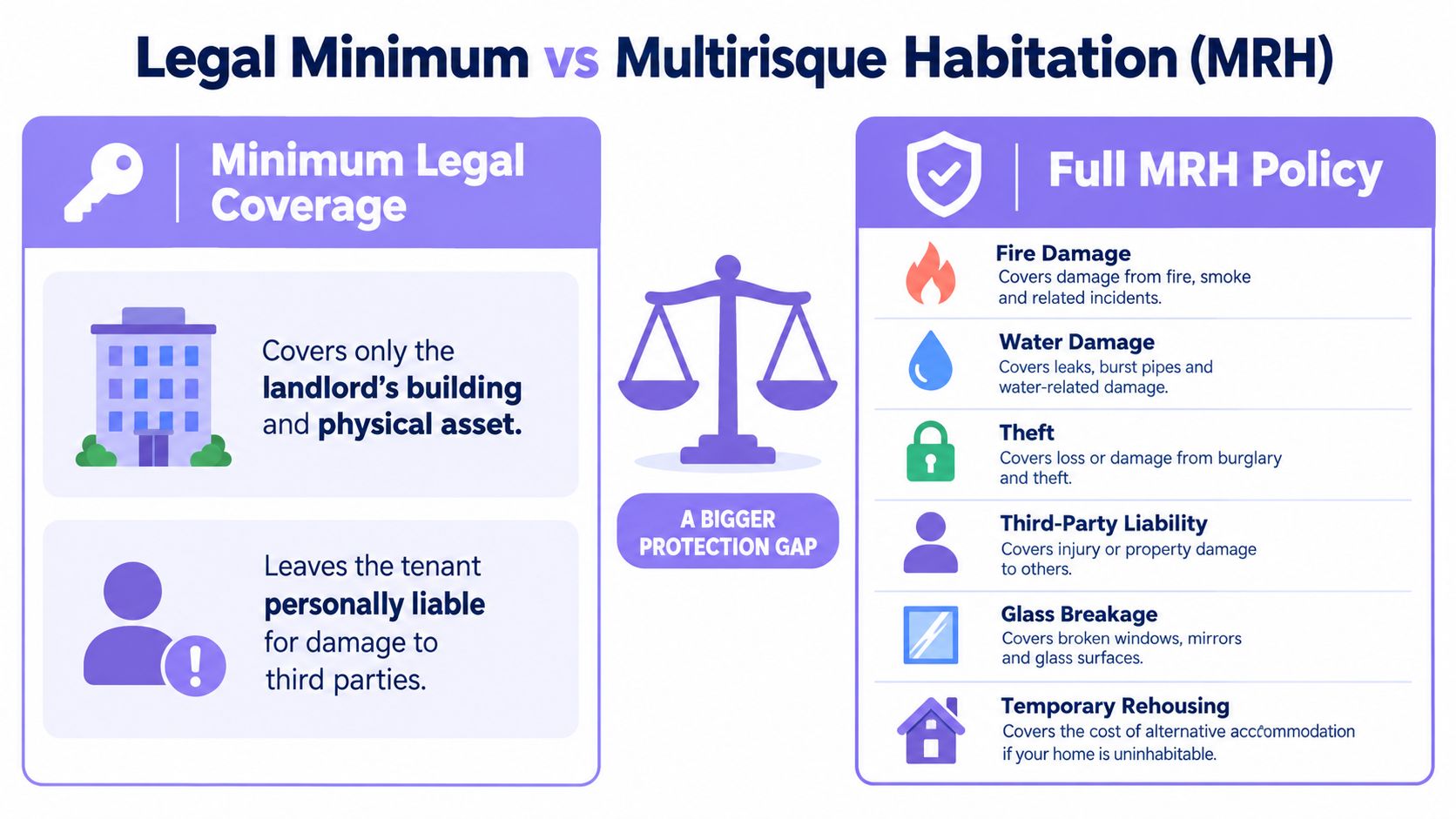
The minimum policy is designed to protect the rented building from specific risks. It isn't a complete financial shield for the tenant. It doesn't automatically mean that personal possessions, theft, accidental damage to neighbours, or every form of personal liability is covered.
That distinction matters at the move-in stage. A tenant may believe that “being insured” means the contents of the flat, laptop, furniture, and liability to third parties are all protected. The certificate may only demonstrate the narrower risks locatifs floor. The wording and scope must be checked rather than inferred from the product name.
For agents, the process should be controlled and repeatable:
- Request the certificate before handover: Ask for a document that identifies the rented address and confirms cover from the relevant tenancy date.
- Check the tenant and property details: A certificate for a family home or previous address doesn't prove that the new rental is insured.
- Record the document: Store the certificate with the tenancy file and note when the next annual request may be needed.
- Escalate missing proof quickly: Don't treat the matter as an informal reminder once the handover is imminent.
Practical rule: No certificate means no confirmed compliance. Resolve the gap before the tenant takes possession, not after the first incident.
Why the obligation matters
Without the minimum cover, the tenant can face landlord sanctions and personal liability for damage caused to the dwelling. A tenant who causes a serious fire or major water damage may therefore confront a financial exposure that extends well beyond the premium they were trying to avoid.
The rule has limited exceptions, including some seasonal rentals and certain service housing arrangements. Those exceptions shouldn't be assumed for an ordinary residential tenancy. When an agent, landlord, or tenant is uncertain, the lease type and the applicable legal guidance should be checked before the keys are released.
Insurance decisions also involve the distribution channel. An agent may deal with a direct insurer, a bank, or an intermediary, and the advice structure can differ. A useful explanation of the distinction between an agent and a broker is available in this guide to general insurance agents and brokers. Whatever the channel, the tenant remains responsible for having the required cover and supplying proof.
Understanding the Compliance Gap and Market Scale
The law is clear, but real-world compliance is incomplete. France Assureurs estimated that 797,000 primary residences were uninsured on 1 January 2024, out of 31.4 million primary residences, equivalent to roughly 2.5% without cover, as reported in the industry coverage analysis published by JSS. That gap is large enough to matter to every property professional managing a portfolio.
The problem is not that home insurance is an obscure product. It's a mainstream part of the French housing system. The same industry data indicates that non-insurance persists even though tenants must normally provide an attestation and landlords can request proof during the tenancy.
Why tenants remain uninsured
The reasons are practical rather than mysterious. Some tenants treat the certificate as a document needed only once, then fail to renew or update it after moving. Others assume that a parent's policy, a previous address, or the landlord's building insurance protects them personally. Price anxiety can also push households towards delay, especially when they see insurance as another cost attached to moving home.
Urban rental markets make the operational problem more visible. The JSS article cites a local estimate that around 20% of tenants in Marseille lacked home insurance. That figure shouldn't be generalised to France, but it illustrates how local compliance can diverge from the national picture and why agents shouldn't rely on assumptions about tenant behaviour.
Property managers should treat the certificate as a control point, not as a box to tick casually. The file should show that the tenant supplied proof, that the address is correct, and that the policy remains active when renewal evidence is requested. A missing document doesn't prove that no policy exists, but it does mean the professional can't demonstrate compliance.
A mature market with an execution problem
The French market has broad insurance penetration, yet the handover process still fails when responsibility is unclear. Tenants may believe the agent will arrange cover. Agents may assume the tenant understands the difference between a legal minimum and broader protection. Landlords may only discover the gap when they ask for an annual attestation.
The solution is a consistent workflow. Send the requirement with the tenancy documents, explain the risks locatifs in plain English, request the certificate before handover, and set a reminder for future checks. This protects the tenant, reduces avoidable administration, and gives the property professional a defensible record of the process.
Beyond the Minimum, The Multirisque Habitation Wrapper
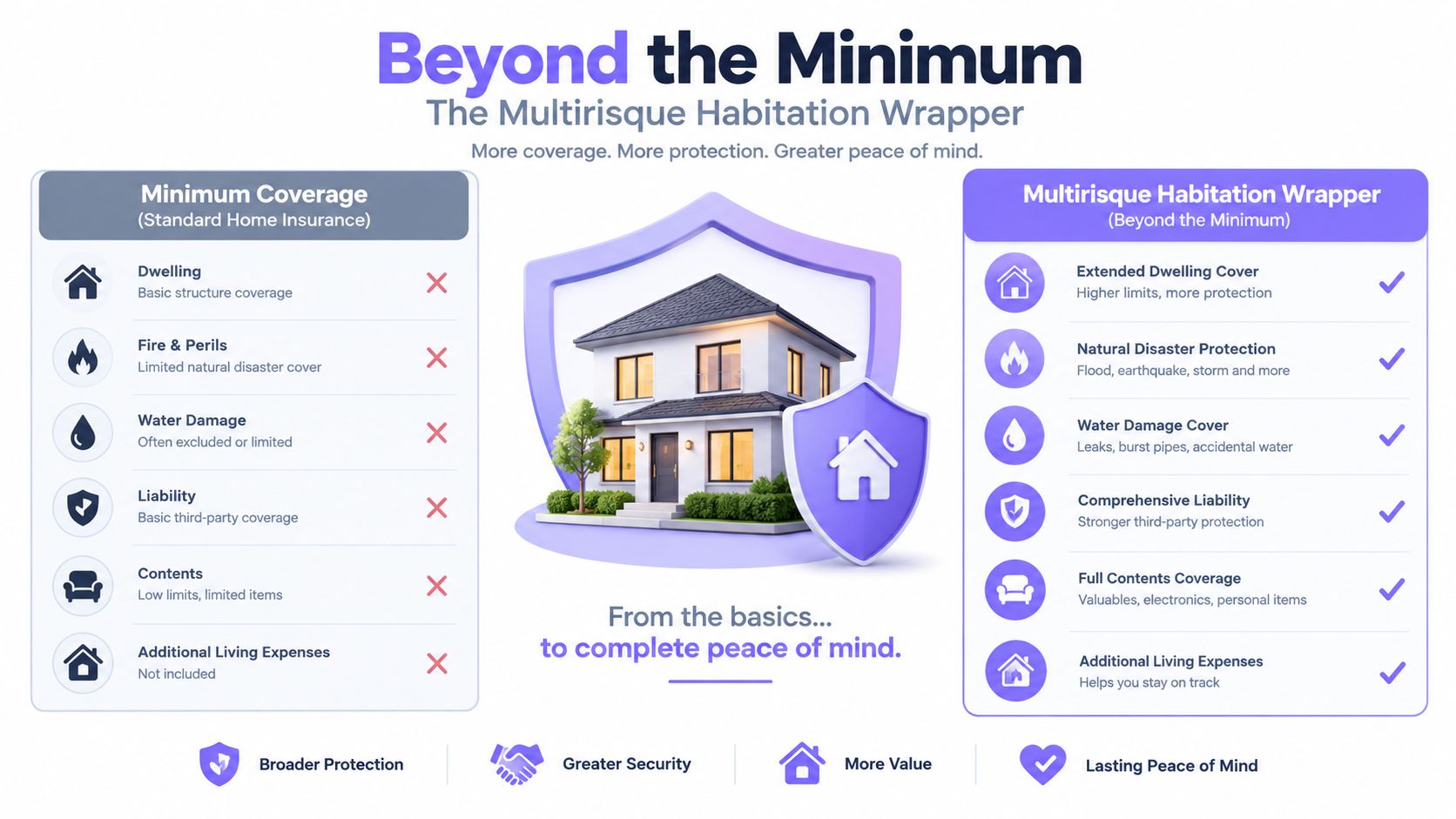
The legal minimum answers one question: is the rented dwelling protected against defined damage to the landlord's property? It doesn't answer the tenant's more important household questions. What happens to personal belongings after a fire? Who deals with damage caused to a neighbour? Is theft covered? What support is available if the flat can't be occupied?
That's where multirisque habitation, usually shortened to MRH, becomes relevant. The MRH policy acts as the market's broad home insurance wrapper. It can combine the compulsory risks locatifs foundation with liability and property protections that address the tenant's own exposure.
Minimum cover versus usable protection
Consider a water leak in a rented flat. The minimum risks locatifs cover may address damage to the rented building, subject to the policy terms. But the event can also affect a neighbour, the tenant's furniture, electronics, flooring, and temporary living arrangements. Those consequences require a broader review of the contract.
A full MRH policy commonly brings together several layers:
- Risks locatifs: Protection for specified damage to the rented property, including fire, water damage, and explosion.
- Tenant liability: Cover for damage the tenant causes to other people or their property, subject to the contract.
- Contents protection: Cover for personal belongings, with valuation rules, limits, and possible depreciation.
- Theft and vandalism: Protection that depends on the policy definition, security requirements, declared contents, and exclusions.
- Emergency assistance: Services may help with urgent incidents, repairs, or temporary accommodation where the policy includes them.
- Optional extensions: Items such as valuable possessions, outbuildings, accidental damage, or glass may need specific declarations or additions.
The important point is not that every tenant needs every extension. It's that the minimum legal certificate shouldn't be mistaken for full protection.
Why MRH has become the practical standard
France Assureurs reported 46.1 million MRH contracts at the end of 2024, with the market up 0.4% year on year, according to its 2024 home insurance report. That scale shows how widely the MRH format is used in France.
The popularity of MRH also reflects the way claims work in real buildings. A single incident often affects several parties and types of property. A burst pipe can involve the tenant, landlord, neighbours, shared areas, and damaged personal belongings. A policy that only addresses one part of that chain leaves the tenant to manage the rest.
The sensible recommendation
For most tenants, a properly selected MRH policy is the better choice than buying the narrowest certificate available. The policy should match the contents of the home, the tenant's liability exposure, and the building's practical risks. A student in a sparsely furnished studio and a family in a furnished flat shouldn't automatically buy identical protection.
Read the schedule and exclusions. Check whether the policy uses replacement value or applies depreciation, whether valuables have separate limits, and whether a cellar, parking space, or other declared area is included. Cheap cover can be perfectly adequate when its scope matches the home. It becomes dangerous when the tenant assumes it includes benefits that were never purchased.
Decoding Tenant Insurance Pricing and Cost Factors
Tenant insurance prices vary because insurers aren't pricing the word “tenant”. They're pricing a particular risk at a particular address with a particular level of protection. Surface area, location, building characteristics, contents, occupancy, claims history, payment terms, deductibles, and optional guarantees can all affect the quotation.
Recent French market data shows a substantial difference between occupier types. In 2025, tenants paid about €114 per year on average, while owners paid more than €250 per year, according to the 2026 French home insurance barometer. These figures are market averages, not a promise for an individual tenant. They also don't make quotes directly comparable when the included protections differ.
The variables behind a quote
Location can change the assessment of theft, water damage, building exposure, and local claims conditions. A small flat in one city may produce a different quote from a similar flat in another city. The insurer may also ask about the floor, security arrangements, type of occupancy, and whether the home is furnished.
The property profile matters just as much. A larger home generally contains more rooms and potentially more contents to insure. A shared home introduces questions about named occupants and the organisation of cover. A tenant with specialist equipment, jewellery, collections, or high-value electronics must check whether standard contents limits are sufficient.
Coverage design is often the biggest source of apparent price divergence. Compare:
| Occupier type | Average annual premium | Primary cost drivers |
|---|---|---|
| Tenant | About €114 in 2025 | Address, property profile, contents, liability, deductibles, and selected options |
| Owner | More than €250 in 2025 | Broader building and contents exposure, property profile, location, liability, and selected options |
A headline premium can look attractive because it covers only the legal floor, uses a high deductible, applies low contents limits, or excludes assistance and theft. That isn't necessarily poor value, but the buyer must understand what has been removed.
How to compare quotes properly
Don't compare monthly prices until the underlying cover is aligned. Put the quotes side by side and mark the risks locatifs, liability, water damage, theft, glass, contents valuation, temporary accommodation, deductibles, and maximum payouts. If one quote doesn't include a protection layer, record that difference instead of calling it cheaper.
A deductible can make a low premium less attractive during a claim. This guide to insurance deductibles explains the principle and why the amount matters when comparing policies. The correct question is not “Which quote has the lowest price?” It's “Which quote gives this tenant the right protection at an acceptable total cost?”
A published starting price can also be conditional on a specific apartment profile and location. Treat it as an illustration, not as a benchmark for every household. Ask the insurer to show the assumptions behind the quote and obtain a certificate that matches the actual rental address.
Step-by-Step Guide to Comparing and Subscribing
A reliable subscription process starts before the move-in appointment. The tenant needs enough property information to obtain a relevant quote, and the agent needs proof that the cover applies to the right home at the right time.

1. Gather the facts insurers need
Prepare the address, type of lease, surface area, number of rooms, occupancy arrangement, furnished status, and intended start date. Note any cellar, garage, parking space, or other area that needs to be declared. Estimate the value of personal belongings accurately, including electronics and specialist equipment.
For a colocation, establish whether one policy names everyone or each occupant arranges separate cover. Don't assume that a policy held by one flatmate automatically protects the others.
2. Request comparable quotes
Use at least two channels, such as a direct insurer, bank, broker, or online comparison service. Ask each provider for the same core protections and the same declared contents value. If you're a tenant with prior refusals, unusual occupancy, or a difficult insurance history, a specialist resource such as Select Insurance Group, Inc. high-risk renters policy may help you identify an appropriate route.
3. Read the schedule, not just the price
Check the policy start date, insured address, named occupants, liability scope, contents limits, deductibles, exclusions, and claim contact method. Pay particular attention to whether theft, glass, emergency assistance, and temporary rehousing are included or optional.
A certificate proves a defined level of cover. It doesn't replace the full policy documents. Save both, preferably in a place you can access when travelling or dealing with an emergency.
4. Subscribe before the keys change hands
Set the policy to begin when the tenancy requires cover, then download the attestation. Send it to the agent or landlord before the handover appointment. If the certificate contains the wrong address, tenant name, or start date, correct it immediately rather than hoping the error won't matter.
5. Maintain the file
Keep renewal documents and update the insurer after a move, change in occupancy, major acquisition, or change in the property. Property professionals should request fresh proof when appropriate and avoid storing outdated certificates as if they confirm current cover.
For agents: Make insurance verification part of the same checklist as the signed inventory, meter readings, and key record. A standard sequence prevents a routine handover from becoming a dispute.
The process is simple, but it fails when tenants wait until the appointment or treat an old certificate as valid evidence. Early comparison gives time to correct details and choose protection based on risk rather than panic.
Navigating Claims and Common Policy Exclusions
A policy only helps if the tenant can use it correctly after an incident. The first response should be practical: protect people, limit further damage where it is safe to do so, document what happened, and contact the insurer through the method stated in the contract.
Don't throw away damaged property before the insurer has explained what it needs. Take clear photographs, keep invoices and purchase records, note the date and circumstances, and preserve communications with neighbours, the landlord, contractors, or emergency services. For water damage, record the visible source and affected areas, but don't make assumptions about responsibility before the insurer assesses the event.
A disciplined claims sequence
Start by checking the policy and contacting the insurer promptly. Use the insurer's online portal, telephone line, or agency process, and ask for confirmation that the notification has been registered. The guide to declaring a home insurance claim can help tenants organise the information before making contact.
Then create a concise incident file:
- Record the event: Write down what happened, when you discovered it, and what immediate action you took.
- Photograph the damage: Capture wide views, close details, affected rooms, and any apparent source.
- List the losses: Identify damaged or missing items and gather purchase evidence where available.
- Notify relevant parties: Inform the landlord, building manager, neighbour, or police where the circumstances require it.
- Follow instructions: Ask whether an expert, repairer, quotation, or additional document is required before work begins.
The contract controls the notification deadline. Some incidents have shorter deadlines than others, so don't postpone the report while waiting for a complete estimate. Early notification gives the insurer the chance to inspect and advise on urgent repairs.
Exclusions are part of the cover
Tenants most often get caught by assumptions. A standard policy may not cover every form of theft, every water-related cause, or every period when the property is left unoccupied. Security conditions, declared occupancy, maintenance responsibilities, and negligence provisions can affect the outcome. The exact wording matters more than the marketing label.
Check these areas before a claim:
- Unoccupied property: Find out whether extended absence changes protection or creates security conditions.
- Water damage: Confirm which sources, costs, and responsibilities are included, especially where the incident involves neighbouring or shared areas.
- Theft: Review alarm, lock, shutter, and evidence requirements, along with contents limits.
- Valuable possessions: Ask whether high-value items require separate declaration, appraisal, or a special extension.
- Temporary accommodation: Check whether assistance or rehousing applies, for how long, and under what conditions.
If an insurer refuses a claim, ask for the decision and the precise contractual clause in writing. Compare the explanation with the policy schedule and exclusions, then use the insurer's complaint process before considering external escalation. A tenant who reads the contract before the loss is in a much stronger position than one who discovers its boundaries during a dispute.
Strategic Takeaways for Tenants and Property Professionals
Tenant insurance should be managed as part of the tenancy, not treated as an isolated purchase. The certificate confirms a legal baseline, while the policy wording determines whether the household can cope with wider consequences. That distinction should guide every recommendation.
For tenants, the priorities are clear:
- Secure cover before handover: Have the correct certificate ready for the rented address and relevant tenancy date.
- Choose protection for the actual household: Match contents limits and optional guarantees to possessions, occupancy, and location.
- Read the exclusions: Understand deductibles, security conditions, absence rules, and claim procedures before paying.
- Keep evidence: Store the policy, certificates, invoices, photographs, and claim correspondence together.
- Update after change: Tell the insurer about a move, new occupant, changed use, or significant contents change.
Property professionals should standardise the same discipline across every file. Explain the difference between risks locatifs and broader MRH cover, request proof at the right moment, record the certificate, and remind tenants when updated evidence is needed. That workflow reduces handover friction and helps agents build trust without pretending to advise on cover they haven't reviewed.
The compliance gap shows why reminders and clear explanations still matter in a mature insurance market. Price divergence shows why a cheap quotation isn't automatically good value. The strongest operational approach is to verify the legal minimum, compare equivalent protection, and make the claims path understandable before anyone needs it.
Wispra helps insurance and property businesses present their services through an AI-optimised directory, content tools, and visibility tracking for AI search engines. If you want prospective tenants and local clients to find your offer when they ask conversational platforms about home insurance, visit Wispra and review the platform.